
Brazil Cloud Computing Market
 |
Pages:
190
|
Pages:
190
Brazil Cloud Computing Market Size, Share, By Type (Public Cloud, Private Cloud, and Hybrid Cloud), By Service (Infrastructure as a Service (IaaS), Platform as a Service (PaaS), and Software as a Service (SaaS)), By Industry (BFSI, IT and Telecommunications, Government, Consumer Goods and Retail, Healthcare, Manufacturing, and Others), Brazil Cloud Computing Market Insights, Industry Trend, Forecasts to 2035
REPORT COVERAGE
Country
Brazil Cloud Computing Market Insights Forecasts to 2035
- Brazil Cloud Computing Market Size 2024: USD 3.34 Mn
- Brazil Cloud Computing Market Size 2035: USD 22.63 Mn
- Brazil Cloud Computing Market CAGR 2024: 19%
- Brazil Cloud Computing Market Segments: Type, Service, Industry.
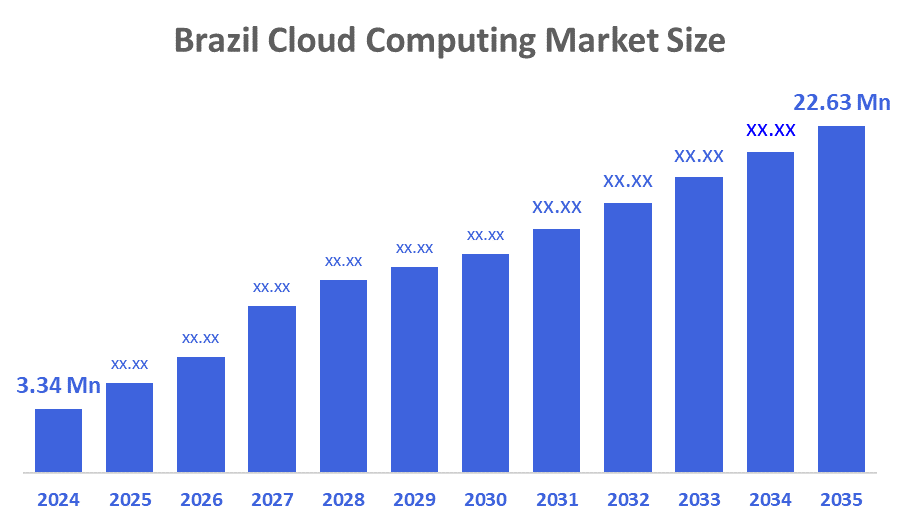
Cloud computing delivers various computing services that include servers, storage, databases, networking, software, and analytics via the internet. It empowers users to access and manage resources as per their needs, lower infrastructure costs, expand their operations effortlessly, and make payments only for the services they utilize. Moreover, the expansion of cloud computing is attributed to the global digital transformation, the need for a scalable IT infrastructure, the continuous increase in data generation, the trend of remote working, cost effectiveness, quicker deployment, better security features, and the increasing use of AI, IoT, and big data technologies by different industries.
Brazilian companies are increasingly leveraging cloud platforms to enable the use of AI and machine learning technologies. They are improving their operations through predictive analytics and automation. By making use of these cloud-based solutions, companies are able to process large datasets, make data-driven decisions, and automate repetitive tasks, thereby increasing their efficiency and lowering their operational costs. In this way, AI-powered insights are facilitating the optimization of supply chains, the improvement of customer service, and the identification of market trends across industries.
Several industries across Brazil, including finance, healthcare, and retail, are rapidly adopting cloud-based solutions for scalability and digital transformation. The finance sector uses cloud technology to perform real-time data processing and enhance security measures. Healthcare professionals benefit from more efficient patient management systems and greater ease of data access. Retailers deploy cloud platforms to manage inventory and deliver personalized customer experiences. This widespread acceptance allows these industries to automate operations, reduce expenses, and enhance their offerings, thus maintaining their competitive edge in a rapidly changing digital landscape. Hence, this is contributing to a positive Brazil cloud computing market outlook. An example of this would be when, in September 2024, WideLabs, a Brazilian AI startup, decided to use Oracle Cloud Infrastructure (OCI) to train a large language model (LLM) that can record and interpret the memories of Alzheimers patients. The AI model, hosted on the OCI AI infrastructure, generates autobiographies to support reminiscence therapy. By utilizing OCIs So Paulo Region, WideLabs is also ensuring data sovereignty.
Market Dynamics of the Brazil Cloud Computing Market:
The Brazil cloud computing market is driven by rapid digital transformation among businesses, increasing adoption of remote working models, and rising demand for cost-effective IT infrastructure. Growing use of e-commerce, fintech, and digital banking boosts cloud demand. Expansion of data centers by global providers improves service reliability. Government digitalization initiatives and improved internet connectivity also support cloud adoption across enterprises of all sizes.
The Brazil cloud computing market faces restraints such as data security and privacy concerns, high compliance costs under LGPD regulations, limited cloud awareness among small enterprises, and dependence on reliable internet infrastructure. Latency issues in remote regions and high migration costs from legacy systems also slow cloud adoption.
The Brazil cloud computing market presents strong opportunities due to rising adoption among small and medium-sized enterprises seeking affordable and scalable IT solutions. Growth of fintech, e-commerce, healthcare IT, and smart city projects increases cloud demand. Expansion of local data centers improves performance and trust. Increasing use of AI, big data analytics, IoT, and hybrid cloud models further creates new revenue opportunities for cloud service providers.
Market Segmentation
The Brazil Cloud Computing Market share is classified into type, service, and industry.
By Type:
The Brazil Cloud Computing market is divided by type into public cloud, private cloud, and hybrid cloud. Among these, the public cloud segment dominated the share in 2024 and is anticipated to grow at a remarkable CAGR during the forecast period. The public cloud segment dominates due to its cost efficiency, scalability, and minimal infrastructure requirements. Brazilian enterprises, especially SMEs and startups, prefer public cloud to avoid high capital investment and maintenance costs. The rapid growth of e-commerce, fintech, and digital services increases demand for flexible and on-demand computing resources. Additionally, the strong presence of global cloud providers with local data centers improves reliability, security, and performance, encouraging widespread public cloud adoption.
By Service:
The Brazil Cloud Computing market is divided by service into infrastructure as a service (IaaS), platform as a service (PaaS), and software as a service (SaaS). Among these, the software as a service segment dominated the share in 2024 and is anticipated to grow at a remarkable CAGR during the forecast period. The software as a service (SaaS) segment dominates because it offers ready-to-use applications with low upfront costs and minimal IT complexity. Brazilian businesses widely adopt SaaS solutions for CRM, ERP, HR, finance, and collaboration to support digital transformation and remote work. SaaS reduces the need for in-house infrastructure and skilled IT staff, making it attractive to SMEs. Continuous software updates, scalability, and subscription-based pricing further drive strong SaaS adoption across industries.
By Industry:
The Brazil Cloud Computing market is divided by industry into BFSI, IT and telecommunications, government, consumer goods and retail, healthcare, manufacturing, and others. Among these, the BFSI segment dominated the share in 2024 and is anticipated to grow at a remarkable CAGR during the forecast period. The BFSI segment dominates due to the rapid expansion of digital banking, fintech platforms, and online payment systems in the country. Financial institutions rely on cloud solutions for scalability, real-time data processing, fraud detection, and improved customer experience. Cloud adoption helps BFSI players reduce operational costs while meeting regulatory and security requirements. Increasing mobile banking usage and demand for high system availability further accelerate cloud adoption across banks, insurers, and financial service providers.
Competitive Analysis:
The report offers the appropriate analysis of the key organisations/companies involved within the Brazil cloud computing market, along with a comparative evaluation primarily based on their product offering, business overviews, geographic presence, enterprise strategies, segment market share, and SWOT analysis. The report also provides an elaborative analysis focusing on the current news and developments of the companies, which includes product development, innovations, joint ventures, partnerships, mergers & acquisitions, strategic alliances, and others. This allows for the evaluation of the overall competition within the market.
Top Key Companies in Brazil Cloud Computing Market:
- Amazon Web Services (AWS)
- Microsoft Corporation
- Google LLC (Google Cloud Platform)
- IBM Corporation
- Alibaba Group Holding Limited
- Oracle Corporation
- SAP SE
- Salesforce, Inc.
- Huawei Technologies Co., Ltd.
- Others
Recent Developments in Brazil Cloud Computing Market:
March 2025, Serpro reported BRL 3.93 billion net revenue and launched Government Cloud, signalling domestic viability in sovereign computing.
In May 2025, Brazil’s Patria Investimentos launched Omnia, a USD 1 billion hyperscale data center platform focused on AI and cloud services. The first site will be built in Brazil, with expansion into Mexico and Chile, using only renewable energy. The platform targets major global tech firms as cloud and AI demand surges across Latin America.
Key Target Audience
- Market Players
- Investors
- End-users
- Government Authorities
- Consulting and Research Firm
- Venture capitalists
- Value-Added Resellers (VARs)
Market Segment
This study forecasts revenue at the Brazil, regional, and country levels from 2020 to 2035. Decisions Advisors has segmented the Brazil cloud computing market based on the below-mentioned segments:
Brazil Cloud Computing Market, By Type
- Public Cloud
- Private Cloud
- Hybrid Cloud
Brazil Cloud Computing Market, By Service
- Infrastructure as a Service (IaaS)
- Platform as a Service (PaaS)
- Software as a Service (SaaS)
Brazil Cloud Computing Market, By Industry
- BFSI
- IT and Telecommunications
- Government
- Consumer Goods and Retail
- Healthcare
- Manufacturing
- Others
FAQ
Q1: What is cloud computing?
Cloud computing delivers computing services like servers, storage, and software over the internet, enabling businesses to access resources on demand without owning physical infrastructure.
Q2: Which cloud type is dominant in Brazil?
Public cloud dominates Brazil due to its low costs, scalability, and easy deployment, making it ideal for SMEs, startups, and enterprises adopting digital transformation initiatives.
Q3: Which service segment leads the market?
SaaS leads Brazil’s cloud market, as businesses adopt ready-to-use applications like CRM, ERP, and collaboration tools, reducing IT costs and simplifying deployment and maintenance.
Q4: Which industry is the largest adopter?
BFSI dominates cloud adoption in Brazil due to digital banking, fintech growth, high data security needs, and demand for scalable, reliable, and compliant cloud solutions.
Q5: What are the key growth drivers?
Growth is driven by digital transformation, e-commerce expansion, remote working, AI, IoT adoption, and investments in local data centers, improving cloud accessibility and performance.
Q6: What are the challenges?
Challenges include data security concerns, high migration costs, regulatory compliance, limited awareness among SMEs, and reliance on stable internet infrastructure for efficient cloud operations.
Check Licence
Choose the plan that fits you best: Single User, Multi-User, or Enterprise solutions tailored for your needs.
We Have You Covered
- 24/7 Analyst Support
- Clients Across the Globe
- Tailored Insights
- Technology Tracking
- Competitive Intelligence
- Custom Research
- Syndicated Market Studies
- Market Overview
- Market Segmentation
- Growth Drivers
- Market Opportunities
- Regulatory Insights
- Innovation & Sustainability
Report Details
| Scope | Country |
| Pages | 190 |
| Delivery | PDF & Excel via Email |
| Language | English |
| Release | Jan 2026 |
| Access | Download from this page |