
Brazil Digital Twin Market
 |
Pages:
194
|
Pages:
194
Brazil Digital Twin Market Size, Share, and COVID-19 Impact Analysis, By Type (System Digital Twin, Product Digital Twin, Process Digital Twin, Other), By Industry (Aerospace & Defense, Automotive & Transportation, Home & Commercial, Healthcare, Energy & Utilities, Oil & Gas, Agriculture, Telecommunication, Others), and Brazil Digital Twin Market Insights, Industry Trend, Forecasts to 2035
REPORT COVERAGE
Country
Brazil Digital Twin Market Insights Forecasts to 2035
- The Brazil Digital Twin Market Size Was Estimated at USD 824 Million in 2024
- The Market Size is Expected to Grow at a CAGR of Around 31.07% from 2025 to 2035
- The Brazil Digital Twin Market Size is Expected to Reach USD 16,160 Million by 2035
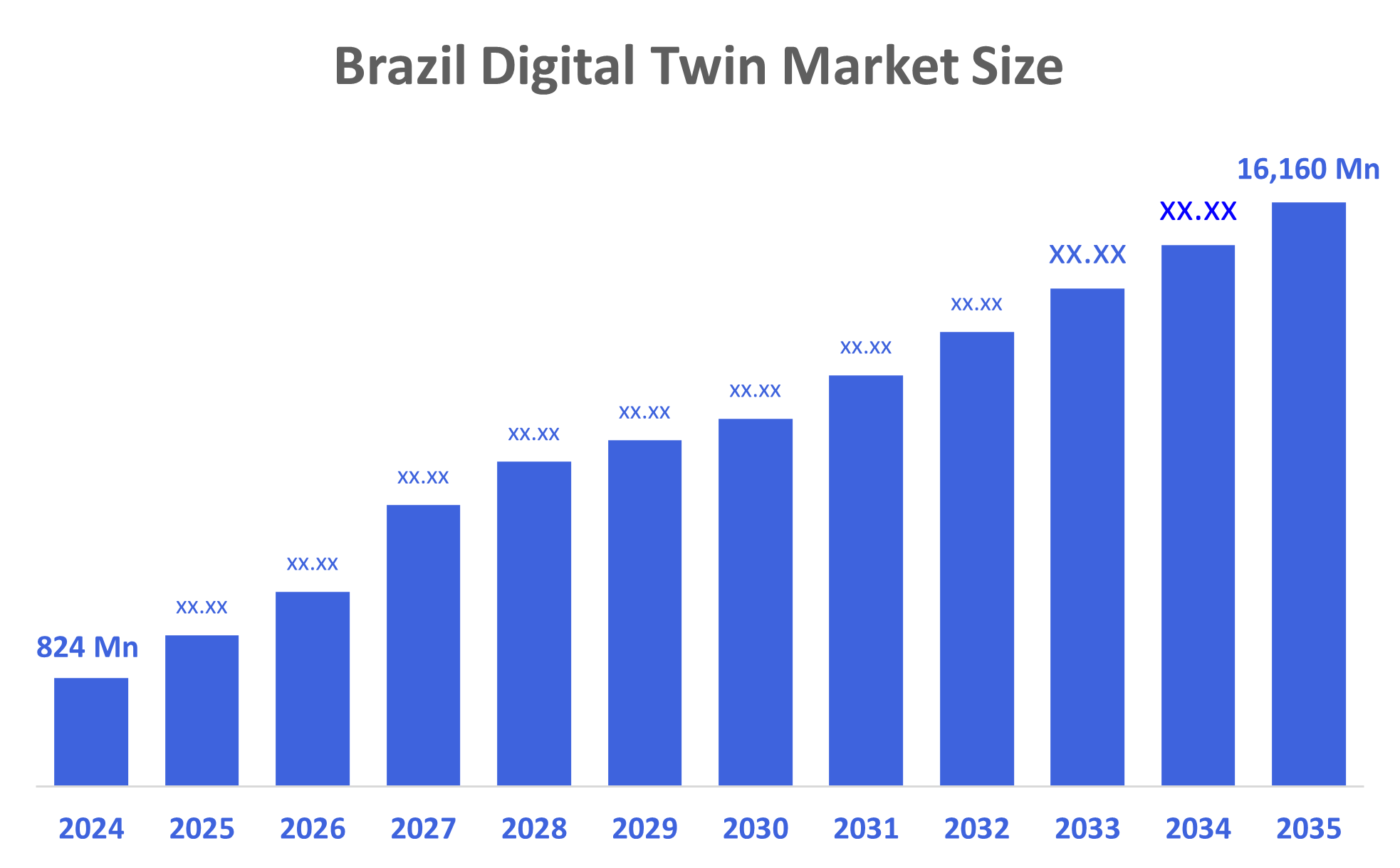
According to a research report published by Decisions Advisors, The Brazil Digital Twin Market Size is Anticipated to Reach USD 16,160 Million by 2035, Growing at a CAGR of 31.07% from 2025 to 2035. The Brazil digital twin market is driven by the rapid adoption of IoT, AI, and cloud computing technologies, rising industrial automation, and increasing demand for real-time monitoring and predictive maintenance. Growing smart city initiatives, digitalization in manufacturing, and focus on operational efficiency further accelerate market growth across various sectors.
Market Overview
A digital twin is a virtual replica of a physical object, system, or process that simulates its real-time performance, behavior, and conditions. It integrates data from sensors, IoT devices, and software to enable monitoring, analysis, and optimization, supporting predictive maintenance, decision-making, and enhanced operational efficiency across industries. Additionally, the Brazil digital twin market is growing due to increasing adoption of IoT, AI, and cloud technologies, rising demand for predictive maintenance and real-time monitoring, and government initiatives supporting Industry 4.0. Expansion in automotive, energy, healthcare, and smart city projects further drives digital twin deployment and operational efficiency. Furthermore, new technologies in Brazil’s digital twin market include AI-driven simulations, IoT sensor integration, edge computing, and cloud-based platforms. These enable real-time monitoring, predictive maintenance, and operational optimization across energy, automotive, and smart-city sectors. GPU-accelerated processing and advanced analytics enhance accuracy, efficiency, and scalability for industrial and infrastructure applications. The application of 3D modeling software for generating digital companions for real-world objects is a prime instance of digital twins. It may be employed to perceive the current condition of the actual physical object, allowing physical objects to be projected into the digital world. A digital twin may additionally be utilized for asset monitoring, evaluations, and forecasting to improve asset availability and efficiency.
Report Coverage
This research report categorizes the market for the Brazil digital twin market based on various segments and regions, and forecasts revenue growth and analyses trends in each submarket. The report analyses the key growth drivers, opportunities, and challenges influencing the Brazil digital twin market. Recent market developments and competitive strategies, such as expansion, product launch, development, partnership, merger, and acquisition, have been included to draw the competitive landscape in the market. The report strategically identifies and profiles the key market players and analyses their core competencies in each sub-segment of the Brazil digital twin market.
Driving Factors
The Brazil digital twin market is driven by rapid adoption of Industry 4.0 technologies, increasing demand for real-time monitoring, predictive maintenance, and operational efficiency across manufacturing, energy, automotive, and smart-city sectors. Integration of IoT, AI, and cloud computing enables accurate virtual replicas of physical assets. Growing government initiatives for smart infrastructure, rising investments in digital transformation, and the need to reduce operational costs and downtime further fuel market growth. Additionally, partnerships between local and global tech companies accelerate technology deployment and adoption across industries.
Restraining Factors
The Brazil digital twin market is restrained by high implementation and maintenance costs, limited technical expertise, and low awareness among small and medium enterprises. Integration challenges with legacy systems, data security concerns, and inconsistent regulatory frameworks further hinder adoption, slowing large-scale deployment despite growing interest in Industry 4.0 technologies and smart-city initiatives.
Market Segmentation
The Brazil digital twin market share is categorized by type and industry.
- The system digital twin segment accounted for the largest revenue market share in 2024 and is expected to grow at a significant CAGR during the forecast period.
The Brazil digital twin market is segmented by type into system digital twin, product digital twin, process digital twin, and other. Among these, the system digital twin segment accounted for the largest revenue market share in 2024 and is expected to grow at a significant CAGR during the forecast period. The segmental growth is driven by its ability to replicate entire operational systems rather than individual products or processes. Industries such as manufacturing, energy, automotive, and smart cities increasingly rely on system-level simulations for real-time monitoring, predictive maintenance, and optimization of complex workflows. Integration with AI, IoT, and cloud computing allows accurate analysis of interconnected components, reducing downtime and operational costs. Additionally, government initiatives and industrial digital transformation strategies prioritize holistic system management, making system digital twins more valuable and widely adopted than product or process digital twins.
- The automotive & transportation segment dominated the market in 2024 and is projected to grow at a substantial CAGR during the forecast period.
The Brazil digital twin market is segmented by industry into aerospace & defense, automotive & transportation, home & commercial, healthcare, energy & utilities, oil & gas, agriculture, telecommunication, and others. Among these, the residential segment accounted for the largest revenue share in 2024 and is expected to grow at a significant CAGR during the forecast period. The growth of the segment is due to the sector’s emphasis on innovation, efficiency, and safety. Automotive manufacturers leverage digital twins for virtual prototyping, real-time monitoring, predictive maintenance, and optimizing production lines. Integration with AI, IoT, and cloud technologies enables accurate simulations of vehicles and transportation systems, reducing costs and downtime while improving performance. Additionally, rising demand for electric and autonomous vehicles encourages extensive use of digital twin solutions, making the automotive & transportation sector the leading adopter compared to aerospace, healthcare, or energy industries.
Competitive Analysis:
The report offers the appropriate analysis of the key organizations/companies involved within the Brazil digital twin market, along with a comparative evaluation primarily based on their product offering, business overviews, geographic presence, enterprise strategies, segment market share, and SWOT analysis. The report also provides an elaborate analysis focusing on the current news and developments of the companies, which includes product development, innovations, joint ventures, partnerships, mergers & acquisitions, strategic alliances, and others. This allows for the evaluation of the overall competition within the market.
List of Key Companies
- Siemens AG
- Dassault Systèmes
- PTC Inc.
- SAP SE
- IBM Corporation
- Autodesk Inc.
- Microsoft Corporation
- General Electric
- Oracle Corporation
- Other
Key Target Audience
- Market Players
- Investors
- End-users
- Government Authorities
- Consulting and Research Firm
- Venture capitalists
- Value-Added Resellers (VARs)
Recent Developments
- May 2025, The Digital Twin Consortium launched a new Testbed Program, giving companies the opportunity to showcase and test next-generation digital twin technologies in real-world applications.
Market Segment
This study forecasts revenue at the Brazil, regional, and country levels from 2020 to 2035. Decisions Advisors has segmented the Brazil digital twin market based on the below-mentioned segments:
Brazil Digital Twin Market, By Type
- System Digital Twin
- Product Digital Twin
- Process Digital Twin
- Other
Brazil Digital Twin Market, By Industry
- Aerospace & Defense
- Automotive & Transportation
- Home & Commercial
- Healthcare
- Energy & Utilities
- Oil & Gas
- Agriculture
- Telecommunication
- Others
Check Licence
Choose the plan that fits you best: Single User, Multi-User, or Enterprise solutions tailored for your needs.
We Have You Covered
- 24/7 Analyst Support
- Clients Across the Globe
- Tailored Insights
- Technology Tracking
- Competitive Intelligence
- Custom Research
- Syndicated Market Studies
- Market Overview
- Market Segmentation
- Growth Drivers
- Market Opportunities
- Regulatory Insights
- Innovation & Sustainability
Report Details
| Scope | Country |
| Pages | 194 |
| Delivery | PDF & Excel via Email |
| Language | English |
| Release | Dec 2025 |
| Access | Download from this page |