
Brazil Insulin Delivery Devices Market
 |
Author:
David J
|
Pages:
245
|
Author:
David J
|
Pages:
245
Brazil Insulin Delivery Devices Market Size, Share, By Product Type (Insulin Pens, Insulin Pumps, Insulin Syringes, Pen Needles and Others), By Device Technology (Manual insulin delivery devices, Automated insulin delivery systems, and Smart/connected insulin pens), By Indication (Type 1 Diabetes, Type 2 Diabetes, and Gestational Diabetes) By Distribution Channel (Hospital Pharmacies, Retail & Drug Stores, and Online Pharmacies / Providers) Analysis and Forecast 2026-2035
CAGR
7.22%
REVENUE 2025
USD Million 346.4
FORECAST 2035
USD Million 695.6
REPORT COVERAGE
Country
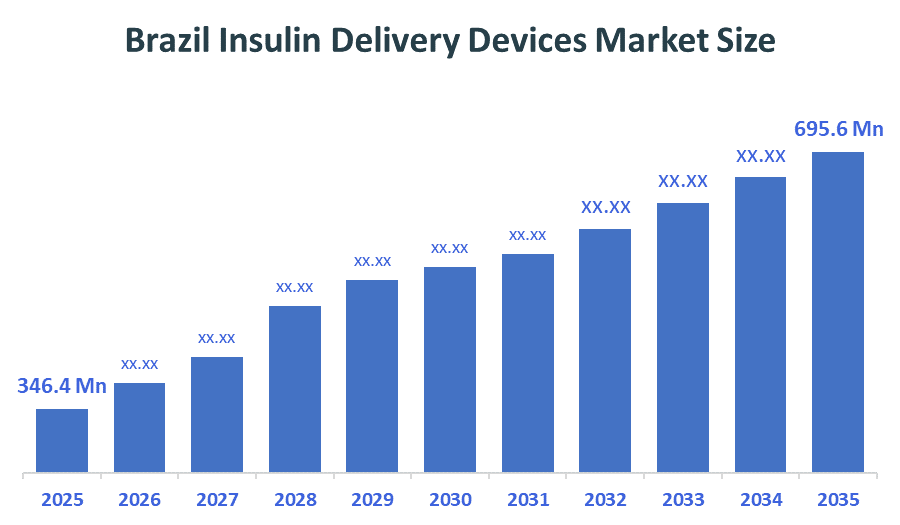
The Brazil Insulin Delivery Devices Market Size is projected USD 346.4 Million in 2025 and is forecasted to reach around USD 695.6 Million by 2035. According to Decision Advisors, a detailed report on analysis of the Brazil Insulin Delivery Devices Market indicates that the Shift toward insulin pens trend dominates the market, accounting for approx. 67% of the total Brazil demand worldwide. Novo Nordisk is one of the most dominating companies in Brazil’s Insulin Delivery Devices Market, supported by revenue of approx. USD 949.4 million, driven by rising diabetes prevalence and insulin pen adoption.
Market Snapshot
- Brazil Insulin Delivery Devices Market Size (2025): USD 346.4 Million
- Brazil Insulin Delivery Devices Market Projected Market Size (2035): USD 695.6 Million
- Brazil Insulin Delivery Devices Market Compound Annual Growth Rate (CAGR): 7.22%
- Base Year: 2025
- Historical Period: 2021–2024
- Forecast Period: 2026–2035
Market Overview/Introduction
Insulin Delivery Devices Market refers to the market associated with medical equipment that is used by healthcare professionals to provide insulin to patients having diabetes. Such insulin delivery devices consist of insulin pens, insulin syringes, insulin pumps, as well as new-age smart pens for ensuring that insulin is administered accurately and safely. These devices find their uses in managing both Type 1 diabetes, Type 2 diabetes, and gestational diabetes in order to maintain the optimum level of blood glucose. Rising prevalence of diabetes cases, increasing sedentary lifestyles and obesity rates along with aging population are some of the main factors driving this market. Apart from this, the increasing awareness about diabetes management techniques and move towards self-care have also been contributing to growth of this market. Some of the prominent innovations in this market have been the development of advanced technology such as the use of smart insulin pens that are capable of connecting with the Bluetooth, closed-loop pump system, as well as use with CGM. Further assistance is provided by government programs. For example, efforts to increase awareness about diabetes, subsidies for insulin, and health care infrastructure such as the SUS system in Brazil help facilitate the uptake of the device. In addition, regulatory approval for sophisticated medical devices is also increasing use.
- In March 2026, Brazil’s STJ ruled health plans must cover insulin pumps for eligible type 1 diabetes patients, strengthening private insurance access and boosting advanced insulin delivery device adoption.
- In January 2026, ANVISA’s Regulatory Agenda focuses on faster approvals, international reliance, and improved medical device regulation, enabling quicker access to insulin pens, pumps, and glucose monitoring systems in Brazil.
- In September 2025, Brazil enacted Law 15,210/2025 to improve SUS procurement efficiency, standardizing diagnostic and therapeutic equipment purchases, indirectly supporting faster access to insulin delivery devices nationwide.
Notable Insights: -
- By product type, the Insulin Pens segment holds a dominant position with an estimated share of over 56% in 2025.
- By technology, the Manual insulin delivery devices segment holds a dominant position with an estimated share of over 66% in 2025.
- By distribution channel, the retail & drug stores segment holds a dominant position with an estimated share of over 53% in 2025.
- By Indication, the Type 2 Diabetes segment holds a dominant position with an estimated share of over 76% in 2025.
- The forecasted CAGR for the Brazil Insulin Delivery Devices market is expected to be about 7.22% for the period between 2026 and 2035.
- The market is expected to reach a valuation of approximately USD 695.6 Million by 2035
What is the Role of Technology in Grooming the Market?
Technology is a significant factor influencing the development of the Brazilian insulin delivery devices market by enhancing accuracy, convenience, and compliance. Use of Bluetooth-enabled smart insulin pens ensures accurate recording and transfer of dose data to healthcare professionals. Insulin pumps that incorporate CGM help in managing patients’ glycaemic levels by providing precise and timely doses of the drug. Digital solutions like mobile applications and platforms ensure personalized diabetes management and monitoring. Technology is also being incorporated in the form of artificial intelligence to provide optimal dosages. These factors not only help reduce the risk of errors but also improve the efficacy of the therapy and motivate patients to manage their condition at home.
Market Drivers
Several factors contribute to the growth of the Brazil insulin delivery devices market. The first one is the increasing occurrence of diabetes, especially Type 2 diabetes, owing to urbanization, lifestyle changes, obesity, and poor diet habits. As a result, there has been an urgent need to address the problem through appropriate insulin delivery devices. Moreover, the changing trends towards patient-oriented insulin delivery devices like insulin pens have contributed immensely to the market development. There is a significant increase in patients' willingness to manage their diabetes at home rather than going to hospitals frequently. Technological innovations such as smart insulin pens, automated insulin pumps, and CGM devices have greatly facilitated the treatment process. Lastly, there are notable contributions from governmental health programs, especially SUS in Brazil, that facilitate the provision of healthcare services and insulin delivery devices to a significant number of patients. Increased public awareness campaigns on diabetes and improved healthcare facilities have also played a major role in early detection and management of the disease.
Restraints
The Brazil insulin delivery devices market faces several restraints, including high cost of advanced devices like insulin pumps and smart pens, limiting adoption among low-income populations. Limited reimbursement coverage and unequal access in public healthcare systems also restrict market penetration. Additionally, lack of awareness in rural areas and preference for traditional syringes hinder growth. Infrastructure challenges and inadequate diabetes management education further slow the adoption of advanced insulin delivery technologies in Brazil.
Study on the Supply, Demand, Distribution, and Market Environment
The market for diabetes insulin delivery devices in Brazil exhibits a balanced market structure, which depends more on the dynamics of demand. There has been an upward trend in demand because of the increase in the prevalence rate of diabetes, particularly Type 2 diabetes, and the preference for insulin pens and other devices. The market has dominant firms in the form of large multinational firms such as Novo Nordisk, Sanofi, and Eli Lilly that offer a reliable supply through imports and distribution. In terms of distribution, retail pharmacies, hospital pharmacies, and even the Internet are significant distribution avenues. The market operates under the backdrop of public health in Brazil, including the SUS policy.
Price Analysis and Consumer Behaviour Analysis
In the Brazilian market, there is an appreciable difference in the price of both types of equipment. Insulin syringes represent the lowest end of the price range, whereas insulin pens are moderately priced but more popular due to the better ease of use and precision in dosing. On the other hand, insulin pumps and smart/connected devices are relatively costly and used predominantly in wealthy urban areas. Consumer-wise, people living in Brazil have a preference for insulin pens compared to syringes due to their improved usability, decreased pain, and adherence. Moreover, there has been a transition toward the management of diabetes at home that is facilitated by the ease of administration and increasing awareness of this type of equipment. Nevertheless, patients' concern regarding costs remains substantial and forces individuals to opt for conventional syringes instead of more modern types of equipment.
Market Segmentation
The Brazil Insulin Delivery Devices market is categorised by product type, device technology, indication and distribution channel
- The Insulin Pens segment dominated the market in 2025 and is projected to grow at a steady CAGR of approximately 5% during the forecast period.
Based on the product type, the Insulin Delivery Devices market is divided into Insulin Pens, Insulin Pumps, Insulin Syringes, and Others. Among these, Insulin Pens dominate the revenue share, accounting for approximately 47%–58% of total market value, driven by ease of use and higher patient compliance. They grow at a CAGR of around 4%–5.5%.
- The manual insulin delivery devices segment accounted for the largest share in 2025 and is anticipated to grow at a significant CAGR of approximately 3.6% during the forecast period.
Based on the technology, the insulin delivery devices market is divided into manual insulin delivery devices, automated insulin delivery systems, and smart/connected insulin pens. Among these, Manual insulin delivery devices (insulin pens and syringes) dominate with the highest revenue share of around 60%–70%, driven by affordability, wide availability, and strong adoption in public healthcare. However, they show slower growth with a CAGR of about 3%–4%.
- The Type 2 Diabetes segment accounted for the largest share in 2025 and is anticipated to grow at a significant CAGR of approximately 4.6% during the forecast period.
Based on the indication, the Insulin Delivery Devices market is divided into type 1 diabetes, type 2 diabetes, and gestational diabetes. Among these, Type 2 diabetes dominates with the highest revenue share of around 70%–80%, driven by the large and growing diabetic population, lifestyle factors, and increased insulin therapy adoption in advanced stages. It records a CAGR of about 4%–5%. Type 1 diabetes holds a smaller share (~15%–25%) but shows steady growth, while gestational diabetes remains a niche segment with limited share but relatively stable demand due to rising screening and maternal care programs.
- The retail & drug stores segment accounted for the largest share in 2025 and is anticipated to grow at a significant CAGR of approximately 4.7% during the forecast period.
Based on the distribution channel, the Insulin Delivery Devices market is divided into hospital pharmacies, retail & drug stores, and online pharmacies / providers. Among these, the retail & drug stores dominate with the highest revenue share of around 45%–55%, driven by easy accessibility, widespread pharmacy networks, and strong patient preference for in-person purchases of insulin pens and syringes. This segment shows a CAGR of about 3.5%–5%. Hospital pharmacies hold a significant share for initial prescriptions, while online pharmacies and specialty pharmacies are the fastest-growing channels, expanding at a CAGR of around 6%–8% due to digital adoption.
Recent Developments
- In April 2026, Insulet’s Omnipod 5 and emerging tubeless patch pumps like Modular Medical Pivot and PharmaSens niia advance insulin delivery innovation, strengthening automated diabetes management and supporting global adoption including Brazil market.
- In February 2025, Novo Nordisk launched smart insulin pens like NovoPen 6 and Echo Plus with Bluetooth/NFC connectivity, improving insulin dose tracking and supporting digital diabetes management globally, including Brazil market adoption.
- In April 2023, Medtronic MiniMed 780G automated insulin delivery system with Smart Guard technology enhances real-time glucose-based insulin adjustments, improving glycaemic control and supporting advanced diabetes management globally, including Brazil adoption growth.
Competitive Analysis
The report offers the appropriate analysis of the key organisations/companies involved within the Brazil Insulin Delivery Devices market, along with a comparative evaluation primarily based on their product offering, business overviews, geographic presence, enterprise strategies, segment market share, and SWOT analysis. The report also provides an elaborate analysis focusing on the current news and developments of the companies, which includes product development, innovations, joint ventures, partnerships, mergers & acquisitions, strategic alliances, and others. This allows for the evaluation of the overall competition within the market.
Top Key Companies in the Brazil Insulin Delivery Devices Market
- Novo Nordisk A/S
- Sanofi S.A.
- Eli Lilly and Company
- Medtronic plc
- Insulet Corporation
- Ypsomed Holding AG
- Becton, Dickinson and Company (BD)
- Roche Diabetes Care
- Tandem Diabetes Care, Inc.
- Biocon Ltd.
- Others
Key Target Audience
- Market Players
- Investors
- End-users
- Government Authorities
- Consulting and Research Firm
- Venture capitalists
- Value-Added Resellers (VARs)
Market Segmentation
This study forecasts revenue at the national and regional levels from 2021 to 2035. The report segmented the Brazil Insulin Delivery Devices Market based on the following segments:
Brazil Insulin Delivery Devices Market, By Product Type
- Insulin Pens
- Insulin Pumps
- Insulin Syringes
- Pen Needles
- Others
Brazil Insulin Delivery Devices Market, By Device Technology
- Manual insulin delivery devices
- Automated insulin delivery systems
- Smart/connected insulin pens
Brazil Insulin Delivery Devices Market, By Indication
- Type 1 Diabetes
- Type 2 Diabetes
- Gestational Diabetes
Brazil Insulin Delivery Devices Market, By Distribution Channel
- Industrial sector
- Retail & Drug Stores
- Online Pharmacies / Providers,
Frequently Asked Questions (FAQ)
FAQ 1: What is the future role of AI in insulin delivery devices in Brazil?
Answer:
AI will enable predictive insulin dosing, real-time glucose pattern recognition, and personalized diabetes management. It will improve treatment precision and reduce hypoglycaemia risks, especially when integrated with smart insulin pens and automated insulin pumps.
FAQ 2: How is rural healthcare access impacting insulin device adoption in Brazil?
Answer:
Rural areas in Brazil face limited access to advanced diabetes technologies due to infrastructure gaps, lower awareness, and affordability issues. This results in higher dependence on conventional syringes compared to urban regions.
FAQ 3: What role do digital health ecosystems play in Brazil’s diabetes management?
Answer:
Digital ecosystems, including mobile apps and cloud-based monitoring platforms, enable remote patient tracking, physician feedback, and improved adherence. They are increasingly integrated with smart insulin delivery systems.
FAQ 4: How are environmental sustainability concerns influencing insulin device development?
Answer:
Manufacturers are focusing on eco-friendly device materials, recyclable pen components, and reduced plastic waste. Sustainability initiatives are gradually shaping product innovation in insulin delivery systems globally, including Brazil.
FAQ 5: What challenges exist in integrating insulin devices with continuous glucose monitoring systems in Brazil?
Answer:
Key challenges include high device costs, limited interoperability across brands, regulatory approval timelines, and inconsistent digital infrastructure, which slow down full integration of CGM with insulin delivery systems.
Check Licence
Choose the plan that fits you best: Single User, Multi-User, or Enterprise solutions tailored for your needs.
We Have You Covered
- 24/7 Analyst Support
- Clients Across the Globe
- Tailored Insights
- Technology Tracking
- Competitive Intelligence
- Custom Research
- Syndicated Market Studies
- Market Overview
- Market Segmentation
- Growth Drivers
- Market Opportunities
- Regulatory Insights
- Innovation & Sustainability
Report Details
| Scope | Country |
| Pages | 245 |
| Delivery | PDF & Excel via Email |
| Language | English |
| Release | Apr 2026 |
| Access | Download from this page |