
Brazil Location-Based Services Market
 |
Author:
Piya P
|
Pages:
167
|
Author:
Piya P
|
Pages:
167
Brazil Location-Based Services Market Size, Share, and COVID-19 Impact Analysis, By Component (Hardware, Software, Services), By Location (Indoor, Outdoor), By Application (Mapping and Navigation, Business Intelligence and Analytics, Location-based Advertising, Social Networking and Entertainment, Others), and Brazil Location-Based Services Market Size Insights, Industry Trend, Forecasts to 2035
CAGR
12.72%
REVENUE 2024
USD Billion 1.9
FORECAST 2035
USD Billion 7.08
REPORT COVERAGE
Country
Brazil Location-Based Services Market Size Insights Forecasts to 2035
- The Brazil Location-Based Services Market Size Was Estimated at USD 1.9 Billion in 2024
- The Market Size is Expected to Grow at a CAGR of Around 12.7% from 2025 to 2035
- The Brazil Location-Based Services Market Size is Expected to Reach USD 7.08 Billion by 2035
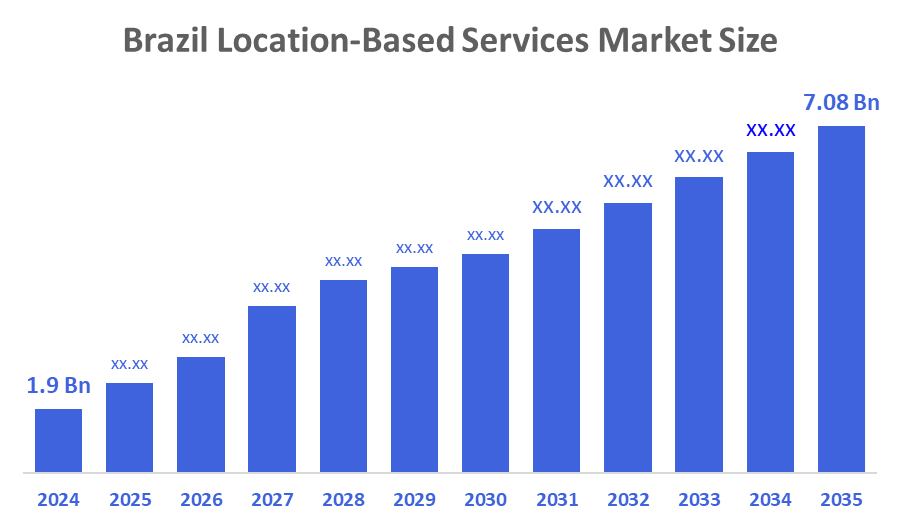
According to a Research Report Published by Decisions Advisors & Consulting, The Brazil Location-Based Services Market Size is Anticipated to Rreach USD 7.08 Billion by 2035, Growing at a CAGR of 12.7% from 2025 to 2035. The Brazil location-based services market is driven by increasing smartphone penetration, widespread mobile internet access, the growing adoption of GPS-enabled applications, rising demand for navigation and real-time tracking, the expansion of e-commerce and logistics, and the increasing use of location-based marketing across the retail and transportation sectors.
Market Overview
The?????? global location-based services (LBS) industry is the market providing applications and solutions that geographically locate using data from mobile devices, GPS, and networks to provide personalized services such as information, navigation, tracking, mapping, advertising, and emergency services to consumers and enterprises across various sectors. Moreover, in Brazil, market expansion is driven by factors such as increased smartphone penetration, enhanced mobile broadband networks, the proliferating ride-hailing and food delivery services industry, the growing demand for real-time navigation and tracking, location-based advertising adoption, and digital transformation in retail, logistics, and smart city sectors. Additionally, the Brazilian government has introduced a set of measures to manage the location-based service market, which prioritizes data protection, privacy, and consumer rights. The General Data Protection Law (LGPD) that regulates the gathering, handling, and sharing of personal data, including location data, mandates that companies get the users' consent explicitly. Furthermore, the Brazilian Internet Law (Marco Civil da Internet) sets the standards for internet use and thus ensures that user privacy and freedom of expression are protected. The National Data Protection Authority (ANPD) is responsible for monitoring the implementation of these rules and, in case of violations, has the authority to issue fines. These policies are designed to provide a balance between the advantages of location-based services and the protection of the user data and privacy rights in Brazil's progressing digital ??????environment.
The?????? LBS market in Brazil is growing very fast and turning out excellent figures, which is essentially a result of the emergence of good long-term trends in the market. One of the most vital aspects that fuel the development of the social networking scene and the entertainment applications is the LBS market, which can be available in the form of location-based check-ins, geotagging, and augmented reality games, where the use of AI is to improve the correspondence, save time, and personalize location-based services. The location-based services are being merged with Internet of Things (IoT) gadgets and smart technologies in such a way that completely new and innovative applications are ??????created.
Report Coverage
This research report categorizes the market for the Brazil location-based services market based on various segments and regions, and forecasts revenue growth and analyses trends in each submarket. The report analyses the key growth drivers, opportunities, and challenges influencing the Brazil location-based services market. Recent market developments and competitive strategies, such as expansion, product launch, development, partnership, merger, and acquisition, have been included to draw the competitive landscape in the market. The report strategically identifies and profiles the key market players and analyses their core competencies in each sub-segment of the Brazil location-based services market.
Driving Factors
The?????? Brazil location-based services market is largely driven by a fast-rising mobile phone usage, the continuous expansion of 4G and 5G networks, and the growing number of GPS-based applications. The demand is being propelled by the industries of ride-hailing, food delivery, e-commerce logistics, and mobile payments. Furthermore, the market growth is being supported by the increasing use of location-based advertising, smart city initiatives, and enterprise fleet tracking ??????solutions.
Restraining Factors
The?????? Brazil location-based services market is restrained by a series of issues, including data privacy and security concerns, stringent regulations on the use of personal location data, low user awareness, and high implementation costs. The problem of patchy network coverage in remote areas, precision issues, and the need for a reliable GPS and internet connection also act as barriers to the widespread adoption of these ??????services.
Market Segmentation
The Brazil location-based services market share is categorized by component, location, and application.
- The software segment accounted for the largest revenue market share in 2024 and is expected to grow at a significant CAGR during the forecast period.
The Brazil location-based services market is segmented by component into hardware, software, and services. Among these, the software segment accounted for the largest revenue market share in 2024 and is expected to grow at a significant CAGR during the forecast period. The segmental growth is driven by the fact that most value creation occurs through applications, platforms, and analytics rather than physical devices. Widespread smartphone usage increases demand for mapping, navigation, location-based advertising, and real-time tracking software. Enterprises in retail, logistics, transportation, and smart city projects increasingly rely on scalable, cloud-based location software solutions, further strengthening software segment leadership.
- The outdoor segment dominated the market in 2024 and is projected to grow at a substantial CAGR during the forecast period.
The Brazil location-based services market is segmented by location into indoor and outdoor. Among these, the outdoor segment accounted for the largest revenue share in 2024 and is expected to grow at a significant CAGR during the forecast period. The growth of the segment is due to the widespread use of GPS-enabled smartphones for navigation, ride-hailing, delivery services, and fleet management. Strong demand from the transportation, logistics, and e-commerce sectors supports outdoor applications. Additionally, outdoor location-based advertising and mapping services are more mature and cost-effective, while indoor solutions require higher infrastructure investment and face slower adoption.
- The mapping and navigation segment dominated the market in 2024 and is projected to grow at a substantial CAGR during the forecast period.
The Brazil location-based services market is segmented by application into mapping and navigation, business intelligence and analytics, location-based advertising, social networking and entertainment, and others. Among these, the mapping and navigation segment accounted for the largest revenue share in 2024 and is expected to grow at a significant CAGR during the forecast period. The growth of the segment is due to its extensive daily use by consumers and enterprises. Ride-hailing, food delivery, logistics, and fleet management rely heavily on real-time navigation and traffic updates. Widespread smartphone penetration and affordable mobile internet further boost adoption, while continuous improvements in map accuracy and routing technologies strengthen demand compared to other application segments.
Competitive Analysis:
The report offers the appropriate analysis of the key organizations/companies involved within the Brazil location-based services market, along with a comparative evaluation primarily based on their product offering, business overviews, geographic presence, enterprise strategies, segment market share, and SWOT analysis. The report also provides an elaborate analysis focusing on the current news and developments of the companies, which includes product development, innovations, joint ventures, partnerships, mergers & acquisitions, strategic alliances, and others. This allows for the evaluation of the overall competition within the market.
List of Key Companies
- Google LLC
- Apple Inc.
- HERE Technologies
- TomTom NV
- Qualcomm Technologies Inc.
- Cisco Systems Inc.
- Oracle Corporation
- IBM Corporation
- Microsoft Corporation
- ESRI
- Others
Key Target Audience
- Market Players
- Investors
- End-users
- Government Authorities
- Consulting and Research Firm
- Venture capitalists
- Value-Added Resellers (VARs)
Recent Developments
- In September 2023, Intelsat, a leading operator of integrated satellite and terrestrial networks and a prominent provider of in-flight connectivity (IFC), introduced new services in Brazil. These offerings encompass local support, the establishment of new teleport facilities, and an extended satellite coverage area to enhance connectivity services for a broader user base across the region. The deployment of Intelsat 46e and Galaxy 28, positioned over Brazil and Latin America, ensures reliable connectivity, benefiting Enterprises, Mobile Network Operators, Media, and Commercial Aviation customers.
- In January 2023, ExxonMobil, a global player in the oil and gas sector, announced its support for the Federal University of Paraná (UFPR) to develop a solution leveraging artificial intelligence and natural language processing. This initiative aims to enhance interactions with consumers in the fields of sales, marketing, and distribution operations. The objective is to empower a Virtual Assistant to guide stakeholders in the fuels, lubricants, and chemical products sectors, assisting them in making informed decisions regarding the technological and economic aspects of their business lines.
Market Segment
This study forecasts revenue at the Brazil, regional, and country levels from 2020 to 2035. Decisions Advisors has segmented the Brazil location-based services market based on the below-mentioned segments:
Brazil Location-Based Services Market, By Component
- Hardware
- Software
- Services
Brazil Location-Based Services Market, By Location
- Indoor
- Outdoor
Brazil Location-Based Services Market, By Application
- Mapping and Navigation
- Business Intelligence and Analytics
- Location-based Advertising
- Social Networking and Entertainment
- Others
FAQ’s
1. How do location-based services support Brazil’s smart city initiatives?
- Location-based services enable traffic management, public safety monitoring, urban planning, and efficient use of public infrastructure through real-time location data and analytics.
2. What role do telecom operators play in Brazil’s location-based services market?
- Telecom operators provide network infrastructure, location data, and APIs that support accurate positioning, geofencing, and large-scale LBS deployment.
3. Are indoor location-based services gaining traction in Brazil?
- Yes, indoor LBS adoption is growing in shopping malls, airports, hospitals, and large venues, although it remains smaller than outdoor applications due to higher infrastructure requirements.
4. How does Brazil’s geography influence LBS adoption?
- Brazil’s large geographic area and urban congestion increase demand for navigation, fleet tracking, and logistics optimization solutions.
5. What technologies are commonly used in Brazil’s LBS market?
- GPS, Wi-Fi positioning, Bluetooth beacons, cellular triangulation, cloud analytics, and AI-driven location intelligence are widely used across applications.
Check Licence
Choose the plan that fits you best: Single User, Multi-User, or Enterprise solutions tailored for your needs.
We Have You Covered
- 24/7 Analyst Support
- Clients Across the Globe
- Tailored Insights
- Technology Tracking
- Competitive Intelligence
- Custom Research
- Syndicated Market Studies
- Market Overview
- Market Segmentation
- Growth Drivers
- Market Opportunities
- Regulatory Insights
- Innovation & Sustainability
Report Details
| Scope | Country |
| Pages | 167 |
| Delivery | PDF & Excel via Email |
| Language | English |
| Release | Dec 2025 |
| Access | Download from this page |