
Brazil Microwave Oven Market
 |
Pages:
210
|
Pages:
210
Brazil Microwave Oven Market Size, Share, By Product Type (Solo microwave ovens, Grill microwave ovens, and Convection microwave ovens), By Technology (Smart microwave ovens, and non-smart microwave ovens), By Applications (Residential, and Commercial,) By Distribution Channel (Supermarkets & hypermarkets, Electronics & appliance stores, Specialty stores, and online/e-commerce platforms) Analysis and Forecast 2026-2035
REPORT COVERAGE
Country
Market Snapshot
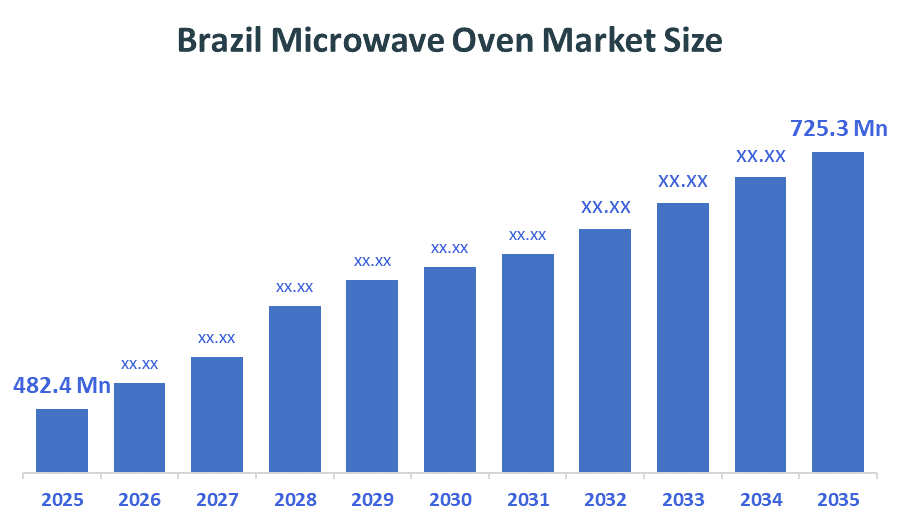
- Brazil Microwave Oven Market Size (2025): USD 482.4 Million
- Brazil Microwave Oven Projected Market Size (2035): USD 725.3 Million
- Brazil Microwave Oven Compound Annual Growth Rate (CAGR): 4.16%
- Base Year: 2025
- Historical Period: 2021–2024
- Forecast Period: 2026–2035
Market Overview/Introduction
The Microwave Oven Market in Brazil is defined as the business activity relating to the manufacture, importation, marketing, and sale of microwave ovens, which are used for domestic and commercial cooking purposes throughout Brazil, and represents an important part of the home appliances industry. A microwave oven is a kitchen electrical appliance that cooks, heats, and defrosts food using electromagnetic microwaves that cause vibration of water molecules within food to produce heat rapidly. They are extensively used in Brazil for the reheating of foods, cooking pre-prepared foods, defrosting foods, baking, grilling, and fast-food preparations at both domestic level and in commercial establishments such as hotels, restaurants, and cafeterias. There is significant growth in this industry owing to urbanization, increase in disposable income levels, increase in working population, change in food habits, and desire for convenience and saving of time in the preparation process. Innovation in technology such as convection cooking, inverter technology, sensor-automatic cooking technology, and intelligent IoT-powered microwave ovens is adding to this growth. Moreover, the government of Brazil, through its energy efficiency initiatives such as PROCEL (National Energy Conservation Program), indirectly fuels the growth in this market. Positive retail expansion, e-commerce growth, and manufacturing in the area are additional ways to increase market accessibility. The Brazilian market for microwaves is developing very quickly because of changes in people's lifestyles, technology development, and high demand for energy-efficient kitchen appliances.
- In February 2025, BNPL and instalment financing support Brazil appliance demand, enabling 24–60 monthly payments, boosting adoption of premium microwave ovens, which hold approximately 38% convection segment.
- In January 2025, Brazil microwave oven market is driven by energy efficiency programs, with PROCEL and INMETRO labels covering 90%+ appliances, boosting demand for “A” rated low-energy convection microwave ovens.
Notable Insights: -
- By product type, the convection microwave ovens segment holds a dominant position with an estimated share of over 4.1% in 2025.
- By technology, the non-smart microwave ovens segment holds a dominant position with an estimated share of over 5.5% in 2025.
- By distribution channel, the supermarkets & hypermarkets segment holds a dominant position with an estimated share of over 39% in 2025.
- By application, the residential segment holds a dominant position with an estimated share of over 4.3% in 2025.
- The forecasted CAGR for the Brazil Microwave Oven market is expected to be about 4.16% for the period between 2026 and 2035.
- The market is expected to reach a valuation of approximately USD 725.3 Million by 2035
What is the Role of Technology in Grooming the Market?
Technology plays a pivotal role in the growth and evolution of the market. Using the tools of data analytics and artificial intelligence, companies gain insights into the behaviour of consumers and develop personalized marketing techniques and accurate forecasting of demand. The digital nature of Supermarkets & hypermarkets technologies and e-commerce removes geographic limitations, turning local markets into global spaces. In addition, automation and blockchain improve supply chain efficiency, creating the level of consumer confidence that ensures the maturity of the market. Through the use of financial technologies and continuous feedback, technology ensures adaptability and competitiveness in new economic trends.
Market Drivers
There are some prominent driving factors that help the market grow steadily. Urbanization and lifestyle changes have led to an increased need for efficient cooking devices from working professionals as well as nuclear families. The increasing disposable income levels and growing middle-class population base are aiding the uptake of home appliances. The involvement of women in the workforce is creating a higher dependency on gadgets that make cooking easy and fast. There is a rising preference for products such as ready-to-eat meals as well as frozen meals which is acting as a demand booster for the market. The advancements in technology in terms of convection cooking, inverters, and even IoT-enabled appliances are contributing to market growth. Organized retailing and the development of e-commerce platforms in the country are contributing to product availability in both urban and semi-urban locations. Lastly, there are energy-efficiency campaigns along with government schemes such as PROCEL which promote energy-efficient devices.
Restraints
The Brazil microwave oven market faces restraints such as high electricity costs, economic volatility, and limited adoption in low-income regions. Additionally, strong competition from alternative cooking appliances like gas stoves and air fryers, along with repair and maintenance concerns, restrict wider market penetration and slow overall growth in rural areas.
Study on the Supply, Demand, Distribution, and Market Environment
The Brazil microwave oven market has an equilibrium structure characterized by demand growth and stable supply. Demand stems from increasing urbanization, income levels, and consumer interest in convenient kitchen gadgets, with increasing popularity among convection and smart ovens. On the supply side, major players include Electrolux, Whirlpool, LG, and Midea, supplemented by robust importation from Asian countries like China. The distribution channels consist primarily of supermarkets, electronics retail stores, specialty shops, and online marketplaces. The market environment features moderate competition and a high degree of preference among buyers for cost-effective, versatile goods.
Price Analysis and Consumer Behaviour Analysis
The prices of microwave ovens in Brazil vary considerably, ranging from USD 80 to USD 400+. Solo microwave ovens can be categorized under the medium-low price bracket, whereas the convection microwave ovens and the intelligent ones are classified under the high price bracket due to their additional capabilities. Sensitivity towards price remains high amongst the middle-income group, leading to high demand for inexpensive products. Yet, urban residents are increasingly favoring microwave ovens that are equipped with additional features and save energy. This is driving the growth of the high price bracket.
Market Segmentation
The Brazil microwave oven market is categorised by product type, Technology, application and Distribution Channel
- The Convection microwave ovens segment dominated the market in 2025 and is projected to grow at a steady CAGR of approximately 4.1% during the forecast period.
Based on the product type, the microwave oven market is divided into solo microwave ovens, grill microwave ovens, convection microwave ovens. Among these, Convection microwave ovens dominate the Brazil microwave oven market due to their multifunction capability (microwave, baking, grilling, and roasting). They hold the largest revenue share of around 48% in 2025, driven by rising demand for premium and versatile kitchen appliances. The overall market is valued growing at a CAGR of about 4.1%. Urban households prefer convection models for convenience, efficiency, and space-saving benefits, making them the leading segment.
- The non-smart microwave ovens segment accounted for the largest share in 2025 and is anticipated to grow at a significant CAGR of approximately 5.5% during the forecast period.
Based on the technology, the microwave oven market is divided into smart microwave ovens, and non-smart microwave ovens. Among these, non-smart microwave ovens dominate the Brazil market, holding around 70–80% revenue share in 2025, due to their low cost, simple operation, and strong adoption in mass households. The total Brazil microwave oven market is valued at approximately USD 460–500 million in 2025, growing at a CAGR of approximately 2.8%. However, smart microwave ovens are the fastest-growing segment with a higher CAGR of approximately 14–18%, driven by IoT features, sensor cooking, and rising demand for smart home appliances in urban areas.
- The residential segment accounted for the largest share in 2025 and is anticipated to grow at a significant CAGR of approximately 4.3% during the forecast period.
Based on the application, the microwave oven market is divided into residential, and commercial. Among these, the residential segment dominates the Brazil microwave oven market, holding around 80–85% revenue share in 2025, driven by rising urban households, busy lifestyles, and demand for convenient cooking solutions. The total market is valued at approximately USD 460–500 million in 2025, growing at a CAGR of approximately 4%–4.5%. Residential demand is fuelled by replacement purchases and adoption of multifunction ovens. The commercial segment (hotels, restaurants) is smaller but growing steadily at a CAGR of approximately 3–4%, supported by food service expansion.
- The supermarkets & hypermarkets sector segment accounted for the largest share in 2025 and is anticipated to grow at a significant CAGR of approximately 39% during the forecast period.
Based on the distribution channel, the microwave oven market is divided into supermarkets & hypermarkets, electronics & appliance stores, specialty stores, and online/e-commerce platforms. Among these, the Supermarkets & hypermarkets segment dominates the microwave oven distribution channel in 2025, holding around 35–40% revenue share, due to strong offline presence, product visibility, and consumer trust in physical retail. The total microwave oven market is valued at approximately USD 460–500 million in 2025, growing at a CAGR of approximately 35–40%. However, online/e-commerce is the fastest-growing channel, with a higher CAGR of approximately 10–12%, driven by discounts, wider product range, and increasing digital adoption among urban consumers.
Recent Developments
In October 2025, Samsung has launched smart all-in-one microwave ovens featuring air-fry, grilling, convection, and smart connectivity functions, supporting the growing demand for multifunction and energy-efficient appliances in markets such as Brazil.
In August 2024, Midea expanded manufacturing in Brazil with ~$96 million investment, strengthening local production of household appliances, improving supply chain efficiency and supporting microwave oven market growth in Brazil.
In July 2024, LG launched Wi-Fi-enabled microwave ovens with Scan-to-Cook and ThinQ smart connectivity, offering automated cooking programs and energy efficiency, boosting demand for smart appliances in Brazil market.
Competitive Analysis
The report offers the appropriate analysis of the key organisations/companies involved within the Brazil Microwave Oven market, along with a comparative evaluation primarily based on their product offering, business overviews, geographic presence, enterprise strategies, segment market share, and SWOT analysis. The report also provides an elaborate analysis focusing on the current news and developments of the companies, which includes product development, innovations, joint ventures, partnerships, mergers & acquisitions, strategic alliances, and others. This allows for the evaluation of the overall competition within the market.
Top Key Companies in the Brazil Microwave Oven Market
- Electrolux
- Whirlpool
- LG Electronics
- Samsung Electronics
- Midea Group
- Panasonic Corporation
- BSH Hausgeräte
- Sharp Corporation
- Haier Group
- GE Appliances
- Groupe SEB
- Mueller Eletrodomésticos
- Others
Key Target Audience
- Market Players
- Investors
- End-users
- Government Authorities
- Consulting and Research Firm
- Venture capitalists
- Value-Added Resellers (VARs)
Market Segmentation
This study forecasts revenue at the national and regional levels from 2021 to 2035. The report segmented the Brazil Microwave Oven Market based on the following segments:
Brazil Microwave Oven Market, By Product Type
- Solo microwave ovens
- Grill microwave ovens
- Convection microwave ovens
Brazil Microwave Oven Market, By Technology
- Smart microwave ovens
- Non-smart microwave ovens
Brazil Microwave Oven Market, By Application
- Residential
- Commercial
Brazil Microwave Oven Market, By Distribution Channel
- Industrial sector
- Electronics & appliance stores
- Specialty stores,
- Online/e-commerce platforms
Frequently Asked Questions (FAQ)
Q1. What are the key trends influencing consumer preferences in the Brazil microwave oven market?
A: The market is witnessing a shift toward compact, multifunctional, and energy-efficient kitchen appliance. Increasing adoption of smart home technologies and appliances with integrated cooking features such as air frying and sensor-based cooking is also shaping consumer preferences.
Q2. How does urbanization impact the adoption of microwave ovens in Brazil?
A: Urbanization is contributing significantly to market growth by increasing the number of nuclear households and apartment-based living. This has led to higher demand for space-efficient and convenient cooking appliances such as microwave ovens, particularly in metropolitan regions.
Q3. What is the significance of product replacement cycles in market development?
A: Replacement demand plays a crucial role in sustaining market growth, as consumers periodically upgrade older appliances with advanced models offering improved energy efficiency, durability, and multifunctional capabilities, typically within a 6–8 year cycle.
Q4. How does changing dietary behaviour influence microwave oven usage in Brazil?
A: The increasing consumption of processed, frozen, and ready-to-eat food products has enhanced the utilization of microwave ovens for reheating and quick meal preparation, particularly among urban working populations with time-constrained lifestyles.
Q5. What are the primary challenges faced by manufacturers in the Brazil microwave oven market?
A: Manufacturers face challenges such as fluctuating import duties, currency volatility, high taxation structures, and increasing competition from alternative cooking appliances, including air fryers and induction cooktops, which may limit market expansion.
Check Licence
Choose the plan that fits you best: Single User, Multi-User, or Enterprise solutions tailored for your needs.
We Have You Covered
- 24/7 Analyst Support
- Clients Across the Globe
- Tailored Insights
- Technology Tracking
- Competitive Intelligence
- Custom Research
- Syndicated Market Studies
- Market Overview
- Market Segmentation
- Growth Drivers
- Market Opportunities
- Regulatory Insights
- Innovation & Sustainability
Report Details
| Scope | Country |
| Pages | 210 |
| Delivery | PDF & Excel via Email |
| Language | English |
| Release | Apr 2026 |
| Access | Download from this page |