
Brazil Near Infrared Imaging Market
 |
Author:
David J
|
Pages:
220
|
Author:
David J
|
Pages:
220
Brazil Near Infrared Imaging Market Size, Share, and COVID-19 Impact Analysis, By Product (Devices, Reagents), Application (Preclinical Imaging, Cancer Surgeries, Gastrointestinal Surgeries, Cardiovascular Surgeries, Plastic/Reconstructive Surgeries, and Others), By End User (Hospitals and Clinics, Pharmaceutical and Biotechnology Companies, Research Laboratories and Academic Institutes, and Others), and Brazil Near Infrared Imaging Market Insights, Industry Trend, Forecasts to 2035
CAGR
4.1%
REVENUE 2025
Million 28.17
FORECAST 2035
Million 44.0
REPORT COVERAGE
Country
Brazil Near Infrared Imaging Market Insights Forecasts to 2035
- The Brazil Near Infrared Imaging Market Size Was Estimated at USD 28.17 Million in 2024
- The Market Size is Expected to Grow at a CAGR of Around 4.1% from 2025 to 2035
- The Brazil Near Infrared Imaging Market Size is Expected to Reach USD 44 Million by 2035
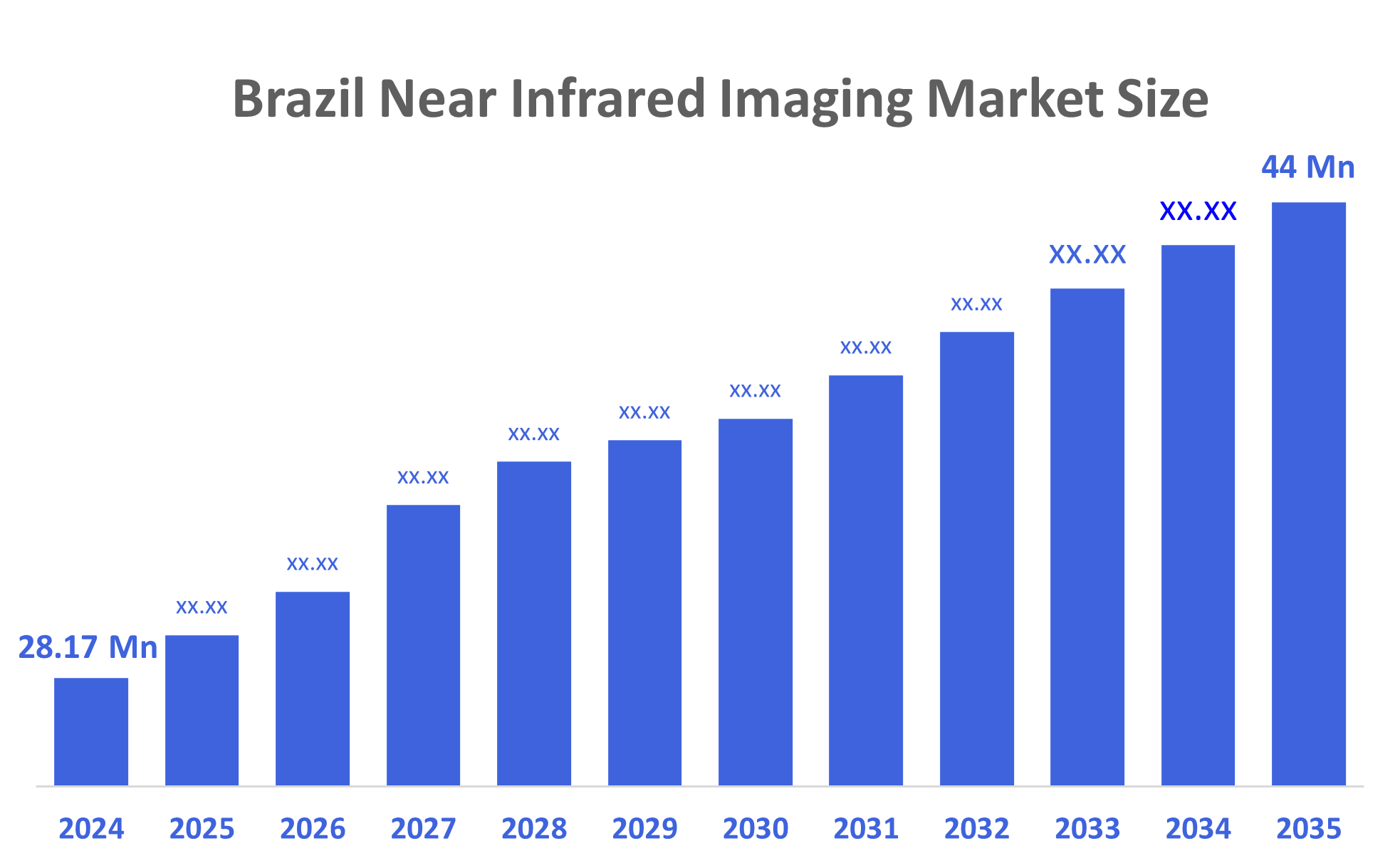
According to a research report published by Decisions Advisors, The Brazil Near Infrared Imaging Market Size is Anticipated to Reach USD 44 Million by 2035, Growing at a CAGR of 4.1% from 2025 to 2035. The Brazil Near Infrared (NIR) Imaging Market is driven by increasing demand for non-invasive medical diagnostics, rising adoption in food and pharmaceutical quality control, growing awareness of advanced imaging technologies, and government initiatives promoting precision healthcare and research applications.
Market Overview
Near Infrared (NIR) Imaging is a non-invasive technology that uses near-infrared light (wavelengths of 700–2500 nm) to capture images of tissues, materials, or substances. It enables real-time visualization, analysis, and monitoring in medical diagnostics, pharmaceuticals, food quality, and industrial applications by detecting molecular composition and structural changes. Additionally, the growth of the Brazil near-infrared (NIR) imaging market is driven by increasing healthcare investments, rising prevalence of chronic diseases, technological advancements in imaging devices, expanding applications in pharmaceuticals and food quality assessment, and growing awareness among researchers and industries about the benefits of non-invasive, real-time imaging solutions. Furthermore, Key trends include the adoption of portable and handheld NIR devices, integration with AI for enhanced analysis, growing use in pharmaceutical and food quality testing, rising preference for non-invasive diagnostics, and increased collaborations between research institutions and technology providers to develop advanced imaging solutions. For instance, the Brazilian government supports the near-infrared (NIR) imaging market through healthcare modernization initiatives, allocating over R$4?billion for medical equipment and labs. The Health Industrial Complex aims to meet 70% of public-system demand domestically, while the health sector contributes 10% of GDP, fostering NIR adoption in diagnostics and research.
Report Coverage
This research report categorizes the market for the Brazil near-infrared imaging market based on various segments and regions, and forecasts revenue growth and analyses trends in each submarket. The report analyses the key growth drivers, opportunities, and challenges influencing the Brazil near-infrared imaging market. Recent market developments and competitive strategies, such as expansion, product launch, development, partnership, merger, and acquisition, have been included to draw the competitive landscape in the market. The report strategically identifies and profiles the key market players and analyses their core competencies in each sub-segment of the Brazil near-infrared imaging market.
Driving Factors
The Brazil near-infrared imaging market is driven by increasing investments in healthcare infrastructure and advanced diagnostic technologies. Rising demand for non-invasive, real-time imaging in medical diagnostics, combined with growing adoption in pharmaceutical quality control and food industry applications, fuels market growth. Technological advancements, including portable, handheld, and AI-integrated NIR devices, enhance efficiency and accessibility. Expanding research and academic initiatives promote innovation and application development. Additionally, supportive government policies and programs encouraging domestic medical device production and precision healthcare adoption further accelerate the market’s growth trajectory.
Restraining Factors
The Brazil near-infrared (NIR) imaging market faces restraints from high equipment costs, limited awareness among smaller healthcare providers, and the need for skilled professionals to operate devices. Regulatory challenges, slow adoption in certain regions, and competition from established imaging technologies like MRI and CT scans also hinder widespread market penetration.
Market Segmentation
The Brazil near-infrared imaging market share is categorized by product, application, and end user.
- The devices segment accounted for the largest revenue market share in 2024 and is expected to grow at a significant CAGR during the forecast period.
The Brazil near-infrared imaging market is segmented by product into devices, reagents. Among these, the devices segment accounted for the largest revenue market share in 2024 and is expected to grow at a significant CAGR during the forecast period. The segmental growth is driven due to these instruments are essential for capturing and analyzing near-infrared signals across medical, pharmaceutical, and food industry applications. Hospitals, research laboratories, and quality-control facilities require advanced imaging systems for non-invasive diagnostics and real-time monitoring, driving consistent demand. Additionally, technological innovations such as portable, handheld, and AI-integrated NIR devices increase efficiency and usability, further boosting adoption. In contrast, reagents have a narrower application scope and lower recurring demand, making devices the primary revenue-generating segment in the market.
- The preclinical imaging segment dominated the market in 2024 and is projected to grow at a substantial CAGR during the forecast period.
The Brazil near-infrared imaging market is segmented by application into preclinical imaging, cancer surgeries, gastrointestinal surgeries, cardiovascular surgeries, plastic/reconstructive surgeries, and others. Among these, the preclinical imaging segment accounted for the largest revenue share in 2024 and is expected to grow at a significant CAGR during the forecast period. The growth of the segment is due to its critical role in research, drug development, and understanding disease mechanisms. Academic institutions, pharmaceutical companies, and biotechnology firms extensively use NIR imaging for non-invasive visualization of biological processes in small animals and laboratory studies. This widespread adoption is driven by the need for accurate, real-time imaging to accelerate preclinical trials and reduce experimental errors. In contrast, surgical applications like cancer or cardiovascular surgeries are growing but represent a smaller portion of the market’s overall revenue.
- The research laboratories and academic institutes segment dominated the market in 2024 and is projected to grow at a substantial CAGR during the forecast period.
The Brazil near-infrared imaging market is segmented by end user into hospitals and clinics, pharmaceutical and biotechnology companies, research laboratories and academic institutes, and others. Among these, the research laboratories and academic institutes segment accounted for the largest revenue share in 2024 and is expected to grow at a significant CAGR during the forecast period. The growth of the segment is due to these institutions being the primary adopters of NIR technology for preclinical studies, drug discovery, and biological research. Universities, pharmaceutical R&D centers, and biotechnology firms extensively use NIR imaging for non-invasive, real-time visualization of molecular and cellular processes. High demand for advanced imaging systems to accelerate research, improve accuracy, and support innovation drives this segment. In contrast, hospitals and clinics adopt NIR imaging more slowly, making research and academic applications the market’s largest revenue contributor.
Competitive Analysis:
The report offers the appropriate analysis of the key organizations/companies involved within the Brazil near-infrared imaging market, along with a comparative evaluation primarily based on their product offering, business overviews, geographic presence, enterprise strategies, segment market share, and SWOT analysis. The report also provides an elaborate analysis focusing on the current news and developments of the companies, which includes product development, innovations, joint ventures, partnerships, mergers & acquisitions, strategic alliances, and others. This allows for the evaluation of the overall competition within the market.
List of Key Companies
- Stryker Corporation
- KARL STORZ SE & Co. KG
- Carl Zeiss Meditec AG
- Olympus Corporation
- Hamamatsu Photonics K.K.
- PerkinElmer, Inc.
- Leica Microsystems
- Medtronic plc
- Shimadzu Corporation
- Other
Key Target Audience
- Market Players
- Investors
- End-users
- Government Authorities
- Consulting and Research Firm
- Venture capitalists
- Value-Added Resellers (VARs)
Recent Developments
In November 2024, Hamamatsu Photonics K.K., headquartered in Hamamatsu City, Japan, acquired BAE Systems Imaging Solutions. This acquisition enhances Hamamatsu's opto-semiconductor segment by incorporating advanced CMOS image sensor technologies. The acquisition allows Hamamatsu to strengthen its position in the market by leveraging BAE Systems Imaging Solutions' expertise in high-performance CMOS image sensors, particularly in the visible to near-infrared and X-ray regions
In February 2025, Stryker, headquartered in Portage, Michigan, completed the acquisition of Inari Medical for $4.9 billion. This acquisition enhances Stryker's position in the high-growth peripheral vascular market, particularly in the treatment of venous thromboembolism (VTE). Inari Medical's portfolio includes innovative thrombectomy solutions like the FlowTriever and ClotTriever systems, which are used to treat pulmonary embolism and deep vein thrombosis, respectively. This strategic move is expected to improve patient outcomes and expand Stryker's interventional endovascular portfolio
Market Segment
This study forecasts revenue at the Brazil, regional, and country levels from 2020 to 2035. Decisions Advisors has segmented the Brazil near-infrared imaging market based on the below-mentioned segments:
Brazil Near Infrared Imaging Market, By Product
- Devices
- Reagents
Brazil Near Infrared Imaging Market, By Application
- Preclinical Imaging
- Cancer Surgeries
- Gastrointestinal Surgeries
- Cardiovascular Surgeries
- Plastic/Reconstructive Surgeries
- Others
Brazil Near Infrared Imaging Market, By End User
- Hospitals and Clinics
- Pharmaceutical and Biotechnology Companies
- Research Laboratories and Academic Institutes
- Others
Check Licence
Choose the plan that fits you best: Single User, Multi-User, or Enterprise solutions tailored for your needs.
We Have You Covered
- 24/7 Analyst Support
- Clients Across the Globe
- Tailored Insights
- Technology Tracking
- Competitive Intelligence
- Custom Research
- Syndicated Market Studies
- Market Overview
- Market Segmentation
- Growth Drivers
- Market Opportunities
- Regulatory Insights
- Innovation & Sustainability
Report Details
| Scope | Country |
| Pages | 220 |
| Delivery | PDF & Excel via Email |
| Language | English |
| Release | Dec 2025 |
| Access | Download from this page |