
Brazil Precision Gearbox Market
 |
Author:
Pranali P
|
Pages:
146
|
Author:
Pranali P
|
Pages:
146
Brazil Precision Gearbox Market Size, Share, and COVID-19 Impact Analysis, By Product (Planetary, Harmonic, and Cycloid), By Application (Military, Aerospace, Food, Beverage, Tobacco, Machine Tools, Materials Handling, Packaging, Robotics, Medical, and Others), and Brazil Precision Gearbox Market Insights, Industry Trend, Forecasts to 2035
CAGR
9.5%
REVENUE 2025
Million 32.5
FORECAST 2035
Million 88.2
REPORT COVERAGE
Country
Brazil Precision Gearbox Market Size Insights Forecasts to 2035
- The Brazil Precision Gearbox Market Size Was Estimated at USD 32.5 Million in 2024
- The Market Size is Expected to Grow at a CAGR of Around 9.5% from 2025 to 2035
- The Brazil Precision Gearbox Market Size is Expected to Reach USD 88.20 Million by 2035
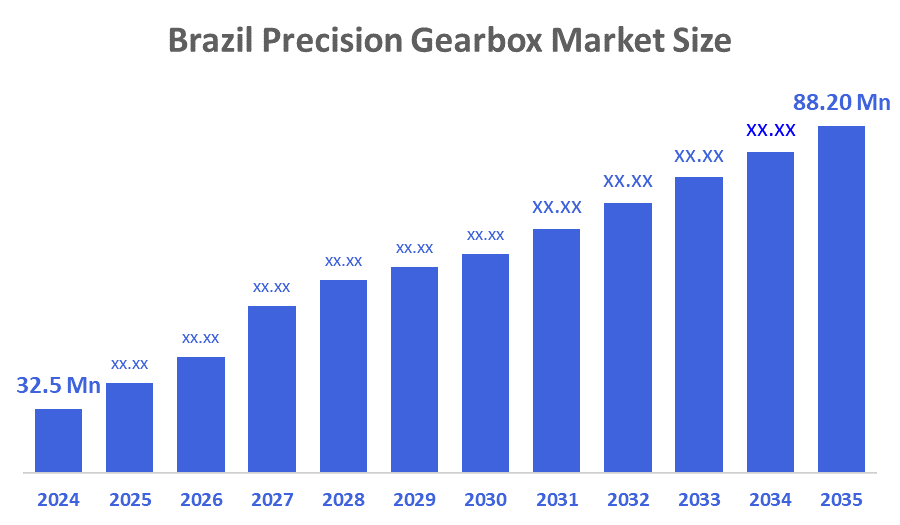
According to a Research Report Published by Decisions Advisors & Consulting, The Brazil Precision Gearbox Market Size is anticipated to Reach USD 88.20 Million by 2035, Growing at a CAGR of 9.5% from 2025 to 2035. The Brazil precision gearbox market is driven by growing industrial automation, rising robotics adoption, expanding automotive manufacturing, increasing demand for energy-efficient machinery, infrastructure development, smart manufacturing initiatives, and strong demand from packaging, food processing, mining, and renewable energy sectors across the country.
Market Overview
Precision gearboxes are industrial machines used to reduce the speed of conveyor belts in the food and pharmaceutical industries while maintaining a consistent pace of output. It reduces raw material waste and improves machine efficiency by lowering energy consumption. The rapidly increasing aerospace sector is projected to boost the precision gearbox market over the forecast time frame. A precision gearbox is a mechanical device often used to provide more tolerance than regular gearboxes. These devices are machined to achieve more than 90% efficiency by altering the torque and speed within certain limits. Their use saves space because they have compact component designs and consist of two or more gears. They operate with low-frequency vibrations and are suitable for low-speed applications. Manufacturers have supplied evolved gearboxes with high energy density and precision to food and beverage firms for use in the development of food handling equipment. Furthermore, the products for the food business provide health assurance to prevent food contamination caused by contact with gearboxes.
The precision gearbox market in Brazil is projected to grow over the forecast period on account of increasing demand for the food & beverage industry. Gearboxes are known to maintain speed and torque, resulting in improved safety, efficiency, and productivity. Moreover, gearboxes eliminate the use of components such as bearings and pulleys and the territorial expansion of Brazil allows it to produce a range of agricultural products. The country is involved in the production of coffee, sugar, orange juice, soya beans, beef, poultry, soya oil, pork, milk, cotton, and grapes. Furthermore, the agricultural business has witnessed constant growth in Brazil, resulting in the increasing demand for food processing technologies. The rising use of precision gearboxes in the food & beverage industry in order to maintain speed and torque results in improved safety, efficiency, and productivity.
Report Coverage
This research report categorizes the market for the Brazil precision gearbox market based on various segments and regions, and forecasts revenue growth and analyses trends in each submarket. The report analyses the key growth drivers, opportunities, and challenges influencing the Brazil precision gearbox market. Recent market developments and competitive strategies, such as expansion, product launch, development, partnership, merger, and acquisition, have been included to draw the competitive landscape in the market. The report strategically identifies and profiles the key market players and analyses their core competencies in each sub-segment of the Brazil precision gearbox market.
Driving Factors
The Brazil precision gearbox market is driven by rapid industrial automation, increasing adoption of robotics, and expanding automotive manufacturing, including electric vehicles. Growing focus on energy-efficient machinery and infrastructure development further boosts demand. Renewable energy projects, especially wind and solar, require reliable gearboxes for turbines. Additionally, the packaging, food processing, and manufacturing sectors rely on precise motion control. The adoption of advanced manufacturing technologies and Industry 4.0 initiatives, combined with rising foreign investment in Brazil’s industrial sector, collectively stimulates the growth of the precision gearbox market across various applications.
Restraining Factors
The Brazil precision gearbox market faces restraints such as high initial costs of precision gearboxes, complex maintenance requirements, and limited technical expertise in smaller industries. Market growth is also hindered by fluctuating raw material prices, economic instability, and competition from low-cost imported gearboxes. These challenges slow adoption, especially among small and medium-sized manufacturers seeking cost-effective solutions.
Market Segmentation
The Brazil precision gearbox market share is categorized by product and application.
- The planetary segment accounted for the largest revenue market share in 2024 and is expected to grow at a significant CAGR during the forecast period.
The Brazil precision gearbox market is segmented by product into planetary, harmonic, and cycloid. Among these, the planetary segment accounted for the largest revenue market share in 2024 and is expected to grow at a significant CAGR during the forecast period. The segmental growth is driven by its high torque-to-size ratio, compact design, and superior efficiency, which make it ideal for space-constrained industrial and automotive applications. Its durability, load-sharing capability, and precise motion control suit robotics, automation, and renewable energy sectors. Additionally, planetary gearboxes offer flexibility across varying speed and torque requirements, reducing maintenance needs and operational costs. These advantages, combined with growing industrial automation and expanding automotive and renewable energy projects in Brazil, drive higher adoption compared to harmonic and cycloid gearbox types.
- The robotics segment dominated the market in 2024 and is projected to grow at a substantial CAGR during the forecast period.
The Brazil precision gearbox market is segmented by application into military, aerospace, food, beverage, tobacco, machine tools, materials handling, packaging, robotics, medical, and others. Among these, the robotics segment accounted for the largest revenue share in 2024 and is expected to grow at a significant CAGR during the forecast period. The growth of the segment is due to the increasing adoption of industrial and service robots across manufacturing, automotive, packaging, and food processing sectors. Robots require high-precision motion control, reliability, and compact gearbox designs to perform complex tasks efficiently. Precision gearboxes, particularly planetary types, provide the necessary torque, accuracy, and durability for robotic applications. Additionally, Brazil’s focus on industrial automation, Industry 4.0 initiatives, and labor-efficient manufacturing drives higher demand for robotic systems, making this segment the largest consumer of precision gearboxes in the country.
Competitive Analysis:
The report offers the appropriate analysis of the key organizations/companies involved within the Brazil precision gearbox market, along with a comparative evaluation primarily based on their product offering, business overviews, geographic presence, enterprise strategies, segment market share, and SWOT analysis. The report also provides an elaborate analysis focusing on the current news and developments of the companies, which includes product development, innovations, joint ventures, partnerships, mergers & acquisitions, strategic alliances, and others. This allows for the evaluation of the overall competition within the market.
List of Key Companies
- WEG
- SEW-EURODRIVE
- Bonfiglioli
- Sumitomo Drive Technologies
- ZF Friedrichshafen
- Wittenstein
- PCCM Technologies
- Mult Engrenagens
- Others
Key Target Audience
- Market Players
- Investors
- End-users
- Government Authorities
- Consulting and Research Firm
- Venture capitalists
- Value-Added Resellers (VARs)
Recent Developments
In October 2023, Schaeffler expanded its precision bearing, motor, and gearbox offerings for machine tool applications. Schaeffler is addressing the machine tool industry's difficulties with innovative automation systems that include even greater dynamic characteristics, precision, energy efficiency, and longer machine runtimes.
In February 2022, Nabtesco, a manufacturer of robotic gearboxes, disclosed plans to invest in a third precision gearbox manufacturing factory, increasing the company's production capacity to two million per year by 2026.
Market Segment
This study forecasts revenue at the Brazil, regional, and country levels from 2020 to 2035. Decisions Advisors has segmented the Brazil precision gearbox market based on the below-mentioned segments:
Brazil Precision Gearbox Market, By Product
- Planetary
- Harmonic
- Cycloid
Brazil Precision Gearbox Market, By Application
- Military
- Aerospace
- Food
- Beverage
- Tobacco
- Machine Tools
- Materials Handling
- Packaging
- Robotics
- Medical
- Others
FAQ’s
1. Why are precision gearboxes important in modern factories?
- They help machines move smoothly, reduce errors, and improve production accuracy.
2. Are Brazilian industries locally manufacturing precision gearboxes?
- Yes, Brazil has both local production and strong dependence on imported advanced gearbox technologies.
3. Which industries use precision gearboxes the most in Brazil?
- Robotics, automotive manufacturing, packaging, mining, and food processing industries.
4. How do precision gearboxes support energy saving?
- They reduce power loss by improving torque transmission and machine efficiency.
5. What role does Industry 4.0 play in this market?
- Smart factories and digital automation systems increase demand for high-precision motion control solutions.
6. Is demand expected to grow in the future?
- Yes, demand is rising due to automation, infrastructure growth, and renewable energy investments.
Check Licence
Choose the plan that fits you best: Single User, Multi-User, or Enterprise solutions tailored for your needs.
We Have You Covered
- 24/7 Analyst Support
- Clients Across the Globe
- Tailored Insights
- Technology Tracking
- Competitive Intelligence
- Custom Research
- Syndicated Market Studies
- Market Overview
- Market Segmentation
- Growth Drivers
- Market Opportunities
- Regulatory Insights
- Innovation & Sustainability
Report Details
| Scope | Country |
| Pages | 146 |
| Delivery | PDF & Excel via Email |
| Language | English |
| Release | Dec 2025 |
| Access | Download from this page |