
Brazil Remote Patient Monitoring System Market
 |
Author:
David J
|
Pages:
228
|
Author:
David J
|
Pages:
228
Brazil Remote Patient Monitoring System Market Size, Share, and COVID-19 Impact Analysis, By Type (Wearable Devices, Connected Devices, Mobile Health Apps, Software Platforms, Others), By Applications (Cardiology, Diabetes Management, Respiratory Disorders, Hypertension, Elderly Care, Others), and Brazil Remote Patient Monitoring System Market Insights, Industry Trend, Forecasts to 2035
CAGR
17.9%
REVENUE 2024
USD Million 570.5
FORECAST 2035
USD Million 3490.0
REPORT COVERAGE
Country
Brazil Remote Patient Monitoring System Market Size Insights Forecasts to 2035
- The Brazil Remote Patient Monitoring System Market Size Was Estimated at USD 570.5 Million in 2024
- The Market Size is Expected to Grow at a CAGR of Around 17.9% from 2025 to 2035
- The Brazil Remote Patient Monitoring System Market Size is Expected to Reach USD 3490 Million by 2035
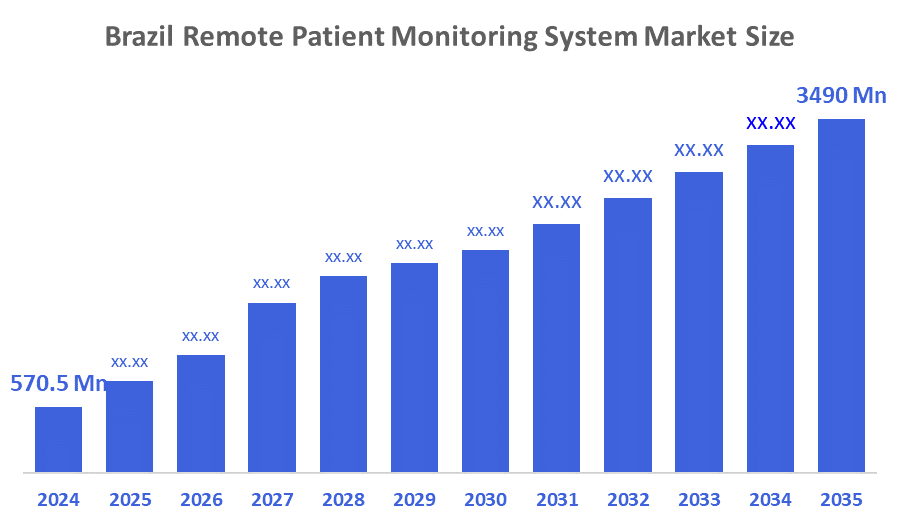
According to a Research Report Published by Decisions Advisors & Consulting, The Brazil Remote Patient Monitoring System Market Size is anticipated to Reach USD 3490 Million by 2035, Growing at a CAGR of 17.9% from 2025 to 2035. The Brazil remote patient monitoring system market is driven by increasing prevalence of chronic diseases, rising geriatric population, growing healthcare digitalization, government initiatives for telehealth, adoption of wearable devices, and demand for cost-effective, continuous patient monitoring solutions.
Market Overview
A remote patient monitoring system is a healthcare technology that tracks a patient’s health, like heart rate or blood sugar, using devices. It sends this information to doctors remotely, allowing them to monitor the patient’s condition, give advice, and take action without the patient visiting a hospital. Additionally, in Brazil, the market is growing due to rising chronic disease cases, an increasing elderly population, the adoption of wearable and connected health devices, advancements in digital healthcare infrastructure, government support for telehealth, and the need for continuous, cost-effective, and convenient patient care solutions across the country. Furthermore, in Brazil, around 30% of healthcare facilities offer telehealth services, including remote patient monitoring, supported by the government’s SUS Digital–Telehealth program. About one in five public facilities provides digital services like online scheduling and records access, promoting remote care and improving healthcare accessibility nationwide.
Furthermore, New trends in Brazil’s remote patient monitoring market include the integration of AI and IoT for real-time health analytics, cloud-based platforms for seamless data sharing, and wearable devices for continuous monitoring of vital signs. Technology innovations also involve mobile health apps, predictive analytics for early disease detection, and telemedicine integration, enhancing personalized care, improving patient engagement, and enabling healthcare providers to make timely, data-driven decisions remotely.
Report Coverage
This research report categorizes the market for the Brazil remote patient monitoring system market based on various segments and regions, and forecasts revenue growth and analyses trends in each submarket. The report analyses the key growth drivers, opportunities, and challenges influencing the Brazil remote patient monitoring system market. Recent market developments and competitive strategies, such as expansion, product launch, development, partnership, merger, and acquisition, have been included to draw the competitive landscape in the market. The report strategically identifies and profiles the key market players and analyses their core competencies in each sub-segment of the Brazil remote patient monitoring system market.
Driving Factors
The Brazil remote patient monitoring system market is primarily driven by the increasing prevalence of chronic diseases, including diabetes, hypertension, and cardiovascular disorders, which require continuous monitoring. The growing elderly population further fuels demand for remote healthcare solutions. Rapid adoption of digital health technologies, wearable devices, and mobile health applications enables real-time patient data collection and analysis. Government initiatives, such as the SUS Digital–Telehealth program, promote telemedicine and remote monitoring services. Additionally, the need for cost-effective, convenient, and accessible healthcare, along with rising patient awareness, significantly supports market growth.
Restraining Factors
The Brazil remote patient monitoring system market faces restraints such as high initial costs of devices and infrastructure, limited internet connectivity in rural areas, and concerns over data privacy and security. Additionally, lack of awareness among some patients and healthcare providers, regulatory challenges, and resistance to adopting new digital healthcare technologies slow market growth despite increasing demand for remote monitoring solutions.
Market Segmentation
The Brazil remote patient monitoring system market share is categorized by type and application.
- The wearable devices segment accounted for the largest revenue market share in 2024 and is expected to grow at a significant CAGR during the forecast period.
The Brazil remote patient monitoring system market is segmented by type into wearable devices, connected devices, mobile health apps, software platforms, and others. Among these, the wearable devices segment accounted for the largest revenue market share in 2024 and is expected to grow at a significant CAGR during the forecast period. The segmental growth is driven by they provide continuous, real-time tracking of vital health parameters such as heart rate, blood pressure, glucose levels, and oxygen saturation. Their portability and ease of use allow patients to monitor their health conveniently at home or on the go. Integration with mobile health apps and software platforms enables seamless data transmission to healthcare providers, supporting timely interventions. Additionally, increasing awareness of personal health management, rising adoption of fitness and health trackers, and technological advancements in wearable sensors contribute significantly to their market dominance.
- The cardiology segment dominated the market in 2024 and is projected to grow at a substantial CAGR during the forecast period.
The Brazil remote patient monitoring system market is segmented by application into cardiology, diabetes management, respiratory disorders, hypertension, elderly care, and others. Among these, the cardiology segment accounted for the largest revenue share in 2024 and is expected to grow at a significant CAGR during the forecast period. The growth of the segment is due to the high prevalence of cardiovascular diseases, which require continuous monitoring of heart rate, blood pressure, and other cardiac parameters. Remote monitoring helps in early detection of complications, timely interventions, and reducing hospital visits. The integration of wearable devices and mobile apps allows healthcare providers to track patients’ cardiac health in real time, improving outcomes and patient adherence, making cardiology the largest and most critical application segment in the market.
Competitive Analysis:
The report offers the appropriate analysis of the key organizations/companies involved within the Brazil remote patient monitoring system market, along with a comparative evaluation primarily based on their product offering, business overviews, geographic presence, enterprise strategies, segment market share, and SWOT analysis. The report also provides an elaborate analysis focusing on the current news and developments of the companies, which includes product development, innovations, joint ventures, partnerships, mergers & acquisitions, strategic alliances, and others. This allows for the evaluation of the overall competition within the market.
List of Key Companies
- American Tele Care
- Philips Healthcare
- Roche
- OMRON
- Abbott
- Medtronic
- BIOTRONIK
- Life Watch
- Others
Key Target Audience
- Market Players
- Investors
- End-users
- Government Authorities
- Consulting and Research Firm
- Venture capitalists
- Value-Added Resellers (VARs)
Recent Developments
In May 2025, Medtronic revealed a new strategic collaboration with Corsano Health B.V., an innovative MedTech company specializing in real-time remote patient monitoring solutions. Through this partnership, Medtronic will have exclusive rights to distribute Corsano Health’s advanced technology in Western Europe for hospital and home applications, boosting remote monitoring capabilities and enhancing patient care across various healthcare environments.
Market Segment
This study forecasts revenue at the Brazil, regional, and country levels from 2020 to 2035. Decisions Advisors has segmented the Brazil remote patient monitoring system market based on the below-mentioned segments:
Brazil Remote Patient Monitoring System Market, By Type
- Wearable Devices
- Connected Devices
- Mobile Health Apps
- Software Platforms
- Others
Brazil Remote Patient Monitoring System Market, By Application
- Cardiology
- Diabetes Management
- Respiratory Disorders
- Hypertension
- Elderly Care
- Others
FAQ’s
Q1. What is a Remote Patient Monitoring (RPM) system?
- RPM systems are healthcare technologies that track patients’ vital signs and health data remotely, transmitting it to healthcare providers for monitoring and timely intervention.
Q2. What are the key types of RPM systems in Brazil?
- Wearable devices, connected devices, mobile health apps, software platforms, and others.
Q3. What are the main applications of RPM systems?
- Cardiology, diabetes management, respiratory disorders, hypertension, elderly care, and others.
Q4. Which segment dominates the RPM market in Brazil?
- Wearable devices dominate by type, and cardiology dominates by application.
Q5. What factors are driving the RPM market in Brazil?
- Rising chronic diseases, aging population, adoption of digital healthcare, government initiatives, wearable device usage, cost-effective care, and patient awareness.
6. What are the challenges or restraints in the market?
- High device costs, limited internet access in rural areas, data privacy concerns, regulatory hurdles, and resistance to new technologies.
Check Licence
Choose the plan that fits you best: Single User, Multi-User, or Enterprise solutions tailored for your needs.
We Have You Covered
- 24/7 Analyst Support
- Clients Across the Globe
- Tailored Insights
- Technology Tracking
- Competitive Intelligence
- Custom Research
- Syndicated Market Studies
- Market Overview
- Market Segmentation
- Growth Drivers
- Market Opportunities
- Regulatory Insights
- Innovation & Sustainability
Report Details
| Scope | Country |
| Pages | 228 |
| Delivery | PDF & Excel via Email |
| Language | English |
| Release | Dec 2025 |
| Access | Download from this page |