
Brazil Textile Manufacturing Market
 |
Pages:
170
|
Pages:
170
Brazil Textile Manufacturing Market Size, Share, and COVID-19 Impact Analysis, By Process Type (Spinning, Weaving, Knitting, Finishing, and Others), By Textile Type (Fiber, Yarn, Fabric, Garments, and Others), and Brazil Textile Manufacturing Market Insights, Industry Trend, Forecasts to 2035
REPORT COVERAGE
Country
Brazil Textile Manufacturing Market Insights Forecasts to 2035
- The Brazil Textile Manufacturing Market Size was estimated at USD 22.2 Million in 2024
- The Market Size is Expected to Grow at a CAGR of around 4.31% from 2025 to 2035
- The Brazil Textile Manufacturing Market Size is Expected to Reach USD 35.3 Million by 2035
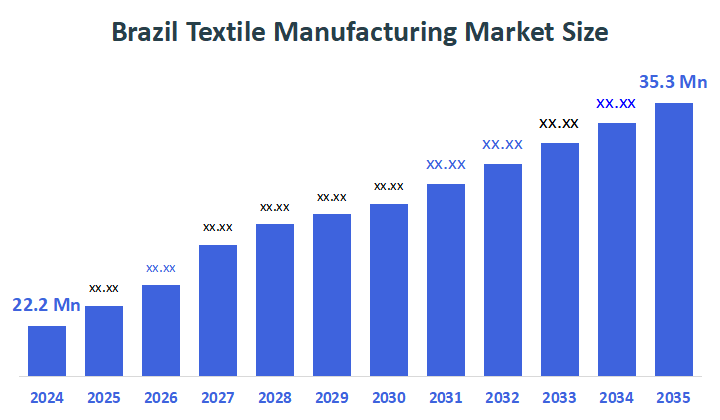
According to a research report published by Decisions Advisors, the Brazil Textile Manufacturing Market is anticipated to reach USD 35.3 million by 2035, growing at a CAGR of 4.31% from 2025 to 2035. The Brazil textile manufacturing market is driven by the rapidly increasing number of middle-class people and the ever-changing trends will continue to stimulate domestic demand for textiles in Brazil. The rise of foreign direct investment along with partnerships made with international companies will lead to the increase of these industries through the means of improved innovations, competitive advantages, and improved global presence.
Market Overview
Textiles comprise a market that includes developing, producing, and distributing textile products and textiles. Automating production processes has allowed companies to increase both the speed and accuracy of their operations, leading to decreased workforce size and higher-quality products. In addition to improving customer experience, AI also provides a means by which to automate manufacturing, increasing overall efficiency while allowing manufacturers the flexibility to respond more quickly to current trends and to grow their businesses. Export opportunities are increase, particularly in Europe and North America region because of there is a strong demand for sustainable and ethically produced textiles Government of Brazil is actively promoting this sector of the economy, through tax incentives, grants for technological upgrades, reduced import duties on machinery, employee training programs, and initiatives to promote sustainable practices, exports, and increasing competitiveness across the various domestic textile manufacturing clusters.
Report Coverage
This research report categorizes the market for the Brazil textile manufacturing market based on various segments and regions and forecasts revenue growth and analyzes trends in each submarket. The report analyses the key growth drivers, opportunities, and challenges influencing the Brazil textile manufacturing market. Recent market developments and competitive strategies such as expansion, product launch, and development, partnership, merger, and acquisition have been included to draw the competitive landscape in the market. The report strategically identifies and profiles the key market players and analyses their core competencies in each sub-segment of the Brazil textile manufacturing market.
Driving Factors
The driving factors of Brazil’s textile manufacturing market is production of a substantial amount of cotton which reduces costs of raw materials. Furthermore, improvements in production efficiency and increased levels of customization to textile products, because of developments in technology, including automation, artificial intelligence, and digital printing, also help to facilitate growth in the industry. The government has implemented a variety of programs promoting sustainability which support industry growth in Brazil, as do growing export markets, and increased levels of e-commerce activity. As a result, there is an increasing demand for diverse, rapidly produced textile products to satisfy the growing demand for e-commerce in the textile industry.
Restraining Factors
The restraining Factors of Brazil textile manufacturing market is high manufacturing costs, old machines in smaller firms, and the increased reliance on imported technology. The existence of complicated regulations, fluctuating prices for raw materials. Moreover, Brazil has a limited number of skilled workers available, as well as expensive energy sources, which negatively impact both the efficiency and potential growth of the textile manufacturing industry.
Market Segmentation
The Brazil Textile Manufacturing Market share is classified into process type and textile type.
- The spinning segment accounted for the largest revenue market share in 2024 and is expected to grow at a significant CAGR during the forecast period.
The Brazil textile manufacturing market is segmented by process type into spinning, weaving, knitting, finishing, and others. Among these, the spinning segment accounted for the largest revenue market share in 2024 and is expected to grow at a significant CAGR during the forecast period. The segmental growth is driven by a leading producer of cotton. Brazil's textile industry relies heavily on spinning as the primary method of producing cotton yarn. Spinning serves as the basis for weaving, knitting, and finishing, resulting in high levels of demand from businesses-to-business and generating a significant portion of industry revenues. Spinning is also supported by the trend of vertical integration in the textile industry and the development of global supply chains.
- The garments segment dominated the market in 2024 and is projected to grow at a substantial CAGR during the forecast period.
The Brazil textile manufacturing market is segmented by textile type into fiber, yarn, fabric, garments, and others. Among these, the garments segment dominated the market in 2024 and is projected to grow at a substantial CAGR during the forecast period. The growth of the segment is due the textile manufacturing industry is largely supported by the domestic fashion industry's strong demand for garments, as well as its large number of potential consumers. The Sao Paulo Fashion Week (SPFW), gives the apparel industry an opportunity to receive attention on a global scale, this is due to in part to the increasing income levels of consumers within Brazil, and the increasing urbanization of the population of the country. As a result, clothing is the most profitable and dominant component of the entire textile value chain.
Competitive Analysis:
The report offers the appropriate analysis of the key organizations/companies involved within the Brazil textile manufacturing market along with a comparative evaluation primarily based on their product offering, business overviews, geographic presence, enterprise strategies, segment market share, and SWOT analysis. The report also provides an elaborative analysis focusing on the current news and developments of the companies, which includes product development, innovations, joint ventures, partnerships, mergers & acquisitions, strategic alliances, and others. This allows for the evaluation of the overall competition within the market.
List of Key Companies
- Evora SA
- Fabricato SA
- H and M Hennes and Mauritz GBC AB
- Hyosung Corp.
- Merrow Sewing Machine Co.
- Pettenati Industria Textil SA
- Santana Textiles Group
- Santista Argentina SA
- Springs Global
- Toray Industries Inc.
- Vicunha Textil SA
- Others
Recent Developments:
- In August 2024: Monforts diversified its presence in Brazil by appointing Uniferro as its new regional representative following the retirement of Herbert Erdmann of Euro Texteis. At Febratex 2024, Monforts showcased its new coaTTex coating unit, which demonstrated improved efficiency and enhanced sustainability for textile finishing in the Brazilian market.
- In April 2023: Shein said it would invest US$150 million in Brazil to boost the competitiveness of Brazilian textile producers. The investment was part of Shein’s Latin-America expansion plan to make Brazil a manufacturing and export hub. The company planned to launch a local marketplace, onboard 2,000 local producers, and generate about 100,000 jobs over the following three years.
Key Target Audience
- Market Players
- Investors
- End-users
- Government Authorities
- Consulting and Research Firm
- Venture capitalists
- Value-Added Resellers (VARs)
Market Segment
This study forecasts revenue at Brazil, regional, and country levels from 2020 to 2035. Decisions Advisors has segmented the Brazil Textile Manufacturing Market based on the below-mentioned segments:
Brazil Textile Manufacturing Market, By Process Type
- Spinning
- Weaving
- Knitting
- Finishing
- Others
Brazil Textile Manufacturing Market, By Textile Type
- Fiber
- Yarn
- Fabric
- Garments
- Others
FAQ’s
Q: What is the Brazil textile manufacturing market size?
A: The Brazil Textile Manufacturing Market size is expected to grow from USD 22.2 million in 2024 to USD 35.3 million by 2035, growing at a CAGR of 4.31% during the forecast period.
Q: Who are the key players in the Brazil textile manufacturing market?
A: Evora SA, Fabricato SA, H and M Hennes and Mauritz GBC AB, Hyosung Corp., Merrow Sewing Machine Co., Pettenati Industria Textil SA, Santana Textiles Group, Santista Argentina SA, Springs Global, Toray Industries Inc., Vicunha Textil SA, and Others are the key players in the Brazil textile manufacturing market.
Q: Who are the target audiences for this market report?
A: The report targets market players, investors, end-users, government authorities, consulting and research firms, venture capitalists, and value-added resellers (VARs).
Check Licence
Choose the plan that fits you best: Single User, Multi-User, or Enterprise solutions tailored for your needs.
We Have You Covered
- 24/7 Analyst Support
- Clients Across the Globe
- Tailored Insights
- Technology Tracking
- Competitive Intelligence
- Custom Research
- Syndicated Market Studies
- Market Overview
- Market Segmentation
- Growth Drivers
- Market Opportunities
- Regulatory Insights
- Innovation & Sustainability
Report Details
| Scope | Country |
| Pages | 170 |
| Delivery | PDF & Excel via Email |
| Language | English |
| Release | Dec 2025 |
| Access | Download from this page |