
Brazil Vital Signs Monitoring Market
 |
Pages:
272
|
Pages:
272
Brazil Vital Signs Monitoring Market Size, Share, and COVID-19 Impact Analysis, By Product (Consumer Wearables and Medical Devices), By Distribution Channel (Hospital, Clinic, and Other), and Brazil Vital Signs Monitoring Market Insights, Industry Trend, Forecasts to 2035
REPORT COVERAGE
Country
Brazil Vital Signs Monitoring Market Size Insights Forecasts to 2035
- The Brazil Vital Signs Monitoring Market Size Was Estimated at USD 450 million in 2024
- The Market Size is Expected to Grow at a CAGR of Around 8.2% from 2025 to 2035
- The Brazil Vital Signs Monitoring Market Size is Expected to Reach USD 1071 Million by 2035
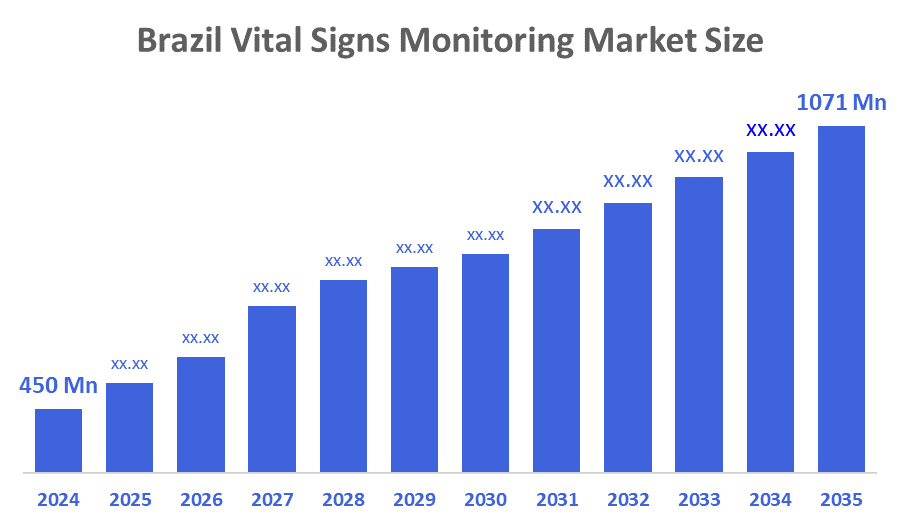
According to a Research Report Published by Decisions Advisors & Consulting, The Brazil Vital Signs Monitoring Market Size is anticipated to Reach USD 1071 Million by 2035, Growing at a CAGR of 8.2% from 2025 to 2035. The Brazil vital signs monitoring market is driven by the rising prevalence of chronic diseases, increasing geriatric population, and growing demand for continuous patient monitoring. Technological advancements in wearable and remote monitoring devices, along with government initiatives to improve healthcare infrastructure, further propel market growth in Brazil.
Market Overview
Monitoring vital signs is the method of assessing the fundamental indicators of one’s health, including pulse rate, blood pressure, respiratory rate, body temperature, and oxygen saturation. The monitoring of vital signs is important for doctors and nurses to evaluate the state of a patient’s health, to identify potential issues prior to them becoming real, and to provide appropriate care to patients in a hospital, clinic, or community setting, as well as in the home environment. There is a growing demand for the monitoring of vital signs due to the increasing prevalence of chronic disease and an aging population. As a result, there is an increased requirement for remote health monitoring. Wearable technology, advancements in hospital equipment, and continued support through government health care policies are allowing the general public to easily manage their health more frequently than ever before.
In Brazil, government support is currently bolstering the growth of the vital signs monitoring market. This includes investing in health care infrastructure, promoting digital health/telemedicine, and funding publicly funded hospitals to provide advanced monitoring technology to their patients. The implementation of policies that support remote patient care, chronic disease management, and proactive health intervention also promotes the expanding usage of vital signs monitoring technology across Brazil. Additionally, key developments in the vital signs monitoring space include the launch of wearable technologies with multiple sensors, the integration of telemedicine with wearable devices, and the utilization of artificial intelligence (AI) to generate predictions about patients’ health status. Collectively, these innovations will facilitate the ongoing use of remote monitoring and allow patients to receive better care without needing to travel to a medical facility.
Report Coverage
This research report categorizes the market for the Brazil vital signs monitoring market based on various segments and regions, and forecasts revenue growth and analyses trends in each submarket. The report analyses the key growth drivers, opportunities, and challenges influencing the Brazil vital signs monitoring market. Recent market developments and competitive strategies, such as expansion, product launch, development, partnership, merger, and acquisition, have been included to draw the competitive landscape in the market. The report strategically identifies and profiles the key market players and analyses their core competencies in each sub-segment of the Brazil vital signs monitoring market.
Driving Factors
The Brazil vital signs monitoring market is driven by several key factors. The rising prevalence of chronic diseases like hypertension, diabetes, and cardiovascular disorders increases demand for continuous monitoring. The aging population requires regular health tracking, while growing awareness of preventive care boosts adoption. Technological advancements in wearable devices, smart sensors, and remote monitoring systems enable real-time data collection and analysis. Additionally, government initiatives supporting digital health, hospital modernization, and telemedicine further encourage market growth. Increasing healthcare expenditure and the shift toward home-based care also play significant roles in driving demand.
Restraining Factors
The Brazil vital signs monitoring market faces restraints such as high costs of advanced monitoring devices, limited healthcare infrastructure in rural areas, and a lack of skilled personnel to operate and interpret data. Data privacy concerns, regulatory challenges, and slow adoption of digital health solutions in some regions also hinder market growth, limiting widespread implementation and accessibility.
Market Segmentation
The Brazil vital signs monitoring market share is categorized by product and distribution channel.
- The medical devices segment accounted for the largest revenue market share in 2024 and is expected to grow at a significant CAGR during the forecast period.
The Brazil vital signs monitoring market is segmented by product into consumer wearables and medical devices. Among these, the medical devices segment accounted for the largest revenue market share in 2024 and is expected to grow at a significant CAGR during the forecast period. The segmental growth is driven by they offer higher accuracy, reliability, and clinical validation compared to consumer wearables. Hospitals, clinics, and other healthcare facilities require precise measurements for effective patient diagnosis and treatment, which consumer devices cannot consistently provide. Additionally, medical devices comply with stringent regulatory standards, ensuring patient safety and data integrity. The growing prevalence of chronic diseases, increasing hospitalizations, and government initiatives to modernize healthcare infrastructure further drive demand for professional monitoring equipment over wearables, making medical devices the leading segment in the market.
- The hospital segment dominated the market in 2024 and is projected to grow at a substantial CAGR during the forecast period.
The Brazil vital signs monitoring market is segmented by distribution channel into hospital, clinic, and other. Among these, the hospital segment accounted for the largest revenue share in 2024 and is expected to grow at a significant CAGR during the forecast period. The growth of the segment is due to hospitals managing large patient populations and requiring continuous, accurate monitoring for critical care, surgeries, and emergency cases. Hospitals invest in advanced monitoring systems to ensure patient safety and comply with healthcare regulations. In contrast, clinics and other facilities have lower patient volumes, limited budgets, and less need for high-end monitoring equipment. Additionally, government initiatives to modernize hospital infrastructure and support digital health solutions further boost hospital procurement, making it the largest and most influential distribution channel in the market.
Competitive Analysis:
The report offers the appropriate analysis of the key organizations/companies involved within the Brazil vital signs monitoring market, along with a comparative evaluation primarily based on their product offering, business overviews, geographic presence, enterprise strategies, segment market share, and SWOT analysis. The report also provides an elaborate analysis focusing on the current news and developments of the companies, which includes product development, innovations, joint ventures, partnerships, mergers & acquisitions, strategic alliances, and others. This allows for the evaluation of the overall competition within the market.
List of Key Companies
- Philips Healthcare
- GE Healthcare
- Mindray Medical
- Dräger
- Medtronic
- Masimo
- Nihon Kohden
- Omron Healthcare
- Other
Key Target Audience
- Market Players
- Investors
- End-users
- Government Authorities
- Consulting and Research Firm
- Venture capitalists
- Value-Added Resellers (VARs)
Recent Developments
- February 2023, Miltenyi Biotec acquired Lino Biotech AG. Lino Biotech is a pioneer in developing new biosensors to facilitate quality control in bioprocessing, measuring viral load in cell & gene therapy manufacturing, and testing for off-target responses in living cells to support drug discovery.
Market Segment
This study forecasts revenue at the Brazil, regional, and country levels from 2020 to 2035. Decisions Advisors has segmented the Brazil vital signs monitoring market based on the below-mentioned segments:
Brazil Vital Signs Monitoring Market, By Product
- Consumer Wearables
- Medical Devices
Brazil Vital Signs Monitoring Market, By Distribution Channel
- Hospital
- Clinic
- Other
FAQ’s
1. What is the purpose of vital signs monitoring?
- It helps track key health indicators like heart rate, blood pressure, temperature, oxygen levels, and breathing to detect abnormalities early and guide treatment.
2. Which devices are most reliable in Brazil?
- Medical-grade monitors used in hospitals are considered most reliable due to precision, regulatory approval, and continuous monitoring capabilities.
3. Are wearable devices effective?
- Yes, wearables help monitor health at home or during daily activities, but they are less accurate than hospital equipment.
4. How does technology enhance the market?
- AI, cloud analytics, and IoT-enabled sensors allow real-time monitoring, predictive health insights, and remote patient management.
5. What role do clinics play in the market?
- Clinics use monitoring devices for outpatient care, routine checkups, and early detection, but demand is smaller compared to hospitals.
Check Licence
Choose the plan that fits you best: Single User, Multi-User, or Enterprise solutions tailored for your needs.
We Have You Covered
- 24/7 Analyst Support
- Clients Across the Globe
- Tailored Insights
- Technology Tracking
- Competitive Intelligence
- Custom Research
- Syndicated Market Studies
- Market Overview
- Market Segmentation
- Growth Drivers
- Market Opportunities
- Regulatory Insights
- Innovation & Sustainability
Report Details
| Scope | Country |
| Pages | 272 |
| Delivery | PDF & Excel via Email |
| Language | English |
| Release | Dec 2025 |
| Access | Download from this page |