
Global Breast Reconstruction Market
 |
Pages:
250
|
Pages:
250
Global Breast Reconstruction Market Size, Share, and COVID-19 Impact Analysis, By Product [(Implants, Silicone Breast Implants, Saline Breast Implants, and Tissue Expander (Saline Expander, Air Tissue Expander), and Acellular Dermal Matrix], By Shape (Round, and Anatomical), By End-use (Hospitals, Cosmetology Clinics, and Ambulatory Surgical Centers), and By Region (North America, Europe, Asia-Pacific, Latin America, Middle East, and Africa), Analysis and Forecast 2025-2035
REPORT COVERAGE
Global
Global Breast Reconstruction Market Size Insights Forecasts to 2035
- The Global Breast Reconstruction Market Size Was Estimated at USD 561.34 Million in 2024
- The Market Size is Expected to Grow at a CAGR of around 6.71 % from 2025 to 2035
- The Worldwide Breast Reconstruction Market Size is Expected to Reach USD 1147.26 Million by 2035
- Europe is expected to grow the fastest during the forecast period.
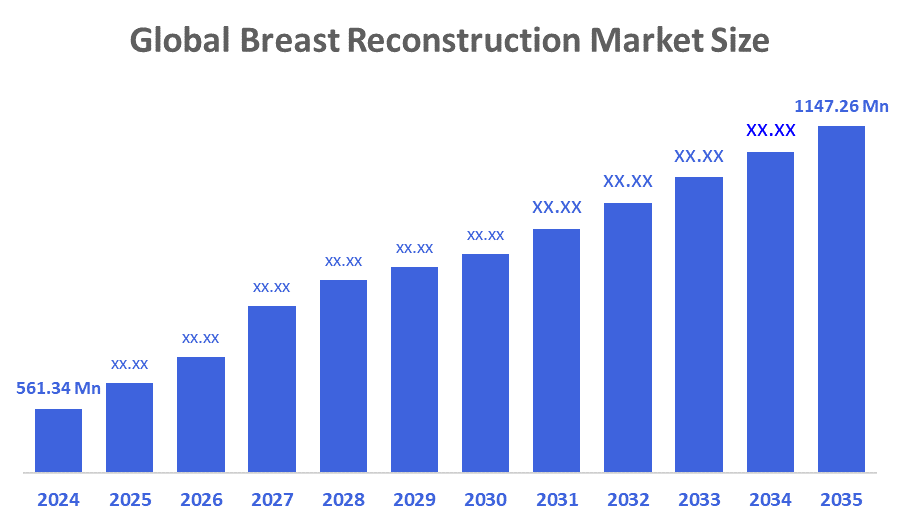
According to a research report published by Decisions Advisors and Consulting, The Global Breast Reconstruction Market Size Was Worth Around USD 561.34 Million In 2024 And Is Predicted To Grow To Around USD 1147.26 Million By 2035 With A Compound Annual Growth Rate (CAGR) Of 6.71 % From 2025 To 2035. The market for breast reconstruction is expanding positively due to several factors, including the rising incidence of breast cancer, the rise in cosmetic and reconstructive surgeries, the introduction of more sophisticated breast reconstruction products, and factors like ageing, race, and ethnicity that influence the demand for breast reconstruction.
Market Overview
The breast reconstruction market represents the worldwide sector that provides surgical and non-surgical methods to restore breast shape and appearance after mastectomy, traumatic injury, or congenital deformity. The market includes products that consist of implants, tissue expanders, and acellular dermal matrices, together with autologous tissue reconstruction, which represents advanced medical techniques. Breast reconstruction procedures frequently involve a flap of this skin and a portion of the rectus abdominus muscle underneath. An abdominal flap is a tissue that breast surgeons remove from the abdomen when doing breast reconstruction procedures on women who have excess abdominal tissue. It can also be commonly used as a free flap. Following breast surgery, a tattoo artist can restore the nipple through a method known as "nipple tattooing," which is an efficient breast reconstruction technique. The market develops to enhance patient outcomes and aesthetic results and overall life quality because breast cancer rates increase, and people learn about reconstructive options, and new technologies emerge. The rising need for less invasive treatments, together with favourable reimbursement systems, drives market growth, which establishes breast reconstruction as an important component of both medical aesthetics and reconstructive surgery markets.
The World Health Organisation (WHO) reports that 2.3 million women globally received a breast cancer diagnosis in 2020, leading to 6,85,000 fatalities. Additionally, 7.8 million women who had been diagnosed with breast cancer within the previous five years were still alive in 2020, making it one of the most common cancers worldwide. The Centres for Disease Control and Prevention (CDC) estimates that 255,000 women and 2300 men are diagnosed with breast cancer in the US each year. Sadly, less than 50% of women who need a good mastectomy worldwide receive the best breast reconstruction procedures each year.
The European Commission Initiative on Breast Cancer (ECIBC) is a comprehensive program designed to ensure high-quality, evidence-based breast cancer care across Europe. It provides clear, independent guidance for healthcare providers and women on screening, diagnosis, treatment, rehabilitation, and palliative care. ECIBC also includes a European quality assurance scheme, covering the entire cancer pathway to guarantee consistency and accessibility of care throughout member states.
Report Coverage
This research report categorizes the breast reconstruction market based on various segments and regions, forecasts revenue growth, and analyzes trends in each submarket. The report analyses the key growth drivers, opportunities, and challenges influencing the breast reconstruction market. Recent market developments and competitive strategies, such as expansion, product launch, development, partnership, merger, and acquisition, have been included to draw the competitive landscape in the market. The report strategically identifies and profiles the key market players and analyzes their core competencies in each sub-segment of the breast reconstruction market.
Driving Factors
The Global Breast Reconstruction Market Size is driven by several key factors that are shaping its growth trajectory. Rising breast cancer incidence worldwide has increased demand for reconstructive procedures post-mastectomy. Growing awareness of advanced surgical options, coupled with supportive government initiatives and reimbursement policies, is encouraging more patients to opt for reconstruction. Technological innovations, such as improved implants, tissue expanders, and regenerative techniques, are enhancing outcomes and patient satisfaction. Additionally, the rising focus on aesthetics, psychological well-being, and minimally invasive approaches is fueling adoption. Expanding healthcare infrastructure in emerging economies and increasing investments by medical device companies further strengthen market growth, making breast reconstruction a vital segment in global healthcare.
Yale School of Medicine recently received a philanthropic gift to advance breast cancer research and reconstruction surgery. The donation will support innovative studies, enhance surgical techniques, and improve patient care outcomes, reflecting growing investment in medical progress and quality of life for survivors.
Tiger Aesthetics Medical, a division of Tiger Biosciences, made a strategic investment in GenesisTissue Inc., a biotechnology startup pioneering patient-specific 3D bioprinted scaffolds for breast reconstruction and augmentation. This partnership aims to advance regenerative tissue solutions as alternatives to traditional implants, addressing growing demand in post-cancer care and cosmetic surgery. GenesisTissue, led by healthcare 3D printing expert Katie Weimer, focuses on applying bioprinting and material science innovations to create living, regenerative tissues.
Restraining Factors
The expansion of the global breast reconstruction market is constrained by a number of issues. Patient adoption is hampered by the intricacy of procedures, high procedure costs, and restricted reimbursement in some areas. Further obstacles to market expansion include the possibility of complications, the scarcity of qualified surgeons in developing nations, and the social stigma associated with reconstructive surgery.
Market Segmentation
The breast reconstruction market share is classified into product, shape, and end use.
- The implants segment accounted for the largest market share in 2024 and is anticipated to grow at a substantial CAGR over the forecast period.
Based on the product, the breast reconstruction market is segmented into implants, silicone breast implants, saline breast implants, tissue expander (saline expander, air tissue expander), and acellular dermal matrix. Among these, the implants segment accounted for the largest market share in 2024 and is anticipated to grow at a substantial CAGR over the forecast period. The growing demand for breast implants among women worldwide to improve their aesthetic appeal is one of the main factors behind the growth of the breast reconstruction industry. Breast reconstructive surgery is used to improve the size and shape of the breast in addition to treating congenital abnormalities and deformities of the chest wall.
For instance, Johnson & Johnson Medical Technology declared its Orano Star Diamond breast implants would be formally introduced in China. This product enhances the Orano product line and better meets Chinese women's need for natural beauty. In addition to utilising scientific power to assist countless women radiate confidence and beauty, it showcases Johnson & Johnson Medical Technology's extensive knowledge and experience in aesthetic and reconstructive medicine.
- The round segment accounted for the largest share in 2024 and is anticipated to grow at a significant CAGR during the forecast period.
Based on the shape, the breast reconstruction market is segmented into round and anatomical. Among these, the round segment accounted for the largest share in 2024 and is anticipated to grow at a significant CAGR during the forecast period. The round-shaped segment had the highest revenue share as a result of several clinical trials, frequent FDA updates on the safety of breast implants, and an increase in product releases. Robotic nipple-sparing mastectomy (RNSM) represents a major evidence-based advance in breast surgery.
Following FDA clearance, centres like Mayo Clinic have adopted this minimally invasive approach, which preserves the nipple-areolar complex and healthy breast skin, leading to more natural cosmetic outcomes and potential sensory restoration. UT Southwestern pioneered single-port robotic NSM in the U.S., reporting that about 80% of patients retained sensation post-surgery—an outcome rarely achieved with traditional mastectomy.
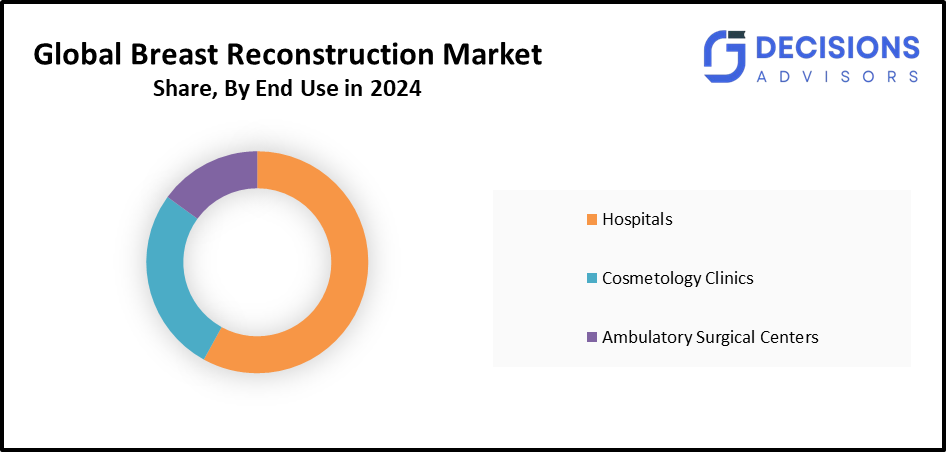
- The hospitals segment accounted for the highest market share in 2024 and is anticipated to grow at a substantial CAGR over the forecast period.
Based on the end use, the breast reconstruction market is divided into hospitals, cosmetology clinics, and ambulatory surgical centers. Among these, the hospitals segment accounted for the highest market share in 2024 and is anticipated to grow at a substantial CAGR over the forecast period. Additionally, medical tourism has increased globally. As a result, it is expected that hospitals would provide higher-quality medical care as medical tourism grows. The hospital category is expected to grow significantly over the forecast period due to the aforementioned considerations.
For instance, Sengkang General Hospital in Singapore introduced a minimally invasive approach to breast removal and reconstruction for cancer patients. Using advanced robotic-assisted techniques, surgeons can perform mastectomies and immediate reconstruction through smaller incisions, reducing scarring, shortening recovery times, and improving cosmetic outcomes. This innovation reflects a growing trend in Asia toward patient-centred, precision-driven cancer care, combining surgical expertise with cutting-edge technology to enhance both survival and quality of life.
Regional Segment Analysis of the Breast Reconstruction Market
- North America (U.S., Canada, Mexico)
- Europe (Germany, France, U.K., Italy, Spain, Rest of Europe)
- Asia-Pacific (China, Japan, India, Rest of APAC)
- South America (Brazil and the Rest of South America)
- The Middle East and Africa (UAE, South Africa, Rest of MEA)
Asia Pacific is anticipated to hold the largest share of the breast reconstruction market over the predicted timeframe.
Asia Pacific is anticipated to hold the largest share of the breast reconstruction market over the predicted timeframe. This is due to increasing rates of breast cancer, an increase in the number of women who know about reconstructive surgery, and an increase in the capabilities of surgeons to perform this type of surgery. More investment in healthcare, government support for health care reforms, and better access to hospitals and clinics are all contributing factors to the growth of breast reconstruction in countries such as China, Japan, India, and South Korea. Cultural norms surrounding breast reconstruction as an acceptable option for women continue to change, while additionally, more women are desiring minimally invasive procedures. Innovation and advancement in technology, such as new implant designs and regenerative ways to rebuild breasts, are also driving the growth of the breast reconstruction market; these innovations improve the outcomes (e.g., quality of life, cosmetic appearance) of patients who have undergone breast reconstruction surgery.
On World Cancer Day, Fortis Hospital, Mulund, Mumbai, unveiled Breastcare360, a comprehensive initiative dedicated to breast health. The program integrates awareness, screening, diagnosis, treatment, and rehabilitation under one umbrella, aiming to provide holistic care for women at every stage of their breast health journey. By combining advanced medical technology with patient education and support services, this initiative reflects Fortis Hospital’s commitment to tackling breast cancer through innovation, accessibility, and compassionate care, setting a benchmark for integrated breast health programs in India.
Gleneagles Hospital Chennai launched Sakhi – Comprehensive One-Stop Breast Care Clinic, a specialised centre dedicated to holistic breast health. The clinic offers screening, diagnosis, treatment, and counselling services under one roof, aiming to provide seamless care for women. Sakhi focuses on early detection of breast cancer, advanced reconstructive options, and emotional support, ensuring patients receive both medical expertise and compassionate guidance.
Europe is expected to grow at a rapid CAGR in the breast reconstruction market during the forecast period. The European breast reconstruction sector is greatly impacted by diverse factors that contribute to overall development. The increase in the number of patients diagnosed with breast cancer and undergoing mastectomy surgeries has helped create an increase in demand for breast reconstructive surgery. Many factors will help drive up reconstructive surgery, including government support for surgical procedures, greater availability of favourable reimbursement methods, and the growing trend toward the use of technologically advanced surgical methods, including regenerative tissue techniques, which produce better results and greater patient satisfaction.
Doctors in Ia?i achieved a regional breakthrough by performing the first robot-assisted breast reconstruction surgery in Romania and Eastern Europe, marking a major step in medical innovation that enhances surgical precision, shortens recovery, and improves outcomes for breast cancer patients.
Competitive Analysis:
The report offers the appropriate analysis of the key organizations/companies involved within the breast reconstruction market, along with a comparative evaluation primarily based on their product offering, business overviews, geographic presence, enterprise strategies, segment market share, and SWOT analysis. The report also provides an elaborative analysis focusing on the current news and developments of the companies, which includes product development, innovations, joint ventures, partnerships, mergers & acquisitions, strategic alliances, and others. This allows for the evaluation of the overall competition within the market.
List of Key Companies
- Allergan, Inc. (AbbVie)
- Establishment Labs
- GC Aesthetics
- Ideal Implant Incorporated
- Integra LifeSciences
- Mentor Medical Systems B.V. (Johnson & Johnson)
- POLYTECH Health & Aesthetics GmbH
- RTI Surgical
- Sebbin
- Sientra, Inc.
- Others
Key Target Audience
- Market Players
- Investors
- End-users
- Government Authorities
- Consulting and Research Firm
- Venture capitalists
- Value-Added Resellers (VARs)
Recent Development
- In October 2025, Apollo Athena’s BRAVE initiative is designed to empower women by raising awareness about breast reconstruction options after cancer treatment. The program focuses on education, counselling, and support, helping patients understand the medical, emotional, and aesthetic aspects of reconstruction. It also highlights advances in surgical techniques and personalised care, ensuring women are aware of choices that can improve both physical outcomes and quality of life.
Market Segment
This study forecasts revenue at global, regional, and country levels from 2020 to 2035. Decisions Advisors has segmented the breast reconstruction market based on the below-mentioned segments:
Global Breast Reconstruction Market, By Product
- Implants
- Silicone Breast Implants
- Saline Breast Implants
- Tissue Expander
- Saline Expander
- Air Tissue Expander
- Acellular Dermal Matrix
Global Breast Reconstruction Market, By Shape
- Round
- Anatomical
Global Breast Reconstruction Market, By End Use
- Hospitals
- Cosmetology Clinics
- Ambulatory Surgical Centers
Global Breast Reconstruction Market, By Regional Analysis
- North America
- US
- Canada
- Mexico
- Europe
- Germany
- UK
- France
- Italy
- Spain
- Russia
- Rest of Europe
- Asia Pacific
- China
- Japan
- India
- South Korea
- Australia
- Rest of Asia Pacific
- South America
- Brazil
- Argentina
- Rest of South America
- Middle East & Africa
- UAE
- Saudi Arabia
- Qatar
- South Africa
- Rest of the Middle East & Africa
Frequently Asked Questions (FAQ)
- How is robotic-assisted surgery transforming breast reconstruction outcomes?
Robotic-assisted surgery enhances precision, reduces incision size, minimises blood loss, and shortens recovery time. Techniques like robotic nipple-sparing mastectomy allow better cosmetic outcomes and improved preservation of sensation compared to traditional procedures.
- What role does 3D bioprinting play in the future of breast reconstruction?
3D bioprinting is emerging as a potential alternative to traditional implants by creating patient-specific scaffolds using regenerative materials. Companies like Tiger Aesthetics Medical and GenesisTissue Inc. are investing in regenerative tissue solutions, which may reduce implant-related complications in the future.
- How does reimbursement policy impact adoption rates globally?
In regions with favourable reimbursement systems (e.g., North America and parts of Europe), reconstruction rates are significantly higher. In developing regions, limited insurance coverage and out-of-pocket costs restrict procedure adoption.
- What are the most common complications associated with breast reconstruction procedures?
Complications may include capsular contracture, implant rupture, infection, seroma formation, flap necrosis (in autologous reconstruction), and the need for revision surgery. Risk levels vary depending on technique and patient health status.
- How is medical tourism influencing the breast reconstruction market?
Countries such as India, Thailand, and South Korea are seeing growth due to cost-effective treatment, advanced hospital infrastructure, and skilled surgeons, making them attractive destinations for reconstructive and aesthetic procedures.
- What psychological benefits are associated with post-mastectomy reconstruction?
Studies show reconstruction improves body image, emotional recovery, confidence, and overall quality of life. Awareness initiatives and holistic programs like Breastcare360 by Fortis Hospital Mulund focus on integrated physical and emotional support.
- How are implant materials evolving to improve safety and aesthetics?
Manufacturers are developing cohesive gel silicone implants, textured and smooth surface variations, and lightweight implants designed to reduce strain and improve natural appearance. Companies like Mentor Medical Systems B.V. and Establishment Labs continue product innovation in this space.
- What is the long-term outlook for autologous (flap-based) reconstruction compared to implant-based reconstruction?
Autologous reconstruction offers more natural results and avoids implant-related risks but involves longer surgery and recovery. Implant-based reconstruction remains dominant due to shorter operative time and wider accessibility.
- How do cultural perceptions influence reconstruction adoption in the Asia-Pacific?
Changing social attitudes, increasing awareness campaigns, and growing acceptance of reconstructive surgery are improving adoption rates in countries like India, China, and Japan.
Check Licence
Choose the plan that fits you best: Single User, Multi-User, or Enterprise solutions tailored for your needs.
We Have You Covered
- 24/7 Analyst Support
- Clients Across the Globe
- Tailored Insights
- Technology Tracking
- Competitive Intelligence
- Custom Research
- Syndicated Market Studies
- Market Overview
- Market Segmentation
- Growth Drivers
- Market Opportunities
- Regulatory Insights
- Innovation & Sustainability
Report Details
| Scope | Global |
| Pages | 250 |
| Delivery | PDF & Excel via Email |
| Language | English |
| Release | Mar 2026 |
| Access | Download from this page |