
Global Capacitive Sensor Market
 |
Author:
Achal E
|
Pages:
210
|
Author:
Achal E
|
Pages:
210
Global Capacitive Sensor Market Size, Share By Type (Surface Capacitance Sensors, Projected Capacitance Sensors, Mutual Capacitance Sensors, Self Capacitance Sensors, and Others), By Application (Consumer Electronics, Automotive, Industrial, Healthcare, Aerospace & Defense), By Technology (Touch Sensors, Proximity Sensors, Position Sensors, Level Sensors), and By Region (North America, Europe, Asia-Pacific, Latin America, Middle East & Africa), Analysis and Forecast 2026-2035.
REPORT COVERAGE
Global
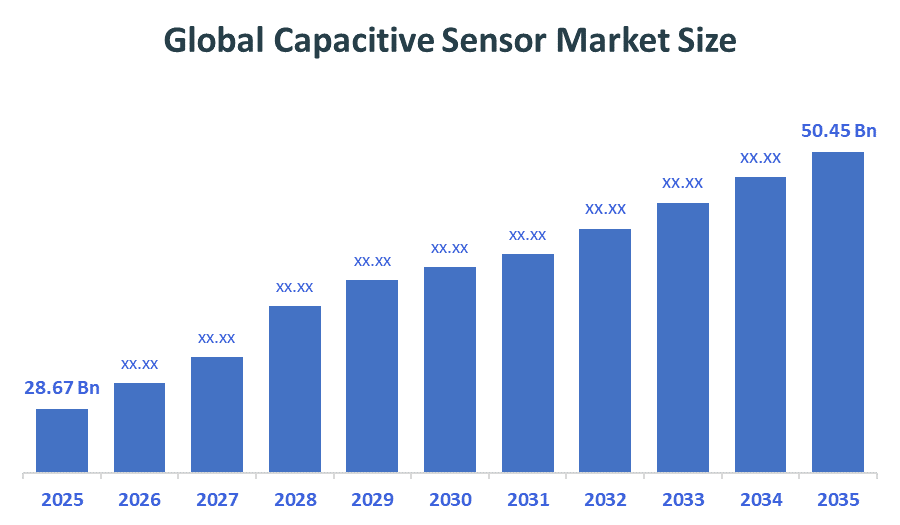
The Global Capacitive Sensor Market Size is predicted to grow from USD 28.67 Billion in 2025 and is likely to reach around USD 50.45 Billion by 2035 with a CAGR of 5.81%. According to Decision Advisors, a detailed research report on the market reflects that the touchless sensing adoption trend dominates the Global Capacitive Sensor Market, accounting for approximately 45% of the total share worldwide. Texas Instruments leads the market with annual revenue of approximately USD 17.5 billion and approx 16 - 20% global market share, making it the key contributor to global market development and growth dynamics.
Market Snapshot
- Global Capacitive Sensor Market Size (2025): USD 28.67Billion
- Projected Global Capacitive Sensor Market Size (2035): USD 50.45 Billion
- Global Capacitive Sensor Market Compound Annual Growth Rate (CAGR): 5.81%
- Largest Regional Market: Asia Pacific
- 2nd Largest Region: North America
- Fastest Growing Region: Europe
- Base Year: 2025
- Historical Period: 2021-2024
- Market Forecast Period: 2026-2035
Market Overview/ Introduction
The Global Capacitive Sensor Market refers to the industry that develops sensors that measure capacitance changes through touch, proximity and pressure, and environmental changes. The market is experiencing substantial growth because of increasing demand for touch-based interfaces and people adopting smart devices, and businesses implementing automation solutions. Government programs like the US CHIPS Act and EU Semiconductor Strategy and Asia-Pacific electronics manufacturing incentives are creating better conditions for semiconductor manufacturing and supply chain security. Key companies, including Texas Instruments, Analog Devices, STMicroelectronics, Infineon Technologies, and NXP Semiconductors are developing compact sensing solutions that use less power while achieving high precision. The market provides customers with products that combine high sensitivity features through compact designs which provide long-lasting durability and low power consumption. The global market will experience future expansion through the development of IoT technologies, smart automotive systems and industrial automation solutions, wearable electronics and advanced human-machine interface systems.
- The UK government supports Industry 4.0 initiatives and manufacturing digitalization through grants and incentives, promoting the adoption of advanced sensors in industrial automation and smart manufacturing systems.
- Smart city and IoT initiatives in Japan are driving the adoption of advanced proximity sensor ICs, supporting the development of connected, intelligent infrastructure and IoT-enabled devices across urban environments.
Notable Insights: -
- Asia Pacific is anticipated to hold approximately 38% share of the Global Capacitive Sensor Market over the predicted timeframe.
- North America is expected to grow at a rapid CAGR in the Global Capacitive Sensor Market by holding approximately 28% of the share during the forecast period.
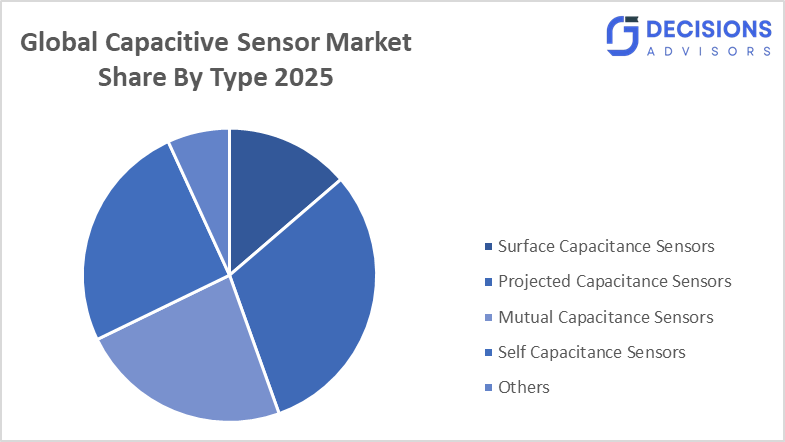
- By type, the Projected Capacitance Sensors, segment dominated the market and holds approximately 42% share in 2025 and is projected to grow at a substantial CAGR during the forecast period.
- By application, the consumer electronics segment dominated the market and holds approximately 44% share in 2025 and is projected to grow at a substantial CAGR during the forecast period.
- The compound annual growth rate of the Global Capacitive Sensor Market is 5.81%.
- The market is likely to achieve a valuation of USD 50.45 Billion by 2035.
What is the role of technology in grooming the market?
Technology plays a critical role in the Global Capacitive Sensor Market by enhancing accuracy, sensitivity, and integration capabilities across applications. Advanced signal processing techniques improve detection precision even in noisy environments. Multi-touch and projected capacitive technologies enable highly responsive user interfaces in smartphones, tablets, and interactive displays. AI-integrated sensing systems allow adaptive calibration and intelligent gesture recognition, improving user experience. Miniaturization of semiconductor components enables ultra-thin and flexible sensors suitable for wearables and foldable devices. Low-power design innovations significantly extend battery life in portable electronics. Integration with IoT platforms allows capacitive sensors to support smart environments, including connected homes, industrial monitoring systems, and automotive dashboards. Additionally, advancements in materials such as flexible polymers and conductive nanomaterials are expanding sensor durability and application scope.
Market Drivers
The Global Capacitive Sensor Market experiences growth because more people use touchscreen devices which include smartphones, tablets and laptops, and wearable electronics. The expansion of smart homes and Internet of Things (IoT) ecosystems drives increased adoption of touch and proximity sensing technologies in devices that use these technologies. The automation of industrial processes and Industry 4.0 initiatives drives the adoption of capacitive sensors in robotics systems, control systems and smart manufacturing facilities. The automotive sector shows increasing demand because of the rising use of infotainment systems and touch dashboards and proximity-based controls. The market expands because the healthcare sector uses patient monitoring devices together with diagnostic equipment. The global electronics industry moves towards compact energy-efficient products drives manufacturers to implement low-power high-precision capacitive sensing systems.
Restrain
The Global Capacitive Sensor Market faces challenges such as sensitivity to environmental interference including humidity, temperature variation, and electromagnetic noise. High design complexity in multi-layer sensor integration also increases development costs.
Competitive Analysis:
The report offers the appropriate analysis of the key organizations/companies involved within the Global Capacitive Sensor Market along with a comparative evaluation primarily based on their product offerings, business overviews, geographic presence, enterprise strategies, segment market share, and SWOT analysis. The report also provides an elaborative analysis focusing on the current news and developments of the companies, which includes product development, innovations, joint ventures, partnerships, mergers & acquisitions, strategic alliances, and others. This allows for the evaluation of the overall competition within the market.
Top Companies in the Global Capacitive Sensor Market
- Texas Instruments
- Analog Devices
- STMicroelectronics
- Infineon Technologies
- NXP Semiconductors
- Honeywell International
- Renesas Electronics
- Microchip Technology
- Broadcom Inc.
- ON Semiconductor
Government Initiatives
|
Country |
Key Government Initiatives |
|
US |
The U.S. government, through NSF funding, supports R&D in nanotechnology and smart sensor technologies, driving innovation in advanced sensing systems and enhancing development of next-generation capacitive sensor solutions. |
|
Japan |
Automotive safety regulations supporting Advanced Driver Assistance Systems (ADAS) are driving the adoption of advanced sensors, including capacitive sensing technologies, by improving vehicle safety, collision prevention, and driver assistance capabilities. |
|
China |
Policies focusing on smart manufacturing, IoT integration, and “Made in China 2025” are driving innovation and increasing the adoption of smart sensor technologies across industrial and electronics applications. |
Study on the Supply, Demand, Distribution, and Market Environment of the Global Capacitive Sensor Market
The Global Capacitive Sensor Market supply is supported by semiconductor fabrication plants and IC manufacturers producing high-precision sensing components. Demand is rising across consumer electronics, automotive systems, healthcare devices, and industrial automation due to increasing adoption of smart and connected technologies. Distribution takes place through OEM integration, semiconductor distributors, EMS providers, and direct B2B contracts, ensuring efficient large-scale deployment across industries. Strong demand is concentrated in regions with advanced electronics manufacturing and rapid digital transformation. Continuous advancements in low-power, miniaturized, and high-accuracy sensing technologies are improving supply chain efficiency, reducing costs, and expanding global accessibility, thereby strengthening overall market growth and stability.
Price Analysis and Consumer Behaviour Analysis
Price trends in the Global Capacitive Sensor Market are driven by sensor type, integration level, and required accuracy. Projected capacitance sensors dominate due to their balance of performance and cost efficiency in mass applications. Nearly 60% of manufacturers prefer integrated sensor ICs to reduce design complexity and overall system cost. About 55% of end-users prioritize low power consumption and fast response in touch-enabled devices, while around 68% of automotive infotainment systems use capacitive touch interfaces for improved usability and premium user experience, influencing pricing and adoption patterns across consumer electronics and automotive sectors globally.
Market Segmentation
The Global Capacitive Sensor Market share is classified into type, application and technology
- The Projected Capacitive Sensors segment dominated the market and holds approximately 42% share in 2025 and is projected to grow at a substantial CAGR during the forecast period.
Based on the type of sensor, the Global Capacitive Sensor Market is divided into Surface Capacitance Sensors, Projected Capacitance Sensors, Mutual Capacitance Sensors, Self Capacitance Sensors, and Others. Among these, the Projected Capacitive Sensors segment dominates the market and holds approximately 42% share in 2025. This dominance is due to its high accuracy, multi-touch capability, and strong compatibility with modern smart devices. These sensors are widely used in smartphones, tablets, automotive touch panels, and interactive displays, making them the most preferred choice across advanced human-machine interface applications globally.
- The Consumer Electronics segment accounted for the largest share of approximately 44% in 2025 and is anticipated to grow at a significant CAGR during the forecast period.
Based on the application, the market is divided into Consumer Electronics, Automotive, Industrial, Healthcare, and Aerospace & Defense. Among these, Consumer Electronics accounted for the largest share and holds approximately 44% share in 2025. This dominance is due to rising demand for smartphones, smart wearables, laptops, smart TVs, and connected devices. Increasing adoption of touch-based interfaces and smart technologies further supports segment growth, making consumer electronics the primary revenue contributor in the Global Capacitive Sensor Market.
- The Touch Sensors segment accounted for the largest share of approximately 46% in 2025 and is anticipated to grow at a significant CAGR during the forecast period.
Based on technology, the market is divided into Touch Sensors, Motion Sensors, Position Sensors, and Proximity Sensors. Among these, Touch Sensors dominate the market and hold approximately 46% share in 2025. This dominance is due to widespread adoption in consumer electronics, automotive infotainment systems, and industrial control panels. Their high responsiveness, durability, and low power consumption make them essential for modern interactive systems, driving strong global adoption across multiple end-use industries.
Strategies to Implement for Growth of the Market in Non-Leading Regions
To drive growth in non-leading regions, companies should focus on affordable and energy-efficient capacitive sensor solutions tailored for mid-range consumer electronics and industrial applications. Establishing local manufacturing and assembly units can help reduce production costs and improve supply chain reliability. Strong collaboration with regional OEMs, distributors, and electronics manufacturers will enhance market penetration. Continuous investment in R&D for low-power, high-precision sensing technologies will improve product competitiveness. Additionally, promoting IoT-enabled applications, smart automation systems, and touch-based interfaces will accelerate adoption across emerging economies, supporting long-term market expansion and revenue growth globally.
Regional Segment Analysis of the Global Capacitive Sensor Market
- North America (U.S., Canada, Mexico)?
- Europe (Germany, France, U.K., Italy, Spain, Rest of Europe)
- Asia-Pacific (China, Japan, India, Rest of APAC)
- South America (Brazil and the Rest of South America)?
- The Middle East and Africa (UAE, South Africa, Rest of MEA)
Asia Pacific is anticipated to hold approximately 38% share of the Global Capacitive Sensor Market over the predicted timeframe.
Asia Pacific holds approximately 38% share of the Global Capacitive Sensor Market due to strong electronics manufacturing ecosystems in China, Japan, South Korea, and India, along with large-scale production of smartphones, tablets, laptops, and automotive electronics. The region benefits from the presence of major semiconductor and electronics manufacturers, which support continuous innovation in sensor design and integration. High adoption of smart devices, IoT-enabled systems, and touch-based interfaces further strengthens market growth. Additionally, advanced digital infrastructure and rapid deployment of connected technologies contribute to sustained demand. The automotive sector also plays a key role, with increasing integration of capacitive sensing in infotainment systems, touch controls, and smart vehicle platforms across the region.
North America is expected to grow at a rapid CAGR in the Global Capacitive Sensor Market, holding approximately 28% of the share during the forecast period
North America is expected to grow at a rapid CAGR in the Global Capacitive Sensor Market, holding approximately 28% share during the forecast period due to strong demand from consumer electronics, automotive systems, and industrial automation. The region benefits from the presence of leading semiconductor and sensor technology companies, which drive continuous innovation in high-precision and low-power sensing solutions. High adoption of smart devices, IoT-enabled ecosystems, and advanced touch-based interfaces further supports market expansion. Additionally, the growing integration of capacitive sensors in electric vehicles, smart home systems, and healthcare devices contributes to sustained demand across the region, strengthening North America’s position in the global market.
Europe is the fastest-growing region in the Global Capacitive Sensor Market during the period, holding approximately 23% share.
Europe is the fastest-growing region in the Global Capacitive Sensor Market during the forecast period, holding approximately 23% share due to strong adoption of advanced automotive technologies, industrial automation, and smart manufacturing systems. The region benefits from increasing deployment of electric vehicles, which widely integrate capacitive sensing in infotainment systems, touch controls, and driver-assist interfaces. Additionally, strict energy efficiency regulations are encouraging the use of low-power and high-performance sensing technologies. Growing demand for smart home devices, healthcare monitoring systems, and connected industrial equipment further supports market expansion. Continuous investments in semiconductor innovation and digital infrastructure across countries such as Germany, France, and the UK are accelerating the adoption of capacitive sensor solutions across multiple end-use industries.
Future Market Trends in Global Atomic Layer Deposition Equipment Market:
- Expansion of Flexible and Wearable Sensors
Flexible capacitive sensors are increasingly used in wearable devices, medical patches, and foldable electronics due to their lightweight, bendable structure and high sensitivity. They enable continuous health monitoring, improved user comfort, and innovative product designs. Growing demand for smart healthcare and next-gen consumer electronics is accelerating adoption globally.
- AI-Enabled Touch and Gesture Recognition
AI integration enhances capacitive sensing by enabling intelligent gesture recognition, adaptive touch response, and context-aware interaction. It improves accuracy, reduces false inputs, and personalizes user experience across smartphones, automotive systems, and smart devices. This trend is driving more intuitive, responsive, and efficient human–machine interfaces worldwide.
- Growth in Automotive Touch Interfaces
Automotive manufacturers are increasingly integrating capacitive touch dashboards, steering controls, and infotainment systems to enhance user experience and reduce mechanical components. These interfaces offer better durability, sleek design, and improved functionality. Rising electric vehicle adoption and demand for smart cockpits are significantly boosting this trend globally.
- Rising Adoption in Smart Homes and IoT Devices
Capacitive sensors are widely used in smart home devices such as lighting systems, appliances, and security controls for seamless touch and proximity-based interaction. Their low power consumption and high responsiveness make them ideal for IoT ecosystems. Growing smart home adoption is accelerating market expansion globally.
Recent Development
- In January 2024, Synaptics Inc. launched specialized sensors for foldable and curved-edge smartphones, enhancing touch performance, flexibility, and display responsiveness in next-generation mobile devices.
- In November 2023, Balluff introduced a new capacitive level sensor integrated with IO-Link technology, enhancing industrial automation and smart manufacturing capabilities. In 2021, Somalytics launched paper-based carbon nanotube flexible sensors, enabling next-generation applications in wearable and advanced sensing technologies.
- In August 2025, Texas Instruments reportedly advanced medical-grade capacitive sensor technology for non-invasive glucose monitoring, highlighting growing applications of capacitive sensing in wearable healthcare and diagnostic devices.
How is Recent Developments Helping the Market?
Recent developments are significantly strengthening the Global Capacitive Sensor Market by improving performance, integration, and efficiency across applications. Advanced IC designs enhance sensitivity and enable multi-touch and gesture-based interfaces in smartphones, tablets, and smart devices. Reduced power consumption and miniaturization allow seamless integration into compact and wearable electronics. Automotive-grade capacitive sensors improve safety, durability, and user interaction in infotainment systems, touch dashboards, and control panels. AI-based calibration and adaptive sensing technologies increase accuracy by minimizing false triggers in dynamic and noisy environments. Furthermore, the expansion of IoT-enabled sensor ecosystems is driving widespread adoption in smart homes, industrial automation, and connected healthcare systems, supporting smarter, more responsive, and energy-efficient digital environments globally.
Market Segment
This study forecasts revenue at global, regional, and country levels from 2020 to 2035. Decision Advisors has segmented the Global Capacitive Sensor Market based on the below-mentioned segments:
Global Capacitive Sensor Market, By Type
- Surface Capacitance Sensors
- Projected Capacitance Sensors
- Mutual Capacitance Sensors
- Self Capacitance Sensors
- Others
Global Capacitive Sensor Market, By Application
- Consumer Electronics
- Automotive
- Industrial
- Healthcare
- Aerospace & Defense
Global Capacitive Sensor Market, By Technology
- Touch Sensors
- Proximity Sensors
- Position Sensors
- Level Sensors
Global Capacitive Sensor Market, By Regional Analysis
- North America
- US
- Canada
- Mexico
- Europe
- Germany
- UK
- France
- Italy
- Spain
- Russia
- Rest of Europe
- Asia Pacific
- China
- Japan
- India
- South Korea
- Australia
- Rest of Asia Pacific
- South America
- Brazil
- Argentina
- Rest of South America
- Middle East & Africa
- UAE
- Saudi Arabia
- Qatar
- South Africa
- Rest of the Middle East & Africa
Frequently Asked Questions (FAQ)
Q. How is capacitive sensing improving user interface design in modern devices?
A. Capacitive sensing enables smoother, more responsive, and highly accurate touch interactions, allowing manufacturers to design bezel-less screens, gesture-based controls, and fully digital interfaces with improved durability and aesthetic appeal.
Q. Why are capacitive sensors preferred over resistive sensing technologies?
A. They offer higher sensitivity, multi-touch capability, longer lifespan, and better optical clarity, making them more suitable for modern consumer electronics and interactive digital systems.
Q. What role do capacitive sensors play in predictive maintenance systems?
A. They help detect subtle changes in proximity, position, or material conditions, enabling early fault detection and reducing equipment downtime in industrial automation environments.
Q. How is semiconductor innovation influencing capacitive sensor development?
A. Advances in chip miniaturization and low-power IC design are enabling more compact, energy-efficient, and highly integrated sensing solutions across mobile, automotive, and wearable devices.
Check Licence
Choose the plan that fits you best: Single User, Multi-User, or Enterprise solutions tailored for your needs.
We Have You Covered
- 24/7 Analyst Support
- Clients Across the Globe
- Tailored Insights
- Technology Tracking
- Competitive Intelligence
- Custom Research
- Syndicated Market Studies
- Market Overview
- Market Segmentation
- Growth Drivers
- Market Opportunities
- Regulatory Insights
- Innovation & Sustainability
Report Details
| Scope | Global |
| Pages | 210 |
| Delivery | PDF & Excel via Email |
| Language | English |
| Release | Apr 2026 |
| Access | Download from this page |