
Global Carbohydrate Market Size, Forecast
 |
Author:
Sayali T
|
Pages:
210
|
Author:
Sayali T
|
Pages:
210
Global Carbohydrate Market Size, Share By Type (Simple Carbohydrates, Complex Carbohydrates, Dietary Fiber), By Application (Food & Beverages, Pharmaceuticals, Animal Feed, Personal Care), By End User (Household, Industrial, Commercial) and By Region (North America, Europe, Asia-Pacific, Latin America, Middle East & Africa), Analysis and Forecast 2025-2035
CAGR
5.25%
REVENUE 2025
USD Billion 24.65
FORECAST 2035
USD Billion 41.11
REPORT COVERAGE
Global
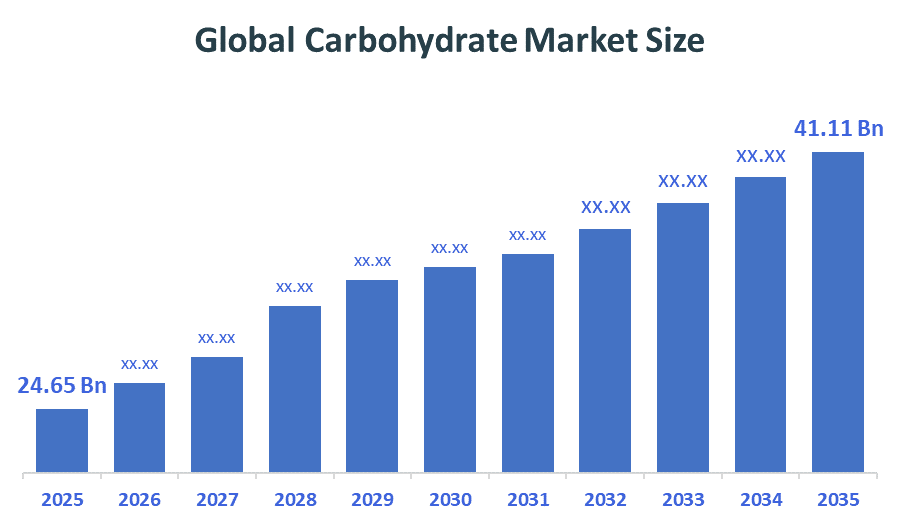
The Global Carbohydrate Market Size is foreseen to grow from USD 24.65 Billion in 2025 and is govern to reach around USD 41.11 Billion by 2035. According to Decision Advisors, a detailed research report on the global carbohydrate market is boosts by the rising demand for clean-label and natural ingredients, accounting for approximately up to the 30% to 40% share of the total share worldwide. Cargill is the prime player in the market with approximately 26.84 billion to $27.76 billion in annual turnover and a 20-40% global market share, positioning it as the primary driver of the global carbohydrate market.
Market Snapshot
- Global Carbohydrate Market Size (2025): USD 24.65 Billion
- Projected Global Carbohydrate Market Size (2035): USD 41.11 Billion
- Global Carbohydrate Market Compound Annual Growth Rate (CAGR): 5.25%
- Largest Regional Market: North America
- Fastest Growing Region: Asia Pacific
- 3rd Largest Region: Europe
- Base Year: 2025
- Historical Period: 2021–2024
- Forecast Period: 2026–2035
Market Overview/ Introduction
The Global Carbohydrate Market encompasses the production and distribution of various saccharides including simple sugars, complex starches, and functional fibers used across the food and beverage, pharmaceutical, and animal feed industries. This growth isn't just about volume, it’s driven by a massive shift in how we think about food. consumers are moving away from mystery ingredients and demanding clean labels basically, they want natural, plant-based starches and fibers they can actually recognise and trust.
Looking forward, the biggest opportunities aren't in carbs in the old-school sense, but in smart nutrition. market is seeing a huge rise in personalized diets and prebiotics designed to fix gut health. As consumers in fast-growing regions like Asia become more health-conscious, the real winners will be companies that create intelligent carbs ones that provide energy without the blood sugar spikes, making healthy eating feel a lot more effortless for everyone. To keep up, industry giants like Cargill, ADM, and Ingredion aren't just selling bulk flour anymore. They are pouring money into green innovation, turning crops into high-tech functional ingredients that do more than just provide calories. For example, ADM is focusing heavily on its Carbohydrate Solutions wing, pivoting toward sustainable, bio-based materials that perform better and treat the planet better.
Notable Insights: -
- North America is anticipated to hold the largest share, approximately 40% of the Global Carbohydrate Market over the predicted timeframe.
- Asia Pacific is expected to grow at the fastest CAGR in the Global Carbohydrate Market during the forecast period.
- By type, the cellulase segment dominated the market in 2025, and is projected to grow at a substantial CAGR of approximately 7.5% during the forecast period.
- By end user, the transportation sector segment dominated the market at a share of approximately 60% in 2025, and is projected to grow at a substantial CAGR during the forecast period.
- The compound annual growth rate of the Global Carbohydrate Market is 5.25%.
- The market is likely to achieve a valuation of USD 41.11 Billion by 2035.
What is the role of technology in grooming the market?
Technology plays a crucial role in shaping the global carbohydrate market by enhancing production efficiency, product quality, and functionality. Advanced processing techniques such as enzymatic modification and fermentation enable the development of specialized carbohydrates like low-calorie sweeteners and dietary fibers. Additionally, innovations in food technology and biotechnology support the creation of clean-label and health-focused products, helping manufacturers meet evolving consumer demand while reducing costs and improving scalability.
Market Drivers
The engine behind the carbohydrate market's growth isn't just a list of stats it's a massive shift in how we actually think about our food. We were moving away from the old idea of carbs as cheap fillers and starting to see them as high-performance tools for our bodies. A huge part of this is the "no-mystery" movement, where people are tired of ingredients they can’t pronounce. This has created a massive boom for simple, plant-based starches like tapioca, chicory root, and cassava, which feel much more real and trustworthy to the average shopper. Whether it’s a marathon runner looking for fuel that actually lasts or a parent just trying to find a cereal that won't leave their kids grumpy and hangry by recess, were all looking for the same thing: stability. The market is finally moving away from cheap, fast sugars and pivoting toward these smarter, steadier options that actually fit into our busy, modern lives.
Restrain
The global carbohydrate market faces restraints due to rising health concerns over high sugar consumption, increasing adoption of low-carb diets, and fluctuating raw material prices, which can impact production costs and overall market growth.
Competitive Analysis:
The report offers the appropriate analysis of the key organizations/companies involved within the global carbohydrate market, along with a comparative evaluation primarily based on their product of offering, business overviews, geographic presence, enterprise strategies, segment market share, and SWOT analysis. The report also provides an elaborative analysis focusing on the current news and developments of the companies, which includes product development, innovations, joint ventures, partnerships, mergers & acquisitions, strategic alliances, and others. This allows for the evaluation of the overall competition within the market.
Top Companies in the Global Carbohydrate Market
- Cargill, Incorporated
- Archer Daniels Midland Company
- Ingredion Incorporated
- Tate & Lyle PLC
- Roquette Freres
- Tereos Group
- Südzucker AG / BENEO
- AGRANA Beteiligungs-AG
- Avebe U.A
- Grain Processing Corporation
Government Initiatives
|
Country |
Key Government Initiatives |
|
India |
Pradhan Mantri Garib Kalyan Anna Yojana (PMGKAY): Extended for five years starting January 1, 2024, this scheme provides free food grains (5 kg per person/month for PHH and 35 kg per household/month for AAY families) to over 81 crore beneficiaries to ensure access to staple carbohydrates.
|
|
US |
The U.S. government secured approximately $1 billion in additional funding for the Special Supplemental Nutrition Program (WIC)
|
|
Europe |
Common Agricultural Policy (CAP) & EU Sugar Regime: The European Union provides financial support and subsidies to sugar beet farmers under CAP, along with market intervention mechanisms such as price support, import tariffs, and restructuring funds. These initiatives ensure stable carbohydrate (sugar) production, support farmer income, and regulate supply across member states. |
Study on the Supply, Demand, Distribution, and Market Environment of the Global Carbohydrate Market
The global carbohydrate market is supported by steady supply from abundant agricultural sources such as corn, wheat, and sugarcane, while demand is driven by the expanding food & beverage, pharmaceutical, and animal feed industries. Distribution occurs through well-established global supply chains involving processors, manufacturers, and retailers. The market environment is highly competitive and evolving, with increasing focus on health-oriented products, sustainability, and innovation in functional carbohydrates.
Price Analysis and Consumer Behaviour Analysis
Price trends in the global carbohydrate market are influenced by fluctuations in raw material costs such as corn, wheat, and sugarcane, along with processing and transportation expenses. Functional and specialty carbohydrates (like dietary fibers and low-calorie sweeteners) generally command higher prices due to added health benefits and advanced processing. From a consumer behavior perspective, there is a clear shift toward healthier, low-sugar, and natural carbohydrate options, with increasing preference for clean-label and functional products, even at a premium price.
Market Segmentation
The Global Carbohydrate Market share is classified into type, application and end user.
- The complex carbohydrates segment dominated the market in 2025, and is projected to grow at a substantial CAGR during the forecast period.
Based on the type, the global carbohydrate market is divided into simple carbohydrates, complex carbohydrates, and dietary fiber. Among these, the complex carbohydrates segment dominated the market in 2025, and is projected to grow at a substantial CAGR during the forecast period. It is attributed to their widespread use in staple foods such as grains, cereals, and starchy products, providing sustained energy release and higher nutritional value. Additionally, increasing consumer preference for healthier and low-glycemic index foods is driving the demand for complex carbohydrates across food and nutrition applications.
- The food & beverages segment accounted for the largest share in 2025, and is anticipated to grow at a significant CAGR during the forecast period.
Based on the application, the global carbohydrate market is divided into food & beverages, pharmaceuticals, animal feed, and personal care. Among these, the food & beverages segment accounted for the largest share in 2025, and is anticipated to grow at a significant CAGR during the forecast period. It is attributed to the extensive use of carbohydrates as sweeteners, thickeners, stabilizers, and energy sources in a wide range of food products. The growing demand for processed and convenience foods, along with rising consumption of functional and fortified products, is further boosting segment growth.
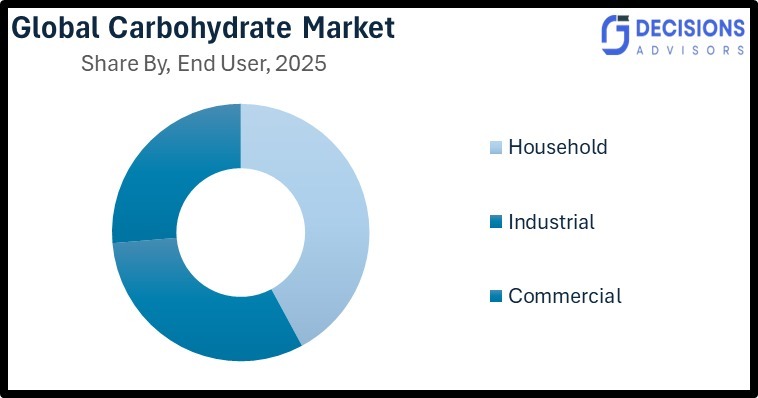
- The industrial segment dominated the market in 2025, and is projected to grow at a substantial CAGR during the forecast period.
Based on the end user, the Global Carbohydrate Market is divided into household, industrial, and commercial. Among these, the industrial segment dominated the market in 2025, and is projected to grow at a substantial CAGR during the forecast period. It is attributed to the large-scale utilization of carbohydrates in food processing, pharmaceutical manufacturing, and animal nutrition industries. Additionally, increasing demand for bulk ingredients and functional carbohydrate solutions is driving growth in the industrial segment.
Strategies to Implement for Growth of the Market in Non-Leading Regions
Growth in non-leading regions of the global carbohydrate market can be driven by expanding local processing facilities, leveraging low-cost agricultural raw materials, and strengthening supply chain networks. Companies should focus on partnerships with regional food and pharmaceutical manufacturers, while promoting awareness of functional and nutritional benefits of carbohydrates. Additionally, government support, infrastructure development, and increasing demand for processed foods can further accelerate market penetration.
Regional Segment Analysis of the Global Carbohydrate Market
- North America (U.S., Canada, Mexico)
- Europe (Germany, France, U.K., Italy, Spain, Rest of Europe)
- Asia-Pacific (China, Japan, India, Rest of APAC)
- South America (Brazil and the Rest of South America)
- The Middle East and Africa (UAE, South Africa, Rest of MEA)
North America is anticipated to hold the largest share, approximately 38% of the Global Carbohydrate Market over the predicted timeframe.
North America is anticipated to hold the largest share, approximately 38% of the Global Carbohydrate Market over the predicted timeframe. The region dominates due to its well-established food processing industry, particularly in the United States, where high consumption of processed and convenience foods drives significant demand for carbohydrates. The presence of advanced technologies, strong R&D capabilities, and major market players further strengthens regional leadership. Additionally, supportive regulatory frameworks and increasing demand for functional ingredients such as dietary fibers and low-calorie sweeteners are accelerating market growth.
Asia Pacific is expected to grow at the fastest CAGR in the Global Carbohydrate Market during the forecast period.
Asia Pacific is expected to grow at the fastest CAGR in the Global Carbohydrate Market during the forecast period. The growth is driven by rapid population growth, increasing disposable income, and expanding food & beverage and pharmaceutical industries in countries such as China, India, and Southeast Asian nations. The region benefits from abundant agricultural raw materials like rice, wheat, and corn, which support large-scale carbohydrate production. Additionally, rising demand for processed foods and government support for food processing industries are further driving market expansion.
Europe is the third largest region in the Global Carbohydrate Market during the forecast period.
Europe is the third largest region in the Global Carbohydrate Market during the forecast period. The region is characterized by strong regulatory standards and a growing focus on health and wellness. Increasing demand for clean-label, low-sugar, and functional carbohydrate products is driving market growth. The market is also supported by initiatives aimed at reducing sugar consumption and promoting healthier diets. Additionally, advancements in food technology and increasing adoption of natural and plant-based ingredients are encouraging the use of innovative carbohydrate solutions across the region.
Future Market Trends in the Global Carbohydrate Market: -
1. Rising Demand for Functional Carbohydrates
There is a growing shift toward functional carbohydrates such as dietary fibers and prebiotics that support gut health, digestion, and overall wellness, driven by increasing health-conscious consumers.
2. Expansion of Natural and Low-Calorie Sweeteners
Consumers are increasingly opting for natural and low-calorie alternatives to traditional sugar, leading to higher demand for products like stevia-based sweeteners and other sugar substitutes.
3. Growth of Clean-Label and Plant-Based Ingredients
The demand for minimally processed, natural, and plant-based carbohydrate sources is rising, encouraging manufacturers to develop clean-label products with transparent sourcing and fewer additives.
Recent Development
- In January 2026, UK-based bakery brand HeyLO launched the country’s first lupin flour-based low-carb, high-protein crackerbreads as part of the January reset trend. The product was introduced to cater to growing demand for healthier snacking options, particularly among consumers following low-carb and keto diets. Made using lupin flour, the crackerbreads offered high protein and low carbohydrate content, while delivering improved taste and texture compared to traditional low-carb snacks. The launch also aimed to strengthen the brand’s presence in the functional and better-for-you bakery segment.
- In October 2025, Mission Foods expanded its health-focused product portfolio with the launch of Zero Net Carbs Spinach Tortillas. The product was introduced as part of the company’s “better-for-you” range, targeting health-conscious consumers seeking low-carb, high-fiber food options without compromising on taste. Made with real spinach and containing no added sugar or artificial flavors, the tortillas were designed to support dietary trends such as keto and GLP-1 lifestyles and were made available across major grocery retailers in the United States.
- In January 2024, Carbs Fuel launched a more affordable high-carbohydrate energy gel aimed at endurance athletes seeking cost-effective nutrition solutions. The product delivered 50 grams of carbohydrates per serving at around $2, making it significantly cheaper than comparable gels on the market. It was formulated without preservatives, gelling agents, or additives to improve digestibility and reduce stomach issues, while supporting the growing trend of higher carbohydrate intake in endurance sports.
- In September 2022, Mission Foods launched Keto-certified Zero Net Carbs Tortillas to cater to growing demand for low-carb and health-focused food options. The product was introduced with zero net carbs and zero sugar, while being high in fiber and low in calories, targeting consumers following keto and low-carbohydrate diets. Available in Original and Sundried Tomato Basil flavors, the tortillas were rolled out across retail stores in the United States, reinforcing the company’s expansion in the better-for-you product segment.
How are recent developments helping the Market?
Recent developments are significantly supporting the growth of the global carbohydrate market by driving innovation, improving functionality, and expanding application areas. Advances in technologies such as enzymatic processing, fermentation, and bioengineering are enabling the production of specialized carbohydrates like prebiotics, resistant starches, and low-glycemic sweeteners, which cater to rising health-conscious demand. Additionally, companies are investing in new product launches, capacity expansions, and strategic partnerships to enhance their portfolios and global reach. The integration of carbohydrates into functional foods, personalized nutrition, and plant-based products, along with improved labeling regulations and R&D in gut health, is further accelerating market adoption and growth.
Market Segment
This study forecasts revenue at global, regional, and country levels from 2020 to 2035. Decision Advisors has segmented the global carbohydrate market based on the below-mentioned segments:
Global Carbohydrate Market, By Type
- Simple Carbohydrates
- Complex Carbohydrates
- Dietary Fiber
Global Carbohydrate Market, By Application
- Food & Beverages
- Pharmaceuticals
- Animal Feed
- Personal Care
Global Carbohydrate Market, By End User
- Household
- Industrial
- Commercial
Global Carbohydrate Market, By Regional Analysis
- North America
- US
- Canada
- Mexico
- Europe
- Germany
- UK
- France
- Italy
- Spain
- Russia
- Rest of Europe
- Asia Pacific
- China
- Japan
- India
- South Korea
- Australia
- Rest of Asia Pacific
- South America
- Brazil
- Argentina
- Rest of South America
- Middle East & Africa
- UAE
- Saudi Arabia
- Qatar
- South Africa
- Rest of the Middle East & Africa
Frequently Asked Questions (FAQ)
Q. How do seasonal crop variations impact the carbohydrate market?
A.Seasonal changes in crop yield can affect the availability and pricing of key raw materials like corn, wheat, and sugarcane, influencing overall market stability.
Q. What role do carbohydrates play in sports and performance nutrition?
A.Carbohydrates are essential for energy replenishment and endurance, making them a key ingredient in sports drinks, energy bars, and supplements.
Q. How is sustainability influencing carbohydrate production?
A.Manufacturers are adopting sustainable farming practices and eco-friendly processing methods to reduce environmental impact and meet regulatory requirements.
Q. What innovations are emerging in carbohydrate-based packaging materials?
A.Biodegradable packaging derived from starch and other carbohydrates is gaining traction as an alternative to plastic materials.
Q. How do carbohydrates contribute to texture and stability in food products?
A.Carbohydrates such as starches and gums are widely used to improve texture, viscosity, and shelf stability in processed foods.
Check Licence
Choose the plan that fits you best: Single User, Multi-User, or Enterprise solutions tailored for your needs.
We Have You Covered
- 24/7 Analyst Support
- Clients Across the Globe
- Tailored Insights
- Technology Tracking
- Competitive Intelligence
- Custom Research
- Syndicated Market Studies
- Market Overview
- Market Segmentation
- Growth Drivers
- Market Opportunities
- Regulatory Insights
- Innovation & Sustainability
Report Details
| Scope | Global |
| Pages | 210 |
| Delivery | PDF & Excel via Email |
| Language | English |
| Release | Apr 2026 |
| Access | Download from this page |