
Global Card-Based Access Control Market
 |
Author:
Kunal M
|
Pages:
210
|
Author:
Kunal M
|
Pages:
210
Global Card-Based Access Control Market Size, Share By Card Type (Magnetic Stripe Cards, Proximity Cards, Smart Cards, Biometric Cards, and Others), By Application (Commercial, Residential, Government, Healthcare, and Education), By Technology (Contactless Technology, RFID Technology, Wired Technology, and Mobile-Integrated Technology), and By Region (North America, Europe, Asia-Pacific, Latin America, Middle East & Africa), Analysis and Forecast 2026-2035
CAGR
7.4%
REVENUE 2025
USD Billion 6.85
FORECAST 2035
USD Billion 13.99
REPORT COVERAGE
Global
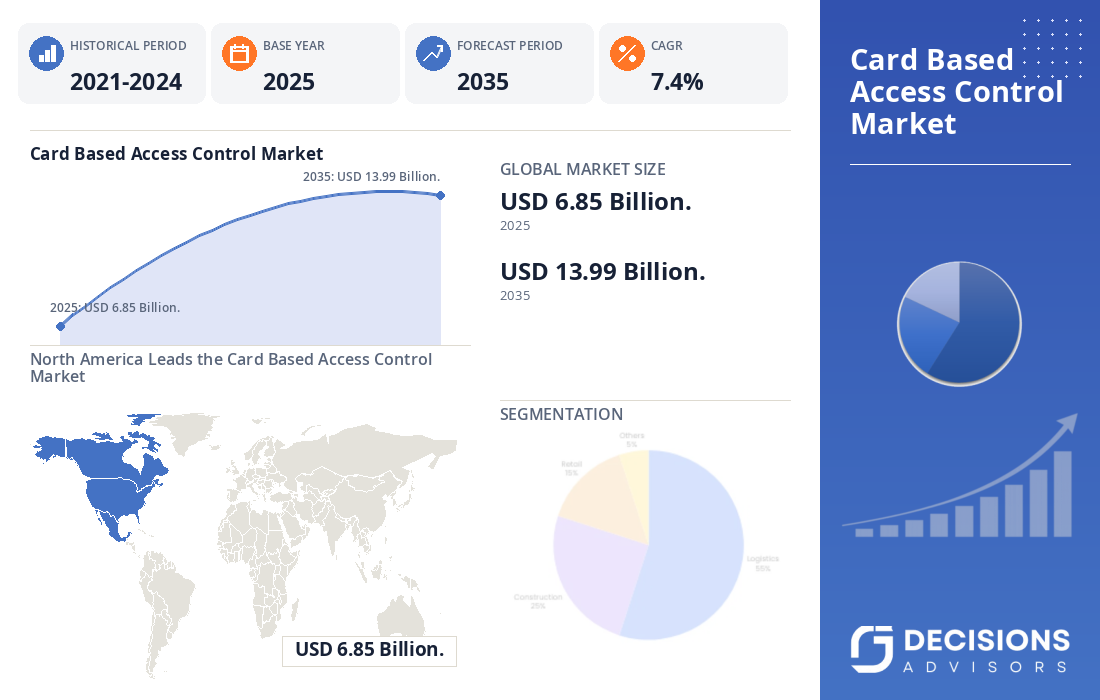
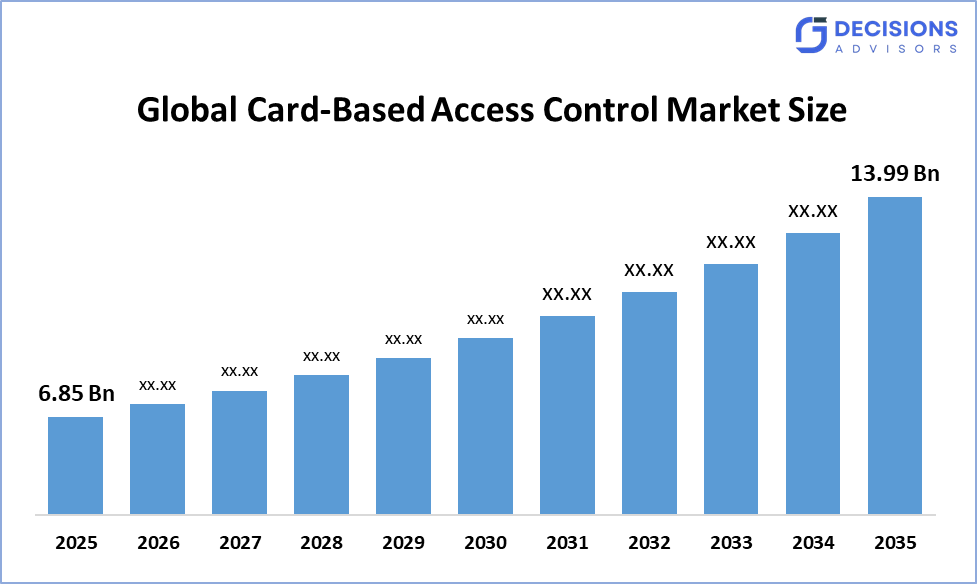
The global card-based access control market size is predicted to grow from USD 6.85 Billion in 2025 and is likely to reach around USD 13.99 Billion by 2035, with a CAGR of 7.4%. According to Decision Advisors, increasing security requirements, smart-building development, contactless authentication, and modernization of enterprise security infrastructure are driving the Global Card-Based Access Control Market. Smart cards and proximity credentials remain important because they provide convenient authentication while supporting encryption, credential management, and integration with electronic locks and security platforms.
Market Snapshot
- Global Card-Based Access Control Market Size (2025): USD 6.85 Billion.
- Projected Global Card-Based Access Control Market Size (2035): USD 13.99 Billion.
- Global Card-Based Access Control Market CAGR: 7.4%.
- Largest Regional Market: North America
- 2nd Largest Region: Asia-Pacific
- Fastest Growing Region: Asia-Pacific
- Base Year: 2025
- Historical Period: 2021-2024
- Market Forecast Period: 2026-2035
Market Overview/ Introduction
The global card-based access control market comprises electronic security solutions that authenticate individuals through physical credentials such as proximity cards, smart cards, magnetic-stripe cards, RFID cards, and multi-technology credentials. These systems are deployed across corporate offices, government facilities, educational institutions, healthcare organizations, hotels, residential properties, manufacturing facilities, and critical infrastructure. Card-based access control allows organizations to assign access privileges, restrict sensitive areas, maintain entry records, and rapidly deactivate credentials when users leave an organization. The market is expanding as organizations modernize physical-security infrastructure and move toward connected access-control environments. Smart cards with encrypted communication, RFID technologies, cloud-based management, mobile credential integration, and interoperability with video surveillance are reshaping traditional card-based systems.
- United States, Enterprise security modernization and integrated building-security platforms are increasing demand for electronic access control. Johnson Controls introduced enhancements to C•CURE IQ and iSTAR controllers, including support for up to 1 million cardholders and OSDP-secured communications.
- Japan, Smart-building development, connected infrastructure, and increasing adoption of contactless technologies support demand for RFID and electronic access credentials.
- China, Smart-city development, industrial digitalization, commercial construction, and intelligent-building investments support deployment of electronic access-control systems.
Notable Insights: -
- North America is anticipated to hold approximately 35% share of the global card-based access control market over the predicted timeframe.
- Asia-Pacific is expected to grow at a rapid CAGR and account for approximately 31% share during the forecast period.
- By Card Type, the Smart Cards segment dominated the market and holds approximately 39% share in 2025 and is projected to grow at a substantial CAGR during the forecast period.
- By Application, the Commercial segment dominated the market and holds approximately 34% share in 2025 and is projected to grow at a substantial CAGR during the forecast period.
- By Technology, the Contactless Technology segment dominated the market and holds approximately 44% share in 2025.
- The compound annual growth rate of the global card-based access control market is 7.4%.
- The market is likely to achieve a valuation of USD 13.99 Billion by 2035.
Market Drivers
The global card-based access control market is driven by increasing security requirements across commercial buildings, government facilities, healthcare institutions, educational campuses, manufacturing sites, and residential developments. Organizations increasingly require centralized systems capable of controlling employee, visitor, contractor, and tenant access while maintaining detailed audit records. Smart-building development is another major driver because modern properties require access control to communicate with video surveillance, visitor-management systems, alarms, elevators, building-management platforms, and security operations centers. Technology modernization is also accelerating demand for smart and contactless credentials. Secure RFID and smart-card technologies provide faster authentication and stronger protection than traditional magnetic-stripe credentials. HID's FIDO-enabled Seos and MIFARE DESFire EV3 cards further demonstrate the movement toward converged physical and digital credentials.
Restrain
The global card-based access control market faces several restraints, including the increasing availability of biometric and mobile-based authentication systems that can reduce dependence on physical cards. Initial installation costs for readers, electronic locks, controllers, software, networking infrastructure, and credential issuance can also be significant for large facilities. Legacy systems create another challenge because organizations may need to replace or upgrade older readers and cards before adopting encrypted smart-card technologies. Cybersecurity and credential-management concerns can further increase operational complexity.
Competitive Analysis:
The report offers the appropriate analysis of the key organizations/companies involved within the global card-based access control market, along with a comparative evaluation primarily based on their product offerings, business overviews, geographic presence, enterprise strategies, segment market share, and SWOT analysis. The report also provides an elaborative analysis focusing on the current news and developments of the companies, which includes product development, innovations, joint ventures, partnerships, mergers & acquisitions, strategic alliances, and others. This allows for the evaluation of the overall competition within the market.
Top Companies in the Global Card-Based Access Control Market
- HID Global
- ASSA ABLOY AB
- Allegion plc
- Johnson Controls International plc
- Honeywell International Inc.
- dormakaba Holding AG
- Identiv, Inc.
- Suprema Inc.
- Nedap N.V.
- Gallagher Group Limited.
Government Initiatives
|
Country |
Key Government Initiatives |
|
United States |
Federal facility-security modernization, cybersecurity requirements, smart-building investment, and protection of critical infrastructure support demand for stronger electronic access-control technologies |
|
Japan |
Smart-city and smart-building initiatives encourage connected infrastructure, contactless identification, IoT deployment, and advanced security systems |
|
China |
Smart-city, intelligent-manufacturing, and digital-infrastructure programs support deployment of connected security and electronic identification technologies |
Market Segmentation
The global card-based access control market share is classified into card type, application, and technology.
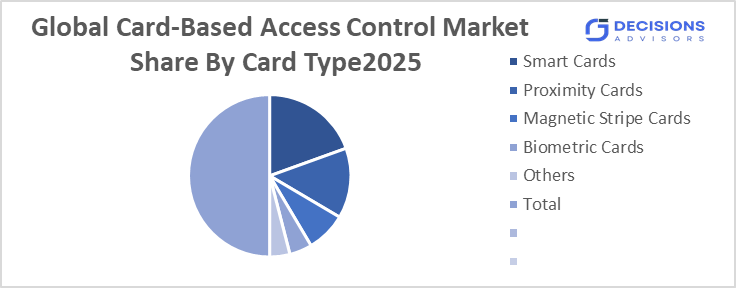
- The Smart Cards segment dominated the market and holds approximately 39% share in 2025 and is projected to grow at a substantial CAGR during the forecast period.
Based on card type, the global card-based access control market is divided into magnetic stripe cards, proximity cards, smart cards, biometric cards, and others. Among these, smart cards dominate because they provide stronger authentication, encryption, and data-storage capabilities. Their compatibility with RFID, NFC, and modern electronic access-control readers supports widespread deployment across corporate, government, healthcare, and educational facilities. Smart cards also provide a practical migration path from legacy proximity credentials toward more secure access-control architectures.
- The Commercial segment accounted for the largest share of approximately 34% in 2025 and is anticipated to grow at a significant CAGR during the forecast period.
Based on application, the market is divided into commercial, residential, government, healthcare, and education. Commercial facilities represent the largest application because offices, retail buildings, hotels, financial institutions, and corporate campuses require controlled employee and visitor access. Organizations increasingly integrate access control with employee identity management, video surveillance, visitor systems, and building-management platforms. Growth in smart offices and connected commercial properties is expected to maintain commercial demand.
- The Contactless Technology segment accounted for the largest share of approximately 44% in 2025 and is anticipated to grow at a significant CAGR during the forecast period.
Based on technology, the market is divided into Contactless Technology, RFID Technology, Wired Technology, and Mobile-Integrated Technology. Contactless technology dominates because it enables rapid authentication without inserting a card into a reader. RFID-based smart cards can support secure authentication, encrypted data transfer, and integration with electronic locks. The growing transition toward mobile credentials is also encouraging vendors to develop systems capable of supporting cards and mobile devices within the same access-control environment.
Regional Segment Analysis of the Global Card-Based Access Control Market
- North America (U.S., Canada, Mexico)?
- Europe (Germany, U.K., France, Italy, Spain, Netherlands, Rest of Europe).
- Asia-Pacific (China, Japan, India, Australia, South Korea, Rest of Asia-Pacific).
- South America (Brazil, Argentina, Rest of South America).
- Middle East & Africa (UAE, Saudi Arabia, South Africa, Rest of MEA).
North America is anticipated to hold approximately 35% share of the Global Card-Based Access Control Market over the predicted timeframe.
North America is anticipated to hold approximately 35% share of the global card-based access control market over the predicted timeframe. The region benefits from mature physical-security infrastructure, high enterprise security spending, and the presence of leading access-control providers. The United States represents the largest contributor because of strong adoption across corporate offices, healthcare facilities, universities, government buildings, airports, and data centers. Technology adoption is moving toward integrated access control, video surveillance, cloud administration, and mobile credentials.
Asia-Pacific is expected to grow at a rapid CAGR in the Global Card-Based Access Control Market, holding approximately 31% share during the forecast period.
Asia-Pacific is expected to grow at a rapid CAGR in the global card-based access control market, holding approximately 31% share during the forecast period. china, japan, india, south korea, and Australia are major contributors due to rapid urbanization, commercial construction, manufacturing expansion, and smart-building investments. Increasing adoption of RFID, contactless authentication, and connected security infrastructure is creating significant opportunities. Large-scale development of offices, residential complexes, educational campuses, transportation infrastructure, and industrial facilities is supporting demand for electronic access systems.
Europe is expected to hold approximately 23% share of the Global Card-Based Access Control Market during the forecast period.
Europe is expected to hold approximately 23% share of the global card-based access control market during the forecast period. Germany, the U.K., France, Italy, and Spain are major contributors because of established commercial infrastructure and increasing investments in secure and connected buildings. Demand is shifting toward encrypted credentials, interoperable systems, cloud management, and mobile access. Security and privacy requirements are also encouraging organizations to adopt stronger credential technologies. HID's M1 Transparent Gateway, announced in February 2026, addresses high-security compliance requirements by allowing cryptographic operations to be performed in a secured location without replacing existing access-control infrastructure.
Future Market Trends in Global Card-Based Access Control Market: -
-
- Convergence of Physical and Digital Credentials
Physical access cards are evolving beyond conventional door-entry credentials. HID's FIDO-enabled Seos and MIFARE DESFire EV3 cards allow a single card to support physical access and passwordless authentication for digital applications, creating a converged identity model.
-
- Growth of Mobile-Integrated Access
Mobile credentials are increasingly being deployed alongside physical cards. Smartphones and wearables can complement existing card infrastructure, allowing organizations to introduce digital credentials without immediately replacing existing readers. This hybrid model is particularly relevant for universities, multifamily properties, and corporate environments.
-
- Cloud-Based Access Management
Cloud-based platforms are expected to gain importance as organizations seek remote credential management, centralized reporting, automatic software updates, and easier multi-site administration. Cloud architecture also enables access-control systems to integrate with identity-management and building-management applications.
-
- Integration With Video Surveillance and Building Systems
Access control is increasingly becoming part of unified security platforms. Johnson Controls' C•CURE IQ integrates access control and video surveillance through a single interface, illustrating the industry's movement toward centralized security operations and actionable intelligence.
Recent Development
- In February 2026, HID Global launched the M1 Transparent Gateway, designed to add cryptographic security between existing OSDP controllers and readers without requiring organizations to replace their existing access-control infrastructure.
- In September 2025, HID Global announced the availability of FIDO-enabled Seos and MIFARE DESFire EV3 cards, combining physical access credentials with FIDO-based passwordless authentication for business applications and facilities.
- In March 2025, Allegion formed a strategic alliance with Atrium Campus to advance cloud-native campus card, credentialing, access-control, and mobile credential solutions for higher-education institutions.
Market Segment
This study forecasts revenue at global, regional, and country levels from 2021 to 2035. Decision Advisors has segmented the global card-based access control market based on the below-mentioned segment:
Global Card-Based Access Control Market, By Card Type.
- Magnetic Stripe Cards
- Proximity Cards
- Smart Cards
- Biometric Cards
- Others.
Global Card-Based Access Control Market, By Application.
- Commercial
- Residential
- Government
- Healthcare
- Education.
Global Card-Based Access Control Market, By Technology.
- Contactless Technology
- RFID Technology
- Wired Technology
- Mobile-Integrated Technology.
Global Card-Based Access Control Market, By Regional Analysis.
- North America
- US
- Canada
- Mexico
- Europe
- Germany
- UK
- France
- Italy
- Spain
- Russia
- Rest of Europe
- Asia Pacific
- China
- Japan
- India
- South Korea
- Australia
- Rest of Asia Pacific
- South America
- Brazil
- Argentina
- Rest of South America
- Middle East & Africa
- UAE
- Saudi Arabia
- Qatar
- South Africa
- Rest of the Middle East & Africa
Frequently Asked Questions (FAQ)
Q. What is driving the Global Card-Based Access Control Market?
A. Rising security requirements, smart-building development, commercial infrastructure modernization, and increasing demand for contactless authentication are major growth drivers. Integration with cloud platforms, video surveillance, mobile credentials, and digital identity systems is further expanding the market.
Q. Why are smart cards preferred over traditional magnetic-stripe cards?
A. Smart cards provide stronger encryption, authentication, and data-storage capabilities than traditional magnetic-stripe cards. Their compatibility with RFID, NFC, and modern secure-reader technologies makes them suitable for organizations requiring stronger credential protection.
Q. How are mobile credentials affecting card-based access control?
A. Mobile credentials are increasingly complementing physical cards rather than immediately eliminating them. Organizations can operate cards, smartphones, and wearables through increasingly integrated access-control ecosystems, allowing gradual migration toward digital credentials.
Q. Which region represents the largest market for card-based access control?
A. North America is estimated to remain the largest regional market because of mature electronic-security infrastructure, established access-control vendors, and high enterprise adoption. Asia-Pacific is expected to record faster expansion due to urbanization, smart-building investments, and expanding commercial and industrial infrastructure.
Check Licence
Choose the plan that fits you best: Single User, Multi-User, or Enterprise solutions tailored for your needs.
We Have You Covered
- 24/7 Analyst Support
- Clients Across the Globe
- Tailored Insights
- Technology Tracking
- Competitive Intelligence
- Custom Research
- Syndicated Market Studies
- Market Overview
- Market Segmentation
- Growth Drivers
- Market Opportunities
- Regulatory Insights
- Innovation & Sustainability
Report Details
| Scope | Global |
| Pages | 210 |
| Delivery | PDF & Excel via Email |
| Language | English |
| Release | Aug 2026 |
| Access | Download from this page |