
Cardiac AI Monitoring and Diagnostics Market
 |
Pages:
180
|
Pages:
180
Cardiac AI Monitoring and Diagnostics Market Size, Share, By Solution Type (AI Cardiac Monitoring Software, AI Cardiac Diagnostic Software, AI-Enabled Cardiac Imaging Analysis Platforms, AI-Powered Remote Cardiac Monitoring Platforms, AI Clinical Decision Support Systems For Cardiology), By Technology (Machine Learning Algorithms, Deep Learning Algorithms, Natural Language Processing, Predictive Analytics Engines, Computer Vision Algorithms), By Application (Arrhythmia Detection, Heart Failure Monitoring, Coronary Artery Disease Diagnosis, Stroke Risk Prediction, Cardiac Imaging Interpretation, Other Cardiovascular Disease Monitoring), and By Region (North America, Europe, Asia-Pacific, Latin America, Middle East, and Africa), Analysis and Forecast 2025-2035.
REPORT COVERAGE
Global
Market Snapshot
- Market Size (2025): USD 4.38 Billion
- Projected Market Size (2035): USD 18.9 Billion
- Compound Annual Growth Rate (CAGR): 15.74%
- Largest Regional Market: North America
- Fastest Growing Region: Asia-Pacific
- 3rd Largest Region: Europe
- Base Year: 2025
- Historical Period: 2021–2024
- Forecast Period: 2025–2035
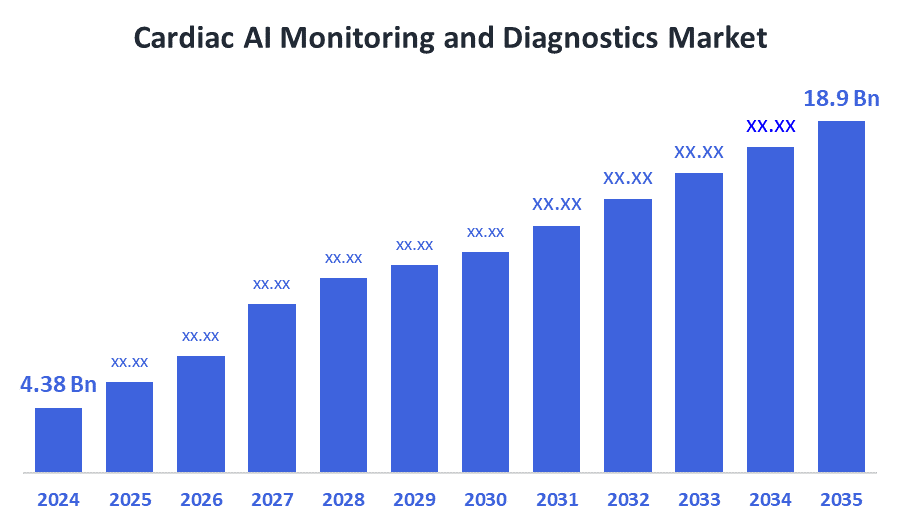
According to Decision Advisors, the Cardiac AI Monitoring and Diagnostics Market Size is expected to grow from USD 4.38 billion in 2025 to USD 18.9 billion by 2035, at a CAGR of 15.74% during the forecast period 2025-2035. Factors propelling the market include the growing incidence of cardiovascular diseases (CVDs), the necessity for early detection, and the convergence of AI with wearables and imaging technologies. The market is seeing a transition from reactive to proactive care, with software solutions at the forefront due to their capacity to deliver immediate and accurate diagnostic insights.
Market Overview/ Introduction
The cardiac AI monitoring and diagnostics market refers to the global industry focused on the development, integration, and commercialization of artificial intelligence (AI) powered technologies, which are used to monitor, detect, analyze, and diagnose heart-related conditions. This market needs to leverage advanced technologies such as machine learning, deep learning, and data analytics to interpret cardiac data from sources like the ECG, wearable devices, imaging systems, and the electronic health record. This is the market for intelligent technologies that leverage AI to monitor heart health, identify issues at an early stage, and assist physicians in making improved choices thereby enhancing patient outcomes and lowering healthcare expenses. AI-driven tools that can identify the subtle, early indicators of the disease, such as detecting left ventricular dysfunction from an ECG a year before clinical symptoms, offer a significant preventive care opportunity.
- In February 2026, the Government of India launched the Strategy for Artificial Intelligence in Healthcare for India (SAHI), a national roadmap designed to guide the safe, ethical, and evidence-based development, validation, and deployment of AI tools across healthcare systems.
- In the United States, the U.S. Food and Drug Administration has accelerated the clearance of AI-based cardiology algorithms through regulatory pathways such as 510(k) and Breakthrough Device designation, supporting the adoption of AI tools in cardiac imaging, ECG analysis, and acute care diagnostics.
Notable Insights: -
- North America holds the largest regional market share, approximately 50.84%, in the cardiac AI monitoring and diagnostics
- Asia Pacific is the fastest-growing region in cardiac AI monitoring and diagnostics with a CAGR of approximately 30.20%.
- By solution type, the AI-powered remote cardiac monitoring platforms segment held a dominant position with approximately 55% in terms of market share in 2025.
- By technology, the predictive analytics engines segment is the dominating accounting for over 54.26% of the global market share in 2025.
- The compound annual growth rate of the cardiac AI monitoring and diagnostics is 15.74%.
- The market is likely to achieve a valuation of USD 18.9 billion by 2035.
What is the role of technology in grooming the market?
Technology plays a crucial role in shaping the cardiac AI monitoring and diagnostics market the technologies such as the smartwatches continuous ECG chest patches, and the smartphone based devices enables continuous, non-invasive and the real time monitoring of the patient outside the hospital With this shift, the need for proactive care is addressed, enabling early detection of cardiac anomalies such as arrhythmias, atrial fibrillation, and heart failure deterioration before they reach an acute stage. Conventional approaches cannot compete with machine learning and deep learning algorithms, such as convolutional neural networks (CNNs), in detecting subtle or nonlinear patterns in ECG signals and medical images (CT, MRI). These algorithms, which often exceed the performance of average cardiologists in arrhythmia classification, enable earlier and more accurate diagnoses.
How are recent developments helping the market?
Recent developments in cardiac AI monitoring and diagnostics are transforming the market through improvements in diagnostic precision, facilitation of early and proactive detection, and advancement of remote patient monitoring using wearables. AI algorithms, developed using extensive datasets, can examine ECGs, imaging, and real-time patient data with great accuracy, assisting in early risk assessment and minimizing hospitalization. Notable advancements such as AI-driven remote monitoring tools (e.g., from iRhythm and Vivalink) and cloud-based applications with FDA approval are broadening the market into specialized areas like paediatrics.
For instance, Kardi AI received MDR Class IIa certification in 2025 for its AI-powered long-term ECG monitoring solution, while the broader market is witnessing the development of portable, AI-integrated cardiac biomarker analyzers enabling rapid point-of-care diagnostics.
Market Drivers
The cardiac AI monitoring and diagnostics market is driven by the intense integration in the ECG and wearable devices. Rapid development in artificial intelligence and machine learning enables real-time analysis of large datasets, enhancing diagnostic accuracy and allowing for earlier intervention. Increased investment in from the government in digital healthcare infrastructure and regulatory approvals for AI-based cardiac devices are accelerating market adoption. This market is heavily influenced by the need to manage chronic conditions effectively and reduce the burden on traditional healthcare.
For Instance, in 2026, Omron Healthcare expanded its partnership with Tricog Health to scale AI-driven remote ECG diagnostics in India, leveraging Tricog’s AI platform and clinical network, with plans to extend these solutions across emerging markets in Asia and Africa.
Restrain
The restraining factors include high implementation cost, stringent regulatory compliance hurdles and severe data privacy concerns. Insufficient clinical validation, absence of standardized protocols, and intricate integration into current clinical workflows impede broader adoption. Dependence on cloud infrastructure for sensitive cardiac data introduces substantial security risks, as potential data breaches and stringent regulatory compliance create wariness among providers.
Competitive Analysis:
The report offers the appropriate analysis of the key organizations/companies involved within the cardiac AI monitoring and diagnostics market, along with a comparative evaluation primarily based on their product offerings, business overviews, geographic presence, enterprise strategies, segment market share, and SWOT analysis. The report also provides an elaborate analysis focusing on the current news and developments of the companies, which includes product development, innovations, joint ventures, partnerships, mergers & acquisitions, strategic alliances, and others. This allows for the evaluation of the overall competition within the market.
Top Companies in Cardiac AI Monitoring and Diagnostics Market
- GE HealthCare
- HeartFlow, Aidoc, Cleerly Inc.
- Koninklijke Philips N.V.
- Medtronic plc
- VoxelCloud
- Siemens Healthineers AG
- iRhythm Technologies
- AliveCor
- Boston Scientific Corporation
- Abbott Laboratories
- Ultromics
Key Government Initiatives To Boost the Market and Increase the opportunities
|
Country |
Key Government Initiatives |
|
UK |
UK Government allocated £21 million to NHS trusts through the AI Diagnostic Fund to support the deployment of AI imaging and decision-support tools, enabling faster diagnosis of conditions such as heart disease an d stroke. |
|
Germany |
BIOTRONIK introduced BIOMONITOR IV, an implantable cardiac monitor featuring AI-powered SmartECG technology, capable of reducing false positive detections by approximately 86% while maintaining high diagnostic accuracy, supported by regulatory approvals such as CE marking in Germany, enabling broader clinical adoption across government and public healthcare systems. |
|
China |
In March 2026, researchers in Xinjiang, supported by regional government-backed research institutions in China, developed an AI- assisted diagnostic technique combining spectral analysis with biomarker evaluation to rapidly differentiate between aortic dissection and myocardial infarction within 5–10 minutes, achieving over 94% accuracy in early studies. |
Market Segmentation
The cardiac AI monitoring and diagnostics market share is classified into solution type, technology, and application
- The AI-powered remote cardiac monitoring platforms segment dominated the market in 2025, and is projected to grow at a substantial CAGR of approximately 55% during the forecast period.
Based on the solution type, the cardiac AI monitoring and diagnostics market is divided into AI cardiac monitoring software, AI cardiac diagnostic software, AI-enabled cardiac imaging analysis platforms, AI-powered remote cardiac monitoring platforms, AI clinical decision support systems for cardiology. Among these, the AI-powered remote cardiac monitoring platforms segment dominated the market in 2025, and is projected to grow at a substantial CAGR of approximately 55% during the forecast period. It is attributed to the remote platforms powered by AI facilitate the early identification of arrhythmias (like Atrial Fibrillation) and other cardiac incidents before they escalate to a critical state, transitioning healthcare from sporadic hospital visits to ongoing patient-centred monitoring.
The machine learning algorithms segment accounted for the largest share in 2025, and is anticipated to grow at a significant CAGR of approximately 54.26 % during the forecast period.
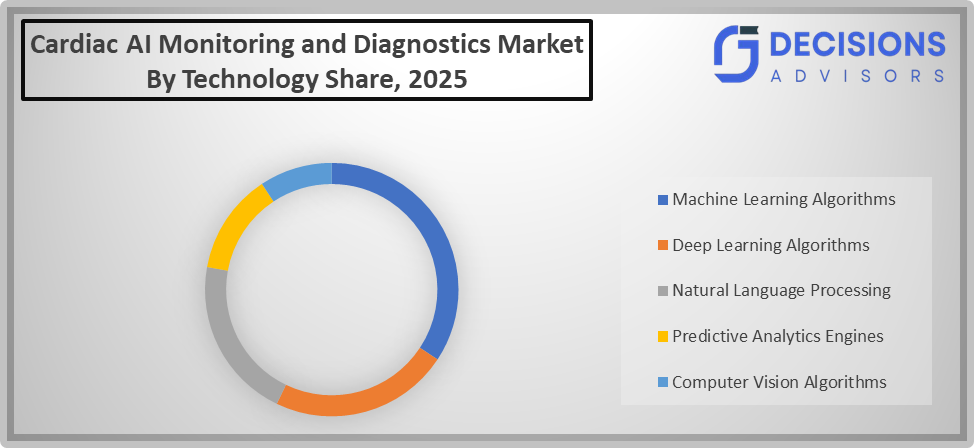
Based on the technology, the cardiac AI monitoring and diagnostics market is divided into machine learning algorithms, deep learning algorithms, natural language processing, predictive analytics engines, computer vision algorithms. Among these, the machine learning algorithms segment accounted for the largest share in 2025, and is anticipated to grow at a significant CAGR of approximately 54.26 % during the forecast period. It is attributed because Machine learning is extensively employed to scrutinize extensive datasets, including sales history, consumer behavior, and external market trends. This facilitates improved inventory management, personalized marketing, and flavor innovation.
- The arrhythmia detections segment dominated the market at a CAGR of approximately 29.3% in 2025, and is projected to grow at a substantial CAGR during the forecast period.
Based on the application, the cardiac AI monitoring and diagnostics market is divided into arrhythmia detection, heart failure monitoring, coronary artery disease diagnosis, stroke risk prediction, cardiac imaging interpretation, other cardiovascular disease monitoring. Among these, the arrhythmia detections segment dominated the market at a CAGR of approximately 29.3% in 2025, and is projected to grow at a substantial CAGR during the forecast period. It is attributed because great prevalence & surveillance needs atrial fibrillation is prevalent, and continuous monitoring is essential for diagnosis, leading to a significant demand for AI-driven wearable sensors and ECG interpretation.
Strategies to Implement for Growth of the Market in Non-Leading Regions
The strategies must focus on the overcoming high implementation costs, limited digital infrastructure and regularity hurdles through tailored, accessible solutions. The key approach is implementing cost effective an d cloud based AI tools that do not require massive upfront investments in on premise hardware, leveraging smartphone compatible apps or existing, low cost wearable sensors to track heart health in remote settings. The growth can be accelerated by establishing public private partnerships. Ultimately, encouraging the integration of telemedicine with cardiac monitoring facilitates proactive management, alleviates the pressure on centralized hospitals, and enhances accessibility an essential development given the increasing rates of cardiovascular disease in these areas.
Regional Segment Analysis of the Cardiac AI monitoring and diagnostics Market
- North America (U.S., Canada, Mexico)
- Europe (Germany, France, U.K., Italy, Spain, Rest of Europe)
- Asia-Pacific (China, Japan, India, Rest of APAC)
- South America (Brazil and the Rest of South America)
- The Middle East and Africa (UAE, South Africa, Rest of MEA)
North America is anticipated to hold the largest share of the cardiac AI monitoring and diagnostics market over the predicted timeframe. North America readily embraces cutting-edge technologies, such as AI-driven wearables, remote patient monitoring systems, and digital health apps. The need for these tools is amplified by the widespread movement toward preventive care and AI-driven real-time data analysis. The area, especially the United States, bears a significant burden of cardiovascular diseases such as arrhythmias, heart failure, and coronary artery disease. This phenomenon is fueled by an older demographic and the prevalence of inactivity, necessitating sophisticated tracking instruments.
Asia Pacific is expected to grow at a rapid CAGR in the cardiac AI monitoring and diagnostics market during the forecast period. It is because of the high burden of cardiovascular diseases, an aging population, and the rapid uptake of AI-enabled wearables and remote monitoring technologies. Major drivers include the rise in investments in healthcare infrastructure, government backing for digital health, and swift digitalization. The region has a high prevalence of cardiovascular diseases (CVDs), diabetes, and hypertension, driven by rapid urbanization and changing lifestyles, leading to high demand for diagnostic tools. In August 2025, Narayana Health announced the development of an AI-powered tool, in collaboration with Medha AI, capable of detecting heart failure from standard ECG images within approximately 10 seconds.
Europe is the 3rd largest region to grow in the cardiac AI monitoring and diagnostics market during the region. By emphasizing the need for standardized and reliable AI within structures such as the Medical Device Regulation (MDR) and the AI Act, the European Union is promoting investment and making it easier to roll out AI solutions that meet compliance standards. European healthcare providers are shifting toward proactive care models. AI tools allow for continuous, real-time monitoring of cardiac parameters via wearables and sensors, which is resulting in earlier intervention and reduced costs. Philips introduced the VeriSight Pro 3D intracardiac echocardiography (ICE) catheter in Europe in 2025, enabling real-time 3D imaging to enhance procedural precision during minimally invasive cardiac interventions.
Future Market Trends in Cardiac AI Monitoring and Diagnostics: -
- Wearable AI & Remote Monitoring Ecosystems:
Transition to continuous monitoring through smart patches and wearables that utilize Deep Learning (DL) algorithms for real-time arrhythmia detection outside of hospital environments.
- Predictive Analytics & Early Detection:
AI will advance from diagnosing existing conditions to predicting future events (e.g., forecasting arrhythmias weeks ahead or detecting concealed structural heart disease using standard ECGs).
- Enhanced Imaging & Multimodal Data:
Echocardiography and MRI will be improved through AI-driven imaging, and new algorithms will combine ECG data with electronic health records (EHR) and genomic information for thorough risk profiling.
Recent Development
- In 2025–2026, next-generation AI models have been developed to detect structural heart disease from standard ECGs, validated on large and diverse datasets, highlighting advancements in non-invasive, AI-driven cardiac diagnostics.
- In November 2025, Philips showcased its AI-enabled cardiac MR innovations at RSNA, including SmartHeart for automated cardiac MR planning and SmartSpeed Precise, a dual-AI technology enabling up to threefold faster and higher-resolution imaging; SmartHeart later received FDA clearance in March 2026.
- In March 2025, GE HealthCare introduced the Revolution Vibe CT system featuring Unlimited One-Beat Cardiac imaging and AI-enabled workflows, and in August 2025, showcased ComboLab AltiX AI.i an advanced electrophysiology recording system with AI-supported decision tools at European Society of Cardiology Congress 2025.
- In March 2024, Caristo Diagnostics expanded the implementation of its CaRi-Heart solution across UK NHS and private hospitals, leveraging AI to analyze cardiac CT scans and improve risk stratification for coronary heart disease.
- In December 2025, vTitan Corporation launched vCardio, a single-lead, wearable point-of-care cardiac monitor designed in India, offering real-time ECG monitoring with AI-powered analytics for arrhythmia detection.
Market Segment
This study forecasts revenue at global, regional, and country levels from 2020 to 2035. Decision Advisor has segmented the cardiac AI monitoring and diagnostics market based on the below-mentioned segments:
Cardiac AI Monitoring and Diagnostics Market, By Solution Type
- AI Cardiac Monitoring Software
- AI Cardiac Diagnostic Software
- AI-Enabled Cardiac Imaging Analysis Platforms
- AI-Powered Remote Cardiac Monitoring Platforms
- AI Clinical Decision Support Systems for Cardiology
Cardiac AI Monitoring and Diagnostics Market, By Technology
- Machine Learning Algorithms
- Deep Learning Algorithms
- Natural Language Processing
- Predictive Analytics Engines
- Computer Vision Algorithms
Cardiac AI Monitoring and Diagnostics Market, By Application
- Arrhythmia Detection
- Heart Failure Monitoring
- Coronary Artery Disease Diagnosis
- Stroke Risk Prediction
- Cardiac Imaging Interpretation
- Other Cardiovascular Disease Monitoring
Cardiac AI Monitoring and Diagnostics Market, By Regional Analysis
- North America
- US
- Canada
- Mexico
- Europe
- Germany
- UK
- France
- Italy
- Spain
- Russia
- Rest of Europe
- Asia Pacific
- China
- Japan
- India
- South Korea
- Australia
- Rest of Asia Pacific
- South America
- Brazil
- Argentina
- Rest of South America
- Middle East & Africa
- UAE
- Saudi Arabia
- Qatar
- South Africa
- Rest of the Middle East & Africa
Frequently Asked Questions (FAQ)
1. How is artificial intelligence transforming traditional cardiology workflows?
A. AI is automating data interpretation, reducing manual workload for clinicians, and enabling faster diagnosis through real-time analysis of cardiac data.
2. What type of data is commonly used in cardiac AI systems?
A. Cardiac AI systems utilize ECG signals, imaging data (CT, MRI), electronic health records, and wearable device data.
3. Why is early detection critical in cardiovascular diseases?
Early detection helps prevent severe complications such as heart attacks or strokes by enabling timely medical intervention.
4. How do AI-powered platforms assist in risk stratification?
A. They analyze patient history and real-time data to categorize patients based on their likelihood of developing cardiac conditions.
5. What distinguishes AI-enabled cardiac diagnostics from conventional methods?
A. AI systems provide faster, more accurate, and scalable analysis compared to traditional manual interpretation.
6. How does AI contribute to reducing hospital readmissions?
A. Continuous monitoring and predictive alerts help manage conditions proactively, reducing emergency hospital visits.
Check Licence
Choose the plan that fits you best: Single User, Multi-User, or Enterprise solutions tailored for your needs.
We Have You Covered
- 24/7 Analyst Support
- Clients Across the Globe
- Tailored Insights
- Technology Tracking
- Competitive Intelligence
- Custom Research
- Syndicated Market Studies
- Market Overview
- Market Segmentation
- Growth Drivers
- Market Opportunities
- Regulatory Insights
- Innovation & Sustainability
Report Details
| Scope | Global |
| Pages | 180 |
| Delivery | PDF & Excel via Email |
| Language | English |
| Release | Mar 2026 |
| Access | Download from this page |