
Global Cardiac Restoration System Market
 |
Pages:
240
|
Pages:
240
Global Cardiac Restoration System Market Size, Share, and COVID-19 Impact Analysis, By Product Type (Electrocardiogram (ECG) Monitoring System, Cardiopulmonary Resuscitation (CPR) System, Implantable Cardioverter-Defibrillator (ICD) Devices, Pacemakers, Cardiac Resynchronization Therapy Devices), By Technology (Non-Invasive Systems, and Invasive Systems), and By Region (North America, Europe, Asia-Pacific, Latin America, Middle East, and Africa), Analysis and Forecast 2025-2035
REPORT COVERAGE
Global
Global Cardiac Restoration System Market Size Insights Forecasts to 2035
- The Global Cardiac Restoration System Market Size Was Estimated at USD 3.28 Billion in 2024
- The Market Size is Expected to Grow at a CAGR of around 5.42 % from 2025 to 2035
- The Worldwide Cardiac Restoration System Market Size is Expected to Reach USD 5.86 Billion by 2035
- North America is expected to grow the fastest during the forecast period.
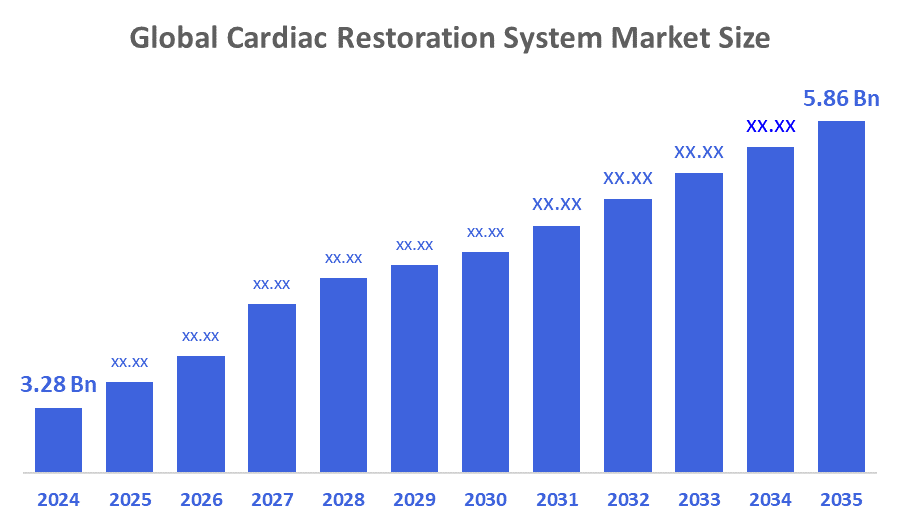
According to a research report published by Decisions Advisors and Consulting, The Global Cardiac Restoration System Market Size Was Worth Around USD 3.28 Billion In 2024 And Is Predicted To Grow To Around USD 5.86 Billion By 2035 With A Compound Annual Growth Rate (CAGR) Of 5.42 % From 2025 To 2035. The market is expected to increase significantly due to new developments in healthcare, such as the use of artificial intelligence (AI) in diagnosis and treatment planning, improvements in tissue engineering and regenerative medicine, and the emergence of customised medicine and therapy. Furthermore, it is anticipated that the growing importance of biochemicals as essential elements of treatment plans will support market growth. Increasing funding for peripheral arterial disease (PAD) research and development (R&D) has great potential to improve treatment outcomes and create new treatments.
Market Overview
The cardiac restoration system market includes the healthcare and medical device industry segment that focuses on technologies intended to restore the heart's structural shape, function, and efficiency, particularly following damage caused by conditions like myocardial infarction (heart attack) or chronic heart failure. Ischemic cardiomyopathy and left ventricular remodelling—a condition in which the heart enlarges, weakens, or changes form after injury—are the main conditions for which cardiac restoration devices are utilised. Without necessitating a complete heart transplant, these devices seek to increase cardiac output, lessen wall stress, and improve overall heart performance.
The World Health Organisation (WHO) has issued fresh alerts over the increasing prevalence of noncommunicable diseases (NCDs) worldwide, advising nations to bolster public health programs and put preventative measures into place. The majority of deaths globally now occur from heart disease, diabetes, cancer, and chronic respiratory diseases, all of which are on the rise, according to the research.
According to 2021 data, the prevalence of CVD is 612 million, with an age-adjusted rate of 7,179/100,000. There are 254 Million people with ischemic heart disease (109 million women and 145 million men).
Atrium Therapeutics launched with $270 Million in funding to develop RNA-based therapies targeting rare cardiovascular conditions. The company aims to leverage cutting-edge RNA science to address unmet medical needs, advancing precision treatments that could transform outcomes for patients with limited therapeutic options.
Report Coverage
This research report categorizes the cardiac restoration system market based on various segments and regions, forecasts revenue growth, and analyzes trends in each submarket. The report analyses the key growth drivers, opportunities, and challenges influencing the cardiac restoration system market. Recent market developments and competitive strategies, such as expansion, product launch, development, partnership, merger, and acquisition, have been included to draw the competitive landscape in the market. The report strategically identifies and profiles the key market players and analyzes their core competencies in each sub-segment of the cardiac restoration system market.
Driving Factors
The cardiac restoration system market is currently in an era of reform due to rapid technology growth; combined with a shift to patient-centred solutions, innovative minimally invasive surgery, and improved imaging technology, this has changed how things operate, leading to better treatment options and better patient outcomes. With an increased number of people with cardiovascular disease, demand for quality cardiac restoration systems is also increasing as healthcare systems look to provide comprehensive treatment to all patients. With stakeholders investing in r&d for next-generation products, this space appears primed for growth as numerous technologies come together to deal with the complex nature of cardiac disease. Moreover, many cardiac restoration systems will utilise artificial intelligence and machine learning, which will help improve diagnostic accuracy and individualise treatment. Stakeholders need to work together (medical device manufacturers, health providers, and government agencies) to navigate this rapidly changing environment by ensuring that innovation meets clinicians’ needs.
BioVentrix announced that the first patient successfully treated with its Revivent System in the RELIVE Trial at Saint Luke’s Mid America Heart Institute. The study evaluates this minimally invasive therapy for heart failure, marking a significant milestone in advancing patient care and clinical innovation.
Ancora Heart received Breakthrough Device Designation from the U.S. FDA for its AccuCinch Ventricular Restoration System, a minimally invasive device designed to treat heart failure by restoring the structure and function of the left ventricle. This designation highlights the system’s potential to address a significant unmet medical need, offering new hope for patients with reduced ejection fraction who have limited treatment options.
Restraining Factors
Some of the reasons that are impeding the growth of the cardiovascular repair and reconstruction devices market include the high cost of sophisticated cardiovascular devices and strict regulatory standards. Devices like heart valve repair devices, grafts, and stents are occasionally regarded as novel approaches to cardiovascular repair, taking delay into account, research, clinical studies, and regulatory approvals, such as FDA approvals.
Market Segmentation
The cardiac restoration system market share is classified into product type and technology.
- The electrocardiogram (ECG) monitoring system segment accounted for the largest market share in 2024 and is anticipated to grow at a substantial CAGR over the forecast period.
Based on the product type, the cardiac restoration system market is divided into electrocardiogram (ECG) monitoring systems, cardiopulmonary resuscitation (CPR) systems, implantable cardioverter-defibrillator (ICD) devices, pacemakers, and cardiac resynchronisation therapy devices. Among these, the electrocardiogram (ECG) monitoring system segment accounted for the largest market share in 2024 and is anticipated to grow at a substantial CAGR over the forecast period. For its vital function in providing real-time data analytics and monitoring heart health. Its extensive use in a variety of healthcare contexts, from routine checkups to emergency care, highlights its significance.
For instance, OMRON Healthcare announced its second investment in Tricog Health, a leading Indian health-tech company specialising in AI-powered cardiac care. The partnership aims to accelerate the adoption of advanced digital health solutions for the early detection and management of heart disease across India. By combining OMRON’s expertise in medical devices with Tricog’s AI-driven diagnostic platforms, the collaboration seeks to expand access to timely, accurate cardiac care, reduce mortality rates, and strengthen preventive healthcare infrastructure in the region.
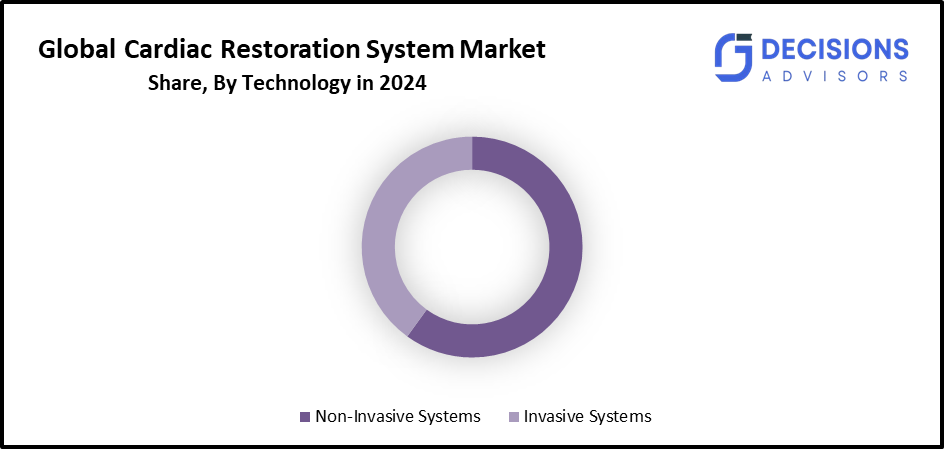
- The non-invasive systems segment accounted for the highest market revenue in 2024 and is anticipated to grow at a significant CAGR during the forecast period.
Based on the technology, the cardiac restoration system market is divided into non-invasive systems and invasive systems. Among these, the non-invasive systems segment accounted for the highest market revenue in 2024 and is anticipated to grow at a significant CAGR during the forecast period. This is due to their methods that reduce patient discomfort and greatly improve the patient experience. Advanced imaging techniques like MRI and echocardiography are frequently used in these systems, enabling comprehensive diagnosis without the need for surgery.
For instance, recently, the Swiss MedTech pioneer Berlin Heals Holding AG raised more than $10 million. An important turning point has been reached with this latest funding round. The company's ambitious goal is fueled by the capital infusion. It develops its exclusive cardiac microcurrent technology, C-MIC. This implanted gadget presents a fresh strategy. Additionally, it encourages the advancement of less intrusive implantation methods.
Regional Segment Analysis of the Cardiac Restoration System Market
- North America (U.S., Canada, Mexico)
- Europe (Germany, France, U.K., Italy, Spain, Rest of Europe)
- Asia-Pacific (China, Japan, India, Rest of APAC)
- South America (Brazil and the Rest of South America)
- The Middle East and Africa (UAE, South Africa, Rest of MEA)
Asia Pacific is anticipated to hold the largest share of the cardiac restoration System market over the predicted timeframe.
Asia Pacific is anticipated to hold the largest share of the cardiac restoration system market over the predicted timeframe. There is rapid growth currently taking place in the area as a result of the increase in healthcare spending, an increase in heart disease prevalence and the growing middle class of individuals in this area. Significant drivers of growth are also supported by government initiatives to help improve access to and the cost of healthcare. The countries leading the way in this market include China, India and Japan, with many local and international companies entering the market. For example, Abbott Laboratories and Medtronic are expanding their operations in the area to take advantage of the increasing demand for advanced cardiac products/solutions. The competitive landscape is changing, with increased innovation and affordability being at the forefront of what patients want to be treated.
Japan’s Shimadzu Future Innovation Fund has invested in A-wave Inc., a cardiac healthcare startup originating from the University of Osaka. A-wave is developing a home monitoring system designed to reduce hospital readmissions for patients with chronic heart failure. With ageing populations driving a global rise in heart failure cases, the technology aims to improve patients' quality of life and lower healthcare costs by detecting worsening symptoms early and enabling timely interventions.
North America is expected to grow at a rapid CAGR in the cardiac restoration system market during the forecast period. Advanced healthcare infrastructure, increasing prevalence of cardiovascular diseases, and major investments in medical technology make this an important area in terms of innovation and overall market growth through the innovation and adoption of new therapies due to regulatory support from entities such as the FDA. The U.S. represents a significant portion of this region, with major companies like Medtronic, Boston Scientific, and Abbott Laboratories leading the competition. With good existing infrastructure for healthcare systems and plenty of research and development efforts, there is a thriving environment for the cardiac restoration technology market. This competitive advantage will be very important to ensure that companies continue to be the leading players in this region.
An Appeal for Proposals (RFP) was released by the American Heart Association (AHA) with the goal of addressing cardiovascular, renal, and metabolic problems in cancer patients and survivors using real-world data. Studies have indicated that individuals who have survived cancer are 52% more likely to experience heart failure than those who have not. The initiative will provide up to five awards totalling $150,000 for a single funding year.
Competitive Analysis:
The report offers the appropriate analysis of the key organizations/companies involved within the cardiac restoration system market, along with a comparative evaluation primarily based on their product offering, business overviews, geographic presence, enterprise strategies, segment market share, and SWOT analysis. The report also provides an elaborative analysis focusing on the current news and developments of the companies, which includes product development, innovations, joint ventures, partnerships, mergers & acquisitions, strategic alliances, and others. This allows for the evaluation of the overall competition within the market.
List of Key Companies
- BioVentrix
- Abbott
- CardioKinetix Inc
- NeoChord Inc
- ON-X LIFE TECHNOLOGIES INC
- Valtech
- Edwards Lifesciences Corp.
- CryoLife Inc.
- Xeltis AG
- Medtronic
- Bard Peripheral Vascular
- Terumo Cardiovascular Systems Corporation
- W. L. Gore & Associates, Inc.
- Getinge AB
- Others
Key Target Audience
- Market Players
- Investors
- End-users
- Government Authorities
- Consulting and Research Firm
- Venture capitalists
- Value-Added Resellers (VARs)
Recent Development
- In January 2026, Researchers at the Chinese University of Hong Kong (CUHK) unveiled the world’s first discovery of a CD4+ regulatory T cell (Treg)–mediated heart regeneration mechanism. This breakthrough identifies a novel biological pathway that could serve as a new therapeutic target for repairing damaged heart tissue. The finding opens up exciting possibilities for regenerative medicine, offering hope for more effective heart repair strategies in the future.
- In November 2025, Philips unveiled DeviceGuide, an AI-powered tool designed to assist physicians during complex heart repair procedures, particularly for treating leaky mitral valves without open-heart surgery. Built on the company’s EchoNavigator platform, DeviceGuide uses artificial intelligence to transform live imaging data into an intuitive 3D view of the beating heart. This real-time guidance helps clinicians track and visualise repair devices with greater precision, confidence, and safety during minimally invasive interventions.
- In October 2025, Ancora Heart’s AccuCinch Ventricular Restoration System demonstrated sustained reverse remodelling at two years, according to clinical trial data. Patients treated with the minimally invasive device showed continued improvements in left ventricular size and function, reinforcing its potential as a breakthrough therapy for heart failure with reduced ejection fraction. These long-term results highlight AccuCinch’s durability and promise in addressing a major unmet need in cardiovascular care
Market Segment
This study forecasts revenue at global, regional, and country levels from 2020 to 2035. Decisions Advisors has segmented the cardiac restoration system market based on the below-mentioned segments:
Global Cardiac Restoration System Market, By Product Type
- Electrocardiogram (ECG) Monitoring System
- Cardiopulmonary Resuscitation (CPR) System
- Implantable Cardioverter-Defibrillator (ICD) Devices
- Pacemakers
- Cardiac Resynchronization Therapy Devices
Global Cardiac Restoration System Market, By Technology
- Non-Invasive Systems
- Invasive Systems
Global Cardiac Restoration System Market, By Regional Analysis
- North America
- US
- Canada
- Mexico
- Europe
- Germany
- UK
- France
- Italy
- Spain
- Russia
- Rest of Europe
- Asia Pacific
- China
- Japan
- India
- South Korea
- Australia
- Rest of Asia Pacific
- South America
- Brazil
- Argentina
- Rest of South America
- Middle East & Africa
- UAE
- Saudi Arabia
- Qatar
- South Africa
- Rest of the Middle East & Africa
Frequently Asked Questions (FAQ)
- How does cardiac restoration differ from traditional heart failure management?
Traditional heart failure management focuses on medication, lifestyle modification, and in advanced cases, LVAD or transplant. Cardiac restoration systems aim to mechanically restore ventricular geometry and improve cardiac function, often serving as an intermediate solution before transplant or long-term mechanical support.
- What is the difference between ventricular restoration devices and ICDs or pacemakers?
Ventricular restoration devices physically reshape or support damaged heart muscle, whereas Implantable Cardioverter-Defibrillators (ICDs) and pacemakers regulate heart rhythm electrically. Restoration systems target structural remodeling, while rhythm devices address electrical abnormalities.
- What are the key reimbursement challenges in this market?
Reimbursement varies widely across countries. Advanced restoration procedures may not be fully covered in developing nations, limiting adoption despite clinical benefits.
- How could regenerative medicine disrupt the cardiac restoration system market?
Breakthroughs such as CD4+ Treg-mediated heart regeneration discovered by Chinese University of Hong Kong may introduce biological repair alternatives to mechanical restoration in the long term.
- How will demographic changes impact demand through 2035?
Aging populations, especially in Japan, Europe, and North America, are expected to significantly increase heart failure prevalence, directly driving demand for restoration technologies.
Check Licence
Choose the plan that fits you best: Single User, Multi-User, or Enterprise solutions tailored for your needs.
We Have You Covered
- 24/7 Analyst Support
- Clients Across the Globe
- Tailored Insights
- Technology Tracking
- Competitive Intelligence
- Custom Research
- Syndicated Market Studies
- Market Overview
- Market Segmentation
- Growth Drivers
- Market Opportunities
- Regulatory Insights
- Innovation & Sustainability
Report Details
| Scope | Global |
| Pages | 240 |
| Delivery | PDF & Excel via Email |
| Language | English |
| Release | Mar 2026 |
| Access | Download from this page |