
Global Cast Removal Device Market
 |
Author:
Disha B
|
Pages:
210
|
Author:
Disha B
|
Pages:
210
Global Cast Removal Device Market Size, Share, By Product Type (Cast Saws, Cast Spreaders, Cast Cutters / Shears, and Vacuum-Assisted Cast Removal Systems), By Cast Material Compatibility (Plaster Cast Removal Device, Fiberglass Cast Removal Device, and Synthetic / Hybrid Cast Devices), By Application (Fracture Management, Post-Surgical Cast Removal, Pediatric Orthopedics, and Emergency Care Centers) By End User (Hospitals, Orthopaedic Clinics, Ambulatory Surgical Centres, and Emergency Care Centres), By Technology (Electric Cast Removal Device, Battery-Operated Devices, and Manual Devices), and By Region (North America, Europe, Asia-Pacific, Latin America, Middle East, and Africa), Analysis and Forecast 2026?2035.
CAGR
5.11%
REVENUE 2025
USD Million 223.13
FORECAST 2035
USD Million 367.23
REPORT COVERAGE
Global
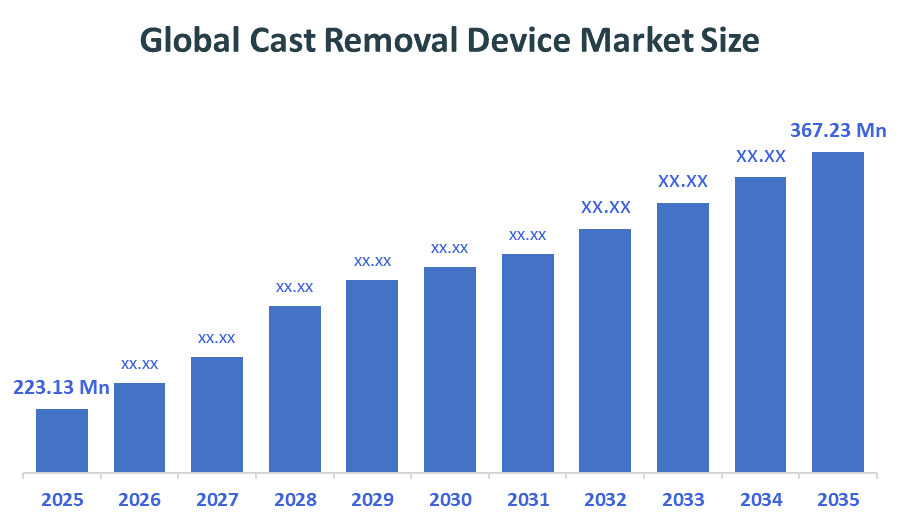
The Global Cast Removal Device Market Size is projected USD 223.13 Million in 2025 and is forecasted to reach around USD 367.23 Million by 2035. According to Decision Advisors, a detailed report on analysis of the Global Cast Removal Device Market indicates that the Safety-enhanced ergonomic and low-vibration cast removal technology trend dominates the Market, accounting for approx. 35% to 40% of the total Global demand worldwide. Stryker Corporation dominates the Global Cast Removal Device Market, supported by revenue of approx. USD 25.11 Billion, due to strong global distribution, advanced orthopedic technologies, and high adoption in hospitals worldwide.
Market Snapshot
- Global Cast Removal Device Market Size (2025): USD 223.13 Million
- Projected Global Cast Removal Device Market Size (2035): USD 367.23 Million
- Global Cast Removal Device Compound Annual Growth Rate (CAGR): 5.11%
- Largest Regional Market: Asia Pacific
- Fastest Growing Region: North America
- 3rd Largest Region: Europe
- Base Year: 2025
- Historical Period: 2021–2024
- Forecast Period: 2026–2035
Market Overview/ Introduction
The Global Cast Removal Device Market is an important segment within the orthopaedic medical devices sector, comprising instruments that assist in the safe and effective removal of casts that are put on by health professionals during fracture repair and surgery recovery procedures. Cast removal devices include oscillating saws, cast spreaders, and vacuum systems. These are extensively employed in hospitals, orthopaedic centres, and ambulatory surgical centres across the globe. Cast removal devices have been designed to facilitate the easy removal of casts from patients without any risk of harm to their body parts. The global cast removal device market is growing rapidly due to the rising prevalence of fractures and accidents caused by road traffic. Moreover, increased participation in physical activities and sports activities is boosting the global cast removal device market. Age-related bone diseases, such as osteoporosis, contribute further to the growth of the global cast removal device market. Every year, billions of fractures occur globally, out of which around 60 percent require the use of cast devices. Government-led efforts towards development in the healthcare industry and production of medical devices are helping to grow the market. For example, India's medical device policy is promoting local manufacturing and innovations in orthopaedic instruments. Furthermore, the emergence of out-patient orthopaedic surgery procedures has led to the increasing need for portable and battery-powered medical devices.
- In November 2024, India’s Scheme for Strengthening Medical Devices Industry allocates ?110 crore for cluster infrastructure and ?100 crore for clinical studies, boosting domestic manufacturing and R&D. The initiative indirectly supports orthopaedic equipment production, including Cast Removal Devices and surgical tools.
- In India’s National Medical Devices Policy 2023 targets expanding the medical devices sector from USD 11 Billion to USD 50 Billion by 2030, promoting Make in India, boosting domestic manufacturing, and strengthening orthopedic equipment demand including Cast Removal Devices.
- In August 2023 India’s PRIP Scheme, launched to boost pharma and MedTech innovation with ?5,000 crore funding, supports R&D and commercialization of medical technologies. It strengthens medical device development, including orthopedic tools such as Cast Removal Devices and surgical equipment.
Notable Insights: -
- Asia-Pacific holds the largest regional market share approximately 37% in the Global Cast Removal Device Market.
- North America is the fastest growing region market share approximately 29 % in the Global Cast Removal Device Market.
- By product type, the Cast Saws segment held a dominant position with 43% in terms of market share in 2025.
- By technology, Electric Cast Removal Devices segment is the dominating accounting for market is approximately 53%.
- By application, Fracture Management segment held a dominant position market is approximately 53%.
- By end user, Hospitals segment held a dominant position market is approximately 58%.
- By cast material compatibility, Cast Material Compatibility segment held a dominant position market is approximately 48%.
- The market is likely to achieve a valuation of USD 367.23 Million by 2035.
What is role of technology in grooming the market?
The Global Cast Removal Device Market experiences transformational shifts owing to advances in technology that increase the level of safety, efficiency, and ease of use of these devices. Current devices are becoming more technologically sophisticated as a number of devices now come with the capability of using low-vibration oscillating blades. Studies reveal that the usage of high-grade oscillating saws could bring down vibration levels by as much as 30-40%. This reduces any fear or stress among patients regarding their safety. Vacuum-assisted technologies have improved working environments in clinics by removing up to 90-95% cast dust particles and improving the health and safety of clinicians. Moreover, the ergonomic design and light materials used in the manufacturing process have increased efficiency in the form of reduced fatigue by up to 25% during repetitive actions. With technological improvements, battery-operated devices are gaining popularity, especially in ambulatory surgical centres that constitute nearly 30-35% of orthopaedic surgeries worldwide. Digital technology is also witnessing a surge in development through features such as smart pressure regulation sensors that improve the precision of cuts during surgery.
How is Recent Developments Helping the Market?
The latest developments in the Global Cast Removal Device Market include enhancing safety and efficiency. The current trends include manufacturing of cast saws that have vacuum systems installed. These devices ensure that up to 90% of airborne debris is minimized, creating an effective operating environment. The advancement in such technologies helps minimize any infections in case they occur in a high-volume hospital environment. In 2023 to 2025, several players launched their innovative devices that were ergonomic and lightweight, making it easier to handle them without experiencing 20% to 25% of operator fatigue. Innovations in the blades are making the devices more efficient with regard to minimizing any heat generation and noise pollution while operating, hence making patients comfortable. Another trend in the current market includes portable and battery-operated devices due to the increasing demand for outpatient orthopaedic procedures that form almost one third of the treatment cases worldwide. These devices enable flexibility and efficiency since they are used in various facilities, including clinics and even emergency care situations. In addition, the use of sustainable materials is being adopted by most manufacturers, which creates environmentally friendly products and ensures sustainability within the industry.
Market Drivers
The main factors driving the Global Cast Removal Device Market include the high number of people experiencing fractures and orthopaedic problems around the world. Road traffic accidents, sports injury, and falls, especially among older people, are increasingly becoming causes of fractures, leading to an increase in the need for cast procedures and removal. Over 50 billion cases of fractures are reported annually across the globe, out of which many require casts. The other factor affecting the demand is the rise in the number of aged people in the population since they are more prone to developing orthopaedic diseases such as osteoporosis. Technological developments in this field also affect the demand for these devices since recent models come with advanced safety features, minimized vibrations, and improved accuracy. The growth in healthcare infrastructure, mainly in developing nations like India and China, is helping the market grow further. Governments' efforts to promote orthopaedic device production and access to hospitals are contributing to the adoption of these devices. Another significant factor includes the trend towards performing orthopaedic surgeries in outpatient settings. Rising healthcare expenditure and growing awareness about patient safety are further accelerating market growth globally.
Restrain
High costs associated with advanced cast removal devices remain a key restraint, particularly in developing regions where healthcare budgets are limited. Many small clinics rely on traditional or manual tools due to affordability issues. Additionally, lack of skilled professionals to operate advanced devices can hinder adoption. Maintenance costs and limited awareness about newer technologies also restrict market penetration. These factors collectively slow down growth, especially in cost-sensitive healthcare systems across emerging economies.
Competitive Analysis:
The report offers the appropriate analysis of the key organizations/companies involved within the Cast Removal Device market, along with a comparative evaluation primarily based on their Product of offering, business overviews, geographic presence, enterprise strategies, segment market share, and SWOT analysis. The report also provides an elaborative analysis focusing on the current news and developments of the companies, which includes Product development, innovations, joint ventures, partnerships, mergers & acquisitions, strategic alliances, and Emergency Care Centers. This allows for the evaluation of the overall competition within the market.
Top Companies in Global Cast Removal Device Market
- Stryker Corporation
- Zimmer Biomet Holdings Inc.
- Johnson & Johnson (DePuy Synthes)
- Smith & Nephew plc
- Medtronic plc
- CONMED Corporation
- Arthrex Inc.
- B. Braun Melsungen AG
- DJO Global (Enovis Corporation)
- OsteoMed (A subsidiary of DJO/Enovis)
Government Initiatives
|
Country |
Key Government Initiatives |
|
India
|
In February 2024, India & China Healthcare infrastructure investment is expanding hospital access, boosting demand for modern orthopaedic equipment, including safer and electric Cast Removal Devices in trauma and surgical care centres. |
|
UK |
In January 2024, US FDA and UK MHRA safety regulations are driving adoption of advanced orthopaedic equipment, promoting low-vibration and safer Cast Removal Devices to reduce patient trauma and improve clinical outcomes. |
|
China |
In January 2024, China is strengthening its medical device sector through R&D investment and innovation under healthcare modernization, boosting orthopaedic equipment and supporting Cast Removal Device development across hospitals. |
Study on the Supply, Demand, Distribution, and Market Environment of Cast Removal Device Market
The Global Cast Removal Device Market demonstrates a stable demand-supply balance driven by consistent orthopaedic procedure volumes worldwide. Demand is primarily generated by hospitals and clinics, which account for approximately 60–65% of total device usage due to high patient inflow. Ambulatory surgical centres contribute around 25–30%, reflecting the growing shift toward outpatient care. On the supply side, the market is dominated by established medical device manufacturers such as Stryker Corporation and Zimmer Biomet Holdings Inc., supported by global distribution networks. Asia-Pacific, North America, and Europe serve as major manufacturing hubs due to advanced healthcare infrastructure and production capabilities. Direct sales to hospitals account for nearly 55–60% of distribution, while distributors and third-party suppliers handle the remaining share. Environmental factors such as safety regulations and infection control standards play a significant role in shaping market dynamics. Technological advancements and increasing awareness about patient safety are also influencing demand patterns, encouraging healthcare providers to adopt advanced and efficient devices.
Price Analysis and Consumer Behaviour Analysis
The pricing of cast removal devices depends on factors such as technology type, features, and brand reputation. Advanced electric devices with integrated vacuum systems typically cost 30–50% more than basic manual tools due to enhanced safety and efficiency features. Hospitals prioritize quality and safety, which account for nearly 50% of purchasing decisions. Cost considerations contribute around 30%, while durability and maintenance account for the remaining 20%. In developing regions, cost sensitivity is higher, with over 40% of healthcare providers prioritizing affordability over advanced features. In contrast, developed markets emphasize technological innovation and patient comfort, leading to higher adoption of premium devices. The average lifespan of cast removal devices ranges from 5 to 10 years, depending on usage and maintenance. There is also a growing preference for portable and battery-operated devices, particularly in outpatient settings. Consumer behaviour is increasingly influenced by factors such as ease of use, safety certifications, and compliance with healthcare standards, reflecting a shift toward value-based purchasing in the global market.
Market Segmentation
The Cast Removal Device Market share is classified into product type, application, end-user, and farm size
- The product type segment dominated the market in 2025, and is projected to grow at a substantial CAGR of approximately 6.5% during the forecast period.
Based on the product type, the Cast Removal Device Market is divided into cast saws, cast spreaders, cast cutters / shears, and vacuum-assisted cast removal systems. Among these, Cast Saws (oscillating saws) segment dominates the Global Cast Removal Device Market, accounting for the highest revenue share of approximately 40–45% in 2025. This dominance is driven by their widespread use in hospitals and orthopaedic clinics due to precision, safety, and efficiency in removing plaster and fiberglass casts. The segment is also expected to grow at a CAGR of around 6.2–6.8% (2026–2035), supported by rising fracture cases, technological improvements, and increasing adoption of advanced safety features.
- The technology segment accounted for the largest share in 2025, and is anticipated to grow at a significant CAGR of approximately 6.3% during the forecast period.
Based on the technology, the Cast Removal Device Market is divided into electric Cast Removal Devices, battery-operated devices, and manual devices. Among these, The Electric Cast Removal Devices segment holds the largest market share, contributing approximately 50–55% of total revenue in 2025, driven by their consistent power output, precision, and widespread hospital adoption. This segment is projected to grow at a CAGR of around 6.0–6.5% (2026–2035) due to increasing demand for efficient and safe orthopaedic procedures. Electric systems dominate over manual and battery-operated devices because they offer higher reliability, better performance, and suitability for high-volume clinical environments and surgical centres.
- The application segment dominated the market in 2025, and is projected to grow at a substantial CAGR of approximately 6.7% during the forecast period.
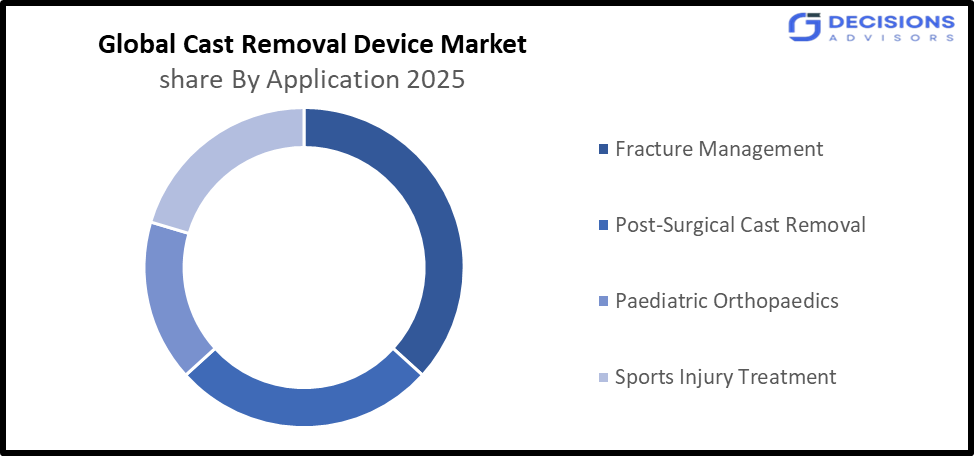
Based on the application, the Cast Removal Device Market is divided into fracture management, post-surgical cast removal, paediatric orthopaedics, and sports injury treatment. Among these, Fracture Management segment dominates the Cast Removal Device Market, accounting for approximately 50–55% of total revenue in 2025. This leadership is driven by the high global incidence of bone fractures caused by accidents, falls, and age-related conditions. Hospitals and clinics heavily rely on cast saws for safe removal after fracture healing. The segment is expected to grow at a CAGR of around 6.3–7.0% (2026–2035) due to rising trauma cases, sports injuries, and expanding orthopaedic care infrastructure worldwide.
- The end user segment dominated the market in 2025, and is projected to grow at a substantial CAGR of approximately 6.4% during the forecast period.
Based on the end user, the Cast Removal Device Market is divided into hospitals, orthopaedic clinics, paediatric orthopaedists, and emergency care centres. Among these, the Hospitals segment dominates the Cast Removal Device Market, contributing around 55–60% of total market revenue in 2025. Hospitals remain the primary centres for orthopaedic treatments, trauma care, and post-surgical cast removal procedures, ensuring consistent demand for advanced devices. This segment is projected to grow at a CAGR of approximately 6.0–6.6% (2026–2035), supported by increasing patient admissions, expanding healthcare infrastructure, and rising investments in modern surgical equipment across both developed and emerging economies globally.
- The cast material compatibility segment dominated the market in 2025, and is projected to grow at a substantial CAGR of approximately 6.6% during the forecast period.
Based on the Cast Material Compatibility, the Cast Removal Device Market is divided into Plaster Cast Removal Devices, Fiberglass Cast Removal Devices, and Synthetic / Hybrid Cast Devices. Among these, Fiberglass Cast Removal Devices segment dominates the Cast Removal Device Market, accounting for approximately 45–50% of total revenue in 2025. This dominance is driven by the widespread replacement of traditional plaster casts with lightweight, durable, and water-resistant fiberglass materials in modern orthopaedic care. The segment is projected to grow at a CAGR of around 6.3–6.8% (2026–2035) due to increasing orthopaedic procedures, higher patient comfort requirements, and the rising adoption of advanced cast materials in hospitals and clinics globally.
Strategies to Implement for Growth of the Market in Non-Leading Regions
Market penetration of non-leadership markets like Asia-Pacific (outside developed regions), Latin American countries, and selected parts of Africa will require deliberate strategies that emphasize cost-effectiveness, availability, and awareness. At present, fewer than 50% of hospitals in developing economies have access to orthopaedic casting devices. This shows there exists a significant potential for growth. Manufacturing companies can produce inexpensive, portable, and battery-operated devices for removing casts specifically for small and medium-sized hospitals. Flexibility in payment plans can further increase market penetration, as up to 35–40 percent of health care organizations have capital spending problems. Establishing stronger supply chains is necessary because up to 25–30% of health care facilities in rural areas do not directly purchase from manufacturers. Involvement of more dealers within each region and the involvement of regional distributors will contribute to increased penetration. It is imperative to conduct training of healthcare practitioners, as technical difficulties hinder penetration in small clinics. Collaboration with government can also facilitate adoption through subsidies and orthopaedic health campaigns. Furthermore, creating awareness about cast removal technologies can enhance penetration by promoting the adoption of safer and efficient casting devices.
Regional Segment Analysis of the Cast Removal Device Market
- North America (U.S., Canada, Mexico)
- Europe (Germany, France, U.K., Italy, Spain, Rest of Europe)
- Asia-Pacific (China, Japan, India, Rest of APAC)
- South America (Brazil and the Rest of South America)
- The Middle East and Africa (UAE, South Africa, Rest of MEA)
Asia Pacific is anticipated to hold the largest share of the Cast Removal Device market over the predicted timeframe.
Asia-Pacific leads the Global Cast Removal Device Market with approximately 35–38% revenue share in 2025 and is expected to grow at a CAGR of 5.8–6.4%. Growth is driven by expanding healthcare infrastructure, rising fracture cases, and increasing government investments in countries like China and India. The region benefits from a large patient pool and improving access to orthopaedic care, making it the largest and most opportunistic market globally.
North America is expected to grow at a rapid CAGR in the Cast Removal Device market during the forecast period. North America is the fastest-growing region, accounting for around 28–30% of market share in 2025, with a CAGR of 6.2–6.8%. Growth is supported by advanced healthcare systems, high adoption of innovative technologies, and strong presence of key players like Stryker Corporation. Increasing outpatient procedures and focus on patient safety are further accelerating demand for advanced cast removal devices.
Europe is the 3rd largest region to grow in the Cast Removal Device market during the region. Europe holds approximately 20–23% of global market revenue and is expected to grow at a CAGR of 5.0–5.6%. The region benefits from strong regulatory frameworks and high healthcare standards. Countries like Germany, the UK, and France are key contributors due to well-established orthopaedic care systems and increasing adoption of technologically advanced medical devices.
Future Market Trends in Global Cast Removal Device Market: -
- Shift Toward Outpatient Orthopaedic Care
Outpatient orthopaedic procedures are increasing rapidly, accounting for nearly 30–35% of total treatments globally. This shift is driving demand for portable, battery-operated cast removal devices that can be used in ambulatory surgical centres. The trend reduces hospital dependency, lowers treatment costs, and supports faster patient recovery. As healthcare systems focus on efficiency and decentralization, demand for compact and user-friendly devices is expected to rise significantly.
2. Adoption of Advanced Safety Technologies
Safety-focused innovations such as low-vibration blades, noise reduction systems, and anti-burn technologies are becoming standard features. These advancements improve patient comfort and reduce procedural risks. Devices with integrated vacuum systems are also gaining popularity, capturing up to 90% of debris. As patient safety regulations tighten globally, healthcare providers are increasingly adopting advanced devices, making safety technology a key differentiator in the market.
3. Integration of Smart & Ergonomic Designs
Manufacturers are focusing on ergonomic and smart device designs to enhance usability and efficiency. Lightweight devices reduce operator fatigue by up to 25%, while smart sensors improve cutting precision. These innovations are particularly important in high-volume hospitals and outpatient settings. The trend toward user-friendly and technologically advanced devices is expected to drive adoption and improve overall clinical outcomes in the coming years.
Recent Development
In January 2024, Germany, companies like B. Braun Melsungen AG are developing ergonomic, lightweight cast removal saws to reduce operator fatigue. These innovations improve handling precision, enhance patient safety, and support efficient orthopaedic procedures in modern hospitals.
In January 2024, United States, companies like Stryker Corporation are advancing cast removal systems with integrated vacuum technology and enhanced safety features. These innovations improve debris control, reduce patient trauma, and support safer orthopaedic procedures in modern hospitals.
In March 2023, De Soutter Medical advanced its orthopaedic cast saw portfolio with ergonomic designs and integrated vacuum extraction systems, enhancing safety and efficiency in cast removal procedures. These innovations support growing demand for advanced orthopaedic devices in modern hospital environments globally.
Market Segment
This study forecasts revenue at global, regional, and country levels from 2021 to 2035. Decision Advisors has segmented the Global Cast Removal Device Market based on the below-mentioned segments:
Global Cast Removal Device Market, By Product Type
- Cast Saws
- Cast Spreaders
- Cast Cutters / Shears
- Vacuum-Assisted Cast Removal Systems
Global Cast Removal Device Market, By Application
- Fracture Management
- Post-Surgical Cast Removal
- Paediatric Orthopaedics
- Sports Injury Treatment
Global Cast Removal Device Market, By End User
- Hospitals
- Orthopaedic Clinics
- Ambulatory Surgical Centres
- Emergency Care Centres
Global Cast Removal Device Market, By Technology
- Electric Cast Removal Devices
- Battery-Operated Devices
- Manual Devices
Global Cast Removal Device Market, By Regional Analysis
- North America
- US
- Canada
- Mexico
- Europe
- Germany
- UK
- France
- Italy
- Spain
- Russia
- Rest of Europe
- Asia Pacific
- China
- Japan
- India
- South Korea
- Australia
- Rest of Asia Pacific
- South America
- Brazil
- Argentina
- Rest of South America
- Middle East & Africa
- UAE
- Saudi Arabia
- Qatar
- South Africa
- Rest of the Middle East & Africa
Frequently Asked Questions (FAQ)
Q1. What factors are driving innovation in Cast Removal Devices?
A1. Innovation is primarily driven by the need for improved patient safety, reduced procedure time, and enhanced clinician comfort. Manufacturers are focusing on ergonomic design, noise reduction, and improved blade control mechanisms to minimize risks during cast removal procedures.
Q2. What are the major safety concerns associated with cast removal procedures?
A2. Key safety concerns include skin abrasions, heat generation during cutting, vibration-related discomfort, and dust inhalation. These risks have led to the development of devices with better insulation, dust extraction systems, and controlled oscillation technology.
Q3. How does outpatient care influence the demand for cast removal equipment?
A3. The expansion of outpatient and day-care orthopaedic services increases demand for compact, easy-to-use, and portable devices. These settings require equipment that supports quick procedures without compromising safety or precision.
Q4. What role do maintenance and durability play in device selection?
A4. Healthcare providers prioritize devices with long operational life, minimal maintenance requirements, and consistent performance. High durability reduces operational downtime and ensures cost efficiency over long-term usage in clinical environments.
Q5. How is patient experience considered in device development?
A5. Patient comfort is a key design focus, leading to quieter operation, reduced vibration, and faster removal processes. Manufacturers aim to minimize anxiety and discomfort during procedures while ensuring safe and precise cast removal.
Check Licence
Choose the plan that fits you best: Single User, Multi-User, or Enterprise solutions tailored for your needs.
We Have You Covered
- 24/7 Analyst Support
- Clients Across the Globe
- Tailored Insights
- Technology Tracking
- Competitive Intelligence
- Custom Research
- Syndicated Market Studies
- Market Overview
- Market Segmentation
- Growth Drivers
- Market Opportunities
- Regulatory Insights
- Innovation & Sustainability
Report Details
| Scope | Global |
| Pages | 210 |
| Delivery | PDF & Excel via Email |
| Language | English |
| Release | Apr 2026 |
| Access | Download from this page |