
Global Cellulose Ether Market
 |
Author:
David J
|
Pages:
240
|
Author:
David J
|
Pages:
240
The Global Cellulose Ether Market Size, Share By Type (HPMC, CMC, MC, HEC), By Application (Pharmaceuticals, Nutraceuticals, Drug Delivery Systems, Medical Devices), By End User (Pharmaceutical Companies, Hospitals, Contract Manufacturers) and By Region (North America, Europe, Asia-Pacific, Latin America, Middle East & Africa), Analysis and Forecast 2025-2035
CAGR
9.65%
REVENUE 2025
USD Billion 23.16
FORECAST 2035
USD Billion 9.15
REPORT COVERAGE
Global
Market Snapshot
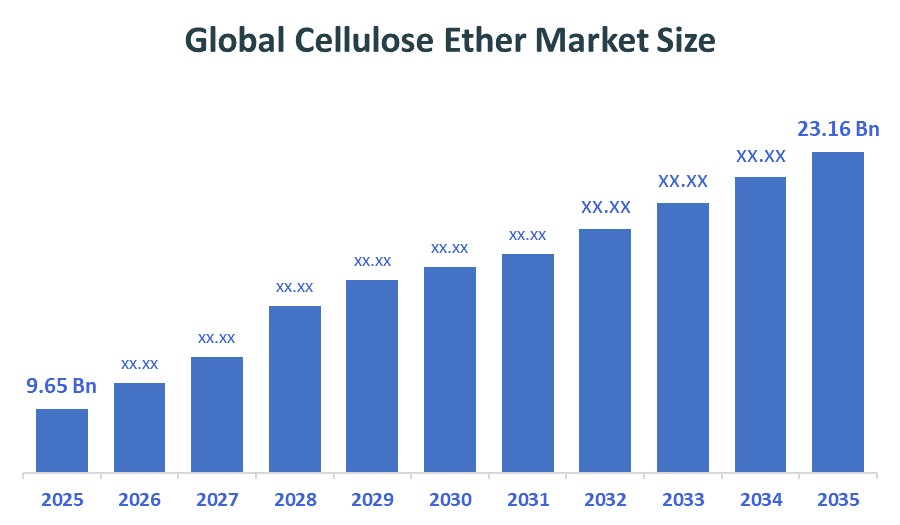
- Global Cellulose Ether Market Size (2025): USD 9.65 Billion
- Projected Global Cellulose Ether Market Size (2035): USD 23.16 Billion
- Global Cellulose Ether Market Compound Annual Growth Rate (CAGR): 9.15%
- Largest Regional Market: Asia pacific
- 2nd Largest Region: North America
- Fastest Growing Region: Europe
- Base Year: 2025
- Historical Period: 2021–2024
- Forecast Period: 2026–2035
Market Overview/ Introduction
The Cellulose Ether Market encompasses a group of water-soluble polymers such as Carboxymethyl Cellulose (CMC) and Hydroxypropyl Methylcellulose (HPMC) derived from natural plant-based cellulose through chemical modification to act as essential thickeners, binders, and stabilizers. The real engine behind this growth is a global green movement. Governments are stepping in with massive support for instance, the EU's strict environmental laws are forcing companies to ditch synthetic chemicals for these biodegradable alternatives. In India, Companies aren't just sitting back, either. Looking forward, the biggest opportunities aren't just in traditional construction. We are seeing a massive spike in demand for smart medicine delivery (pills that release slowly over 24 hours), and even in the tech world, where these ethers are being used to help build more stable EV batteries. As the world moves away from plastics and harsh synthetics, cellulose ethers are becoming the go-to natural solution for almost every major industry.
- The government’s Bio-RIDE scheme is pumping over $1 billion into bio-manufacturing, making it easier for local plants to produce these materials.
- Leaders like Shandong Head are spending $80 million on new factories to churn out billions of plant-based medicine capsules, while Ashland is redesigning its products to make construction materials stronger and eco-friendlier.
Notable Insights: -
- Asia Pacific is anticipated to hold the largest share, approximately 45% of the Global Cellulose Ether Market over the predicted timeframe.
- North America is expected to grow at a steady CAGR in the Global Cellulose Ether Market during the forecast period.
- By product type, the Hydroxypropyl Methylcellulose (HPMC) segment dominated the market in 2025, and is projected to grow at a substantial CAGR of approximately 6.0% during the forecast period.
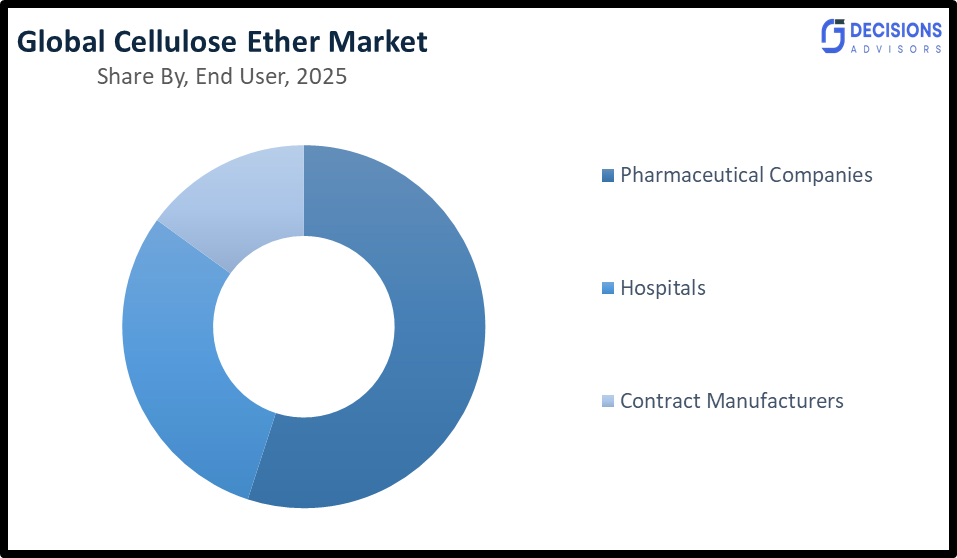
- By end user, the pharmaceutical companies segment dominated the market at a share of approximately 55% in 2025, and is projected to grow at a substantial CAGR during the forecast period.
- The compound annual growth rate of the Global Cellulose Ether Market is 9.15%.
- The market is likely to achieve a valuation of USD 23.16 Billion by 2035.
What is the role of technology in grooming the market?
Technology plays a crucial role in advancing the healthcare cellulose ether market by improving drug formulation, delivery efficiency, and product performance. Innovations such as controlled-release technologies allow cellulose ethers like HPMC to regulate how drugs are released in the body, enhancing patient compliance and treatment outcomes. Advanced coating and encapsulation techniques also improve drug stability and shelf life. A real-world example is the use of HPMC in extended-release tablets by pharmaceutical companies, where the polymer forms a gel barrier that controls the gradual release of active ingredients over time, reducing dosing frequency and improving effectiveness in chronic disease treatments like diabetes and cardiovascular conditions.
Market Drivers
Right now, the biggest push comes from a global shift toward green living. Governments and shoppers are moving away from harsh synthetic chemicals, and since cellulose ethers are made from natural stuff like wood and cotton, they have become the hero ingredient for eco-friendly products. Whether it’s a biodegradable paint or a natural thickener in your almond milk, this back to nature trend is a massive engine for growth.
At the same time, the market is seeing a huge building boom, especially in places like India and China. Cellulose ethers are like a secret sauce for construction; they help cement stay wet longer so workers can do a better job, which is essential for the massive infrastructure projects popping up everywhere. Add to that a healthcare revolution where people are ditching animal-based gelatin for plant-based veggie capsules, and you have a market that isn't just growing, it's evolving to fit a more conscious, high-tech world.
Restrain
The healthcare cellulose ether market faces restraints primarily due to strict regulatory requirements and high production costs associated with pharmaceutical-grade materials. Compliance with standards set by authorities such as the FDA and EMA increases time and cost for product approvals. Additionally, fluctuations in raw material prices and the need for high purity and consistency can limit profitability, especially for smaller manufacturers. These factors can slow down market expansion despite growing demand.
Competitive Analysis:
The report offers the appropriate analysis of the key organizations/companies involved within the global cellulose ether market, along with a comparative evaluation primarily based on their product of offering, business overviews, geographic presence, enterprise strategies, segment market share, and SWOT analysis. The report also provides an elaborative analysis focusing on the current news and developments of the companies, which includes product development, innovations, joint ventures, partnerships, mergers & acquisitions, strategic alliances, and others. This allows for the evaluation of the overall competition within the market.
Top Companies in the Global Cellulose Ether Market
- Ashland Inc
- Dow Inc
- Shin-Etsu Chemical Co., Ltd.
- Nouryon
- Lotte Fine Chemical
- CP Kelco
- Daicel Corporation
- Shandong Head Group Co., Ltd.
- Kima Chemical Co., Ltd.
- Rayonier Advanced Materials
Government Initiatives
|
Country |
Key Government Initiatives |
|
India |
India’s Bio-RIDE & BioE3 Policies: Launched in late 2024 and 2025, these schemes are designed to transform India into a global biomanufacturing hub. The government has allocated over USD 1.1 billion (?9,197 crore) to support research and scale-up for bio-based chemicals and biopolymers, including cellulose ethers
|
|
Europe |
European Green Deal & REACH Updates: The EU is tightening rules on synthetic polymers and microplastics. Recent updates to REACH regulations (expected 2025/2026) and the Chemicals Strategy for Sustainability prioritize non-toxic and bio-based ingredients, making cellulose ethers a preferred choice for construction and personal care sectors.
|
|
UK |
Modern Industrial Strategy (2025): The UK has designated Advanced Materials and Life Sciences as priority sectors for investment. The strategy includes £4.3 billion in funding for advanced manufacturing, with up to £2.8 billion earmarked for R&D in areas like sustainable bio-polymers- is it relate to cellulose ehter market
|
Study on the Supply, Demand, Distribution, and Market Environment of the Global Cellulose Ether Market
The healthcare cellulose ether market shows a stable supply driven by specialized chemical manufacturers producing pharmaceutical-grade excipients, while demand is steadily increasing due to the expansion of the global pharmaceutical and nutraceutical industries. Major demand comes from drug manufacturers using cellulose ethers in tablets, capsules, and controlled-release formulations. Distribution typically occurs through direct supply agreements and global excipient distributors to ensure quality compliance. The market environment remains highly regulated but positive, supported by rising healthcare needs and chronic disease prevalence. For instance, the growing production of generic medicines in countries like India has significantly increased the demand for excipients such as HPMC, as companies require reliable, compliant materials for large-scale drug manufacturing.
Price Analysis and Consumer Behaviour Analysis
In the healthcare segment, cellulose ether prices vary depending on the grade, purity, and application, with pharmaceutical-grade products such as HPMC being priced higher due to stringent quality and regulatory requirements. Prices are influenced by raw material costs (wood pulp, cotton), processing complexity, and compliance with pharmacopeia standards. From a consumer behavior perspective, pharmaceutical companies prioritize quality, consistency, and regulatory approval over cost, as these materials directly impact drug safety and performance. For example, large drug manufacturers prefer certified excipient suppliers even at premium prices to ensure compliance with FDA and GMP standards, especially in the production of controlled-release and critical care medications.
Market Segmentation
The Global Cellulose Ether Market share is classified into product type, application and end user.
- The Hydroxypropyl Methylcellulose (HPMC) segment dominated the market in 2025, and is projected to grow at a substantial CAGR of approximately 6.0% during the forecast period.
Based on the product type, the global cellulose ether market is divided into Hydroxypropyl Methylcellulose (HPMC), Carboxymethyl Cellulose (CMC), Methyl Cellulose (MC), and Hydroxyethyl Cellulose (HEC). Among these, the HPMC segment dominated the market in 2025, and is projected to grow at a substantial CAGR of approximately 6.0% during the forecast period. It is attributed to its excellent film-forming, binding, and controlled-release properties, making it widely used in tablet coatings, capsules, and sustained drug delivery systems. Additionally, HPMC is preferred due to its biocompatibility and suitability for plant-based capsule production, increasing its adoption in pharmaceutical applications.
- The pharmaceuticals segment accounted for the largest share in 2025, and is anticipated to grow at a significant CAGR of approximately 6.3% during the forecast period.
Based on the application, the global cellulose ether market is divided into pharmaceuticals, nutraceuticals, drug delivery systems, and medical devices. Among these, the pharmaceuticals segment accounted for the largest share in 2025, and is anticipated to grow at a significant CAGR of approximately 6.3% during the forecast period. It is attributed to the extensive use of cellulose ethers as excipients in tablets, capsules, and liquid formulations. The increasing global demand for medicines, particularly for chronic diseases, along with the growing adoption of controlled-release formulations, is further driving the adoption of cellulose ethers in this segment.
- The pharmaceutical companies segment dominated the market at a share of approximately 55% in 2025, and is projected to grow at a substantial CAGR during the forecast period.
Based on the end user, the global cellulose ether market is divided into pharmaceutical companies, hospitals, and contract manufacturers. Among these, the pharmaceutical companies segment dominated the market at a share of approximately 55% in 2025, and is projected to grow at a substantial CAGR during the forecast period. It is attributed to the large-scale consumption of cellulose ethers as excipients in tablet formulations, capsules, and controlled-release drug systems. Additionally, the increasing production of generic and branded medicines globally is driving the demand for high-quality pharmaceutical-grade cellulose ethers.
Strategies to Implement for Growth of the Market in Non-Leading Regions
Growth in non-leading regions of the healthcare cellulose ether market can be achieved by focusing on expanding local pharmaceutical manufacturing and strengthening supply chain networks. Companies should invest in regional production facilities to reduce costs and ensure consistent supply of pharmaceutical-grade excipients. Building partnerships with generic drug manufacturers and contract manufacturing organizations (CMOs) can improve market penetration. Additionally, increasing awareness about advanced drug delivery systems and ensuring compliance with international regulatory standards will help boost adoption. For example, the rapid expansion of generic drug production in countries like Brazil and Southeast Asia creates strong opportunities for cellulose ether suppliers to establish long-term supply agreements.
Regional Segment Analysis of the Global Cellulose Ether Market
- North America (U.S., Canada, Mexico)
- Europe (Germany, France, U.K., Italy, Spain, Rest of Europe)
- Asia-Pacific (China, Japan, India, Rest of APAC)
- South America (Brazil and the Rest of South America)
- The Middle East and Africa (UAE, South Africa, Rest of MEA)
Asia Pacific is anticipated to hold the largest share, approximately 45% of the Global Cellulose Ether Market over the predicted timeframe.
Asia Pacific is anticipated to hold the largest share, approximately 45% of the global cellulose ether market (Healthcare Segment) over the predicted timeframe. The region dominates due to its strong presence in pharmaceutical manufacturing, particularly in countries like China and India, where cellulose ethers are widely used as excipients in generic drug production. The availability of low-cost manufacturing, skilled labor, and abundant raw materials strengthens regional supply capabilities. Additionally, the rapid expansion of the healthcare sector, increasing demand for affordable medicines, and government initiatives supporting domestic pharmaceutical production further boost market growth. For instance, India’s growing role as a global supplier of generic medicines has significantly increased the demand for pharmaceutical-grade HPMC used in tablet formulations and capsules.
North America is expected to grow at a steady CAGR in the Global Cellulose Ether Market during the forecast period.
North America is expected to grow at a steady CAGR in the global cellulose ether market (Healthcare Segment) during the forecast period. The growth is driven by strong demand from the pharmaceutical and nutraceutical industries, particularly in the United States. The region benefits from advanced drug formulation technologies, strict regulatory frameworks, and high standards for excipient quality. Increasing adoption of controlled-release drug delivery systems and rising consumption of prescription medications are supporting market expansion. Additionally, the presence of major pharmaceutical companies and continuous investment in research and development contribute to innovation and high-quality product demand.
Europe is the third largest region in the Global Cellulose Ether Market (Healthcare Segment) during the forecast period.
Europe is the third largest region in the global cellulose ether market (Healthcare Segment) during the forecast period. The region is characterised by stringent regulatory standards and a strong emphasis on safe, high-quality pharmaceutical ingredients. Increasing demand for sustainable and plant-based excipients is influencing the adoption of cellulose ethers, especially in capsule and drug coating applications. The market is also supported by a well-established pharmaceutical industry and growing demand for advanced drug delivery systems. Additionally, rising focus on green chemistry and sustainable sourcing practices is encouraging manufacturers to invest in bio-based cellulose ether production. For instance, several European pharmaceutical companies are increasingly adopting HPMC-based vegetarian capsules to replace gelatin capsules in response to changing consumer preferences.
Future Market Trends in the Global Cellulose Ether Market: -
1. Growth in Controlled-Release Drug Delivery Systems
There is increasing adoption of cellulose ethers like HPMC in controlled and sustained-release formulations, allowing drugs to be released gradually over time. This improves patient compliance and treatment effectiveness, especially for chronic diseases.
2. Rising Demand for Plant-Based (Vegan) Capsules
Pharmaceutical companies are shifting from gelatin capsules to HPMC-based vegetarian capsules due to growing consumer preference for plant-based and allergen-free products, particularly in nutraceuticals and OTC medicines.
3. Expansion of Pharmaceutical Manufacturing in Emerging Markets
Countries like India and China are rapidly expanding generic drug production, driving higher demand for pharmaceutical excipients such as cellulose ethers used in tablets, coatings, and formulations.
Recent Development
- In March 2026, BlackRock launched its first staking-enabled Ethereum exchange-traded fund (ETF), the iShares Staked Ethereum Trust (ETHB), marking a major step in integrating blockchain-based yield into traditional financial markets.
- In March 2026, industry experts in India emphasized the need to strengthen quality standards and regulatory oversight for pharmaceutical excipients, with particular attention to widely used materials such as hydroxypropyl methylcellulose (HPMC). The discussion highlighted that excipients like HPMC play a critical role in ensuring drug stability, controlled release, and overall formulation performance.
- In January 2026, Univar Solutions entered into an exclusive distribution partnership with Ashland Inc. to expand access to cellulose ethers across the Europe, Middle East, and Africa (EMEA) food and beverage markets.
- In April 2025, Shin-Etsu Chemical announced that it was expanding its pharmaceutical cellulose business through major investments in Japan and Europe to meet rising global demand for high-performance excipients.
- In January 2022, Ashland Inc. announced that it had begun expanding production capacity for its Benecel cellulose ethers at its manufacturing facility in Doel, Belgium. The expansion, scheduled for completion in 2023, was set to increase capacity by more than 50% to meet rising global demand.
How are recent developments helping the Market?
Recent developments in the healthcare cellulose ether market are significantly improving drug performance, stability, and patient compliance. Innovations such as advanced controlled-release formulations and improved excipient technologies enable better regulation of drug release, enhancing therapeutic effectiveness. Additionally, the shift toward plant-based HPMC capsules is expanding market adoption due to increasing demand for vegan and allergen-free medicines.
Market Segment
This study forecasts revenue at global, regional, and country levels from 2020 to 2035. Decision Advisors has segmented the global cellulose ether market based on the below-mentioned segments:
Global Cellulose Ether Market, By Product Type
- Hydroxypropyl Methylcellulose (HPMC)
- Carboxymethyl Cellulose (CMC)
- Methyl Cellulose (MC)
- Hydroxyethyl Cellulose (HEC)
Global Cellulose Ether Market, By Application
- Pharmaceutics
- Nutraceuticals
- Drug Delivery Systems
- Medical Devices
Global Cellulose Ether Market, By End User
- Pharmaceutical Companies
- Hospitals
- Contract Manufacturers
Global Cellulose Ether Market, By Regional Analysis
- North America
- US
- Canada
- Mexico
- Europe
- Germany
- UK
- France
- Italy
- Spain
- Russia
- Rest of Europe
- Asia Pacific
- China
- Japan
- India
- South Korea
- Australia
- Rest of Asia Pacific
- South America
- Brazil
- Argentina
- Rest of South America
- Middle East & Africa
- UAE
- Saudi Arabia
- Qatar
- South Africa
- Rest of the Middle East & Africa
Frequently Asked Questions (FAQ)
Q. How do cellulose ethers impact drug dissolution rates?
A. Cellulose ethers, especially HPMC, help control drug dissolution by forming a gel layer when in contact with fluids, allowing precise regulation of how quickly the drug is released in the body.
Q. Are cellulose ethers compatible with all types of active pharmaceutical ingredients (APIs)?
A. Cellulose ethers are generally compatible with a wide range of APIs, but compatibility depends on factors like drug solubility, pH sensitivity, and formulation requirements, which must be evaluated during drug development.
Q3. What role do cellulose ethers play in moisture protection of drugs?
A.They act as protective barriers in coatings and capsules, preventing moisture penetration and thereby enhancing the stability and shelf life of moisture-sensitive drugs.
Q4. Can cellulose ethers be used in injectable drug formulations?
A. Cellulose ethers are primarily used in oral and topical formulations; their use in injectables is limited due to solubility and sterility constraints, although research is ongoing in specialized applications.
Q5. How is the quality of pharmaceutical-grade cellulose ether ensured?
A. Quality is maintained through strict adherence to pharmacopeial standards (USP, EP) and Good Manufacturing Practices (GMP), along with rigorous testing for purity, viscosity, and microbial limits
Check Licence
Choose the plan that fits you best: Single User, Multi-User, or Enterprise solutions tailored for your needs.
We Have You Covered
- 24/7 Analyst Support
- Clients Across the Globe
- Tailored Insights
- Technology Tracking
- Competitive Intelligence
- Custom Research
- Syndicated Market Studies
- Market Overview
- Market Segmentation
- Growth Drivers
- Market Opportunities
- Regulatory Insights
- Innovation & Sustainability
Report Details
| Scope | Global |
| Pages | 240 |
| Delivery | PDF & Excel via Email |
| Language | English |
| Release | Apr 2026 |
| Access | Download from this page |