
China Anticoccidial Drugs Market
 |
Author:
David J
|
Pages:
210
|
Author:
David J
|
Pages:
210
China Anticoccidial Drugs Market Size, Share, By Product Type (Ionophore Anticoccidials, Chemical/Synthetic Anticoccidials, Antibiotic Anticoccidials, Combination Anticoccidials), By Application (Poultry, Swine, Cattle, Aquaculture, Companion Animals, Others), By End User (Commercial Farms, Veterinary Hospitals & Clinics, Feed Mills, Others), Analysis and Forecast 2026?2035
CAGR
9.0%
REVENUE 2025
USD Billion 12.5
FORECAST 2035
USD Billion 29.6
REPORT COVERAGE
Country
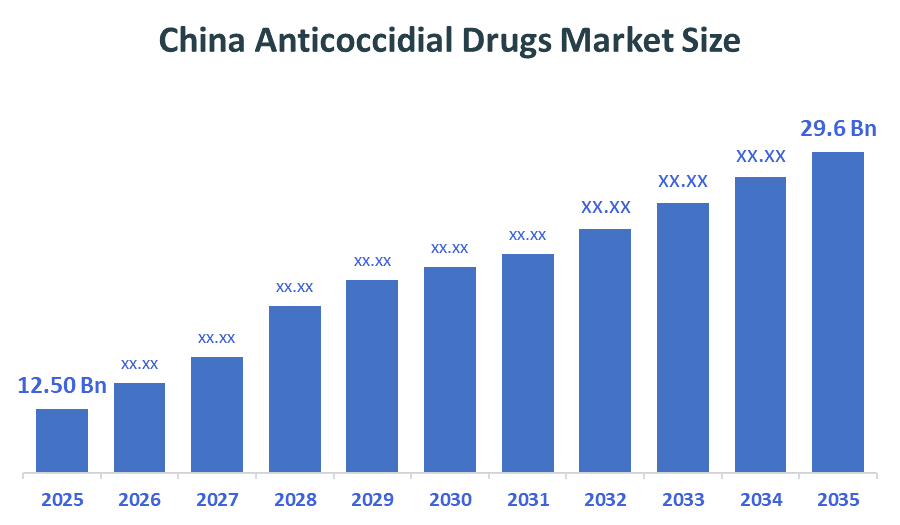
The China Anticoccidial Drugs Market Size is foreseen to grow from USD 12.50 Billion in 2025 and is govern to reach around USD 29.6 Billion by 2035. According to Decision Advisors, a detailed research report on the China Anticoccidial Drugs Market is boosted by intensification and industrialisation of poultry farming, accounting for nearly upto the 20% to 30% share of the total share. Elanco Animal Health is the prime player in the market with approximately USD 41.1 million in annual turnover and a 39-41% market share, positioning it as the primary driver of the china anticoccidial drugs market.
Market Snapshot
- China Anticoccidial Drugs Market Size (2025): USD 12.50 Billion
- Projected China Anticoccidial Drugs Market Size (2035): USD 29.6 Billion
- China Anticoccidial Drugs Market Compound Annual Growth Rate (CAGR): 9%
- Market Base Year: 2025
- Historical Period: 2021–2024
- Forecast Period: 2026–2035
Market Overview/Introduction
The China anticoccidial drugs market is currently booming. This growth is really a byproduct of China’s massive appetite for poultry, with so many birds being raised in high density farms, keeping them healthy and disease-free is a top priority for producers. While standard treatments like ionophores still lead the pack because they work so well at scale, the industry is starting to pivot. Thanks to stricter food safety rules and concerns over drug resistance, we are seeing a big push toward cleaner alternatives like botanical additives and vaccines. It’s a competitive landscape where global names like Zoetis rub shoulders with local powerhouses like Qilu Animal Health, all while digital platforms make it easier than ever for large farms to buy these supplies directly from the factory.
Notable Insights: -
- By product type, the ionophore anticoccidials segment dominated the market in 2025, accounting for approximately 45% of market share, and is projected to grow at a substantial CAGR during the forecast period.
- By end user, the commercial farms segment dominated the market in 2025, accounting for approximately 60% of market share, and is projected to grow at a substantial CAGR during the forecast period.
- The compound annual growth rate of the China anticoccidial drugs market is 9%.
- The market is likely to achieve a valuation of USD 1608.5 by 2035.
What is the role of technology in grooming the market?
Technology is playing a transformative role in the China anticoccidial drugs market by improving drug efficacy, safety, and delivery mechanisms. Innovations such as precision feed additives, controlled-release formulations, and combination drug therapies are enhancing the effectiveness of anticoccidial treatments. Additionally, advancements in diagnostic tools allow early detection of coccidiosis, enabling timely intervention. The integration of digital livestock monitoring systems is also helping farmers track disease outbreaks and optimize drug usage, reducing overdependence and resistance development.
Market Drivers
The growth of China’s anticoccidial drugs market is really being propelled by the sheer scale of its poultry industry. When you have lots of birds being raised in high-volume farms, keeping them healthy isn't just a choice, it’s an economic necessity to prevent huge losses from disease outbreaks. This demand is further amplified by a growing middle class that wants more affordable, high-quality protein on the dinner table. At the same time, the industry is at a turning point, because of rising issues over drug-resistant superbugs and stricter government rules on food safety, farmers are moving away from old-school chemicals. Instead, they are rapidly turning to convenient options like herbal feed additives, probiotics, and vaccines to keep their livestock healthy while meeting the modern standards for cleaner, safer meat.
Study on the Supply, Demand, Distribution, and Market Environment of the China Anticoccidial Drugs Market
The supply, demand, distribution, and market environment of the China anticoccidial drugs market are closely tied to the country’s large-scale poultry production industry. Supply is primarily supported by strong domestic manufacturing along with contributions from multinational animal health companies, ensuring consistent availability of feed-grade and pharmaceutical anticoccidial products. Demand is driven predominantly by intensive poultry farming, where preventive disease management is essential to maintain productivity and reduce economic losses caused by coccidiosis. Distribution occurs through veterinary drug distributors, feed mills, and direct sales to large poultry integrators, enabling efficient bulk delivery. The market environment is shaped by government regulations on drug residues, increasing focus on food safety, and rising concerns over antimicrobial resistance, which are encouraging the adoption of safer and more advanced anticoccidial solutions.
Price Analysis and Consumer Behaviour Analysis
Pricing in the China anticoccidial drugs market is influenced by drug type, formulation, and brand positioning, with ionophore-based products generally being more affordable, while synthetic and combination drugs command higher prices due to enhanced efficacy and resistance control. Bulk purchasing by large poultry integrators also contributes to competitive pricing. From a consumer behaviour perspective, farmers prioritise cost-effectiveness, reliability, and ease of administration, often favouring feed-based preventive solutions over treatment-based approaches. Additionally, there is a growing inclination toward rotational drug usage and advanced formulations to manage resistance and ensure long-term productivity.
Market segmentation
The China Anticoccidial Drugs Market is classified into product type, application and end user.
- The ionophore anticoccidials segment dominated the market in 2025, accounting for approximately 45% of market share, and is projected to grow at a substantial CAGR during the forecast period.
Based on the product type, the China anticoccidial drugs market is divided into ionophore anticoccidials, chemical/synthetic anticoccidials, antibiotic anticoccidials, and combination anticoccidials. Among these, the ionophore anticoccidials segment dominated the market in 2025, accounting for approximately 45% of market share, and is projected to grow at a substantial CAGR during the forecast period. This dominance is attributed to their cost-effectiveness and extensive use as feed additives in large-scale poultry farms across China. For instance, commonly used ionophores such as monensin and salinomycin are routinely incorporated into broiler feed to prevent coccidiosis throughout the production cycle. However, recent studies in China highlight increasing resistance to both ionophore and synthetic drugs due to prolonged usage, pushing the industry toward combination therapies and next-generation formulations.
- The poultry segment accounted for the largest share in 2025 and is anticipated to grow at a significant CAGR during the forecast period.
Based on the application, the China anticoccidial drugs market is divided into poultry, swine, cattle, aquaculture, companion animals, and others. Among these, the poultry segment accounted for approximately 70% of market share in 2025 and is anticipated to grow at a significant CAGR during the forecast period. This is primarily due to the high prevalence of coccidiosis in poultry farms, with infection rates in China reported between 21% and 67%, significantly impacting productivity and profitability. Additionally, almost all commercial poultry farms in China rely on anticoccidial drugs as feed additives throughout the birds’ lifecycle, making this segment the largest consumer.
- The commercial farms segment dominated the market in 2025, accounting for approximately 60% of market share, and is projected to grow at a substantial CAGR during the forecast period.
Based on the end user, the China anticoccidial drugs market is divided into commercial farms, veterinary hospitals & clinics, feed mills, and others. Among these, the commercial farms segment dominated the market in 2025, accounting for approximately 60% of market share, and is projected to grow at a substantial CAGR during the forecast period. This dominance is attributed to the rapid expansion of intensive poultry farming systems in China, where disease prevention is critical for maintaining high output. Real-world practices show that large poultry integrators adopt continuous medication programs and drug rotation strategies to control outbreaks and reduce resistance risks. Furthermore, increasing regulatory pressure on antibiotic use has encouraged farms to adopt structured anticoccidial programs and alternative solutions such as phytogenic additives and probiotics, shaping evolving consumption patterns.
Recent Development
- In May 2025, HIPRA launched its coccidiosis vaccines (EVALON and EVANT) in Asia through regional distribution partnerships. These launches support a shift toward preventive and vaccine-based alternative alongside traditional anticoccidial drugs in markets like China.
- In March 2026, updated product developments around Vecoxan (diclazuril oral suspension) highlighted its continued expansion and usage in livestock for effective coccidiosis control, supporting growing adoption in intensive farming systems.
Competitive Analysis
The report offers the appropriate analysis of the key organisations/companies involved within the China anticoccidial drugs market, along with a comparative evaluation primarily based on their product offering, business overviews, geographic presence, enterprise strategies, segment market share, and SWOT analysis. The report also provides an elaborative analysis focusing on the current news and developments of the companies, which includes product development, innovations, joint ventures, partnerships, mergers & acquisitions, strategic alliances, and others. This allows for the evaluation of the overall competition within the market.
Top Key Companies in the China Anticoccidial Drugs Market
- Elanco Animal Health
- Zoetis Inc.
- Boehringer Ingelheim
- Huvepharma
- Tianjin Ringpu Bio-Technology
Key Target Audience
- Market Players
- Investors
- End-users
- Government Authorities
- Consulting and Research Firm
- Venture capitalists
- Value-Added Resellers (VARs)
Market Segment
This study forecasts revenue at the United Kingdom, regional, and country levels from 2020 to 2035. Decision Advisors has segmented the China anticoccidial drugs market based on the below-mentioned segments
China Anticoccidial Drugs Market, By Product Type
- Ionophore Anticoccidials
- Chemical/Synthetic Anticoccidials
- Antibiotic Anticoccidials
- Combination Anticoccidials
China Anticoccidial Drugs Market, By Application
- Poultry
- Swine
- Cattle
- Aquaculture
- Companion Animals
- Others
China Anticoccidial Drugs Market, By End User
- Commercial Farms
- Veterinary Hospitals & Clinics
- Feed Mills
- Others
Frequently Asked Questions (FAQ)
Q1. How does seasonality affect the demand for anticoccidial drugs in China?
A. Seasonal changes, particularly warm and humid conditions, increase the risk of coccidiosis outbreaks, leading to higher demand for preventive anticoccidial treatments during these periods.
Q2. What role do feed formulation practices play in anticoccidial drug effectiveness?
A. Proper feed formulation ensures uniform drug distribution, improving efficacy and reducing the chances of under-dosing or resistance development in poultry populations.
Q3. How is export demand influencing anticoccidial drug usage in China?
A. Growing poultry exports are encouraging farmers to adopt stricter disease control measures, including regulated anticoccidial usage to meet international food safety standards.
Q4. What are the storage and handling challenges associated with anticoccidial drugs?
A. These drugs require controlled storage conditions to maintain stability and efficacy, especially in large-scale farms where bulk storage is common.
Q5. How are small-scale farms adapting to changes in anticoccidial drug regulations?
A. Small-scale farms are gradually shifting toward integrated disease management practices, including improved hygiene, vaccination, and selective drug usage to comply with evolving regulations.
Check Licence
Choose the plan that fits you best: Single User, Multi-User, or Enterprise solutions tailored for your needs.
We Have You Covered
- 24/7 Analyst Support
- Clients Across the Globe
- Tailored Insights
- Technology Tracking
- Competitive Intelligence
- Custom Research
- Syndicated Market Studies
- Market Overview
- Market Segmentation
- Growth Drivers
- Market Opportunities
- Regulatory Insights
- Innovation & Sustainability
Report Details
| Scope | Country |
| Pages | 210 |
| Delivery | PDF & Excel via Email |
| Language | English |
| Release | Apr 2026 |
| Access | Download from this page |