
China Antidiabetics Market
 |
Pages:
210
|
Pages:
210
China Antidiabetics Market Size, Share, By Diabetes Type (Type 1 Diabetes, Type 2 Diabetes, and other diabetes types), By Drug Class (Insulins, Oral Anti-diabetic Drugs, Non-Insulin Injectable Drugs, and Combination Therapies), By Drug Origin (Branded drugs, Generic drugs, and Biosimilars) By Distribution Channel (Hospital Pharmacies, Retail & Drug Stores, and Online Pharmacies / Providers) Analysis and Forecast 2026-2035
REPORT COVERAGE
Country
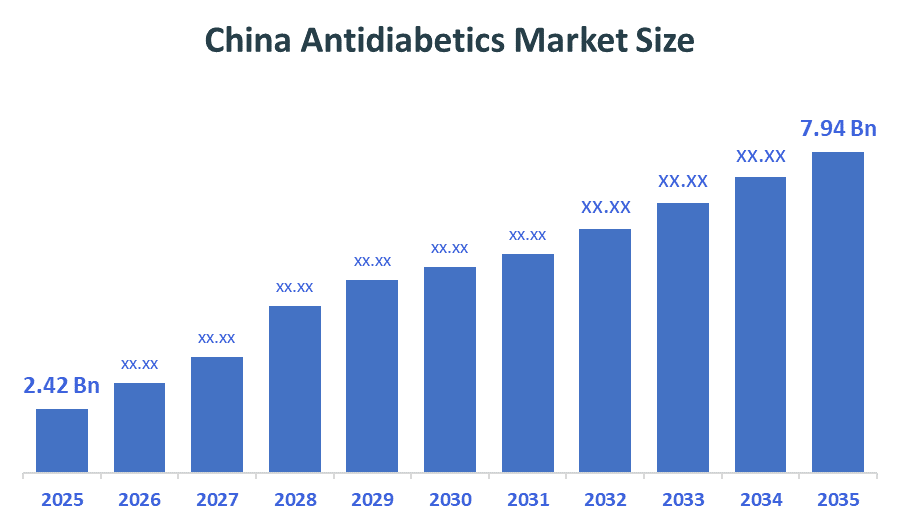
The China Antidiabetics Market Size is projected USD 2.42 Billion in 2025 and is forecasted to reach around USD 7.94 Billion by 2035. According to Decision Advisors, a detailed report on analysis of the China Antidiabetics Market indicates that the Rapid adoption of GLP-1 receptor agonists trend dominates the market, accounting for approx. 38–40% of the total China demand worldwide. Novo Nordisk is one of the most dominating companies in China’s Antidiabetics Market, supported by revenue of approx. USD 4.0 – 5.0 billion, due to strong GLP-1 portfolio, insulin dominance, and widespread hospital adoption nationwide.
Market Snapshot
- China Antidiabetics Market Size (2025): USD 2.42 Billion
- China Antidiabetics Market Projected Market Size (2035): USD 7.94 Billion
- China Antidiabetics Market Compound Annual Growth Rate (CAGR): 12.62%
- Base Year: 2025
- Historical Period: 2021–2024
- Forecast Period: 2026–2035
Market Overview/Introduction
China Antidiabetics Market is defined as the pharmaceutical industry that deals with medicines used for the prevention, management, and treatment of diabetes in China. Antidiabetics are drugs that assist in maintaining the levels of blood glucose in patients suffering from Type 1, Type 2, and other forms of diabetes. Antidiabetics comprise of insulins, oral anti-diabetic medicines, GLP-1 receptor agonists, SGLT2 inhibitors, and combination therapies. They are commonly used for the purpose of controlling blood glucose levels, preventing complications like heart disease, renal failure, and neuropathy, and improving the overall outcome of patients. The China Antidiabetics Market is currently witnessing rapid growth due to the increasing number of cases of diabetes, mainly type 2 diabetes, which can be attributed to the aging population, obesity, and sedentary lifestyle habits. Some of the major factors driving the China Antidiabetics Market include an increase in health consciousness, increasing penetration of health insurance, and better diagnosis rates. The innovation trend in China is also bolstered by the development of biosimilar products by local pharma firms as well as affordable GLP-1 drugs, decreasing reliance on imported medicines. Initiatives like the Healthy China 2030 program, NRDLs, and value-based procurement programs implemented by the government are making medications more accessible to patients. Furthermore, public health awareness programs and diabetes screening in hospitals are aiding early detection and adoption of treatment options.
- In January 2024, China’s NVBP policy sharply cut antidiabetic drug prices, reducing oral drugs by up to 74% and insulin by 42%, boosting access while lowering healthcare expenditure nationwide.
- In January 2026, China’s NRDL expanded coverage of GLP-1 antidiabetic therapies, reducing patient costs and improving access. Mounjaro (tirzepatide) was included in the 2025 update, with reimbursement effective.
Notable Insights: -
- By diabetes type, the Type 2 Diabetes segment holds a dominant position with an estimated share of over 86% in 2025.
- By drug class, the Insulins Antidiabetics segment holds a dominant position with an estimated share of over 43% in 2025.
- By distribution channel, the retail & drug stores segment holds a dominant position with an estimated share of over 53% in 2025.
- By drug origin, the branded drugs segment holds a dominant position with an estimated share of over 58% in 2025.
- The forecasted CAGR for the China Antidiabetics market is expected to be about 12.62% for the period between 2026 and 2035.
- The market is expected to reach a valuation of approximately USD 7.94 Billion by 2035
What is the Role of Technology in Grooming the Market?
Technology has played an important role in the development of China Antidiabetics Market by enhancing diagnoses and treatments as well as the process of disease management. With advanced technologies, such as the use of continuous glucose monitoring (CGM) devices, smart insulin pens, and insulin pumps, there is more accuracy in monitoring glucose levels and providing personalized treatments. Digital platforms and apps provide real-time monitoring of blood sugar levels and increase patient compliance. Technology can also be used for predicting complications through artificial intelligence and big data analytics. Furthermore, telemedicine increases accessibility to diabetes treatment services, even in remote locations. Moreover, technological advancements in biotechnology with GLP-1 receptor agonists, biosimilars, and insulin analogues have contributed significantly to treatment.
Market Drivers
The drivers of China Antidiabetics Market include several factors related to demographics, clinical, economics, and technology. One of the major drivers of the China Antidiabetics market is a fast-rising number of people affected with Type 2 diabetes, caused by such factors as aging of the population, urbanization, unhealthy eating habits, obesity, and leading a sedentary lifestyle. Increased understanding of the importance of diagnosis and development of effective screening programs have led to increased numbers of people treated for diabetes. Government policies aimed at encouraging the implementation of initiatives such as Healthy China 2030, as well as the creation of advanced healthcare infrastructure and inclusion of antidiabetic medications into NRDL, are greatly contributing towards making treatment affordable and easily accessible. Finally, advances in technology, including GLP-1 receptor agonists, SGLT2 inhibitors, biosimilar insulins, CGM systems, and smart insulin delivery devices, are transforming diabetes treatment, which, in turn, improves patients' adherence to treatment. The growth in the number of hospitals, availability of telemedicine and digital health programs, particularly in rural areas, is also playing a major role in diabetes management.
Restraints
The China Antidiabetics Market faces restraints such as high treatment costs for advanced therapies like GLP-1 receptor agonists, limiting patient affordability despite insurance coverage. Strict government pricing controls and volume-based procurement reduce profit margins for manufacturers. Limited awareness in rural regions delays early diagnosis and treatment. Additionally, side effects of certain antidiabetic drugs and dependency on long-term medication adherence also hinder market growth and patient compliance across China.
Study on the Supply, Demand, Distribution, and Market Environment
Demand for antidiabetic medicines in China comes from the ever-increasing number of diabetic patients, mostly with Type 2 diabetes, and increased awareness on time treatment for such diseases. The majority of demand occurs in urban hospitals; at the same time, rural areas witness gradual increase in access to healthcare services because of government healthcare reforms. Supply in China consists of both foreign companies and local manufacturers that produce branded medicines, generic versions, and biosimilars, thus providing widespread availability of products. Hospital pharmacy distribution channels dominate alongside retail and Internet sales, which account for the largest share of sales in the market.
Price Analysis and Consumer Behaviour Analysis
High price elasticity is observed in the China Antidiabetics Market because of tight government control over pricing, particularly through the implementation of Volume-Based Procurement (VBP), thereby minimizing the costs of insulin and oral antidiabetic products. Though such an improvement in accessibility results in smaller margins for drug makers, novel drugs, such as GLP-1 receptor agonists, continue to be costly, thus remaining out of reach for many poorer households regardless of the possibility of reimbursement. There has been a trend towards early diagnostics, long-term treatment, and use of innovative products with reduced adverse effects. In urban areas, patients are using GLP-1-based and SGLT2 drugs, whereas people from the countryside favour cheaper generics and insulin medications.
Market Segmentation
The China Antidiabetics market is categorised by diabetes type, drug class, drug origin and distribution channel
- The Type 2 Diabetes segment dominated the market in 2025 and is projected to grow at a steady CAGR of approximately 9.6% during the forecast period.
Based on the diabetes type, the antidiabetics market is divided into type 1 diabetes, type 2 diabetes, and other diabetes types. Among these, Type 2 Diabetes is the most dominant segment, accounting for approximately 85–90% of total market revenue in 2025. It also records a steady CAGR of approximately 8–10% due to rising obesity, sedentary lifestyles, and aging populations. Type 2 diabetes drives demand for oral antidiabetics, GLP-1 receptor agonists, and SGLT2 inhibitors.
- The Insulins Antidiabetics segment accounted for the largest share in 2025 and is anticipated to grow at a significant CAGR of approximately 5.6% during the forecast period.
Based on the drug class, the antidiabetics market is divided into insulins, oral anti-diabetic drugs, non-insulin injectable drugs, and combination therapies. Among these, Insulins remain the most dominant segment in 2025, accounting for approximately 40–45% of total antidiabetics market revenue due to their essential role in Type 1 diabetes and advanced Type 2 cases. However, they grow at a slower CAGR of approximately 4–6% due to increasing shift toward newer therapies. Oral antidiabetic drugs hold strong usage, but the fastest-growing segment is non-insulin injectables (especially GLP-1 receptor agonists), driven by higher efficacy and weight-loss benefits in Type 2 diabetes treatment.
- The Branded drugs segment accounted for the largest share in 2025 and is anticipated to grow at a significant CAGR of approximately 7.4% during the forecast period.
Based on the drug origin, the antidiabetics market is divided into branded drugs, generic drugs, and biosimilars. Among these, branded drugs dominate the antidiabetics market in 2025, accounting for approximately 55–60% of total market revenue, driven by strong demand for innovative therapies like GLP-1 receptor agonists and patented insulin analogue. However, branded drugs grow at a moderate CAGR of 6–8% due to patent expirations and pricing pressures.
- The hospital pharmacies segment accounted for the largest share in 2025 and is anticipated to grow at a significant CAGR of approximately 6.3% during the forecast period.
Based on the distribution channel, the Antidiabetics market is divided into hospital pharmacies, retail & drug stores, and online pharmacies / providers. Among these, the hospital pharmacies dominate the antidiabetics market in 2025, accounting for approximately 50–55% of total market revenue due to high prescription rates, chronic disease management programs, and preference for insulin and advanced injectables in clinical settings. This segment shows a steady CAGR of approximately 5–7%, supported by increasing diabetes hospitalizations and government healthcare access initiatives.
Recent Developments
- In September 2025, Tzield (teplizumab) was approved in China as the first disease-modifying therapy for Type 1 diabetes, delaying progression from Stage 2 to Stage 3, marking a breakthrough.
- In December 2024, Sanofi announced a €1 billion insulin manufacturing hub in Beijing in December 2024, strengthening local production capacity and supporting China’s rising demand for diabetes care and antidiabetic therapies.
Competitive Analysis
The report offers the appropriate analysis of the key organisations/companies involved within the China Antidiabetics market, along with a comparative evaluation primarily based on their product offering, business overviews, geographic presence, enterprise strategies, segment market share, and SWOT analysis. The report also provides an elaborate analysis focusing on the current news and developments of the companies, which includes product development, innovations, joint ventures, partnerships, mergers & acquisitions, strategic alliances, and others. This allows for the evaluation of the overall competition within the market.
Top Key Companies in the China Antidiabetics Market
- Novo Nordisk
- Eli Lilly and Company
- Sanofi
- Merck & Co.
- AstraZeneca
- Boehringer Ingelheim
- Gan & Lee Pharmaceuticals
- Tonghua Dongbao Pharmaceutical
- Hengrui Medicine
- CSPC Pharmaceutical Group
- Others
Key Target Audience
- Market Players
- Investors
- End-users
- Government Authorities
- Consulting and Research Firm
- Venture capitalists
- Value-Added Resellers (VARs)
Market Segmentation
This study forecasts revenue at the China, national and regional levels from 2020 to 2035. The report segmented the China Antidiabetics Market based on the following segments:
China Antidiabetics Market, By Diabetes Type
- Type 1 Diabetes
- Type 2 Diabetes
- Other diabetes types
China Antidiabetics Market, By Drug Class
- Insulins
- Oral Anti-diabetic Drugs
- Non-Insulin Injectable Drugs
- Combination Therapies
China Antidiabetics Market, By Drug Origin
- Branded drugs
- Generic drugs
- Biosimilars
China Antidiabetics Market, By Distribution Channel
- Hospital Pharmacies
- Retail & Drug Stores
- Online Pharmacies / Providers
Frequently Asked Questions (FAQ)
Q1. What factors are contributing to the growth of the China Antidiabetics Market?
A: The market is growing due to increasing diabetes prevalence, rising awareness of early diagnosis, government healthcare reforms, and wider availability of treatment options across China.
Q2. Which trends are shaping the treatment landscape in the China Antidiabetics Market?
A: Key trends include the shift toward advanced therapies such as GLP-1 receptor agonists, improved digital diabetes management tools, and increasing adoption of biosimilars and combination therapies.
Q3. How does government policy influence the China Antidiabetics Market?
A: Government initiatives improve drug accessibility and affordability through pricing reforms, insurance coverage expansion, and programs that support broader healthcare access across urban and rural regions.
Q4. What role does digital healthcare play in diabetes management in China?
A: Digital healthcare supports better disease monitoring and treatment adherence through remote consultation services, mobile health platforms, and technology-enabled patient tracking systems.
Q5. How is competition structured in the China Antidiabetics Market?
A: The market is highly competitive, involving both multinational pharmaceutical companies and domestic manufacturers that compete across branded, generic, and biosimilar product segments.
Check Licence
Choose the plan that fits you best: Single User, Multi-User, or Enterprise solutions tailored for your needs.
We Have You Covered
- 24/7 Analyst Support
- Clients Across the Globe
- Tailored Insights
- Technology Tracking
- Competitive Intelligence
- Custom Research
- Syndicated Market Studies
- Market Overview
- Market Segmentation
- Growth Drivers
- Market Opportunities
- Regulatory Insights
- Innovation & Sustainability
Report Details
| Scope | Country |
| Pages | 210 |
| Delivery | PDF & Excel via Email |
| Language | English |
| Release | Apr 2026 |
| Access | Download from this page |