
China Arthroscopy Market
 |
Author:
Disha B
|
Pages:
240
|
Author:
Disha B
|
Pages:
240
China Arthroscopy Market Size, Share By Product (Ablation Systems, Visualization Systems, Fluid Management Systems), By Application (Knee, Shoulder, Hip, Elbow), China Arthroscopy Market Insights, Industry Trend, Forecasts to 2035
CAGR
5.1%
REVENUE 2025
USD Million 383.35
FORECAST 2035
USD Million 630.32
REPORT COVERAGE
Country
Market Snapshot
- China Arthroscopy Market Size (2025): USD 383.35 Million
- China Arthroscopy Projected Market Size (2035): USD 630.32 Million
- China Arthroscopy Compound Annual Growth Rate (CAGR): 5.1%
- Base Year: 2025
- Historical Period: 2021–2024
- Forecast Period: 2026–2035
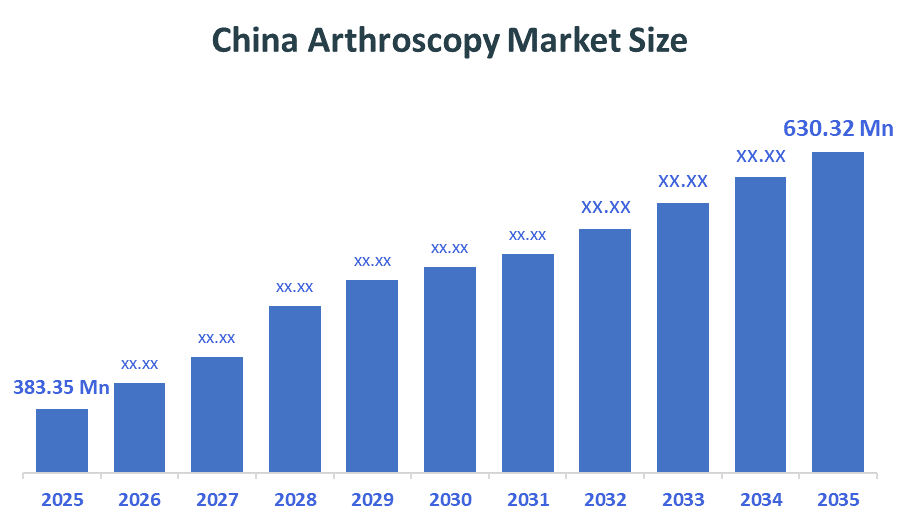
According to Decision Advisors, the China Arthroscopy market was projected to grow from USD 383.35 million in 2025 to USD 630.32 million by 2035, achieving a CAGR of 5.1% during the forecast period of 2026–2035. China Arthroscopy market is primarily driven by the rising prevalence of orthopaedic disorders, including knee and shoulder injuries, coupled with growing geriatric population and increasing sports-related injuries. Additionally, advancements in minimally invasive surgical techniques, improved healthcare infrastructure, and rising awareness among patients and surgeons about faster recovery and reduced complications are fuelling demand across hospitals and orthopaedic clinics nationwide.
Market Overview/Introduction
The China arthroscopy market refers to the industry focused on arthroscopic procedures and devices used to diagnose and treat joint-related conditions such as ligament tears, meniscal injuries, cartilage damage, and degenerative joint diseases through minimally invasive surgery. Arthroscopy utilizes specialized instruments and high?definition visualization systems inserted through small incisions to improve surgical precision, reduce tissue trauma, and accelerate patient recovery compared with open surgery. The market is expanding due to the rising prevalence of joint disorders, including osteoarthritis and sports injuries, driven by China’s aging population and increasing physical activity. Growing patient awareness of the benefits of minimally invasive techniques and the expanding orthopaedic surgical infrastructure in public and private hospitals further support adoption. Continuous technological advancements such as enhanced imaging systems, arthroscopes with improved optics, and integration of digital and robotic assistance—are enhancing procedural accuracy and patient outcomes. Policy frameworks like “Healthy China 2030” and broader healthcare reforms emphasize improved access, innovation in medical technologies and services, and development of high?end medical devices, which indirectly bolster the environment for advanced arthroscopic technologies and related healthcare delivery.
- In early 2026, China expanded its Volume-Based Procurement (VBP) program to cover more high-value medical consumables. This is expected to lower device costs and boost arthroscopic procedure volumes, especially in lower-tier cities, improving patient access nationwide.
- In February 2026, China’s NMPA issued the 2026 National Plan for Medical Device Industry Standards, covering implantable and orthopaedic devices, joint replacements, packaging, and sterility, supporting quality upgrades, innovation, and adoption of arthroscopy-adjacent technologies nationwide.
- In January 2026, China’s Volume-Based Procurement (VBP) program expanded for orthopaedic and sports medicine devices, including arthroscopy. Price reductions boost public hospital adoption, accelerate domestic substitution, pressure foreign margins, and increase overall arthroscopic procedure volumes nationwide.
Notable Insights: -
- By product type, the arthroscopy instruments segment holds a dominant position with an estimated share of over 59% in 2025.
- By application, the knee segment holds a dominant position with an estimated share of over 54% in 2025.
- By end-user, the hospitals segment holds a dominant position with an estimated share of over 57% in 2025.
- The forecasted CAGR for the China Arthroscopy market is expected to be about 5.1% for the period between 2026 and 2035.
- The market is expected to reach a valuation of approximately USD 630.32 million by 2035
What is the Role of Technology in Grooming the Market?
Technology plays a pivotal role in shaping the China arthroscopy market by enhancing surgical precision, improving patient outcomes, and expanding procedural adoption. Advanced arthroscopy instruments, high-definition cameras, and visualization systems allow minimally invasive procedures with smaller incisions, faster recovery, and reduced complications. Innovations such as digital imaging, 3D navigation, and robotic-assisted arthroscopy further improve accuracy and efficiency, attracting more hospitals and surgeons to adopt these techniques. Continuous technological advancements also drive domestic substitution of imported devices, support training of specialists, and improve accessibility in lower-tier cities, collectively boosting procedure volumes and accelerating overall market growth.
Market Drivers
The China arthroscopy market is driven by multiple factors fuelling its rapid growth. Primarily, the rising prevalence of joint disorders, including osteoarthritis, rheumatoid arthritis, and meniscal injuries, has increased demand for minimally invasive procedures. A growing sports culture and higher participation in physical activities have contributed to more ligament, tendon, and cartilage injuries, further boosting arthroscopy adoption. Patients and surgeons increasingly prefer minimally invasive surgeries due to smaller incisions, reduced pain, faster recovery, and shorter hospital stays. Continuous technological advancements, such as high-definition imaging systems, advanced arthroscopes, and digital or robotic-assisted procedures, enhance precision and improve patient outcomes, encouraging wider use. Additionally, increasing awareness among patients about arthroscopy benefits, coupled with expansion of orthopaedic infrastructure in hospitals, specialty clinics, and ambulatory surgical centres across China, supports market growth. Government initiatives under “Healthy China 2030” and healthcare reforms that promote innovative medical technologies and improved access also indirectly drive adoption of advanced arthroscopic procedures nationwide.
Restraints
The China Arthroscopy market faces restraints such as stringent regulatory compliance for food additives, rising raw material costs, and challenges in sourcing natural ingredients sustainably. Consumer concerns over artificial Arthroscopy and allergens limit adoption, while intense competition and price sensitivity among manufacturers hinder profit margins. Additionally, complex supply chains and seasonal variations affect consistent product availability.
Study on the Supply, Demand, Distribution, and Market Environment
The China arthroscopy market exhibits a growing demand driven by the rising incidence of joint disorders and sports injuries, with knee arthroscopy leading usage due to high prevalence of knee issues. Supply is supported by both domestic and global manufacturers offering advanced arthroscopes, visualization systems, ablation, and other instruments, though high equipment costs persist. Distribution primarily occurs through hospitals, orthopaedic clinics, and surgical centres concentrated in urban regions, with expansion into lower?tier cities as healthcare access improves. The market environment reflects rising awareness, steady technological innovation, and competitive dynamics among key players, while cost and workforce constraints continue to shape growth patterns.
Price Analysis and Consumer Behaviour Analysis
In the China arthroscopy market, prices for arthroscopic devices and procedures vary widely based on technology sophistication, with advanced visualization systems and implants commanding premium costs, while basic instruments are relatively lower priced, reflecting varying purchasing power of hospitals and clinics. Imported high?end equipment often carries higher costs due to tariffs and supply chain factors. Consumers (patients) tend to prioritize value, outcomes, and recovery benefits when opting for arthroscopic surgeries, showing willingness to pay more for minimally invasive procedures that reduce hospitalization time and improve recovery, but are price sensitive where insurance coverage is limited or out?of?pocket expenses are high. Demand is strongest in urban areas with better healthcare access, while cost constraints and reimbursement policies influence adoption in smaller cities.
Market Segmentation
The China Arthroscopy Market is categorised by type, application, and end-user
- The arthroscopy instruments segment dominated the market in 2025 and is projected to grow at a steady CAGR of approximately 5.1% during the forecast period.
Based on the type, the arthroscopy market is divided into arthroscopy instruments, arthroscopy cameras & visualization systems, and arthroscopy accessories. Among these, the arthroscopy instruments segment dominates, driven by essential use in nearly all arthroscopic procedures, particularly for soft-tissue removal, ligament repair, and joint treatments. Core instruments generate the largest revenue share, while cameras, visualization systems, and accessories contribute less comparatively. Instruments also benefit from recurring usage and procedural dependency, sustaining demand. The overall market is projected to grow at a CAGR of around 5.0–5.1% from 2025 to 2030, arthroscopy instruments hold the largest market share, accounting for approximately 55–60% of total revenue with advanced visualization systems and high-definition cameras supporting future growth and adoption of minimally invasive techniques.
- The knee segment accounted for the largest share in 2025 and is anticipated to grow at a significant CAGR of approximately 5.2% during the forecast period.
Based on the application, the Arthroscopy market is divided into knee, shoulder, hip, wrist and others. Among these, the knee segment leads in revenue, generating approximately USD 145–150 million in 2025, which represents around 50–55% of the total market. This dominance is driven by the high prevalence of knee-related disorders, including osteoarthritis, meniscal tears, and sports injuries, which are commonly treated using minimally invasive arthroscopic procedures. The overall market is projected to grow at a CAGR of approximately 5.2% from 2025 to 2030, with the knee segment maintaining its leading position due to strong clinical demand, technological advancements in arthroscopy instruments and visualization systems, and increasing patient preference for faster recovery and improved surgical outcomes.
- The hospitals segment dominated the market in 2025 and is projected to grow at a substantial CAGR of approximately 5.7% during the forecast period.
Based on the end-user, the arthroscopy market is divided into hospitals, orthopaedic clinics, and ambulatory surgical centres. Among these, the hospitals segment dominates revenue, generating approximately USD 160–165 million in 2025, accounting for nearly 55–60% of the total market. This dominance is driven by hospitals’ advanced orthopaedic infrastructure, higher surgical capacity, and access to skilled specialists, which enable them to perform the majority of complex arthroscopic procedures. Ambulatory surgical centres and orthopaedic clinics contribute smaller revenue shares due to limited procedural volumes. The overall market is projected to grow at a CAGR of around 5.7% from 2025 to 2030, with hospitals continuing to lead in market share throughout the forecast period.
Recent Developments
In March?2026, China’s NMPA issued 26 new and revised medical device industry standards, emphasizing orthopaedic implants like metal bone plates, bone screws, and hip/knee prostheses, tightening requirements on materials, manufacturing, sterilization, and performance, a move expected to elevate quality and impact arthroscopy?related tools and implants.
In March 2026, Star Sports Medicine resubmitted its HKEX listing application, marking its second attempt. Holding approximately 6.5% of China’s sports medicine implants market, it is the largest domestic provider, strengthening its position in the arthroscopy and orthopaedic devices segment.
Competitive Analysis
The report offers the appropriate analysis of the key organisations/companies involved within the China Arthroscopy market, along with a comparative evaluation primarily based on their product offering, business overviews, geographic presence, enterprise strategies, segment market share, and SWOT analysis. The report also provides an elaborate analysis focusing on the current news and developments of the companies, which includes product development, innovations, joint ventures, partnerships, mergers & acquisitions, strategic alliances, and others. This allows for the evaluation of the overall competition within the market.
Top Key Companies in the China Arthroscopy Market
- Zhejiang Shendasiao Medical Instrument Co., Ltd.
- TITMED
- Shrek
- Xuzhou Hengjia Electronic Technology Co., Ltd.
- Tonglu Wanhe Medical Instrument Co., Ltd.
- Stryker Corporation
- Smith & Nephew plc
- Zimmer Biomet Holdings, Inc.
- Johnson & Johnson Services, Inc.
- Arthrex, Inc.
- Others
Key Target Audience
- Market Players
- Investors
- End-users
- Government Authorities
- Consulting and Research Firm
- Venture capitalists
- Value-Added Resellers (VARs)
Market Segmentation
This study forecasts revenue at the national and regional levels from 2021 to 2035. The report segmented the China arthroscopy market based on the following segments:
China Arthroscopy Market, By Product Type
- Arthroscopy instruments
- Arthroscopy cameras & visualization systems
- Arthroscopy Accessories
China Arthroscopy Market, By Application
- Knee
- Shoulder
- Hip
- Wrist
- Others
China Arthroscopy Market, By End-User
- Hospitals
- Orthopaedic clinics
- Ambulatory surgical centres
Frequently Asked Questions (FAQ)
Question: What is the market share of imported versus domestically manufactured arthroscopy devices in China?
Answer: The report does not provide a quantitative breakdown between imported and domestic arthroscopy devices, which is essential for understanding market dependency on foreign technologies.
Question: How is the China arthroscopy market segmented regionally at the provincial or city level?
Answer: The report lacks detailed regional segmentation, including revenue distribution, adoption rates, or growth trends across provinces, municipalities, or urban versus rural areas.
Question: What are the historical and projected procedure volumes for different types of arthroscopic surgeries (e.g., knee, shoulder)?
Answer: The report mentions revenue and CAGR but does not provide specific data on the number of procedures performed, limiting insights into clinical adoption trends.
Question: What are the average costs for arthroscopic procedures across different hospital tiers or cities in China?
Answer: The report does not detail procedure-level pricing, including variations based on hospital type, location, or insurance coverage, which affects patient affordability analysis.
Question: What is the demographic profile of patients undergoing arthroscopic surgeries in China?
Answer: While the report references aging and sports-active populations, it does not provide specific age, gender, or urban-rural demographic breakdowns of patients receiving arthroscopy procedures.
Check Licence
Choose the plan that fits you best: Single User, Multi-User, or Enterprise solutions tailored for your needs.
We Have You Covered
- 24/7 Analyst Support
- Clients Across the Globe
- Tailored Insights
- Technology Tracking
- Competitive Intelligence
- Custom Research
- Syndicated Market Studies
- Market Overview
- Market Segmentation
- Growth Drivers
- Market Opportunities
- Regulatory Insights
- Innovation & Sustainability
Report Details
| Scope | Country |
| Pages | 240 |
| Delivery | PDF & Excel via Email |
| Language | English |
| Release | Apr 2026 |
| Access | Download from this page |