
China Bend Testing Machines Market
 |
Author:
Pranali P
|
Pages:
210
|
Author:
Pranali P
|
Pages:
210
China Bend Testing Machines Market Size, Share, By Product Type (Automatic, Semi-Automatic, and Manual), By Machine Type (Universal Testing Machines, Mandrel Bend Testers, Guided Bend Testers, and Free Bend Testers), By Material Type (Metals, Polymers, Ceramics, and Composites), By End-Use Industry (Automotive, Aerospace & Defense, Construction, Electronics, and Academic Research), Analysis and Forecast 2026 - 2035
CAGR
4.58%
REVENUE 2025
USD Million 126.4
FORECAST 2035
USD Million 197.8
REPORT COVERAGE
Country
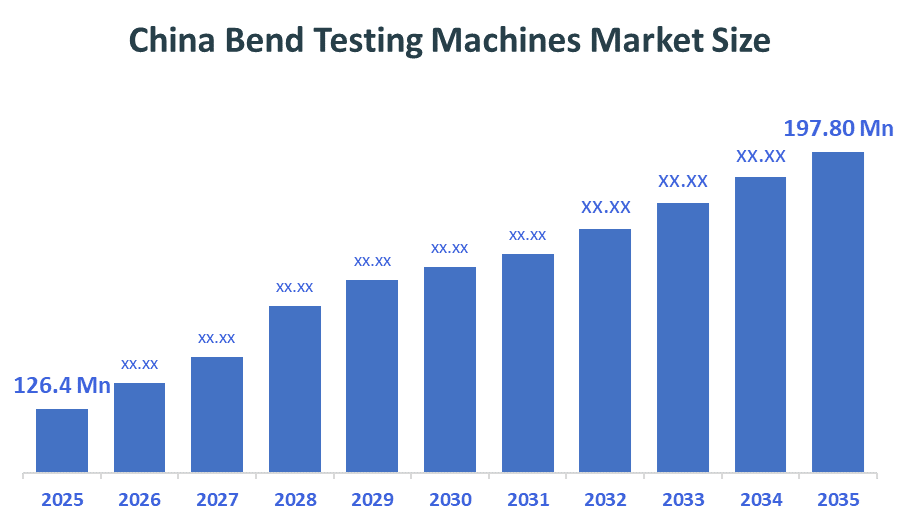
The China Bend Testing Machines Market Size is projected to grow from USD 126.4 Million in 2025 and is expected to reach approximately USD 197.80 Million by 2035. According to Decision Advisors, analysis of the Chinese bend testing market shows that the rising demand for automated and IoT-integrated material analysis systems is emerging as a dominant trend. Jinan Nake Test Equipment Co., Ltd. reported an annual export revenue of roughly USD 1.7 million, making it a key contributor to the China bend testing machines market.
Market Snapshot
- China Bend Testing Machines Market Size (2025): USD 126.4 Million
- China Bend Testing Machines Market Size (2035): USD 197.80 Million
- China Bend Testing Machines Compound Annual Growth Rate (CAGR): 4.58%
- Base Year: 2025
- Historical Period: 2021-2024
- Forecast Period: 2026-2035
Market Overview/Introduction
China bend testing machines market has become significant in the global material testing market due to the heavy manufacturing processes taking place in China and due to China being at the centre of metal manufacture in the world. The increased usage of powerful materials in industries like construction and automotive is seen as the primary driving force behind the growth of the market. CNC technology, hydraulic system and servo, and data collection systems are key components of China bend testing machines that help maintain safety in the tested material while also conforming to SAC and ISO international standards. Furthermore, high demand for testing devices from renewable energy and telecommunications markets increases the growth of the market. Current technological innovations that are taking place in the market include the application of AI in the detection of material defects and cloud-based LIMS to prevent human errors.
The current trend in China's test equipment market is the rapid acceptance of test equipment that is equipped with fast digital control and which is capable of handling heavy loads in universal frames for structural steel. Bending technology has gained popularity, particularly in special production areas such as the Pearl River and Yangtze River deltas, where special machines are used to test the strength of thin-film electronics and aerospace structures.
- In February 2026, the China Material Testing Association launched the Intelligent Laboratory Initiative to foster digital twin technology and automated testing workflows across the country’s industrial testing labs.
- In January 2026, leading manufacturers in Jinan expanded their smart production facilities, enhancing the precision of automatic rebar bend testers through integrated laser-scanning measurement systems.
Notable Insights: -
- The China bend testing machines market is expected to grow at a CAGR of approximately 4.58% from 2025 to 2035, driven by strong demand for lightweight automotive materials and government initiatives focused on New Infrastructure (Xinjijian) projects.
- By product type, fully automated bend testers are becoming increasingly popular because of their high output capabilities with little human interaction and excellent reproducibility of results.
- By end use, both the construction and automobile industries dominate this sector, with increasing urbanisation trends and consumers' heightened emphasis on the safety and structural integrity of automobiles in modern-day urban China.
What is the Role of Technology in Grooming the Market?
There are several aspects that make the China bend testing machines industry more complex today than before, among which we can single out the development of highly precise digital encoders and modular software. As for the most noticeable trends within the industry under consideration, we should note the introduction of a smart quality control system that becomes possible due to the use of data logging technology and is essential for meeting national requirements in industrial production and materials. What innovations should we mention as having an effect on the development of the industry? Apart from other technologies involved in the bend testing process, special multi-axis bending machines and temperature chambers are increasingly used in testing.
Market Drivers
The causes behind the expansion of China bend testing machine include the development of industrial robots and innovations in the areas of non-destructive and destructive testing management. In terms of the key variables affecting the equilibrium status of the market, the rising preference for the use of testing machines based on accuracy arises due to the advanced utilisation of manufacturing techniques and aerospace exports in the market. The demands of the automotive industry concerning materials with high fatigue and welding strengths ensure a steady demand for the superior grade category of products.
Restraints
While this may be a significant issue, there could be some difficulties associated with this due to the substantial financial investment necessary for installing this type of high-capacity system, as well as acquiring the advanced software. The difficulties could include difficulties in meeting international export requirements, as well as the technological gap in sensor manufacturing relative to our competition.
Study on the Supply, Demand, Distribution, and Market Environment
Speaking about the mechanical testing devices under discussion above, it will not be wrong to state that the type of goods represents a crucial component for the country, as the country heavily relies on the industrial engineering industry. Turning to the manufacturing locations of the specified part, one should pay attention to the fact that the components mentioned above are produced in specialised industrial zones situated in the Shandong (Jinan), Jiangsu (Suzhou), and Guangdong (Shenzhen) provinces. When speaking of the demand for the specific product, it should be mentioned that the demand level is relatively steady.
Price Analysis and Consumer Behaviour Analysis
In this context, considering the results gained by applying the pricing strategy, the following hierarchy emerges in the considered market concerning the issue that the manual bending tester has low prices in small enterprises, while the automatic universal testing machine, heavy-duty hydraulic testing machine, and certain environment chamber combined testing machine are expensive because of the complicated manufacturing process. Even though the equipment mentioned above is more costly than usual mechanical products, industrial consumers treat it as a product that will protect engineering projects from any problems in the long term. Speaking of the Chinese market, reliability and precision of the testing system are of great importance. Companies need to purchase more reliable testing machines, the purchase of which depends on many aspects, one of which is a zero-tolerance safety policy when material damage may become the factor that affects the decision. Moreover, some companies like ordering customised machines via the Internet.
Market Segmentation
The China bend testing machines market is categorised by product type, machine type, material type, and end-use industry.
The automatic segment dominated the market in 2025 and is projected to grow at a steady CAGR of approximately 7.1% during the forecast period.
Based on the product type, the bend testing machines market is divided into Automatic, Semi-Automatic, and Manual. Among these, the automatic segment dominated the market in 2025 and is projected to grow at a steady CAGR of approximately 7.1% during the forecast period. Such forms of dominance occur due to the high demands in terms of efficient cycles of product quality control that save manpower and industrial processes and guarantee a very effective flow. These types of products enjoy tremendous popularity among the Chinese automotive industry and Chinese electronics manufacturers as they suit the needs of the present-day automated production lines requiring real-time feedback and automatic detection of errors. The latest computer-controlled technology of servo and data logging through microprocessors has soon entered the Chinese manufacturing industry.
The universal testing machines segment dominated the market in 2025 and is projected to grow at a substantial CAGR of approximately 6.8% during the forecast period.
Based on the machine type, the bend testing machines market is divided into Universal Testing Machines, Mandrel Bend Testers, Guided Bend Testers, and Free Bend Testers. Among these, the universal testing machines segment dominated the market in 2025 and is projected to grow at a substantial CAGR of approximately 6.8% during the forecast period. This dominance is linked to the versatile nature of these systems, which can perform tension, compression, and bend tests on a single platform, making them highly cost-effective for multi-functional laboratories. These machines are essential for analyzing material ductility and fracture toughness in heavy industrial manufacturing. Advanced hydraulic and electromechanical systems are being utilised to ensure precision and compliance with rigorous global mechanical testing benchmarks.
The metals segment dominated the market in 2025 and is projected to grow at a significant CAGR of approximately 5.4% during the forecast period.
Based on the material type, the bend testing machines market is divided into Metals, Polymers, Ceramics, and Composites. Among these, the metals segment dominated the market in 2025 and is projected to grow at a significant CAGR of approximately 5.4% during the forecast period. This is primarily because the structural integrity of steel, aluminium, and various alloys is critical for China’s massive shipbuilding and high-speed rail networks. The demand for reliable metal deformation data drives the high adoption of these machines in metallurgical plants. With the rise of lightweight alloy development for the aerospace sector, manufacturers are increasingly adopting high-resolution sensors to monitor metal stress-strain behaviour during the bending process.
The automotive and construction segment dominated the market in 2025 and is projected to grow at a steady CAGR of approximately 5.8% during the forecast period.
Based on the end-use industry, the bend testing machines market is divided into Automotive, Aerospace & Defense, Construction, Electronics, and Academic Research. Among these, the automotive and construction segment dominated the market in 2025 and is projected to grow at a steady CAGR of approximately 5.8% during the forecast period. In actual fact, it is because of the efficiency and effectiveness of these industries in terms of large-scale material consumption and mandatory safety testing, coupled with stringent compliance with the Chinese National Building Standards, that these segments are the most consistent drivers for high-volume testing equipment. While aerospace and defense are maintaining a presence in the high-end specialised segment due to their precision-focused nature, the sheer volume of metal and rebar testing in the residential and civil engineering industry still makes the construction-related segments the giants of the market structure.
Recent Developments
- In April 2026, Jinan Nake Test Equipment Co., Ltd. achieved a historic milestone by launching its next-generation GW-series rebar bend testers with 100% automated angle detection, targeting a 15% increase in domestic market share for the 2026-27 fiscal period.
- In January 2026, the China Academy of Machinery Science and Technology accelerated the digital transformation of the material testing sector through the National Material Database Project, ensuring 100% digital traceability of testing results across state-level laboratories.
- In March 2025, ZwickRoell Taicang, in coordination with its German headquarters, strengthened its partnership with regional aerospace suppliers to localise the production of specialised Mflow extrusion plastometers and drop weight testers tailored for the Chinese high-performance polymer market.
Competitive Analysis:
The report offers the appropriate analysis of the key organisations/companies involved within the China bend testing machines market, along with a comparative evaluation primarily based on their product offering, business overviews, geographic presence, enterprise strategies, segment market share, and SWOT analysis. The report also provides an elaborate analysis focusing on the current news and developments of the companies, which includes product development, innovations, joint ventures, partnerships, mergers & acquisitions, strategic alliances, and others. This allows for the evaluation of the overall competition within the market.
Top Key Companies in the China Bend Testing Machines Market
- Jinan Nake Test Equipment Co., Ltd.
- Hualong Test Co., Ltd.
- Jinan Kason Testing Equipment Co., Ltd.
- Wance Technologies Ltd.
- MTS Systems (China)
- ZwickRoell (China Operations)
- Shimadzu (China) Co., Ltd.
- Suzhou Tophung Machine Equipment Co., Ltd.
- Guangdong Guangce Instrument Technology Co., Ltd.
- Jinan Victory Instrument Co., Ltd.
- Beijing United Test Co., Ltd.
- Dongguan Xin Bao Instrument Co., Ltd.
- Hangzhou Civit Instrument Equipment Co., Ltd.
- Suzhou Qiantong Instrument Equipment Co., Ltd.
- Jinan Hensgrand Instrument Co., Ltd.
- Others
Key Target Audience
- Market Players
- Investors
- End-users
- Government Authorities
- Consulting and Research Firm
- Venture capitalists
- Value-Added Resellers (VARs)
Market Segmentation
This study forecasts revenue at the national level from 2021 to 2035. The report segmented the China Bend Testing Machines Market based on the following segments:
China Bend Testing Machines Market, By Product Type
- Automatic
- Semi-Automatic
- Manual
China Bend Testing Machines Market, By Machine Type
- Universal Testing Machines
- Mandrel Bend Testers
- Guided Bend Testers
- Free Bend Testers
China Bend Testing Machines Market, By Material Type
- Metals
- Polymers
- Ceramics
- Composites
China Bend Testing Machines Market, By End-Use Industry
- Automotive
- Construction
- Aerospace & Defense
- Electronics
- Academic & Research Labs
Frequently Asked Questions (FAQ)
How is the demand for infrastructure safety driving the China bend testing machines market?
The focus on offering high-strength construction materials and controlling the structural failure risks acts as an effective motivational factor that can help move the industry ahead. The requirement for more sophisticated testing of rebar and structural steel, owing to their ability to ensure bridge and skyscraper stability, is a key factor that helps boost their significance in contemporary engineering plans.
What is the role of CNC technology, and how does it help growth?
It ensures that testing labs can correctly estimate the precise bending angle and peak load of materials by using computer-controlled actuators, which removes human error from the testing process without having to rely on manual measurement tools. It helps extend the reach of precision testing systems to ensure that all manufacturers, whether in industrial hubs or remote zones, have easy access to certified data.
What is the role of IoT and cloud connectivity in the market?
The recent trend is toward automated wireless data logging systems, which result in laboratory networks that lack the risk of data manipulation and have become highly appreciated within the global quality assurance and compliance industries. It not only enhances the transparency of the material certification process but also makes the equipment easier to calibrate and upgrade during operational cycles without damaging testing throughput.
How do SAC standards impact the 2035 forecast?
The national industrial safety policy calls for a move towards organised and digital material testing systems that are inherently quality assured and fully compatible with state-of-the-art laboratory standards. Coupled with the encouragement from the government on smart manufacturing technology and mandatory certification for export-grade materials, this ensures that the move towards intelligence and compliance-driven testing chains is achieved well before 2035.
Check Licence
Choose the plan that fits you best: Single User, Multi-User, or Enterprise solutions tailored for your needs.
We Have You Covered
- 24/7 Analyst Support
- Clients Across the Globe
- Tailored Insights
- Technology Tracking
- Competitive Intelligence
- Custom Research
- Syndicated Market Studies
- Market Overview
- Market Segmentation
- Growth Drivers
- Market Opportunities
- Regulatory Insights
- Innovation & Sustainability
Report Details
| Scope | Country |
| Pages | 210 |
| Delivery | PDF & Excel via Email |
| Language | English |
| Release | Apr 2026 |
| Access | Download from this page |