
China Control Cable Market
 |
Author:
Mayuri S
|
Pages:
190
|
Author:
Mayuri S
|
Pages:
190
China Control Cable Market Size, Share, By Type (Flexible Control Cables, Armored Control Cables, Shielded Control Cables, Unshielded Control Cables), By Material (Copper, Aluminum, Fiber Reinforced, Others), By End-Use Industry (Industrial Automation, Energy & Power, Construction, Transportation, Oil & Gas, Manufacturing) Analysis and Forecast 2026-2035.
CAGR
6.3%
REVENUE 2025
USD Billion 18.8
FORECAST 2035
USD Billion 34.62
REPORT COVERAGE
Country
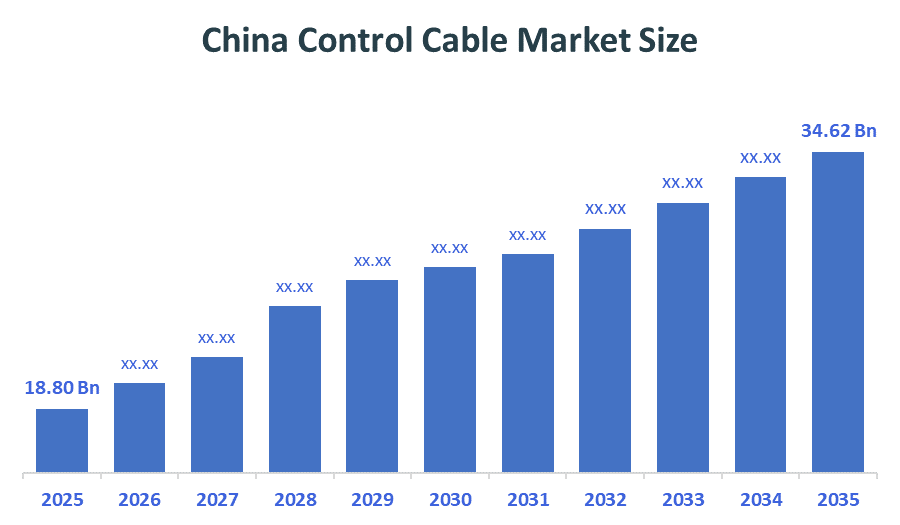
The China Control Cable Market Size is predicted to grow from USD 18.80 Billion in 2025 and is likely to reach around USD 34.62 Billion by 2035 with a CAGR of 6.3%. According to Decision Advisors, a detailed research report on the Industrial Automation Growth trend dominates the China Control Cable Market, accounting for approximately 22.5% of the total share in China. Prysmian Group leads the market with approximately annual revenue of approximately USD 400 million and approx 13% China market share, making it the leading contributor to global market development and growth dynamics.
Market Snapshot
- China Control Cable Market Size (2025): USD 18.80 Billion
- Projected China Control Cable Market Size (2035): USD 34.62 Billion
- Compound Annual Growth Rate (CAGR): 6.3%
- Base Year: 2025
- Historical Period: 2021–2024
- Forecast Period: 2026–2035
Market Overview/Introduction
The China control cable market refers to specialized electrical cables used for transmitting control signals in machinery, automation systems, and industrial equipment. These cables ensure reliable communication between control panels and devices in sectors such as manufacturing, energy, and construction. The market is witnessing strong growth due to China’s rapid industrial automation, expansion of smart manufacturing facilities, and large-scale infrastructure development. Increasing adoption of Industry 4.0 technologies and intelligent robotics is further boosting demand for high-performance control cables. Government investments in renewable energy projects and smart grid modernization are also supporting market expansion. Key benefits of control cables include improved system reliability, enhanced safety, resistance to electromagnetic interference, and efficient signal transmission across industrial environments.
Notable Insights: -
- By type, flexible control cables dominated the market with approximately 38% share in 2025.
- By material, copper-based control cables accounted for nearly 72% of the market share in 2025.
- The compound annual growth rate of the China Control Cable Market is 6.3%.
- The market is likely to achieve a valuation of USD 34.62 Billion by 2035.
What is role of technology in grooming the market?
The China control cable market is evolving with advancements in high-durability insulation materials, fire-resistant coatings, and low-smoke zero-halogen (LSZH) technologies. Smart manufacturing systems require cables with higher flexibility, temperature resistance, and long operational life. Integration of automation and robotics in production lines has increased demand for high-speed signal transmission cables with minimal interference. Additionally, IoT-enabled industrial environments require cables capable of supporting real-time data transmission and machine-to-machine communication. Advanced manufacturing techniques such as precision extrusion and nano-insulation are improving cable performance, reducing energy losses, and enhancing safety standards across industrial applications.
Market Drivers
The China control cable market is driven by rapid industrial automation, expansion of smart factories, and increasing investments in manufacturing infrastructure. Growth in energy and power transmission projects, including renewable energy expansion, is significantly boosting demand. Urbanization and construction activities are increasing installation of electrical systems in commercial and residential buildings. Additionally, rising adoption of robotics and IoT-based industrial systems is creating strong demand for reliable control wiring. Government support for industrial modernization and energy efficiency initiatives further accelerates market growth.
Restrain
High raw material price volatility, especially copper, impacts manufacturing costs and pricing stability. Intense competition among domestic manufacturers leads to margin pressure. Additionally, strict safety and certification requirements increase compliance costs for producers, limiting entry for small-scale players.
Strategies to Implement for Growth of the Market
Manufacturers are focusing on developing high-performance, fire-resistant, and environmentally safe cables to meet evolving safety standards. Expansion of production facilities in industrial hubs is improving supply chain efficiency. Companies are investing in automation-driven manufacturing processes to reduce production costs and improve quality consistency. Strategic partnerships with construction firms, power utilities, and industrial automation companies are increasing market penetration. Additionally, firms are expanding into export markets while developing customized cable solutions for robotics, renewable energy, and smart infrastructure applications.
Study on the Supply, Demand, Distribution, and Market Environment
The supply side is dominated by large-scale manufacturers focusing on copper-based and high-durability cable production. Demand is driven by industrial automation, energy infrastructure development, and manufacturing expansion. Distribution channels include direct B2B contracts, industrial distributors, and OEM partnerships. The market environment is shaped by government regulations on electrical safety, industrial modernization policies, and growing emphasis on energy-efficient infrastructure. Competitive intensity encourages innovation in materials, insulation, and performance optimization.
Price Analysis and Consumer Behaviour Analysis
Control cable pricing varies based on material quality, insulation type, and application requirements. Standard industrial control cables range from USD 0.5 to USD 5 per meter, contributing to nearly 64% of total revenue share due to high-volume industrial usage. Premium fire-resistant and armored cables account for around 36% of market value due to use in critical infrastructure and energy projects. Approximately 71% of buyers prioritize durability and safety compliance, while 52% focus on cost-effectiveness. Industrial buyers prefer long-term reliability, whereas construction firms prioritize availability and installation flexibility.
Market Segmentation
The China Control Cable Market share is classified into type, material and end-use industry.
- The flexible control cables segment dominated the market in 2025, and is projected to grow at a substantial CAGR of approximately 10.2% during the forecast period.
Based on type, the China Control Cable Market is divided into flexible control cables, armored control cables, shielded control cables, and unshielded control cables. Among these, the flexible control cables segment dominates in 2025, driven by increasing demand from robotics, automated machinery, and dynamic industrial applications requiring high flexibility and durability.
- The copper segment dominated the market in 2025, and is projected to grow at a substantial CAGR of approximately 9.6% during the forecast period.
Based on material, the market is divided into copper, aluminum, fiber reinforced, and others. Among these, the copper segment dominates in 2025 due to its superior electrical conductivity, reliability, and widespread use across industrial automation, power transmission, and infrastructure applications.
- The industrial automation segment accounted for the largest share in 2025, and is anticipated to grow at a significant CAGR of approximately 10.8% during the forecast period.
Based on end-use industry, the market is divided into industrial automation, energy & power, construction, transportation, oil & gas, and manufacturing. Among these, the industrial automation segment dominates in 2025 due to rapid adoption of smart factories, robotics, and Industry 4.0 technologies across China’s manufacturing sector.
Recent Development
- In March 2025, Prysmian Group expanded its high-performance cable manufacturing facility in Asia to support rising industrial automation demand in China.
- In December 2024, a leading Chinese cable manufacturer introduced next-generation fire-resistant control cables designed for smart factory and energy infrastructure applications.
Competitive Analysis
The report offers the appropriate analysis of the key organisations/companies involved within the China Control Cable Market, along with a comparative evaluation primarily based on their product offering, business overviews, geographic presence, enterprise strategies, segment market share, and SWOT analysis. The report also provides an elaborative analysis focusing on the current news and developments of the companies, which includes product development, innovations, joint ventures, partnerships, mergers & acquisitions, strategic alliances, and others. This allows for the evaluation of the overall competition within the market.
Top Key Companies in China Control Cable Market
- Prysmian Group
- Nexans S.A.
- LS Cable & System Ltd.
- Far East Cable Co., Ltd.
- Baosheng Cable Co., Ltd.
- Jiangnan Cable Co., Ltd.
- Hengtong Group Co., Ltd.
- Sumitomo Electric Industries
- Fujikura Ltd.
- Leoni AG
Key Target Audience
- Market Players
- Investors
- End-users
- Government Authorities
- Consulting and Research Firm
- Venture capitalists
- Value-Added Resellers (VARs)
Market Segment
This study forecasts revenue at the India, regional, and country levels from 2020 to 2035. Decision Advisors has segmented the China Control Cable Market based on the below-mentioned segments
China Control Cable Market, By Type
- Flexible Control Cables
- Armored Control Cables
- Shielded Control Cables
- Unshielded Control Cables
China Control Cable Market, By Material
- Copper
- Aluminum
- Fiber Reinforced
- Others
China Control Cable Market, By End-Use Industry
- Industrial Automation
- Energy & Power
- Construction
- Transportation
- Oil & Gas
- Manufacturing
Frequently Asked Questions (FAQ)
Q. How is industrial automation influencing demand for control cables in China?
Industrial automation is increasing demand for high-flexibility, high-durability control cables used in robotics, machinery, and smart factory systems.
Q. What role does renewable energy expansion play in market growth?
Renewable energy projects require extensive electrical infrastructure, boosting demand for reliable and high-performance control cables.
Q. How are smart factories impacting product innovation?
Smart factories are driving development of advanced cables with better heat resistance, flexibility, and real-time signal transmission capabilities.
Q. Why is copper still dominant in control cable manufacturing?
Copper offers superior conductivity, durability, and efficiency, making it the preferred material for industrial-grade applications.
Q. How are manufacturers addressing cost pressure in the market?
Companies are adopting automation, efficient raw material sourcing, and localized production to reduce manufacturing costs and improve margins.
Check Licence
Choose the plan that fits you best: Single User, Multi-User, or Enterprise solutions tailored for your needs.
We Have You Covered
- 24/7 Analyst Support
- Clients Across the Globe
- Tailored Insights
- Technology Tracking
- Competitive Intelligence
- Custom Research
- Syndicated Market Studies
- Market Overview
- Market Segmentation
- Growth Drivers
- Market Opportunities
- Regulatory Insights
- Innovation & Sustainability
Report Details
| Scope | Country |
| Pages | 190 |
| Delivery | PDF & Excel via Email |
| Language | English |
| Release | May 2026 |
| Access | Download from this page |