
China Fans and blower Market
 |
Author:
Shruti G
|
Pages:
245
|
Author:
Shruti G
|
Pages:
245
China Fans and Blower Market Size, Share, By Product Type (Axial Fans, Centrifugal Fans, Axial Blowers, Centrifugal Blowers, Positive Displacement Blowers, and Industrial Fans), By Technology (Centrifugal technology, Axial flow technology, Mixed flow systems, and Energy-efficient EC motor-based systems), By Applications (HVAC systems, Industrial processes, Power generation, Chemical & petrochemical industries, Food & beverage processing, Automotive manufacturing, Mining and metallurgy, Data centres & electronics cooling) By End User (Industrial sector, Commercial sector, and Residential sector) Analysis and Forecast 2026-2035
CAGR
10.73%
REVENUE 2025
USD Billion 1.87
FORECAST 2035
USD Billion 5.18
REPORT COVERAGE
Country
Market Snapshot
- China Fans and blower Market Size (2025): USD 1.87 Billion
- China Fans and blower Projected Market Size (2035): USD 5.18 Billion
- China Fans and blower Compound Annual Growth Rate (CAGR): 10.73%
- Base Year: 2025
- Historical Period: 2021–2024
- Forecast Period: 2026–2035
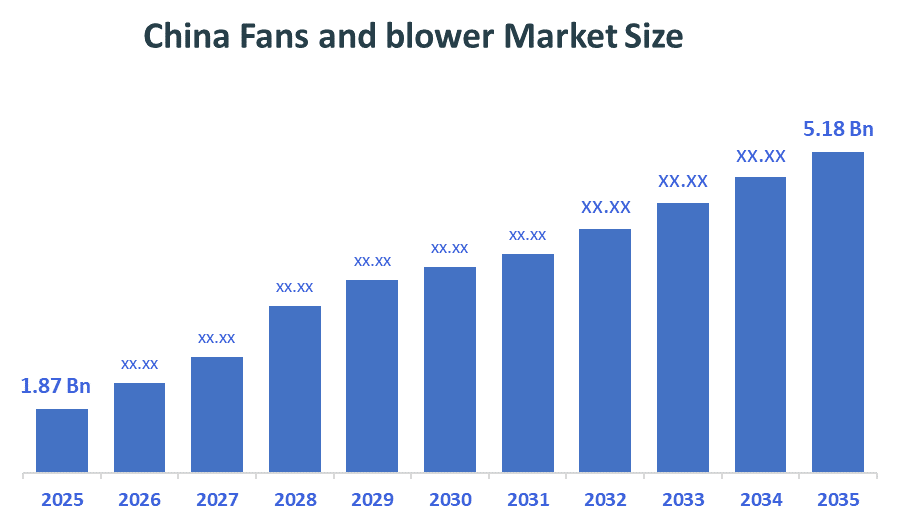
According to Decision Advisors, the China Fans and blowers’ market was projected to grow from USD 1.87 Billion in 2025 to USD 5.18 Billion by 2035, achieving a CAGR of 10.73% during the forecast period of 2026–2035. The market for Fans and blowers in China is mainly fuelled by rising industrialization, rapid urbanization, and expansion of manufacturing facilities. Increasing demand from HVAC systems, power generation, mining, and chemical industries further drives growth. Strict government regulations on energy efficiency and emissions encourage adoption of advanced ventilation systems. Additionally, growth in data centres, electronics cooling, and smart infrastructure projects boosts demand. Technological advancements in energy-efficient and EC motor-based systems also significantly support market expansion across sectors.
Market Overview/Introduction
Fans and blowers market represents the industry which deals with the design, manufacture, and supply of mechanical devices that provide controlled movement of air or gas with respect to pressure and flow. The term fan usually describes a device that pumps large amounts of air with low pressure, whereas blower produces airflow with higher pressures that serve for industrial processes. These devices can be found in various industries including HVAC, industrial manufacturing, power generation, mining, chemical processing, food & beverages, automobile manufacturing, and data centres. They are key elements responsible for maintaining good air quality and efficient operations. The primary drivers for the global fans and blowers market include fast industrialization and urbanization, particularly in developing nations such as China. There is an increasing need for efficient ventilation devices due to environmental standards. Innovation in technology has impacted the industry by introducing EC motors, smart fans, VFDs, and efficient aerodynamic designs in order to save energy and operational expenses. Government efforts, especially from China, have introduced programs focusing on energy efficiency, achieving carbon neutrality by 2060, developing buildings that are sustainable or “green,” and managing emissions from industries. Programs that encourage the development of smart factories and automation in industries (Industry 4.0 programs) also increase demand for products.
- In 2026, China’s Government Work Report emphasizes AI integration in manufacturing, driving smart ventilation systems. Fans and blowers adopt IoT sensors and AI-enabled VSDs to optimize airflow and reduce energy consumption in real time.
- In 2025, China strengthened GB energy efficiency standards for blowers, enforcing strict performance thresholds and testing methods. Inefficient centrifugal and Roots blowers are being phased out, accelerating demand for high-efficiency, energy-saving ventilation systems.
- In 2024, China launched the “Two New” policy framework for equipment renewal, offering subsidies, tax incentives, and low-interest financing. The initiative promotes replacement of outdated industrial systems with high-efficiency fans and blowers across steel, cement, and chemical industries, supporting sustainable modernization.
Notable Insights: -
- By Product Type, the Centrifugal Fans segment holds a dominant position with an estimated share of over 42% in 2025.
- By Technology, the Centrifugal technology segment holds a dominant position with an estimated share of over 45% in 2025.
- By end user, the Industrial sector segment holds a dominant position with an estimated share of over 58% in 2025.
- By application, the HVAC systems segment holds a dominant position with an estimated share of over 38% in 2025.
- The forecasted CAGR for the China Fans and blower market is expected to be about 10.73% for the period between 2026 and 2035.
- The market is expected to reach a valuation of approximately USD 5.18 Billion by 2035
What is the Role of Technology in Grooming the Market?
Technological developments have played a key part in preparing the fans and blowers industry through efficiency, effectiveness, and environmental consciousness. The use of EC motors, smart fans that incorporate IoT technology, and VFDs has enabled the achievement of accurate air flow regulation and reduced energy consumption. The utilization of aerodynamic design and lightweight composites has increased robustness and reduced sound production. The automation of Industry 4.0 has facilitated predictive maintenance and live monitoring within industrial operations. Furthermore, AI-driven optimization software has improved ventilation efficiency in HVAC and data centre installations.
Market Drivers
The demand for fans and blowers is growing due to industrialization and urbanization. These factors will help increase the need for efficient fans and blowers because there will be a higher demand for ventilation and air circulation solutions. The growth in infrastructure, including smart cities and residential complexes, will increase the installation of HVAC systems. The growth of industrial sectors such as power generation, mining, oil & gas exploration, chemical manufacturing, and manufacturing plants increases the requirement for powerful fans and blowers for cooling purposes. Environmental factors such as rising issues over energy efficiency and emission norms from the government also drive the need for more effective and energy-saving products. An increase in the construction of data centres and electronics manufacturing plants drives the need for precision air conditioning solutions. Technological advancements such as IoT-driven smart ventilation and automated flow management increase the demand for fans and blowers. Sustainable construction practices are also helping in the growth of energy-saving solutions.
Restraints
The fans and blowers market faces restraints such as high initial investment and maintenance costs of advanced systems, limiting adoption among small industries. Fluctuating raw material prices increase production costs. Intense competition reduces profit margins, while noise and vibration issues restrict usage in sensitive environments. Additionally, lack of awareness and strict regulatory compliance slow market penetration in developing regions.
Study on the Supply, Demand, Distribution, and Market Environment
In terms of the domestic supply, China’s fans and blowers’ industry has a solid supplier base made up of many manufacturers who produce axial fans, centrifugal fans, and industrial blowers for HVAC applications and industrial use. There is a concentration of suppliers in industrial areas like Guangdong, Zhejiang, and Jiangsu, which allows low-cost mass production. Demand growth factors include HVAC systems, new factories and facilities, power plants, mines, and data centres. Urbanization plays an additional role. Distribution takes place via OEM supply lines, industrial contracts, distributors, and, increasingly, online business-to-business sales for standard products. The competitive landscape is characterized by fierce competition and fragmentation, but there is a strong focus on energy-efficient motors and variable-frequency drive systems due to price pressure, as well as green building codes.
Price Analysis and Consumer Behaviour Analysis
In the fans and blowers market, there is huge variation in price depending on the nature of the product, its capacity and even the technological features offered. Axial fans are cheaper compared to centrifugal fans and also those using new technologies like VFD and EC motors. Industrial grade blowers in heavy duty use in power generation companies, mines, and chemicals industries have a higher price point as a result of their durability and high-pressure capabilities. Cost of raw materials, need for energy efficiency and customization needs are some of the drivers of the pricing trends. As far as consumer behaviour is concerned, customers in the industrial segment prefer products that give them value for money as a result of low maintenance and energy efficiency. Commercial segment looks for quiet operations and energy efficiency whereas domestic market goes for the affordability factor.
Market Segmentation
The China fans and lower market is categorised by product type, technology, application and end user
- The centrifugal fans segment dominated the market in 2025 and is projected to grow at a steady CAGR of approximately 6.2% during the forecast period.
Based on the product type, the fans and blower market is divided into axial fans, centrifugal fans, axial blowers, centrifugal blowers, positive displacement blowers, and industrial fans. Among these, centrifugal fans dominate the fans and blower market with an estimated approximately 40-45% market share in China and related industrial segments. They are widely used in HVAC, power plants, mining, and chemical industries due to their ability to generate high pressure airflow and handle harsh operating conditions. Their strong industrial applicability and retrofit demand support steady growth, with a CAGR of around 6-7%. This dominance is driven by China’s large-scale manufacturing and infrastructure expansion.
- The centrifugal technology segment accounted for the largest share in 2025 and is anticipated to grow at a significant CAGR of approximately 6.5% during the forecast period.
Based on the technology, the Fans and blower market is divided into centrifugal technology, axial flow technology, mixed flow systems, and energy-efficient EC motor-based systems. Among these, centrifugal technology dominates the fans and blower’s market with an estimated approximately 45% market share in China and broader industrial applications. It leads due to its high efficiency in producing strong pressure airflow, making it ideal for HVAC systems, heavy industries, and process manufacturing. Its reliability in harsh environments and wide industrial adoption further strengthen demand. The segment grows at a CAGR of around 6-7%, driven by industrial expansion and strict energy-efficiency and emission regulations.
- The HVAC systems segment accounted for the largest share in 2025 and is anticipated to grow at a significant CAGR of approximately 7.7% during the forecast period.
Based on the application, the fans and blower market is divided into HVAC systems, industrial processes, power generation, chemical & petrochemical industries, food & beverage processing, automotive manufacturing, mining and metallurgy, data centres & electronics cooling. Among these, HVAC systems dominate the fans and blowers’ market, holding around 35-40% market share in China. This dominance is driven by rapid urbanization, commercial infrastructure growth, and increasing demand for energy-efficient heating, ventilation, and air-conditioning solutions in residential and commercial buildings. Rising data centre cooling needs also support growth. The segment is expected to grow at a CAGR of approximately 6-8%, supported by green building regulations, smart city development, and modernization of building infrastructure across major cities nationwide.
- The industrial sector segment accounted for the largest share in 2025 and is anticipated to grow at a significant CAGR of approximately 6.5% during the forecast period.
Based on the end user, the fans and blower market is divided into industrial sector, commercial sector, and residential sector. Among these, the industrial sector dominates the fans and blowers’ market, accounting for approximately 55-60% market share in China. This dominance is driven by extensive use in manufacturing, mining, power generation, chemicals, and heavy process industries requiring continuous ventilation and high-capacity airflow systems. Industrial growth, infrastructure expansion, and strict emission control standards further support demand. The segment is expected to grow at a CAGR of around 6-7%, fuelled by automation, factory modernization, and energy-efficient ventilation upgrades.
Recent Developments
In 2026, Shengzhou City Huahao Motor Manufacturing Co. is advancing production of high-efficiency centrifugal fans and range hood motors. The company is focusing on sustainability and automation trends to improve performance and support growing demand in HVAC and ventilation applications.
In October 2025, ebm-papst expanded its presence in China by strengthening localized production and R&D capabilities under its “local-for-local” strategy. The move enhances manufacturing of energy-efficient fans and blowers, supporting rising demand from HVAC and industrial ventilation markets across China.
Competitive Analysis
The report offers the appropriate analysis of the key organisations/companies involved within the China Fans and blower market, along with a comparative evaluation primarily based on their product offering, business overviews, geographic presence, enterprise strategies, segment market share, and SWOT analysis. The report also provides an elaborate analysis focusing on the current news and developments of the companies, which includes product development, innovations, joint ventures, partnerships, mergers & acquisitions, strategic alliances, and others. This allows for the evaluation of the overall competition within the market.
Top Key Companies in the China Fans and blower Market
- Zhejiang Langdi Group Co., Ltd.
- Ningbo Longwell Electric Technology Co., Ltd.
- Xinxiang SIMO Blower Co., Ltd.
- Zhejiang Jiayi Fan Co., Ltd.
- HEKO Electronic (Suzhou)
- Guangdong Shenghui Technology Co., Ltd.
- Shenzhen Huaxia Hengtai Electronics Co., Ltd.
- Dongguan Xingdong Electronics Co., Ltd.
- Shanghai Blower Works Co., Ltd.
- Nanfang Ventilator Group
- Others
Key Target Audience
- Market Players
- Investors
- End-users
- Government Authorities
- Consulting and Research Firm
- Venture capitalists
- Value-Added Resellers (VARs)
Market Segmentation
This study forecasts revenue at the national and regional levels from 2021 to 2035. The report segmented the China Fans and blower Market based on the following segments:
China Fans and blower Market, By Product Type
- Axial Fans
- Centrifugal Fans
- Axial Blowers
- Centrifugal Blowers
- Positive Displacement Blowers
- Industrial Fans
China Fans and blower Market, By Technology
- Centrifugal technology
- Axial flow technology
- Mixed flow systems
- Energy-efficient EC motor-based systems
China Fans and blower Market, By Application
- HVAC systems
- Industrial processes
- Power generation
- Chemical & petrochemical industries
- Food & beverage processing
- Automotive manufacturing
- Mining and metallurgy
- Data centres & electronics cooling
China Fans and blower Market, By End User
- Industrial sector
- Commercial sector
- Residential sector
Frequently Asked Questions (FAQ)
1. What factors are driving the demand for ventilation and airflow systems in modern industries?
Demand is increasing due to rapid industrial expansion, urban infrastructure development, and the need for efficient temperature control and air quality management in manufacturing and commercial facilities.
2. How are energy efficiency regulations influencing air movement equipment adoption?
Strict environmental and energy efficiency standards are encouraging industries to replace older systems with advanced, low-power consumption solutions that reduce operational costs and emissions.
3. What role does smart technology play in ventilation systems today?
Smart technologies such as IoT sensors, automated controls, and AI-based optimization improve airflow efficiency, enable predictive maintenance, and reduce energy waste in real time.
4. Which industries are most dependent on advanced air handling systems?
Industries such as manufacturing, power generation, chemical processing, mining, and large-scale commercial infrastructure rely heavily on efficient air movement systems for operational safety and performance.
5. Why is sustainability becoming important in air management solutions?
Sustainability is critical due to increasing environmental concerns, regulatory pressures, and corporate goals to reduce energy consumption, leading to greater adoption of eco-friendly and efficient technologies.
Check Licence
Choose the plan that fits you best: Single User, Multi-User, or Enterprise solutions tailored for your needs.
We Have You Covered
- 24/7 Analyst Support
- Clients Across the Globe
- Tailored Insights
- Technology Tracking
- Competitive Intelligence
- Custom Research
- Syndicated Market Studies
- Market Overview
- Market Segmentation
- Growth Drivers
- Market Opportunities
- Regulatory Insights
- Innovation & Sustainability
Report Details
| Scope | Country |
| Pages | 245 |
| Delivery | PDF & Excel via Email |
| Language | English |
| Release | Apr 2026 |
| Access | Download from this page |