
China Healthcare Analytics Market
 |
Pages:
210
|
Pages:
210
China Healthcare analytics Market Size, Share, By Application (Operational and Administrative Analytics, Financial Analytics, Population Health Analytics, and Clinical Analytics) By Type (Type, Predictive Analytics, and Prescriptive analytics) and By Component (Hardware, Software, and Services), By Delivery Model (On-Premise and On-Demand) analysis and forecast 2025 ? 2035
REPORT COVERAGE
Country
Market snapshot
- Market size (2025): USD 1498.8 million
- Projected market size (2035): USD 8261.1 million
- Compound Annual Growth Rate (CAGR): 18.61%
- Base Year: 2025
- Historical Period: 2021–2025
- Forecast Period: 2025–2035
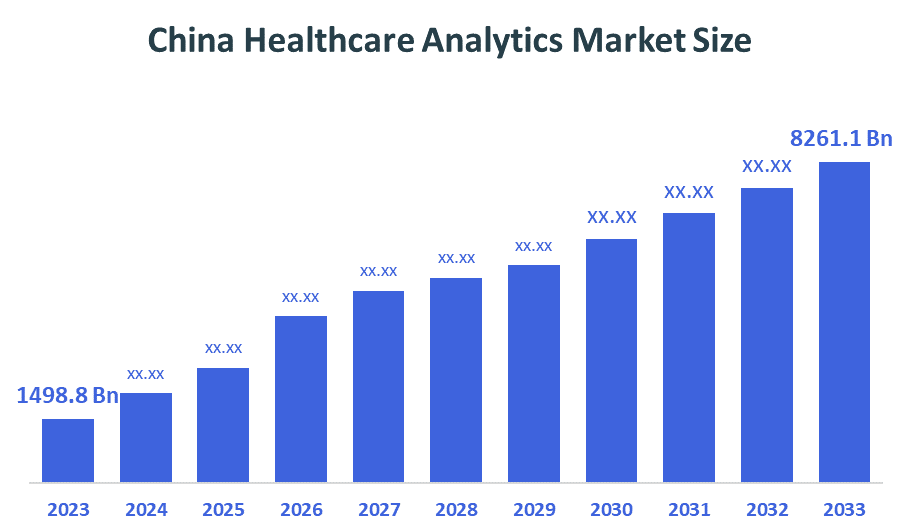
According to Decision Advisors, the China Healthcare Analytics Market Size is expected to grow from USD 1498.8 million in 2024 to USD 8261.1 million by 2035, at a CAGR of 18.61% during the forecast period 2025-2035. China healthcare analytics market is projected to grow significantly over the next decade due to increasing investments in digital health infrastructure, rising adoption of electronic health records (EHRs), expanding use of artificial intelligence (AI) and machine learning in clinical decision-making, and growing demand for data-driven insights to optimize hospital operations and population health management.
Market Overview/Introduction
The China healthcare analytics market utilizes data, statistics, and technology to enhance making decisions regarding health care. Through analysis of data from electronic health records and laboratories, medical charts, and medical imaging, as well as from wearable devices, healthcare analytics can assist in predicting patient risks, making improvements in hospital operations, reducing costs, and guiding the delivery of patient care. Ultimately through the creation of insights derived from the data, healthcare analytics will improve patient care, operating efficiency, and the management of population health. Innovations in healthcare analytics are transforming patient care and operational efficiency. Key developments include AI and machine learning for predictive diagnostics, real-time data analytics for patient monitoring, natural language processing to extract insights from clinical notes, cloud-based platforms for data integration, and advanced visualization tools for decision support. Opportunities in healthcare analytics are expanding as the industry digitizes. Key areas include AI-driven predictive care, personalized medicine, remote patient monitoring, and population health management. Providers can leverage big data for operational efficiency, cloud platforms for integrated analytics, and telehealth insights.
In the present the market is shifting from mass market brans to the specialized ones. The consumers are willing to pay more for the premium, quality heritage, and the authenticity this is proven because of the premium healthcare analytics segment. For future growth companies are leverage Operational and Administrative Analytics AI to analyse the consumer data to create new flavours and also for the personalized and brand marketing.
- BEIJING, March, 2026 – By end-2025, China’s basic medical insurance covered 1.33 billion people, supporting 7.2 billion outpatient visits, 278 million inpatient treatments, maternity care, and assisted reproductive services, with rural low-income populations achieving over 99% coverage.
- BEIJING, December, 2025 – China updated the 2025 NRDL, adding 114 drugs (50 innovative) to 3,253 total, and launched the first Commercial Health Insurance Innovative Drug List for 19 high-cost drugs, supporting innovation, public fund sustainability, and commercial insurance growth from 2026.
- BEIJING, September, 2025 – China’s NHSA rolled out DRG/DIP bundled payment schemes nationwide, using big data to control costs, manage hospital performance, reduce length of stay, detect fraud, and analyse full-sample healthcare data, enhancing efficiency and accountability in 2025–2026.
Notable Insights: -
- By application, the Clinical analytics segment held a dominant position with 40% in terms of market share in 2025.
- By Type, Predictive Analytics segment is the dominating accounting for over 46% of the China market share in 2025.
- The compound annual growth rate of the China healthcare analytics market is 18.61%.
- The market is likely to achieve a valuation of USD 8261.1 million by 2035.
What is role of technology in grooming the market?
The growth of the healthcare analytics market is largely driven by advancements in technology, which will enable the accumulation, integration and evaluation of large quantities of healthcare-related information. Some examples of advanced technology contributing towards this growth include artificial intelligence (AI), machine learning (ML), and predictive analytics that can detect patterns in historical data, predict future risk factors for patients, and develop more effective treatment protocols. Cloud computing and big data enable easier transfer of data between healthcare systems, while wearables/IoT devices allow for continuous monitoring of a patient’s condition. These technologies will ultimately enhance clarity and accuracy when making clinical decisions, improve efficiency within the organization, reduce costs associated with healthcare delivery, and encourage implementation of data-driven decision-making processes; all of which will help stimulate growth of the healthcare analytics market.
Market Drivers
Numerous factors are responsible for the healthcare analytics market's growth. The rapid increase in electronic health records (EHRs) and other digital health platforms has produced an enormous quantity of data available for analysis. Artificial intelligence (AI), machine learning, and data analytics allow for predictive insights, enabling more personalized patient care. There is also an increasing push for hospitals to use healthcare analytics due to the demand for improved cost efficiencies and optimized operational processes. Government initiatives are encouraging both the creation of smart hospitals and the implementation of new data-driven initiatives, which further fuels the growth of the healthcare analytics market. The growing use of wearables, remote patient monitoring, and telemedicine are creating additional avenues for collecting patient data; therefore, enhancing the ability to analyze patients throughout their lifetime will continue to support the expansion of the global healthcare analytics market.
Restrain
The healthcare analytics market faces restraints from high implementation costs, data privacy and security concerns, and lack of skilled professionals. Integration challenges with existing systems, inconsistent data quality, and regulatory compliance issues also slow adoption, limiting the full potential of analytics solutions in improving healthcare outcomes and operational efficiency.
Strategies to Implement for Growth of the Market
To grow the healthcare analytics market, providers should adopt AI and machine learning for predictive and prescriptive insights, expand cloud-based platforms for seamless data integration, and enhance interoperability across healthcare systems. Investing in skilled professionals and robust data security builds trust, while partnerships with technology vendors and government collaboration accelerate innovation. Focusing on personalized care, remote monitoring, and population health management further drives market adoption and growth.
Market Segmentation
The China healthcare analytics market share is classified into application, type, component, and delivery mode.
- The financial analytics segment dominated the market in 2024, and is projected to grow at a substantial CAGR of approximately 40% during the forecast period.
Based on the application, the healthcare analytics market is divided into operational and administrative analytics, financial analytics, population health analytics, and clinical analytics. Among these, financial analytics currently dominates, capturing the largest share—around about 40% of the market—driven by the urgent need for cost control, revenue cycle management, fraud detection, and efficient claims processing by both healthcare payers and providers. Financial analytics helps reduce operational costs and improve billing accuracy, making it the leading application segment compared with clinical, operational/administrative, and population health analytics.
- The predictive analytics segment accounted for the largest share in 2024, and is anticipated to grow at a significant CAGR of approximately 46 % during the forecast period.
Based on the type, the healthcare analytics market is divided into predictive analytics, off-trade, prescriptive analytics, online convenience stores, and others. Among these, the predictive analytics currently dominates the healthcare analytics market because it enables forecasting of patient outcomes, risk stratification, and proactive care planning, which are critical for improving clinical effectiveness and reducing costs. In many reports, predictive analytics holds the largest share (around 35–46%) compared with descriptive and prescriptive types, driven by strong adoption in clinical and operational decision?making worldwide.
- The software segment dominated the market in 2024, and is projected to grow at a substantial CAGR of approximately 60% during the forecast period.
Based on the component, the healthcare analytics market is divided into hardware, software, and services. Among these, the software segment dominates the healthcare analytics market, holding the largest revenue share (over 60% in 2024). Software’s dominance is driven by the rising demand for advanced analytics platforms, integration tools, predictive modelling, and real?time insights. Cloud?based analytics and scalable software solutions help healthcare organizations manage complex data and improve clinical, financial, and operational decision?making, making software the core investment over hardware and services.
- The on-demand segment dominated the market in 2024, and is projected to grow at a substantial CAGR of approximately 60% during the forecast period.
Based on the delivery mode, the healthcare analytics market is divided into on-premise and on-demand. Among these, the on-demand (cloud-based) segment dominates the China healthcare analytics market due to lower upfront costs, scalability, faster deployment, and remote accessibility. It enables real-time data analysis, AI integration, and seamless system connectivity, making it more cost-efficient and flexible than traditional on-premise solutions, driving widespread adoption nationwide.
Recent Development
In April 2026, China launched a pilot phase of AI-assisted diagnosis in 50 hospitals and 500 township clinics, aiming to improve primary care for 900 million people, reduce misdiagnosis, achieve 95% imaging accuracy, and enhance patient services and TCM integration.
In January 2026, China’s NHSA announced smart enhancements, including facial recognition and mobile payments, alongside increased use of big data for fraud recovery and operational efficiency, modernizing healthcare services and improving patient experience nationwide.
Competitive Analysis
The report offers the appropriate analysis of the key organisations/companies involved within the China healthcare analytics market, along with a comparative evaluation primarily based on their product offering, business overviews, geographic presence, enterprise strategies, segment market share, and SWOT analysis. The report also provides an elaborative analysis focusing on the current news and developments of the companies, which includes product development, innovations, joint ventures, partnerships, mergers & acquisitions, strategic alliances, and others. This allows for the evaluation of the overall competition within the market.
Top Key Companies in China Healthcare Analytics Market
- IBM Corporation
- Optum, Inc.
- Oracle Health / Cerner Corporation
- McKesson Corporation
- IQVIA Holdings Inc.
- SAS Institute Inc.
- Allscripts Healthcare Solutions, Inc.
- Verisk Analytics Inc.
- Wisers Information Limited
- Shenzhen Wuchuan Network Technology Co. Ltd.
- Borderless Healthcare Group
- Local Chinese healthcare analytics startups
Key Target Audience
- Market Players
- Investors
- End-users
- Government Authorities
- Consulting and Research Firm
- Venture capitalists
- Value-Added Resellers (VARs)
Market Segment
This study forecasts revenue at the China, regional, and country levels from 2020 to 2035. Decision Advisors has segmented the China healthcare analytics market based on the below-mentioned segments
China Healthcare Analytics Market, By Application
- Operational and Administrative Analytics
- Financial Analytics
- Population health analytics
- Clinical analytics
China Healthcare Analytics Market, By Type
- Descriptive analytics
- Predictive analytics
- Prescriptive analytics
China Healthcare Analytics Market, By Component
- Hardware
- Software
- Services
China Healthcare Analytics Market, By Delivery Model
- On-Premise
- On-Demand
Frequently Asked Questions (FAQ)
1. Which Chinese provinces or cities are expected to show the fastest growth in healthcare analytics adoption by 2035?
Answer: The report does not provide a province- or city-level breakdown. However, major urban hubs like Beijing, Shanghai, Shenzhen, and Guangzhou are likely to see faster adoption due to advanced healthcare infrastructure, higher digital health investments, and concentration of hospitals and tech companies.
2. What are the pricing models or average costs for healthcare analytics solutions in China?
Answer: Pricing information is not included in the report. Typically, healthcare analytics solutions in China follow subscription-based (SaaS), on-premise license, or per-hospital deployment pricing models, with costs varying based on software complexity, analytics capabilities, and scale of implementation.
3. How is patient data privacy being regulated and enforced for healthcare analytics providers in China?
Answer: The report does not detail regulatory enforcement. In general, China’s Personal Information Protection Law (PIPL) and Data Security Law (DSL) govern patient data, requiring secure storage, anonymization, and strict consent protocols for analytics platforms. Enforcement varies by province and hospital compliance.
4. Which local startups in China are leading innovation in AI-powered healthcare analytics, and what are their recent funding rounds?
Answer: The report mentions “local startups” but does not list specific names or funding data. Leading AI-healthcare analytics startups in China often focus on medical imaging, predictive diagnostics, and clinical decision support, with funding rounds typically sourced from venture capital and strategic healthcare partnerships.
5. What is the market share breakdown between public and private hospitals in adopting healthcare analytics solutions in China?
Answer: The report does not provide a public vs. private hospital adoption breakdown. Generally, public hospitals in tier-1 and tier-2 cities drive early adoption due to government initiatives, while private hospitals are adopting analytics gradually, especially in premium or specialty care segments.
Check Licence
Choose the plan that fits you best: Single User, Multi-User, or Enterprise solutions tailored for your needs.
We Have You Covered
- 24/7 Analyst Support
- Clients Across the Globe
- Tailored Insights
- Technology Tracking
- Competitive Intelligence
- Custom Research
- Syndicated Market Studies
- Market Overview
- Market Segmentation
- Growth Drivers
- Market Opportunities
- Regulatory Insights
- Innovation & Sustainability
Report Details
| Scope | Country |
| Pages | 210 |
| Delivery | PDF & Excel via Email |
| Language | English |
| Release | Apr 2026 |
| Access | Download from this page |