
China Heat Pump Market
 |
Author:
Mayuri S
|
Pages:
149
|
Author:
Mayuri S
|
Pages:
149
China Heat Pump Market Size, Share, By Type (Air-Source Heat Pumps [Air-to-Air, Air-to-Water], Water-Source Heat Pumps, Ground-Source Heat Pumps), By Application (Space Heating, Space Cooling, Domestic Hot Water, Others), By End-User (Residential, Commercial, Industrial), By Installation Type (New Build, Retrofit / Replacement), By Sales Channel (Direct Sales, Distributor / Installer Network), China Heat Pump Market Insights, Industry Trend, Forecasts to 2035
CAGR
8.4%
REVENUE 2024
USD Billion 17.9
FORECAST 2035
USD Billion 43.54
REPORT COVERAGE
Country
China Heat Pump Market Size Insights Forecasts to 2035
- China Heat Pump Market Size 2024: USD 17.9 Billion
- China Heat Pump Market Size 2035: USD 43.54 Billion
- China Heat Pump Market CAGR 2024: 8.4%
- China Heat Pump Market Segments: By Type, By Application, By End-User, By Installation Type, and By Sales Channel
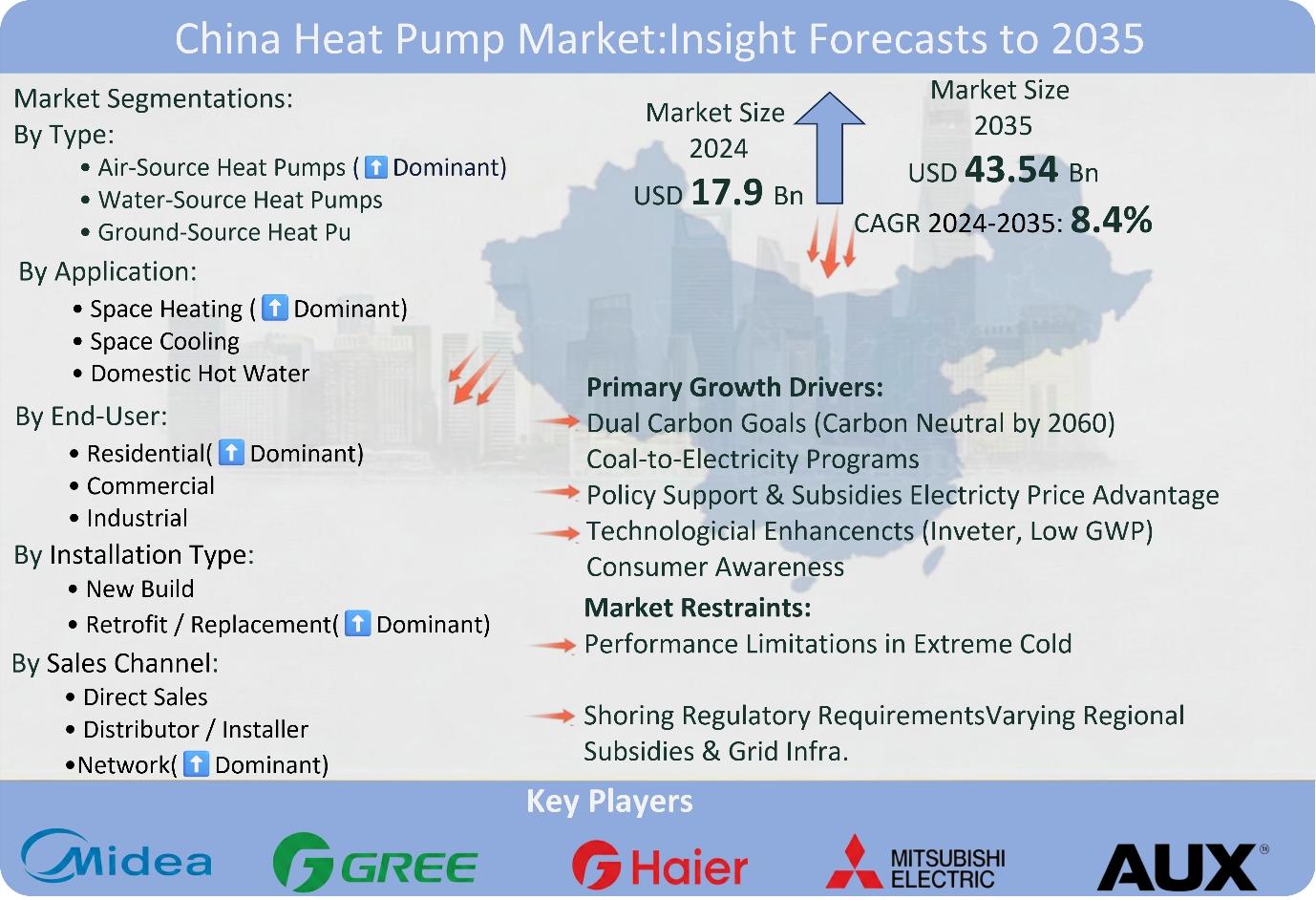
The Market Size for Heat Pumps in China includes efficient electric systems that provide heat for space heating, cooling of buildings, hot water production and other applications, replacing gas or coal-burning boilers. Heat pumps are one of the key pillars of the clean energy transition for China, particularly within buildings.
Air-source heat pumps dominate the market due to their lower cost and flexibility, while ground-source and water-source heat pump technologies have been developed specifically for high-efficiency niches. The large domestic manufacturing base means that Chinese brands account for the majority of global heat pump manufacturing and exports. Innovations focus on products that will perform well in a cold climate, use refrigerants with lower GWP and feature smart control capability.
The market is regulated by national authorities (the National Development & Reform Commission [NDRC], Ministry of Ecology and Environment and the local authorities) that enforce mandatory energy efficiency labelling, refrigerant standards, and subsidies for various types of heat pumps. In addition, there is significant governmental support for the coal-to-electricity programs, building energy codes, subsidies to facilitate rural clean heating and targets for carbon neutrality (peak by 2030, carbon neutral by 2060). All these factors combine to provide long-term demand growth within the Chinese heat pump market.
Market Dynamics of the China Yacht Market:
The China heat pump market is experiencing growth, driven by increased urbanization and the expansion of building stock, which have raised demand for efficient Heating, ventilation, and air conditioning systems. Government policies are implementing aggressive measures including subsidies, new mandates for clean heating in northern provinces, and the provision of incentives for installing green buildings. In addition, price advantages of electricity over coal and gas are driving down operating costs and making heat pumps more competitive with conventional heating options. Technological enhancements, such as inverter compressors, lower-ambient operation, and renewable integration, have improved system reliability and increased consumer appeal. Growing consumer awareness of energy savings, environmental benefits, and improved air quality is further supporting market demand.
Although growth prospects remain favourable, wider adoption is restrained by the higher initial investment required for heat pump systems relative to conventional boilers, especially in cost-conscious rural and low-income segments. Performance-related limitations regarding extreme cold (typical of more common models) require investments in advanced heat pump systems that are typically more expensive than standard models. In addition, there are fewer installation technicians skilled in the installation of heat pump systems than in the installation of conventional boiler systems--this slows the pace of installation and use of heat pump systems. There is a continuing evolution of regulatory requirements for refrigerants and efficiency for heat pump manufacturers, but compliance efforts add to manufacturers' hassles and costs. Further, the availability of subsidies and the availability of grid infrastructure vary widely from region to region and create inconsistency in rates of adoption.
The future outlook remains positive as there are multiple opportunities for growth in the air-source retrofitting market, as well as for hybrid (air-water) and ground-source heat pumps in new commercial buildings, wastewater heat recovery applications in commercial buildings, electric integration of solar PV and smart grids, and continued rural growth due to policy initiatives at the local, state, and federal levels. Ongoing innovation in high-efficiency, low-GWP, and cold-climate technologies will likely continue to encourage strong future growth of this industry.
Market Segmentation
The China heat pump market share is classified into type, application, end-user, installation type, and sales channel.
By Type:
The China heat pump market is divided by type into air-source heat pumps (air-to-air, air-to-water), water-source heat pumps, and ground-source heat pumps. Among these, the air-source heat pumps segment dominated the share in recent years and is anticipated to grow at a remarkable CAGR during the forecast period. The air-source heating pump market dominates because it is less expensive to install than other types of heating systems, can be adapted to meet the needs of anyone living in China regardless of climate type, is being improved to work better in colder areas, and is supported by the Chinese Government's policies regarding clean energy usage through its subsidies. As a result, many people will continue to adopt this technology to take advantage of these benefits.
By Application:
The market is divided by application into space heating, space cooling, domestic hot water, and others. Among these, the space heating segment dominated and is anticipated to grow at a remarkable CAGR during the forecast period. Space heating leads mainly because of severe winter conditions in northern China, large-scale coal-to-electricity replacement campaigns, generous provincial subsidies for coal boiler phase-outs, and widespread adoption in new urban developments for reliable, low-emission heating solutions.
By End-User:
The market is divided by end-user into residential, commercial, and industrial segments. Among these, the residential segment dominated the share and is anticipated to grow at a remarkable CAGR during the forecast period. Residential leads mainly because of explosive urban housing construction, ongoing real estate development activities, extensive government subsidies for rural and urban clean heating upgrades, nationwide coal-to-electric transition programs, rising consumer preference for comfortable, energy-efficient all-season systems, improved indoor comfort standards, and rapid penetration in new apartments across major cities, particularly in northern and tier-1 urban regions.
By Installation Type:
The market is divided by installation type into new build and retrofit/replacement. Among these, the retrofit/replacement segment dominated and is anticipated to grow at a remarkable CAGR during the forecast period. Retrofit/replacement leads mainly because of rapid national programs targeting existing coal-dependent buildings, attractive financial incentives for upgrading old boilers, immediate energy bill savings in high-usage households, and a strong policy focus on emissions reduction in the legacy building stock.
By Sales Channel:
The market is divided by sales channel into direct sales and a distributor/installer network. Among these, the distributor/installer network segment dominated and is anticipated to grow at a remarkable CAGR during the forecast period. Distributor/installer network leads mainly because of its essential expertise in customized installations, reliable local after-sales service, compliance with regional regulations, and trusted relationships that facilitate both residential projects and large commercial deployments across diverse geographic areas.
Competitive Analysis:
The report offers the appropriate analysis of the key organisations/companies involved within the China Yacht Market, along with a comparative evaluation primarily based on their product offering, business overviews, geographic presence, enterprise strategies, segment market share, and SWOT analysis. The report also provides an elaborate analysis focusing on the current news and developments of the companies, which includes product development, innovations, joint ventures, partnerships, mergers & acquisitions, strategic alliances, and others. This allows for the evaluation of the overall competition within the market.
Top Key Companies in China Yacht Market:
- Daikin Industries
- Mitsubishi Electric
- Midea Group Co., Ltd.
- Haier Group Corporation
- Gree Electric Appliances Inc. of Zhuhai
- AUX Group Co., Ltd.
Key Target Audience
- Market Players
- Investors
- End-users
- Government Authorities
- Consulting and Research Firm
- Venture capitalists
- Value-Added Resellers (VARs)
Market Segment
This study forecasts revenue at the China, regional, and country levels from 2020 to 2035. Decisions Advisors has segmented the China heat pump market based on the below-mentioned segments:
China Yacht Market, By Type
- Air-Source Heat Pumps (Air-to-Air, Air-to-Water)
- Water-Source Heat Pumps
- Ground-Source Heat Pumps
China Yacht Market, By Application
- Space Heating
- Space Cooling
- Domestic Hot Water
- Others
China Yacht Market, By End-User
- Residential
- Commercial
- Industrial
China Heat Pump Market, By Installation Type
- New Build
- Retrofit / Replacement
China Heat Pump Market, By Sales Channel
- Direct Sales
- Distributor / Installer Network
FAQ
1. What is the current size and long-term outlook of the China heat pump market?
Approximately USD 17.9 billion in 2024, expected to reach USD 43.54 billion by 2035.
2. What is the expected growth rate of the China heat pump market during the forecast period?
Projected CAGR of about 8.4% during 2025–2035.
3. What does the China heat pump market include?
It covers efficient electric systems for space heating, cooling, and hot water, central to China's clean heating transition.
4. Which heat pump type is experiencing the fastest growth in China?
Air-source heat pumps, due to cost-effectiveness, versatility, and strong policy support.
5. What are the key factors driving the growth of the China heat pump market?
Government subsidies, urbanization, energy cost advantages, and technology improvements.
6. What are the major challenges facing the China heat pump market?
High initial costs, cold-climate performance, installer shortages, and regional variations.
7. Which installation segment is growing fastest in the China heat pump market?
Retrofit/replacement, driven by coal boiler replacement programs and subsidies.
8. What future opportunities exist in the China heat pump market?
Industrial applications, renewable integration, rural expansion, and low-GWP innovations.
Check Licence
Choose the plan that fits you best: Single User, Multi-User, or Enterprise solutions tailored for your needs.
We Have You Covered
- 24/7 Analyst Support
- Clients Across the Globe
- Tailored Insights
- Technology Tracking
- Competitive Intelligence
- Custom Research
- Syndicated Market Studies
- Market Overview
- Market Segmentation
- Growth Drivers
- Market Opportunities
- Regulatory Insights
- Innovation & Sustainability
Report Details
| Scope | Country |
| Pages | 149 |
| Delivery | PDF & Excel via Email |
| Language | English |
| Release | Feb 2026 |
| Access | Download from this page |