
China Neurology Devices Market
 |
Author:
David J
|
Pages:
195
|
Author:
David J
|
Pages:
195
China Neurology Devices Market Size, Share, By Device Type (Neurodiagnostic Devices, Neurointerventional Devices, Neurostimulation Devices, Neurosurgical Devices, Brain Monitoring Devices), By Application (Alzheimer?s Disease, Parkinson?s Disease, Epilepsy, Stroke, Traumatic Brain Injuries, Others), By End User (Hospitals, Neurology Clinics, Ambulatory Surgical Centres, Diagnostic Centres) Analysis and Forecast 2026?2035.
CAGR
6.31%
REVENUE 2025
USD Billion 2.7
FORECAST 2035
USD Billion 4.98
REPORT COVERAGE
Country
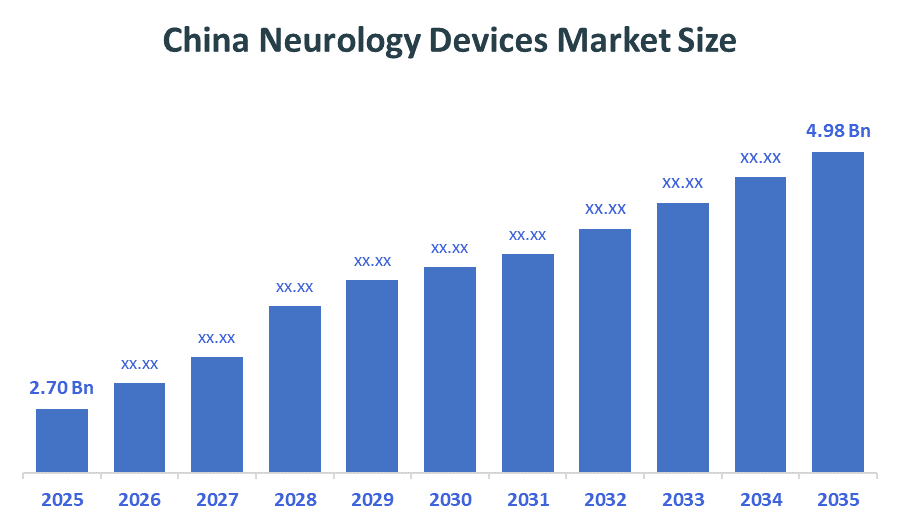
The China Neurology Devices Market Size is projected USD 2.70 Billion in 2025 and is forecasted to reach around USD 4.98 Billion by 2035. According to Decision Advisors, a detailed report on analysis of the China Neurology Devices Market indicates that the Neurostimulation Devices trend dominates the market, accounting for approx. 54.6% of the total China demand worldwide. Medtronic plc is one of the most dominating companies in China’s Neurology Devices Market, supported by revenue of approx. USD 200-300 million, due to strong OTC distribution, trusted global brand presence, wide retail pharmacy access, and growing digestive health demand in China.
Market Snapshot
- China Neurology Devices Market Size (2025): USD 2.70 Billion
- China Neurology Devices Market Projected Market Size (2035): USD 4.98 Billion
- China Neurology Devices Market Compound Annual Growth Rate (CAGR): 6.31%
- Base Year: 2025
- Historical Period: 2021–2024
- Forecast Period: 2026–2035
Market Overview/Introduction
The China Neurology Devices Market refers to the medical devices that diagnose, monitor, and treat diseases related to the brain, spinal cord, and peripheral nerves. Such medical devices can be neuroimaging devices, EEG/EMG devices, neurostimulation devices, and minimally invasive neurosurgical devices. Factors boosting the market growth include increased incidences of neurological diseases like strokes, epilepsy, Alzheimer’s, Parkinson’s, and traumatic brain injury. Factors like aging, sedentary lifestyle habits, and high-stress levels are also contributing factors in causing neurological diseases. Innovations including artificial intelligence (AI) brain imaging technology, neurosurgeries utilizing robotic techniques, and closed-loop neuromodulation devices will help improve patient outcomes and boost market growth. Development of tertiary healthcare facilities and neurological disease centres will fuel market expansion.
- In September 2025: China’s National Medical Products Administration (NMPA) streamlined approval pathways for innovative medical devices, including brain-computer interface technologies, supporting faster commercialization of advanced neurology devices.
- In January 2025: China expanded healthcare reimbursement policies, improving affordability of neurological treatments and indirectly boosting adoption of neurodiagnostic and neurosurgical devices in hospitals across the neurology devices market.
- In October 2023: China increased government funding for neuroscience research and brain mapping infrastructure, supporting development of advanced neurodiagnostic technologies and accelerating innovation in the neurology devices market.
Notable Insights: -
- By device type, the neurodiagnostic devices segment holds a dominant position with an estimated share of over 30% in 2025.
- By application, the stroke segment holds a dominant position with an estimated share of over 32% in 2025.
- By end user, the hospital holds a dominant position with an estimated share of over 60% in 2025.
- The forecasted CAGR for the China Neurology Devices Market is expected to be about 6.31% for the period between 2026 and 2035.
- The market is expected to reach a valuation of approximately USD 4.98 Billion by 2035
What is the Role of Technology in Grooming the Market?
Technology is significantly transforming the China Neurology Devices Market through AI-driven diagnostics, advanced imaging systems, and robotic-assisted neurosurgery. AI algorithms are improving detection accuracy in MRI and CT brain scans, enabling early diagnosis of neurological disorders. Neurostimulation technologies such as deep brain stimulation (DBS) and transcranial magnetic stimulation (TMS) are improving treatment outcomes for Parkinson’s disease and depression. Wearable EEG monitoring devices are enabling continuous brain activity tracking. Integration of tele-neurology and remote monitoring systems is improving access to neurological care in rural areas. Additionally, 3D imaging, neuronavigational systems, and minimally invasive surgical tools are enhancing surgical precision and reducing recovery time.
Market Drivers
The China Neurology Devices Market is fuelled by rising incidences of neurological disorders such as strokes and dementia in the elderly population. Fast-paced urbanization, stress-induced neurological disorders, and changes in lifestyles are some other driving forces behind market growth. Increased use of sophisticated neuro-imaging systems in hospitals and diagnostic centres is facilitating market growth. Funding from the government on developing healthcare facilities and conducting brain research is aiding innovation in the sector. Increasing inclination towards less-invasive neurosurgery and neurostimulation treatments is another key factor propelling market growth. Rising knowledge about early detection and treatments of neurological diseases is also driving market growth.
Restraints
High cost of advanced neurology devices such as neurostimulation implants and robotic neurosurgical systems limits accessibility in smaller healthcare facilities. Strict regulatory approval processes for implantable devices also delay product commercialization. Limited availability of skilled neurosurgeons and neurologists in rural regions restricts adoption. Additionally, concerns regarding device safety, long-term complications, and reimbursement limitations pose challenges to market growth.
Study on the Supply, Demand, Distribution, and Market Environment
China has a strong domestic manufacturing base for diagnostic neurology devices, while advanced neurostimulation and neurosurgical systems are largely imported from global manufacturers. Demand is increasing due to rising neurological disease burden and expansion of specialty neurology hospitals. Urban hospitals dominate consumption, while rural areas are gradually improving access through telemedicine and mobile diagnostic units. Distribution is primarily through hospital procurement systems, followed by specialized medical distributors. Online procurement channels for diagnostic devices are also emerging.
Price Analysis and Consumer Behaviour Analysis
Neurodiagnostic devices such as EEG systems range from USD 5,000-20,000 depending on configuration, while advanced MRI and CT neuroimaging systems can exceed USD 1-3 million. Neurostimulation implants such as deep brain stimulators range between USD 15,000-40,000 per procedure. Competitive pricing among global manufacturers and government procurement policies have led to moderate price stabilization in the market. Hospitals remain primary buyers, focusing on long-term value, clinical accuracy, and device reliability. Increasing preference for AI-integrated systems and minimally invasive tools is shaping procurement decisions.
Market Segmentation
The China Neurology Devices Market is categorised by device type, application, and end user
- The neurodiagnostic devices segment dominated the market in 2025 and is projected to grow at a steady CAGR of approximately 7.0% during the forecast period.
Based on the device type, the China Neurology Devices Market is divided into neurodiagnostic devices, neurointerventional devices, neurostimulation devices, neurosurgical devices, brain monitoring devices. Among these, neurodiagnostic devices segment dominates the China neurology devices market in 2025 with a revenue share of approximately 28–32%, driven by extensive use in EEG, MRI, and CT-based brain imaging for early and accurate diagnosis of neurological disorders. The segment is expected to grow at a CAGR of around 6.8–7.2% (2026–2035) due to rising stroke and epilepsy cases. Neurostimulation devices are the fastest-growing segment, supported by increasing adoption of deep brain stimulation and advanced therapeutic neuromodulation technologies.
- The stroke segment accounted for the largest share in 2025 and is anticipated to grow at a significant CAGR of approximately 6.8% during the forecast period.
Based on the application, the China Neurology Devices Market is divided into Alzheimer’s disease, Parkinson’s disease, epilepsy, stroke, traumatic brain injuries. Among these, stroke segment dominates the market in 2025 with a revenue share of approximately 30–34%, owing to the high incidence of cerebrovascular events, emergency interventions, and increasing demand for neurointerventional procedures in China. It is projected to grow at a CAGR of around 6.5–7.0% (2026–2035) due to rising lifestyle-related risk factors. Alzheimer’s and Parkinson’s disease segments are among the fastest-growing applications, driven by rapid population aging and increasing neurological disease awareness and long-term care demand.
- The hospital segment accounted for the largest share in 2025 and is anticipated to grow at a significant CAGR of approximately 6.3% during the forecast period.
Based on the end user, the China neurology devices market is divided into hospitals, neurology clinics, diagnostic centres, ambulatory surgical centres. Among these, the hospital segment dominates the China neurology devices market in 2025 with a revenue share of approximately 58–62%, supported by advanced infrastructure, availability of specialized neurologists, and high adoption of complex neurodiagnostic and neurosurgical systems. It is expected to grow at a CAGR of around 6.7-6.31% (2026–2035). Diagnostic centres are the fastest-growing end-user segment, driven by increasing demand for early detection, outpatient imaging services, and expansion of AI-enabled brain screening and diagnostic networks.
Recent Developments
- In March 2026, China’s NMPA approved Neuracle’s NEO invasive brain–computer interface system, enabling quadriplegic patients to regain hand movement, marking a breakthrough in neurology devices and neurorehabilitation technology.
- In December 2024, China launched a National Dementia Action Plan to improve early diagnosis, treatment, and rehabilitation services, boosting demand for neurodiagnostic and brain monitoring devices in the neurology devices market.
- In June 2024, Fudan University developed a minimally invasive brain–spinal interface enabling paralyzed patients to regain movement rapidly, advancing neurorehabilitation and strengthening China’s neurology devices market innovation.
Competitive Analysis
The report offers the appropriate analysis of the key organisations/companies involved within the China Neurology Devices market, along with a comparative evaluation primarily based on their product offering, business overviews, geographic presence, enterprise strategies, segment market share, and SWOT analysis. The report also provides an elaborate analysis focusing on the current news and developments of the companies, which includes product development, innovations, joint ventures, partnerships, mergers & acquisitions, strategic alliances, and others. This allows for the evaluation of the overall competition within the market.
Top Key Companies in the China Neurology Devices Market
- Medtronic plc
- Abbott Laboratories
- Boston Scientific Corporation
- Stryker Corporation
- Johnson & Johnson (Cerenovus)
- Siemens Healthineers AG
- GE HealthCare Technologies Inc.
- Mindray Medical International
- MicroPort Scientific Corporation
- United Imaging Healthcare
- Others
Key Target Audience
- Market Players
- Investors
- End-users
- Government Authorities
- Consulting and Research Firm
- Venture capitalists
- Value-Added Resellers (VARs)
Market Segmentation
This study forecasts revenue at the national and regional levels from 2021 to 2035. The report segmented the China Neurology Devices Market based on the following segments:
China Neurology Devices Market, By Device Type
- Neurodiagnostic Devices
- Neurointerventional Devices
- Neurostimulation Devices
- Neurosurgical Devices
- Brain Monitoring Devices
China Neurology Devices Market, By Application
- Alzheimer’s Disease
- Parkinson’s Disease
- Epilepsy
- Stroke
- Traumatic Brain Injuries
China Neurology Devices Market, By End User
- Hospitals
- Neurology Clinics
- Diagnostic Centres
- Ambulatory Surgical Centres
Frequently Asked Questions (FAQ)
Q1. What are the emerging innovation areas in the China Neurology Devices Market?
A1. Key innovation areas include AI-based neuroimaging, closed-loop brain stimulation systems, robotic neurosurgery, and wearable brain monitoring devices that enhance early diagnosis and treatment precision.
Q2. How is competition evolving in the market?
A2. Competition is intensifying with global and domestic manufacturers focusing on AI integration, cost-effective devices, and hospital partnerships to strengthen market presence.
Q3. What role does technology play in market growth?
A3. Technology is enabling earlier diagnosis, minimally invasive treatment, and improved patient monitoring through AI, robotics, and advanced imaging systems.
Q4. What are the major challenges in this market?
A4. High device costs, regulatory complexity, limited skilled professionals, and reimbursement constraints remain major challenges.
Q5. What are future opportunities in this market?
A5. Future opportunities include tele-neurology expansion, AI-powered diagnostics, personalized neurostimulation therapies, and integration of wearable brain health monitoring systems.
Check Licence
Choose the plan that fits you best: Single User, Multi-User, or Enterprise solutions tailored for your needs.
We Have You Covered
- 24/7 Analyst Support
- Clients Across the Globe
- Tailored Insights
- Technology Tracking
- Competitive Intelligence
- Custom Research
- Syndicated Market Studies
- Market Overview
- Market Segmentation
- Growth Drivers
- Market Opportunities
- Regulatory Insights
- Innovation & Sustainability
Report Details
| Scope | Country |
| Pages | 195 |
| Delivery | PDF & Excel via Email |
| Language | English |
| Release | Apr 2026 |
| Access | Download from this page |