
China Neuronavigation Systems Market
 |
Author:
David J
|
Pages:
210
|
Author:
David J
|
Pages:
210
China Neuronavigation Systems Market Size, Share, By Product Type (Optical Neuronavigation Systems, Electromagnetic Neuronavigation Systems), By Application (Brain Tumor Surgery, Spinal Surgery, ENT Surgery, Others), By End User (Hospitals, Ambulatory Surgical Centers, Specialty Clinics), Analysis and Forecast 2025?2035.
CAGR
9.42%
REVENUE 2025
USD Million 71.5
FORECAST 2035
USD Million 175.9
REPORT COVERAGE
Country
Market Snapshot
- China Neuronavigation Systems Market Size (2025): USD 71.5 Million
- Projected China Neuronavigation Systems Market Size (2035): USD 175.9 Million
- China Neuronavigation Systems Market Compound Annual Growth Rate (CAGR): 9.42%
- Market Base Year: 2025
- Historical Period: 2021–2024
- Forecast Period: 2026–2035
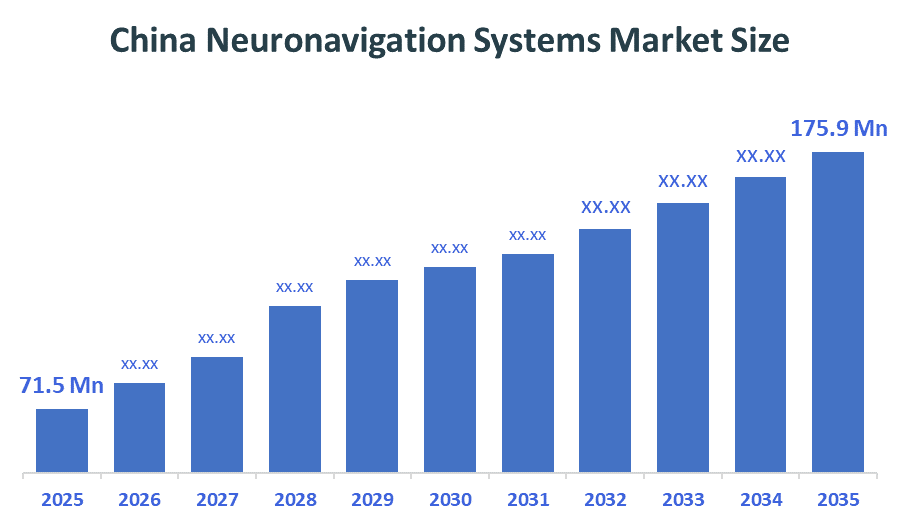
According to Decision Advisors, the China Neuronavigation Systems Market Size is expected to grow from USD 71.5 Million in 2025 to USD 175.9 Million by 2035, at a CAGR of 9.42% during the forecast period 2025-2035. The China Neuronavigation Systems Market is projected to grow significantly over the next decade. The market driven is by rising surgical procedures, technological advancements, and increasing preference for minimally invasive wound closure solutions.
Market Overview/Introduction
China's Neuronavigation Market is essentially the high-tech GPS sector for brain and spine surgeries. These systems use 3D imaging to help surgeons navigate complex anatomy with extreme precision. The market is booming as China modernizes its healthcare infrastructure. This growth is visible in the approximately 450 major hospitals that have already adopted these systems to improve patient outcomes. Global leaders like Medtronic and Stryker are cementing their presence in China by transforming surgery with digital co-pilots. This push is further validated by recent NMPA approvals for advanced tech, proving that these AI tools are no longer just futuristic concepts, they are becoming the new standard for patient care across the country. Meanwhile, companies like ClaroNav are making big moves in China, earning the green light to bring high-tech navigation tools to patients. local innovators like Heal Force are making these high-end tools more accessible and cost-effective for regional hospitals. Looking forward, the biggest opportunities lie in smarter surgeries, think AI-assisted planning and augmented reality, which will make life-saving, minimally invasive procedures more common across the country.
Notable Insights: -
- By product type, the optical neuronavigation systems segment dominated the market in 2025, accounting for approximately 60% of market share, and is projected to grow at a substantial CAGR during the forecast period.
- By end user, the hospitals segment dominated the market in 2025, accounting for approximately 70% of market share, and is projected to grow at a substantial CAGR during the forecast period.
- The compound annual growth rate of the China Neuronavigation Systems Market is 9.42%.
- The market is likely to achieve a valuation of USD 175.9 Million by 2035.
What is the role of technology in grooming the market?
Technological advancements play a crucial role in shaping and accelerating the growth of the China neuronavigation systems market. Innovations such as artificial intelligence (AI), augmented reality (AR), and real-time intraoperative imaging have significantly enhanced the precision and efficiency of neurosurgical procedures. Modern neuronavigation systems integrate high-resolution MRI and CT imaging with advanced software algorithms to provide accurate, real-time guidance during surgery, enabling surgeons to target critical brain structures with minimal risk. Additionally, the integration of these systems with robotic-assisted surgical platforms further improves surgical outcomes by reducing human error and increasing consistency. These technologies not only help in minimizing complications and shortening operation times but also support better patient recovery and clinical outcomes. As hospitals in China continue to adopt smart, digitally integrated surgical solutions, technology remains a key factor in driving market expansion and improving overall healthcare quality.
Market Drivers
A few big things are pushing China toward smarter surgeries. First, as the population gets older, there’s a massive need for the kind of precision only high-tech tools can provide, leading the government to fast-track approvals for AI and robotics. There’s also a real push to close the gap between big city hospitals and rural clinics; these digital co-pilots act like an expert mentor, helping less experienced doctors perform complex operations with the confidence of a veteran. On top of that, global tech giants are building local innovation hubs, creating a ripple effect that makes life-saving, minimally invasive care easier to find and more affordable for everyone.
Study on the Supply, Demand, Distribution, and Market Environment of the China Neuronavigation Systems Market
The China neuronavigation systems market is supported by a strong and evolving healthcare ecosystem across supply, demand, distribution, and market environment. On the supply side, both global companies and emerging domestic manufacturers contribute to technological advancement and improved product availability. Demand is primarily driven by large tertiary hospitals due to rising cases of neurological disorders and increasing neurosurgical procedures. In terms of distribution, the market relies on direct sales, distributor networks, and government-backed procurement systems, ensuring efficient access in urban areas, though rural penetration remains limited. From a market environment perspective, supportive government policies, healthcare infrastructure expansion, and growing adoption of advanced technologies like AI and robotic surgery drive growth, while high costs and regulatory challenges act as key constraints.
Price Analysis and Consumer Behaviour Analysis
The pricing of neuronavigation systems in China varies significantly based on technological sophistication, integration capabilities, and brand positioning. Basic systems typically range from USD 150,000 to 300,000, while advanced platforms integrated with AI, robotics, and real-time imaging can exceed USD 500,000, making them high-value capital investments. From a consumer behavior perspective, purchasing decisions are primarily driven by hospitals and large healthcare institutions, where factors such as clinical accuracy, reliability, compatibility with existing imaging systems, and long-term service support outweigh cost considerations. Tertiary hospitals, in particular, prioritize premium systems to enhance surgical outcomes and maintain competitive clinical standards. However, in mid-tier and smaller hospitals, budget constraints lead to a preference for cost-effective or domestically manufactured solutions. Additionally, government funding and centralized procurement policies play a critical role in influencing buying behavior, often encouraging bulk purchasing and favoring vendors that offer competitive pricing along with comprehensive training and after-sales support.
Market Segmentation
The China Neuronavigation Systems Market share is classified into product type, application, and end user.
- The optical neuronavigation systems segment dominated the market in 2025, accounting for approximately 60% of market share, and is projected to grow at a substantial CAGR during the forecast period.
Based on the product type, the China neuronavigation systems market is divided into optical neuronavigation systems and electromagnetic neuronavigation systems. Among these, the optical neuronavigation systems segment dominated the market in 2025, accounting for approximately 60% of market share, and is projected to grow at a substantial CAGR during the forecast period. Optical systems dominate due to their high accuracy, real-time tracking capability, and widespread use in complex brain surgeries. These systems are particularly preferred in advanced neurosurgical centers across China. However, electromagnetic neuronavigation systems are gaining traction due to their flexibility and effectiveness in procedures where line-of-sight limitations exist. Recent developments include the increasing adoption of AI-integrated optical navigation platforms by leading hospitals in China, enhancing surgical precision and workflow efficiency.
- The brain tumor surgery segment accounted for the largest share in 2025 and is anticipated to grow at a significant CAGR during the forecast period.
Based on the application, the China neuronavigation systems market is divided into brain tumor surgery, spinal surgery, ENT surgery, and others. Among these, the brain tumor surgery segment accounted for the largest share in 2025 and is anticipated to grow at a significant CAGR during the forecast period. Neuronavigation systems are extensively used in brain tumor procedures to ensure precise localization and safe tumor resection while preserving critical brain functions. The rising incidence of brain tumors and increasing demand for minimally invasive neurosurgery are key factors driving this segment. Additionally, spinal surgery is emerging as a fast-growing segment due to the rising prevalence of spinal disorders and growing adoption of navigation-assisted spine procedures. Recent trends highlight the integration of neuronavigation with robotic-assisted neurosurgery in China, improving outcomes in complex tumor and spine surgeries.
- The hospitals segment dominated the market in 2025, accounting for approximately 70% of market share, and is projected to grow at a substantial CAGR during the forecast period.
Based on the end user, the China neuronavigation systems market is divided into hospitals, specialty clinics, and ambulatory surgical centers. Among these, the hospitals segment dominated the market in 2025, accounting for approximately 70% of market share, and is projected to grow at a substantial CAGR during the forecast period. Hospitals dominate due to the presence of advanced imaging infrastructure, the availability of skilled neurosurgeons, and the high volume of complex surgical procedures. Large tertiary hospitals in China are the primary adopters of neuronavigation systems, supported by government funding and healthcare modernisation initiatives. Specialty clinics and ambulatory surgical centers are gradually expanding, driven by the shift toward outpatient and minimally invasive procedures, but they currently hold a smaller share. Recent developments include increased government investment in upgrading hospital surgical capabilities, particularly in Tier-2 cities, further boosting adoption of advanced navigation systems.
Recent Development
- In May 2025, Grena Ltd. announced the expansion and promotion of its advanced surgical adhesive NE'X GLUE across the UK market. The product is designed to enhance surgical safety and efficiency by providing strong tissue adhesion and improved healing outcomes. The launch highlights the growing shift toward next-generation surgical glues that support faster recovery and reduce complications in surgical procedures.
Competitive Analysis
The report offers the appropriate analysis of the key organisations/companies involved within the China neuronavigation systems market, along with a comparative evaluation primarily based on their product offering, business overviews, geographic presence, enterprise strategies, segment market share, and SWOT analysis. The report also provides an elaborative analysis focusing on the current news and developments of the companies, which includes product development, innovations, joint ventures, partnerships, mergers & acquisitions, strategic alliances, and others. This allows for the evaluation of the overall competition within the market.
Top Key Companies in the China Neuronavigation Systems Market
- Huake Precision Medical Technology Co, Ltd.
- Shenzhen Anke High-tech Co, Ltd.
- Heal Force Bio-Meditech Holdings Limited
- MicroPort NeuroTech Limited
- Symbow Medical
Key Target Audience
- Market Players
- Investors
- End-users
- Government Authorities
- Consulting and Research Firm
- Venture capitalists
- Value-Added Resellers (VARs)
Market Segment
This study forecasts revenue at the China, regional, and country levels from 2020 to 2035. Decision Advisors has segmented the China neuronavigation systems market based on the below-mentioned segments
China Neuronavigation Systems Market, By Product Type
- Optical Neuronavigation Systems
- Electromagnetic Neuronavigation Systems
China Neuronavigation Systems Market, By Application
- Brain Tumor Surgery
- Spinal Surgery
- ENT Surgery
- Trauma Cases
China Neuronavigation Systems Market, By End User
- Hospitals
- Ambulatory Surgical Centers
- Specialty Clinics
Frequently Asked Questions (FAQ)
Q. How does interoperability with hospital IT systems impact neuronavigation adoption?
A. Compatibility with hospital IT infrastructure, such as PACS and electronic medical records (EMR), is critical. Systems that seamlessly integrate with existing imaging and data platforms improve workflow efficiency and are more likely to be adopted by large hospitals.
Q. What role do surgeon training and the learning curve play in market growth?
A. Neuronavigation systems require specialized training for accurate usage. Hospitals often consider vendor-provided training programs and ease of use before purchasing, as a steep learning curve can limit adoption despite technological benefits.
Q. How do maintenance and service contracts influence purchasing decisions?
A. Long-term maintenance costs, software updates, and availability of technical support significantly influence buying behavior. Hospitals prefer vendors offering comprehensive service packages to ensure system reliability and minimize downtime.
Q. What are the data security and privacy concerns associated with neuronavigation systems?
A. Since these systems handle sensitive patient imaging and surgical data, concerns around cybersecurity, data storage, and compliance with China’s data protection regulations can impact adoption, especially in large hospitals.
Q. How does competition from alternative surgical technologies affect the market?
A. Technologies such as robotic-assisted surgery and advanced imaging-only guidance systems can act as substitutes or complements, influencing purchasing priorities and slowing adoption in cost-sensitive settings.
Check Licence
Choose the plan that fits you best: Single User, Multi-User, or Enterprise solutions tailored for your needs.
We Have You Covered
- 24/7 Analyst Support
- Clients Across the Globe
- Tailored Insights
- Technology Tracking
- Competitive Intelligence
- Custom Research
- Syndicated Market Studies
- Market Overview
- Market Segmentation
- Growth Drivers
- Market Opportunities
- Regulatory Insights
- Innovation & Sustainability
Report Details
| Scope | Country |
| Pages | 210 |
| Delivery | PDF & Excel via Email |
| Language | English |
| Release | Apr 2026 |
| Access | Download from this page |