
China Underfloor Heating Market
 |
Author:
Omkar J
|
Pages:
210
|
Author:
Omkar J
|
Pages:
210
China Underfloor Heating Market Size, Share, By Product (Hydronic Underfloor Heating, Electric Underfloor Heating), By Component (Heating Pipes, Heating Cables, Manifolds, Control Systems), By Application (Residential, Commercial, Industrial), Analysis and Forecast 2025 ? 2035
REPORT COVERAGE
Country
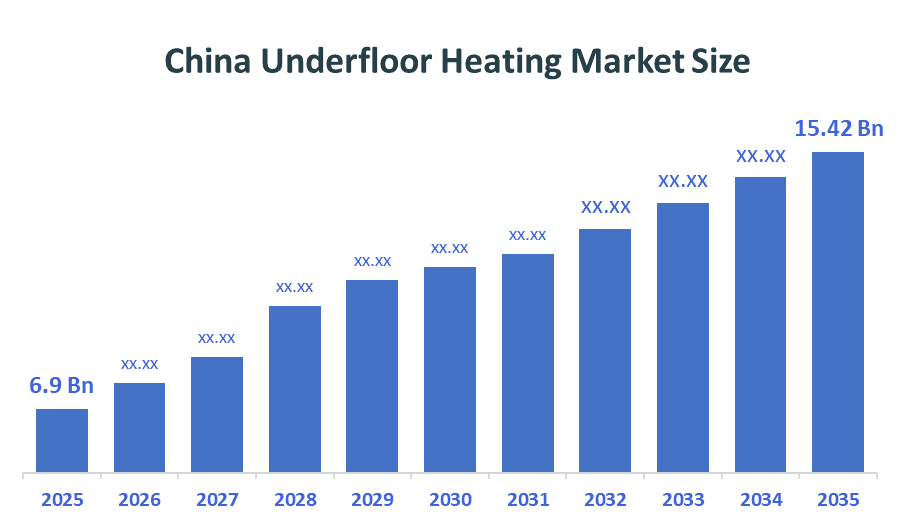
The China Underfloor Heating Market Size is forecasted to grow from USD 6.9 Billion in 2025 and going to reach approx. USD 15.42 Billion by 2035. According to Decision Advisors, there is a detailed research report on the China Underfloor Heating Market highlights that hydronic systems dominate the global market, accounting for approximately 60–65% of the total share worldwide. Uponor Corporation generates strong revenue through their cost efficiency in large-scale installations, which accounts for approximately 12% market share, thus acting as a main driver that innovation, smart controls, and energy-efficient heating technologies in China.
Market Snapshot
- Market Size (2025): USD 6.9 Billion
- Projected Market Size (2035): USD 15.42 Billion
- Compound Annual Growth Rate (CAGR): 8.37%
- Base Year: 2025
- Historical Period: 2021–2025
- Forecast Period: 2026–2035
Market Overview/Introduction
The China Underfloor Heating Market shows total market expansion through its implementation of heating systems which operate under floor materials to deliver multiple types of buildings through their complete heating distribution system. The systems have become more widely used because cities are growing and people have more money to spend while they search for heating solutions that use less energy. The residential market represents about 65-70% of total heating system installations because northern China experiences extreme winter conditions which create strong demand for heating solutions. The Chinese government is accelerating the transition to electric and hydronic underfloor heating systems because it pushes for clean heating through its energy transition policies. The combination of smart home systems with IoT-enabled thermostats and automated control systems gives users a 20-30% energy saving while improving system efficiency and user convenience.
- In June 2022, China’s 14th Five-Year Plan for Renewable Energy emphasized renewable-based heating in northern regions, targeting over 60 million tons of standard coal equivalent replacement through clean heating solutions like geothermal, solar thermal, and biomass
- In April 2025, China’s National Development and Reform Commission (NDRC) issued the Heat Pump Industry Action Plan to improve efficiency by ≥20% and expand deployment across residential and industrial heating applications, supporting clean energy transition
Notable Insights: -
- By product, the Hydronic underfloor heating held a dominant position with 7.9% in terms of market share in 2025.
- By component, heating pipes is the dominating accounting for over 7.6% of the China market share in 2025.
- The compound annual growth rate of the China Underfloor Heating Market is 8.37%.
- The market is likely to achieve a valuation of USD 15.42 Billion by 2035.
What is role of technology in grooming the market?
Technological advancements continue to revolutionize China's underfloor heating sector through their capacity to improve system efficiency and operational effectiveness and customer satisfaction. Hydronic systems provide 25–40% energy savings compared to traditional radiators which makes them suitable for use in large-scale projects. The combination of IoT-enabled thermostats with smart control systems enables users to monitor their setups in real time while the system automatically adjusts temperatures which results in energy savings of up to 30%. Advanced insulation materials enable buildings to retain heat more effectively through their ability to enhance heat retention performance between 15 and 20% while AI-based energy management systems for buildings (BEMS) achieve better heating results with decreased operational expenses. The use of modular installation technologies has achieved installation time reductions of almost 20% which leads to faster project completion times. The market for smart heating systems is expected to grow approximately 45% by 2030 because of rising consumer demand for energy-efficient home solutions which include automated systems.
Market Drivers
The China Underfloor Heating Market experiences its primary growth because urban areas are expanding and people have more money to spend and they want residential buildings which conserve energy. The market experiences rapid expansion because government regulations promote clean heating solutions and they work to decrease carbon emissions. The residential building sector generates more than 65% of total market demand because housing development and renovation activities continue to increase. Smart building projects and energy efficiency standards have led to increased commercial market growth. The combination of better electricity supply and higher use of renewable energy sources drives people to use electric heating systems. The demand for heating systems has increased because people in northern China need regular heating to maintain comfortable indoor temperatures during cold weather. The market is experiencing substantial growth because more renovation projects are taking place and older buildings are being updated.
Restrain
The China Underfloor Heating Market shows strong market potential but its growth will be limited by multiple fundamental market obstacles. The high installation costs of systems create significant challenges for retrofitting existing buildings because these projects require extensive infrastructure changes. The operational efficiency of hydronic systems is supported by their operational performance but their installation requirements and initial financial needs make these systems difficult for customers who have budget constraints. The installation process faces delays because of the existing shortage of qualified professionals who already work as system installers. The organization faces operational difficulties because maintenance work requires complex procedures and service organizations lack standard operating procedures. Small households and businesses avoid using the system because its initial cost exceeds the price of traditional heating systems. The combination of these factors prevents widespread adoption of the technology who live in remote areas and less developed parts of China.
Study on the Supply, Demand, Distribution, and Market China Underfloor Heating Market
The supply chain of the China Underfloor Heating Market operates through its established system which includes manufacturers and distributors and contractors and real estate developers. The domestic manufacturers control roughly 60 to 65% of supply operations because they possess strong local production capacity and cost benefits. The market shares of residential demand reach 65 to 70% which results from urban housing development and renovation work. Commercial applications are experiencing growth especially in office buildings and retail establishments. The distribution channels use contractor networks and OEM partnerships and digital platforms which now serve as online procurement channels that experience a 20% annual growth rate. The company generates approximately 25% of its total revenue through after-sales services and maintenance contracts which shows how vital long-term service solutions are for the business. The ongoing rapid development of infrastructure projects helps maintain equal supply and demand conditions.
Price Analysis and Consumer Behaviour Analysis
Pricing in the China Underfloor Heating Market varies depending on system type, installation complexity, and technology integration. Electric underfloor heating systems typically range between USD 10–25 per square meter which makes them appropriate for applications that require smaller areas and budget-friendly solutions. Hydronic systems require a budget of USD 25–60 per square meter which enables them to deliver energy savings between 30 to 50% throughout their operational life making them suitable for extensive system deployments. Consumer behavior research shows that 68% of customers choose heating systems based on their energy efficiency while 55% of customers select heating systems because they provide comfortable and evenly distributed warmth. The market shows a trend toward value-based purchasing because 48% of customers prefer automated smart heating systems while 40% of customers think about total cost of ownership instead of initial purchase price.
Strategies to Implement for Growth of the Market
Companies should focus on developing cost-effective solutions while strengthening localized manufacturing to decrease installation costs and product expenses in order to drive market growth in the China Underfloor Heating Market. The adoption of modular systems which users can install without difficulty will experience substantial growth because these systems prove beneficial for retrofit implementation. The company can achieve large-scale market expansion through its strategic alliances with real estate developers and construction companies and their partnerships with contractors. Digital marketing campaigns which increase consumer awareness will help the company penetrate new markets through its partnerships with government energy-efficiency programs. The company needs to invest in workforce training programs because skilled installers currently face a shortage. The company will achieve sustained market growth by integrating IoT-enabled smart heating technologies into its mid-range products which will provide customers with increased value.
Market Segmentation
The China Underfloor Heating Market share is classified into product, component, and application
- The Hydronic underfloor heating dominated the market in 2024, and is projected to grow at a substantial CAGR of approximately 7.9% during the forecast period.
Based on the product, the China Underfloor Heating Market is divided Hydronic Underfloor Heating, Electric Underfloor Heating. Among these, the Hydronic underfloor heating dominated the market in 2024, and is projected to grow at a substantial CAGR of approximately 7.9% during the forecast period. Hydronic systems dominate due to their higher energy efficiency and cost-effectiveness in large residential and commercial installations, especially in northern China where continuous heating demand is high.
- The Heating pipes accounted for the largest share in 2024, and is anticipated to grow at a significant CAGR of approximately 11.1 % during the forecast period.
Based on the Component, the China Underfloor Heating Market is divided into Heating Pipes, Heating Cables, Manifolds, Control Systems. Among these, the heating pipes accounted for the largest share in 2024, and is anticipated to grow at a significant CAGR of approximately 11.1% during the forecast period. Heating pipes dominate due to their essential role in hydronic systems, which are widely used in large-scale residential and commercial installations across China.
- The Residential segment dominated the market in 2024, and is projected to grow at a substantial CAGR approximately 7.8% during the forecast period.
Based on the Application, the China Underfloor Heating Market is divided into residential, commercial, industrial. Among these, the Residential segment dominated the market in 2024, and is projected to grow at a substantial CAGR approximately 7.8% during the forecast period. The residential segment leads due to high demand for comfortable, energy-efficient heating in urban housing and increasing adoption of smart home heating solutions across China.
Recent Development
- In January 2024, Uponor Corporation strengthened its focus on hydronic and radiant heating systems, developing energy-efficient solutions that enhance indoor comfort and support sustainable building applications globally
- In March 2024, REHAU Group enhanced its underfloor heating portfolio with advanced RAUTHERM piping systems and installation technologies, improving installation efficiency, reducing deployment time, and supporting high-performance radiant heating applications.
- In March 2023, Danfoss advanced smart underfloor heating solutions by integrating intelligent control systems and energy-efficient technologies, enabling better grid interaction, optimized energy consumption, and improved building heating performance.
Competitive Analysis
The report offers the appropriate analysis of the key organisations/companies involved within the China Underfloor Heating Market, along with a comparative evaluation primarily based on their Technology offering, business overviews, geographic presence, enterprise strategies, segment market share, and SWOT analysis. The report also provides an elaborative analysis focusing on the current news and developments of the companies, which includes Technology development, innovations, joint ventures, partnerships, mergers & acquisitions, strategic alliances, and others. This allows for the evaluation of the overall competition within the market.
Top Key Companies in China Underfloor Heating Market
- Danfoss
- Uponor Corporation
- Schneider Electric
- Honeywell
- Siemens
- Nexans
- Others
Key Target Audience
- Market Players
- Investors
- End-users
- Government Authorities
- Consulting and Research Firm
- Venture capitalists
- Value-Added Resellers (VARs)
Market Segment
This study forecasts revenue at the China, regional, and country levels from 2020 to 2035. Decision Advisors has segmented the China Underfloor Heating Market based on the below-mentioned segments
China Underfloor Heating Market, By Product
- Hydronic Underfloor Heating
- Electric Underfloor Heating
China Underfloor Heating Market, By Component
- Heating Pipes
- Heating Cables
- Manifolds
- Control Systems
China Underfloor Heating Market, By Application
- Residential
- Commercial
- Industrial
Frequently Asked Questions (FAQ)
1. What is driving the growth of the China Underfloor Heating Market?
Growth is driven by rapid urbanization, rising disposable income, cold climate conditions in northern China, and strong demand for energy-efficient heating systems.
2. Why are hydronic underfloor heating systems more popular in China?
Hydronic systems dominate because they offer higher energy efficiency, lower long-term operating costs, and are suitable for large-scale residential and commercial installations.
3. How is government policy influencing the underfloor heating market in China?
Government clean energy policies and carbon reduction goals are promoting adoption of energy-efficient heating systems, including electric and hydronic underfloor heating technologies.
4. Which region in China shows the highest demand for underfloor heating?
Northern China shows the highest demand due to long, harsh winters and stronger heating requirements in residential and commercial buildings.
5. What role does smart technology play in underfloor heating systems?
Smart thermostats, IoT-enabled controls, and AI-based energy management systems help reduce energy consumption by up to 30% while improving comfort and efficiency.
6. What are the main challenges in the China Underfloor Heating Market?
High installation costs, lack of skilled installers, and complex maintenance requirements are major barriers to wider adoption.
Check Licence
Choose the plan that fits you best: Single User, Multi-User, or Enterprise solutions tailored for your needs.
We Have You Covered
- 24/7 Analyst Support
- Clients Across the Globe
- Tailored Insights
- Technology Tracking
- Competitive Intelligence
- Custom Research
- Syndicated Market Studies
- Market Overview
- Market Segmentation
- Growth Drivers
- Market Opportunities
- Regulatory Insights
- Innovation & Sustainability
Report Details
| Scope | Country |
| Pages | 210 |
| Delivery | PDF & Excel via Email |
| Language | English |
| Release | Apr 2026 |
| Access | Download from this page |