
China Wooden Furniture Market
 |
Pages:
210
|
Pages:
210
China Wooden Furniture Market Size, Share, By Product Type (Tables, Chairs, Cabinets, Sofas, and Beds), By Material Type (Solid Wood, Engineered Wood, Plywood, and Particle Board), By Applications (Residential, Commercial, Institutional, Hospitality, and Office) By Design Style (Modern, Traditional, Rustic, Contemporary, and Minimalist) Analysis and Forecast 2026-2035
REPORT COVERAGE
Country
Market Snapshot
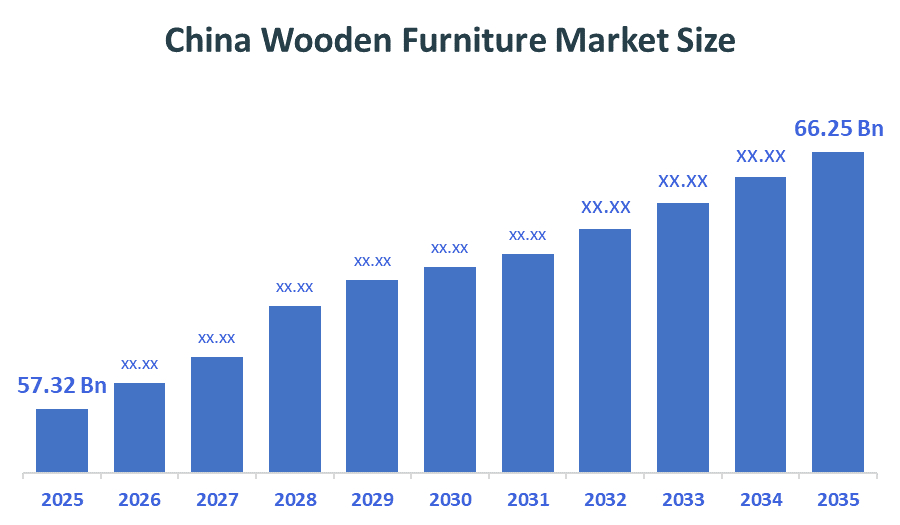
- China Wooden Furniture Market Size (2025): USD 57.32 Billion
- China Wooden Furniture Projected Market Size (2035): USD 66.25 Billion
- China Wooden Furniture Compound Annual Growth Rate (CAGR): 1.46%
- Base Year: 2025
- Historical Period: 2021–2024
- Forecast Period: 2026–2035
Market Overview/Introduction
Wooden Furniture Market means the industry involved in the manufacture, supply, and sale of furniture made up of naturally occurring wood material and manufactured wood products such as plywood, MDF, and particle board. Examples of wooden furniture include chairs, tables, bed frames, sofa sets, wardrobes, cabinets, and office desks. These are some of the most durable and preferred furniture products due to their natural beauty, sturdiness, and environmental friendliness. The growth of this market is mainly propelled by fast urbanization, high disposable income levels, and the growing construction industry in different countries. The increasing demand for luxury, custom-made interiors and changes in lifestyles are further fuelling this market growth. Moreover, people becoming increasingly aware of green living and sustainable materials have led to the adoption of wood-based products. Advancements in technology such as CNC machining, automation in woodworking, laser cutting, and sophisticated polishing technologies are making the manufacturing process easy and more efficient. Innovations in modular furniture, flat packing, smart furniture integration, and sustainable manufacturing practices are also taking place.
- In 2025, China’s “Made in China 2025” initiative continues transforming the wooden furniture industry by promoting automation, AI-driven design, and sustainable materials like bamboo and repurposed wood for greener manufacturing.
- In January 2025, China’s furniture trade-in subsidy schemes expand through JD.com and Alibaba, supported by government policies, boosting domestic demand for wooden furniture and home renovation products nationwide.
- In March 2024, FSC China promotes green furniture initiatives, encouraging wooden furniture manufacturers to adopt sustainable sourcing practices and achieve FSC certification, supporting eco-friendly and responsible global furniture production.
Notable Insights: -
- By Product Type, the Chairs segment holds a dominant position with an estimated share of over 28% in 2025.
- By Material Type, the Solid Wood segment holds a dominant position with an estimated share of over 43% in 2025.
- By Design Style, the Industrial sector segment holds a dominant position with an estimated share of over 58% in 2025.
- By Application, the Residential segment holds a dominant position with an estimated share of over 37% in 2025.
- The forecasted CAGR for the China Wooden furniture market is expected to be about 1.46% for the period between 2026 and 2035.
- The market is expected to reach a valuation of approximately USD 66.25 Billion by 2035
What is the Role of Technology in Grooming the Market?
Technology plays a pivotal role in the growth and evolution of the market. Using the tools of data analytics and artificial intelligence, companies gain insights into the behaviour of consumers and develop personalized marketing techniques and accurate forecasting of demand. The digital nature of modern technologies and e-commerce removes geographic limitations, turning local markets into global spaces. In addition, automation and blockchain improve supply chain efficiency, creating the level of consumer confidence that ensures the maturity of the market. Through the use of financial technologies and continuous feedback, technology ensures adaptability and competitiveness in new economic trends.
Market Drivers
The wood furniture market is propelled by factors like fast-paced urbanization, growing disposable incomes, and robust expansion of the real estate sector and construction industry. High demand for furniture that is visually attractive, sturdy, and environmentally friendly is contributing to its acceptance in both domestic and commercial environments. The development of the hospitality and office space sectors is also providing support to market expansion. Other factors that are driving the market are changing consumer lifestyles and preferences for personalized and modular furniture. Advances in wood manufacturing technology, including the use of computer numerical control (CNC) machines, contribute to improved productivity.
Restraints
The wooden furniture market faces restraints such as high raw material costs, dependence on timber supply, and deforestation regulations. Susceptibility to termites, moisture, and weather damage also limits durability in some regions. Competition from low-cost alternatives like plastic and metal furniture further restricts growth. Additionally, fluctuating wood prices and supply chain constraints impact overall market stability and profitability.
Study on the Supply, Demand, Distribution, and Market Environment
The wooden furniture industry operates under a harmonized balance between supply, demand, distribution, and market environments. The supply factor depends on timber resources, engineered wood products, and production centers located in nations such as China, India, and Vietnam. The demand has been escalating owing to urbanization, expansion in housing, and increased consumer preferences for aesthetics and sustainability in interior decoration. The distribution process encompasses physical retail shops, specialized furniture retailers, wholesale merchants, and expanding e-commerce websites. The market environment is influenced by regulations regarding raw materials, environmental issues, and sustainable forestation programs implemented by the government. Pricing competition from substitute materials such as metals and plastics also plays a significant role in shaping the market environment.
Price Analysis and Consumer Behaviour Analysis
The wooden furniture market shows a wide price range influenced by material quality, craftsmanship, design complexity, and brand positioning. The price range for wooden furniture is quite broad and depends on the quality of the material used, the manufacturing process, and design features. High-quality solid wood furniture, such as teak and oak, is priced higher than engineered wood items like MDF and plywood. Designer and custom-made furniture are sold at high prices as well. Increasing raw material prices and supply chain disruptions also influence pricing strategies. Consumer behaviour in this market is shifting toward durability, eco-friendly materials, and modern aesthetics. They tend to choose durable furniture made from sustainable materials with a contemporary look. Consumers living in urban areas seek modular furniture that maximizes space usage. Online shopping channels greatly affect consumers' purchasing decisions, including reviews, catalogues, and promotional offers. After-sales services and brand reputation are important factors that customers consider when choosing furniture. Consumers also care about the sustainability of wooden furniture products.
Market Segmentation
The China fans and lower market is categorised by product type, material type, application and Design Style
- The sofas segment dominated the market in 2025 and is projected to grow at a steady CAGR of approximately 6% during the forecast period.
Based on the product type, the wooden furniture market is divided into tables, chairs, cabinets, sofas, and beds. Among these, Sofas dominate the wooden furniture market, holding the largest share of around 25–30% due to high demand in living room interiors and premium home décor. Consumers increasingly invest in comfortable, stylish, and modular sofa designs, boosting this segment’s growth. Urbanization, rising disposable income, and housing expansion further support demand. The sofa segment also records a strong CAGR of about 5–7%, driven by renovation trends and preference for luxury and multifunctional furniture in modern residential spaces.
- The engineered Wood segment accounted for the largest share in 2025 and is anticipated to grow at a significant CAGR of approximately 5.5% during the forecast period.
Based on the material type, the Wooden furniture market is divided into solid wood, engineered wood, plywood, and particle board. Among these, Engineered Wood dominates the wooden furniture market with the highest share of around 40–45%. It is preferred due to its cost-effectiveness, durability, uniform quality, and resistance to warping compared to solid wood. It also supports modern designs and mass production. Solid wood follows but is more expensive. Engineered wood is growing at a CAGR of about 5–6%, driven by urban housing demand, affordability, and increasing use in modular and ready-to-assemble furniture across residential and commercial sectors.
- The residential segment accounted for the largest share in 2025 and is anticipated to grow at a significant CAGR of approximately 5.7% during the forecast period.
Based on the application, the wooden furniture market is divided into residential, commercial, institutional, hospitality, and office. Among these, the residential segment dominates the wooden furniture market with the largest share of around 55–60%. This dominance is driven by rapid urbanization, housing development, rising disposable income, and strong demand for home renovation and interior decoration. Consumers increasingly invest in durable, aesthetic, and customized wooden furniture for living spaces. The residential segment is also growing at a CAGR of about 5–6%, supported by expanding real estate projects and increasing preference for modular home furnishings globally.
- The modern sector segment accounted for the largest share in 2025 and is anticipated to grow at a significant CAGR of approximately 6.5% during the forecast period.
Based on the design style, the wooden furniture market is divided into modern, traditional, rustic, contemporary and minimalist. Among these, the modern segment dominates the wooden furniture market with a market share of around 35–40%. It leads due to rising urbanization, compact living spaces, and strong demand for sleek, functional, and space-saving furniture. Consumers prefer modern designs for their versatility, aesthetics, and compatibility with contemporary interiors. This segment is also growing at a CAGR of about 5–7%, driven by smart furniture trends, modular designs, and increasing adoption in both residential and commercial spaces globally.
Recent Developments
- In April 2026, Yeswood (Shanghai Duoyi Furniture) strengthens its wooden furniture portfolio, focusing on healthy solid wood products, including Light Luxury Fishbone Series and natural timber beds for premium consumers.
- In January 2026, wooden furniture design trends highlight American black walnut, tempered glass insets, and integrated LED lighting, reflecting a shift toward premium, modern, and multifunctional luxury furniture aesthetics globally.
- In January 2026, WMF Expo highlights AI automation and smart woodworking technologies transforming the wooden furniture manufacturing industry globally.
Competitive Analysis
The report offers the appropriate analysis of the key organisations/companies involved within the China Wooden furniture market, along with a comparative evaluation primarily based on their product offering, business overviews, geographic presence, enterprise strategies, segment market share, and SWOT analysis. The report also provides an elaborate analysis focusing on the current news and developments of the companies, which includes product development, innovations, joint ventures, partnerships, mergers & acquisitions, strategic alliances, and others. This allows for the evaluation of the overall competition within the market.
Top Key Companies in the China Wooden Furniture Market
- OPPEIN Home Group
- KUKA Home
- Markor International Furniture
- QuMei Furniture Group
- Red Apple Furniture
- QuanU Furniture
- ZUOYOU Furniture
- Landbond Furniture
- Shuangye Furniture
- Yihua Lifestyle Technology
- Suofeiya Home Collection
- Man Wah Holdings
- Others
Key Target Audience
- Market Players
- Investors
- End-users
- Government Authorities
- Consulting and Research Firm
- Venture capitalists
- Value-Added Resellers (VARs)
Market Segmentation
This study forecasts revenue at the national and regional levels from 2021 to 2035. The report segmented the China Wooden Furniture Market based on the following segments:
China Wooden Furniture Market, By Product Type
- Tables
- Chairs
- Cabinets
- Sofas
- Beds
China Wooden Furniture Market, By Material Type
- Solid Wood
- Engineered Wood
- Plywood
- Particle Board
China Wooden Furniture Market, By Application
- Residential
- Commercial
- Institutional
- Hospitality
- Office
China Wooden Furniture Market, By Design Style
- Industrial sector
- Traditional
- Rustic,
- Contemporary
- Minimalist
Frequently Asked Questions (FAQ)
1. What factors are influencing innovation in the China wooden furniture market?
Innovation is driven by increasing use of digital design tools, smart manufacturing systems, and rising consumer demand for customized and multifunctional furniture solutions.
2. How is sustainability shaping the wooden furniture industry in China?
Sustainability is encouraging manufacturers to adopt responsibly sourced materials, reduce waste in production, and implement eco-friendly manufacturing practices across supply chains.
3. What role does e-commerce play in the China wooden furniture market?
E-commerce platforms are expanding market accessibility, enabling direct-to-consumer sales, enhancing product visibility, and supporting personalized shopping experiences.
4. What challenges are faced by wooden furniture manufacturers in China?
Manufacturers face challenges such as fluctuating raw material availability, increasing production costs, and pressure to meet stricter environmental and quality standards.
5. How is consumer preference evolving in the wooden furniture market?
Consumers are increasingly preferring space-efficient, customizable, and aesthetically modern furniture designs that align with urban living lifestyles and interior trends.
Check Licence
Choose the plan that fits you best: Single User, Multi-User, or Enterprise solutions tailored for your needs.
We Have You Covered
- 24/7 Analyst Support
- Clients Across the Globe
- Tailored Insights
- Technology Tracking
- Competitive Intelligence
- Custom Research
- Syndicated Market Studies
- Market Overview
- Market Segmentation
- Growth Drivers
- Market Opportunities
- Regulatory Insights
- Innovation & Sustainability
Report Details
| Scope | Country |
| Pages | 210 |
| Delivery | PDF & Excel via Email |
| Language | English |
| Release | Apr 2026 |
| Access | Download from this page |