
Global Chronic Hand Eczema Market
 |
Pages:
195
|
Pages:
195
Global Chronic Hand Eczema Market Size, Share, By Treatment Type (Topical corticosteroids, Calcineurin Inhibitors, Emollients and Moisturizers, Systemic Therapies, and Biologics and Advanced Therapies), By Route of Administration (Topical, Oral, and Injectable), By Distribution Channel (Hospital Pharmacies, Retail pharmacies, and Online Pharmacies), and By Region (North America, Europe, Asia-Pacific, Latin America, Middle East, and Africa), Analysis and Forecast 2025 ? 2035.
REPORT COVERAGE
Global
Market Snapshot
- Market Size (2025): USD 14.7 Billion
- Projected Market Size (2035): USD 32.5 Billion
- Compound Annual Growth Rate (CAGR): 8.26%
- Largest Regional Market: North America
- Fastest Growing Region: Asia Pacific
- 2nd Largest Region: Europe
- Base Year: 2025
- Historical Period: 2021–2024
- Forecast Period: 2025–2035
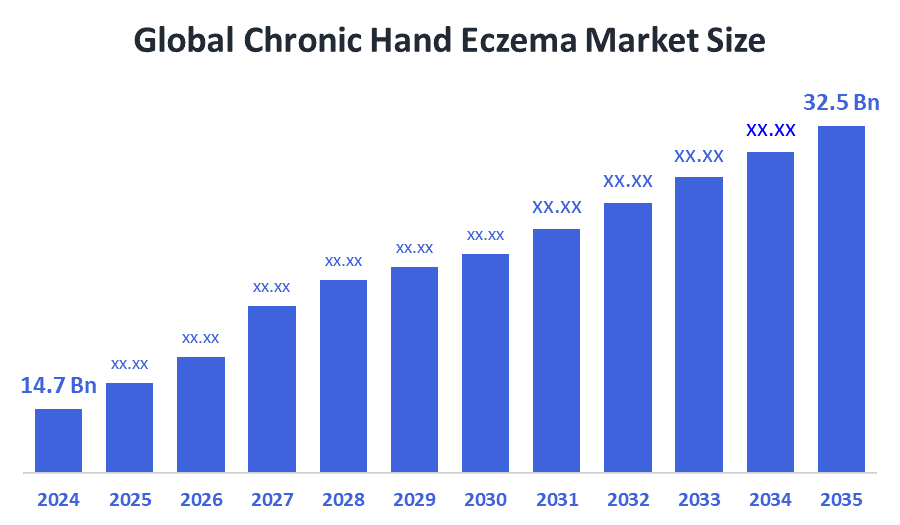
According to Decision Advisors, the Global Chronic Hand Eczema Market Size is expected to grow from USD 14.7 billion in 2025 to USD 32.5 billion by 2035, at a CAGR of 8.26% during the forecast period 2025-2035. The global chronic hand eczema market is projected to grow significantly over the next decade due to the growing number of people who develop occupational skin disorders. The increasing public understanding of skin health. The rising availability of advanced treatment solutions. Chronic hand eczema develops through three main symptoms which include skin inflammation, persistent itching and skin barrier breakdown. The condition creates a major impact on both work efficiency and personal well-being of affected individuals who live in developed countries.
Market Overview/ Introduction
The chronic hand eczema market refers to the global industry that develops, produces, and sells treatment solutions for chronic hand eczema, which is a persistent inflammatory skin disorder that impacts hand skin. The market consists of topical treatments, systemic drugs, biologic medications and skincare products, which provide additional support. Chronic hand eczema is a widespread skin disorder that produces inflamed skin that results in dry, red, itchy and painful skin lesions which develop on the hands. The condition can occur through sudden flare-ups, which alternate with periods of no symptoms, or it can develop into a permanent state of existence.
Market expansion is supported by advancements in dermatology through targeted therapies and biologics, which deliver improved treatment results and patient safety. The combination of increased awareness, improved diagnosis rates, and expanded healthcare infrastructure continues to drive market growth.
The Global Patient Initiative to Improve Eczema Care, which involves 13 countries, works to enhance healthcare systems and patient access and treatment outcomes through its standard evaluation system. The organizations collaborate with governments to shape healthcare policies and enhance reimbursement systems, which will enable greater access to dermatological treatments through their national-level advocacy and policy summits.
- The Medicines and Healthcare products Regulatory Agency has approved the medicine delgocitinib (Anzupgo) to treat moderate to severe chronic hand eczema in adults when topical corticosteroids are not effective or suitable for use.
- European Commission Approves LEO Pharma’s Anzupgo (delgocitinib) Cream for Adults with Moderate to Severe Chronic Hand Eczema (CHE).
Notable Insights: -
- North America holds the largest regional market share, approximately 38.7% in the global chronic hand eczema market.
- Asia Pacific is the fastest-growing region in the global chronic hand eczema market.
- By treatment type, the topical corticosteroids segment held a dominant position in terms of market share in 2025.
- By distribution channel, the hospital pharmacies segment is the dominating one, accounting for over 35% of the global market share in 2025.
- The compound annual growth rate of the global chronic hand eczema market is 8.26%.
- The market is likely to achieve a valuation of USD 32.5 billion by 2035.
What is role of technology in grooming the market?
Technology is playing a critical role in shaping the global chronic hand eczema market by improving diagnosis, enabling advanced treatments, and expanding patient access. Modern technologies are accelerating innovation in dermatology through their current scientific advancements. Biotechnology and molecular research enable scientists to detect particular inflammatory pathways in their studies. The medical field creates targeted therapies, which include JAK inhibitors and biologics as alternatives to conventional steroid treatments. A drug discovery process that employs artificial intelligence achieves time reductions between 30 and 50%. Digital platforms transform patient care through three methods, which include Mobile apps for symptom tracking and adherence, and Teleconsultations via apps like Practo and Teladoc and remote diagnosis using image-based AI tools. AI diagnostic accuracy in dermatology studies achieves 85 to 90%accuracy. Technology development enables the CHE market to transform from its original basic symptom treatment model into a sophisticated healthcare system that uses advanced precision medicine methods.
How is Recent Developments Helping the Market?
Recent developments, such as improving treatment outcomes, expanding therapeutic options, and increasing patient access, are supporting the growth of the global chronic hand eczema market. JAK inhibitors (e.g., delgocitinib cream) are a major breakthrough, directly targeting inflammatory pathways rather than just symptoms. New investigational drugs like gusacitinib (ASN-002) are expanding systemic treatment options. Advanced therapies such as biologics, antimicrobial peptides, and retinoids provide more precise and effective treatment. Recent R&D developments are boosting revenue, such as the U.S. CHE market alone, USD 431 million in 2023.
Market Drivers
The global Chronic Hand Eczema market is propelled by the fact that allergen and irritant exposure risks continue to increase through their growing presence in the environment. Hand eczema has its characteristics marked by redness, itching, cracking, and scaling in the hands. Almirall S.A. (ALM) functions as a worldwide biopharmaceutical enterprise which specializes in medical dermatology from its base in Barcelona. Almirall operates its Shanghai presence through Almirall Shanghai Pharmaceutical Consulting Co. Ltd to establish new medical dermatology research prospects by combining its internal research and development resources with partnerships in China.
Restrain
The main restraints on the global chronic hand eczema market include the global chronic hand eczema market suffers from the lack of standardized diagnostic criteria, which shows no signs of resolution. Different regions and even individual clinicians often employ varied definitions and thresholds for diagnosing this persistent condition. The global chronic hand eczema market faces financial limitations because of the expensive nature of biologic treatments.
Competitive Analysis:
The report offers the appropriate analysis of the key organizations/companies involved within the chronic hand eczema market, along with a comparative evaluation primarily based on their product of offering, business overviews, geographic presence, enterprise strategies, segment market share, and SWOT analysis. The report also provides an elaborative analysis focusing on the current news and developments of the companies, which includes product development, innovations, joint ventures, partnerships, mergers & acquisitions, strategic alliances, and others. This allows for the evaluation of the overall competition within the market.
Top Companies in Global Chronic Hand Eczema Market
- Sanofi
- AbbVie
- Pfizer
- Novartis
- Bristol Myers Squibb
- Amgen
- Eli Lilly
- Johnson & Johnson
- GlaxoSmithKline
- LEO Pharma
Government Initiatives
|
Country |
Key Government Initiatives |
|
UK |
The National Institute for Health and Care Excellence has recommended and the NHS endorsed delgocitinib for adults with moderate?to?severe chronic hand eczema, expanding access to advanced topical treatments on public health plans in England and Wales. This improves equity and patient care nationwide. |
|
US |
The U.S. is actively negotiating trade agreements, including with India, to reduce tariffs on American Chronic Hand Eczema in foreign markets, while reciprocal tariff adjustments on imports remain selective and subject to ongoing policy changes. |
|
India |
Broad national programs such as the National Health Mission and health insurance schemes like Rashtriya Swasthya Bima Yojana improve overall access to dermatological and chronic care services, indirectly supporting eczema management through better healthcare access. |
|
China |
Under the Healthy China Initiative, public health education to raise awareness about chronic skin conditions and improvement of clinical guidelines (e.g., national eczema/atopic dermatitis protocols) help promote standardized diagnosis and management |
Market Segmentation
The chronic hand eczema market share is classified into treatment type, route of administration, and distribution channel
- The topical corticosteroids segment dominated the market in 2025, and is projected to grow at a substantial CAGR during the forecast period.
Based on the treatment type, the chronic hand eczema market is divided into topical corticosteroids, calcineurin inhibitors, emollients and moisturizers, systemic therapies, biologics and advanced therapies. Among these, the topical corticosteroids segment dominated the market in 2025 and is projected to grow at a substantial CAGR during the forecast period. It is because of its neutral flavor profile and clean finish that it is indispensable for popular cocktails. It has a massive appeal across various price points, from value to premium brands. Here, the dominance is driven by the fact that they are considered the first-line treatment for managing mild to moderate chronic hand eczema, widely prescribed due to their effectiveness, ease of use, and availability. The existing treatments maintain their primary market position because both industrialised nations and developing countries have begun to adopt these newer biologic and systemic therapies, which currently account for only a small portion of market share.
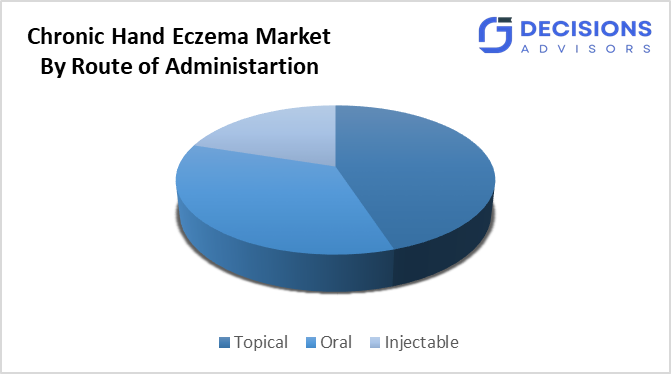
- The topical segment accounted for the largest share in 2025, and is anticipated to grow at a significant CAGR of approximately 45% during the forecast period.
Based on the route of administration, the chronic hand eczema market is divided into topical, oral, and injectable. Among these, the topical segment accounted for the largest share in 2025, and is anticipated to grow at a significant CAGR of approximately 45% during the forecast period. It is ease of use, direct symptom relief, and high patient compliance. Systemic and injectable therapies hold smaller portions but are growing as severe and biologic treatments expand.
- The hospital pharmacies segment dominated the market in 2025, and is projected to grow at a substantial CAGR of approximately 35% during the forecast period.
Based on the distribution channel, the chronic hand eczema market is divided into hospital pharmacies, retail pharmacies, and online pharmacies. Among these, the hospital pharmacies segment dominated the market in 2025, and is projected to grow at a substantial CAGR of approximately 35% during the forecast period. Due to the most advanced treatments, such as prescription topical corticosteroids, systemic therapies, and biologics, being dispensed primarily through hospitals and specialized clinics.
What is the Reason for the Region Dominance?
The dominance of certain regions in the global chronic hand eczema market is primarily driven by their advanced healthcare infrastructure and high awareness levels. The region benefits from its pharmaceutical companies, which conduct extensive R&D while implementing innovative treatments that include biologics and targeted therapies. The market shows positive growth because of reimbursement policies and increased healthcare expenditures. The rising occurrence of skin disorders, with improved dermatology access for patients, leads to increased diagnosis and treatment execution. The United States functions as a key player because it maintains constant clinical progress and strong regulatory backing while delivering advanced medical treatments throughout its healthcare facilities.
Strategies to Implement for Growth of the Market in Non-Leading Regions
Growth in non-leading regions can be supported through strategic investments, product innovation, and expanding distribution networks. Improving awareness and launching public health campaigns and workplace education programs about chronic hand eczema to increase early detection and treatment demand. Investing in dermatology clinics and training healthcare professionals in emerging regions to improve access to diagnosis and advanced therapies. Introduce low-cost generics, biosimilars, and subsidised treatment programs to overcome affordability barriers and increase patient adoption. Expanding reach through retail pharmacies, online platforms, and rural healthcare networks to ensure wider availability of treatments. Collaborate with local pharmaceutical companies to reduce costs, improve supply chains, and accelerate market penetration. Working with governments to streamline approval processes and encourage the entry of innovative therapies.
Regional Segment Analysis of the Chronic Hand Eczema Market
- North America (U.S., Canada, Mexico)
- Europe (Germany, France, U.K., Italy, Spain, Rest of Europe)
- Asia-Pacific (China, Japan, India, Rest of APAC)
- South America (Brazil and the Rest of South America)
- The Middle East and Africa (UAE, South Africa, Rest of MEA)
North America is anticipated to hold the largest share of the chronic hand eczema market over the predicted timeframe.
North America is anticipated to hold the largest share of the chronic hand eczema market over the predicted timeframe. This market is accounting about approximately 38.7% of the total market share. The dominance of this market is driven by the by several key factors. The region benefits from a well-developed healthcare infrastructure, which enables patients to access dermatologists and specialized treatment centers throughout the area. The high awareness that exists among patients and healthcare providers about chronic hand eczema and its available therapies creates a major contribution to the situation. The market leadership of the product exists because North America has more cases of the condition, and patients there show better treatment compliance with their long-term management plans.
Asia Pacific is expected to grow at a rapid CAGR in the Chronic Hand Eczema market during the forecast period. Asia Pacific is poised to be the fastest-growing region in the global chronic hand eczema market with a remarkable CAGR of 9.2% during the forecast period of 2025 to 2035. The aging of populations in Japan and South Korea, combined with the rising awareness about chronic hand eczema has created two main factors driving this situation. The healthcare system improvements and better access to advanced medical treatments that emerging economies like China and India experience are driving this increase.
Europe is the 2nd largest region to grow in the Chronic Hand Eczema market during the period. It is because Europe has a well-established healthcare system, high awareness of dermatological conditions, and strong research and treatment infrastructure. Countries like Germany, France, and the UK contribute significantly to market growth through advanced therapies and increasing diagnosis rates.
Future Market Trends in Global Chronic Hand Eczema Market: -
- Rise of Biologics & Targeted Therapies
The rise of biologics and targeted therapies is a key trend in the chronic hand eczema market, driven by higher efficacy and precision treatment. Biologic drugs like dupilumab show 53% complete response rates, with severity reduction up to 89% in clinical studies. These therapies target immune pathways, improving outcomes. Their adoption is accelerating market growth toward USD 14.7 billion by 2035.
- Strong Pipeline & R&D Investments
Strong pipeline and R&D investments are accelerating innovation in the chronic hand eczema market. Over 5+ companies and 5+ pipeline drugs are currently in development across Phase I–III trials. Increasing funding and collaborations are driving novel therapies, helping the market grow in the forecast period.
- Digital Health & Precision Medicine
Digital health and precision medicine are transforming the chronic hand eczema market by enabling personalized and remote care. Teledermatology shows outcomes comparable to in-person visits, improving access and efficiency. Digital programs report 95% patient engagement and improved adherence, leading to 40–46% symptom improvement. These innovations enhance treatment accuracy, patient monitoring, and long-term disease management.
Recent Development
In September 2024, Eli Lilly and Company announced the U.S. Food and Drug Administration (FDA) approved EBGLYSS (lebrikizumab-lbkz), a targeted IL-13 inhibitor, for the treatment of adults and children 12 years of age and older who weigh at least 88 pounds (40 kg) with moderate-to-severe eczema.
In January 2024, Almirall S.A., a global pharmaceutical company focused on medical dermatology, announced a strategic partnership with Microsoft to drive innovation and digital transformation, advance the research of medical solutions for dermatological diseases, and accelerate the digital transformation of the company.
Market Segment
This study forecasts revenue at global, regional, and country levels from 2020 to 2035. Decision Advisors has segmented the chronic hand eczema market based on the below-mentioned segments:
Global Chronic Hand Eczema Market, By Treatment Type
- Topical corticosteroids
- Calcineurin inhibitors
- Emollients and Moisturizers
- Systemic Therapies
- Biologics and Advanced Therapies
Global Chronic Hand Eczema Market, By Route of Administration
- Topical
- Oral
- Injectable
Global Chronic Hand Eczema Market, By Distribution Channel
- Hospital Pharmacies
- Retail pharmacies
- Online Pharmacies
Global Chronic Hand Eczema Market, By Regional Analysis
- North America
- US
- Canada
- Mexico
- Europe
- Germany
- UK
- France
- Italy
- Spain
- Russia
- Rest of Europe
- Asia Pacific
- China
- Japan
- India
- South Korea
- Australia
- Rest of Asia Pacific
- South America
- Brazil
- Argentina
- Rest of South America
- Middle East & Africa
- UAE
- Saudi Arabia
- Qatar
- South Africa
- Rest of the Middle East & Africa
Frequently Asked Questions (FAQ)
Q: Which route of administration is most common in CHE treatment?
Topical administration is the most common, holding approximately 50–60% market share, as creams and ointments allow targeted treatment of affected areas, minimize systemic side effects, and are easy for patients to use regularly, making them the preferred first-line therapy.
Q: What are the latest trends in the CHE market?
Trends include the launch of novel biologics, JAK inhibitors, and systemic therapies, increased adoption of teledermatology, personalized skincare solutions, digital monitoring tools, and AI-assisted diagnostics, improving patient outcomes and treatment compliance while expanding market reach globally.
Q: What role do biologics play in CHE treatment?
Biologics are increasingly used for moderate-to-severe chronic hand eczema, targeting immune pathways involved in inflammation. Drugs like dupilumab improve symptoms and quality of life. Adoption is growing, with biologics projected to capture 15-20% market share by 2032, especially in North America and Europe where access and reimbursement are higher.
Q: How does technology impact the CHE market?
Technology enhances CHE management through AI-assisted diagnostics, teledermatology, and digital patient monitoring. AI models improve early detection, telemedicine expands access to specialists, and mobile apps track treatment adherence, improving outcomes. Technology also accelerates clinical trials and R&D, driving innovation in biologics, topical therapies, and personalized skincare solutions.
Check Licence
Choose the plan that fits you best: Single User, Multi-User, or Enterprise solutions tailored for your needs.
We Have You Covered
- 24/7 Analyst Support
- Clients Across the Globe
- Tailored Insights
- Technology Tracking
- Competitive Intelligence
- Custom Research
- Syndicated Market Studies
- Market Overview
- Market Segmentation
- Growth Drivers
- Market Opportunities
- Regulatory Insights
- Innovation & Sustainability
Report Details
| Scope | Global |
| Pages | 195 |
| Delivery | PDF & Excel via Email |
| Language | English |
| Release | Mar 2026 |
| Access | Download from this page |