
Global Chronic Heart Failure Market
 |
Author:
David J
|
Pages:
285
|
Author:
David J
|
Pages:
285
Global Chronic Heart Failure Market Size, Share, and COVID-19 Impact Analysis, By Drug Class (Angiotensin-Converting Enzyme (ACE) Inhibitors, Angiotensin II Receptor Blockers (ARBs), Beta-Blockers, Diuretics, Aldosterone Antagonists, and Vasodilators), By Route of Administration (Oral, Intravenous, and Subcutaneous), By Therapeutic Intervention (Medication Therapy Management, Device-Based Therapy (e.g., ICDs, CRT), and Cardiac Rehabilitation Programs), and By Region (North America, Europe, Asia-Pacific, Latin America, Middle East, and Africa), Analysis and Forecast 2025 - 2035
CAGR
9.32%
REVENUE 2025
USD Billion 6.92
FORECAST 2035
USD Billion 18.44
REPORT COVERAGE
Global
Global Chronic Heart Failure Market Size Insights Forecasts to 2035
- The Global Chronic Heart Failure Market Size Was Estimated at USD 6.92 Billion in 2024
- The Market Size is Expected to Grow at a CAGR of around 9.32% from 2025 to 2035
- The Worldwide Chronic Heart Failure Market Size is Expected to Reach USD 18.44 Billion by 2035
- North America is expected to Grow the fastest during the forecast period.
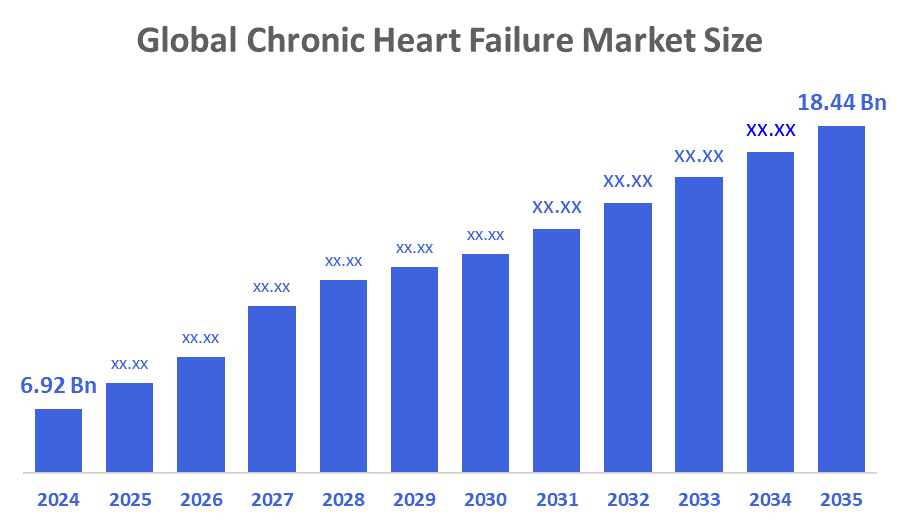
According to a Research Report Published by Decisions Advisors and Consulting, The Global Chronic Heart Failure Market Size was worth around USD 6.92 Billion in 2024 and is predicted to Grow to around USD 18.44 Billion by 2035 with a compound annual growth rate (CAGR) of 9.32% from 2025 to 2035. The market for chronic heart failure (CHF) is developing as the world's population grows, cardiovascular diseases become more common, and healthcare awareness rises. Furthermore, market growth is being driven by advancements in treatment alternatives, including novel medications, medical technologies, and customised therapy. Additionally, better disease management and customised strategies are helping to improve case outcomes.
Market Overview
The chronic heart failure (CHF) market refers to the global healthcare industry segment focused on the diagnosis, treatment, and management of patients with chronic heart failure, encompassing pharmaceuticals, medical devices, diagnostics, and supportive care services. Congestive heart failure, another name for chronic heart failure (CHF), is a progressive illness in which the heart cannot pump enough blood to fulfil the body's demands. An irregular heartbeat, exhaustion, dyspnea, chest pain, nausea, swelling in the legs, ankles, and feet, coughing, and other symptoms are some of the typical signs of the illness. Chronic heart failure is usually diagnosed after a thorough evaluation that includes a physical examination, a medical history, and several tests. The purpose of the physical examination is to assess the heart and lungs and take vital signs.
According to Global Health Data Exchange estimates, CHF affects over 64 million individuals worldwide, resulting in 9.91 million years lived with disability each year. Further, notable geographical differences, such as increased mortality in Africa and India, prevalence rates are higher among older populations, surpassing 10% over the age of seventy.
In July 2025, Ultromics, an Oxford University spinout specialising in AI-driven cardiovascular diagnostics, raised $55 million in Series C funding to expand its platform for detecting undiagnosed heart failure at scale.
In June 2025, Ceryx Medical, a UK-based medtech innovator, raised $15 million to accelerate development of its next-generation bioelectronic pacemaker technology for heart failure patients.
Report Coverage
This research report categorises the chronic heart failure market based on various segments and regions, forecasts revenue growth, and analyses trends in each submarket. The report analyses the key growth drivers, opportunities, and challenges influencing the chronic heart failure market. Recent market developments and competitive strategies, such as expansion, product launch, development, partnership, merger, and acquisition, have been included to draw the competitive landscape in the market. The report strategically identifies and profiles the key market players and analyzes their core competencies in each sub-segment of the chronic heart failure market.
Driving Factors
The market for chronic heart failure is mainly being driven by the rising incidence of cardiac valve problems and coronary artery diseases. Furthermore, the market growth is being propelled by the increasing prevalence of various significant co-morbidities linked to CHF, such as obesity, diabetes, pulmonary illnesses, and hypertension etc. Additionally, the growing number of elderly patients, who are more prone to cardiovascular illnesses, is supporting market expansion. In addition, a major growth-inducing aspect is the widespread use of device-based therapies, such as cardiac resynchronisation therapy (CRT) and implanted cardioverter-defibrillators (ICDs), which use implantable devices to enhance the heart's pumping performance. The chronic heart failure market is also anticipated to be driven in the next years by a number of technological developments, such as the launch of cardiac mapping equipment for determining the aetiology of CHF, such as arrhythmias, structural heart problems, or ischemia.
In August 2024, Eli Lilly’s tirzepatide showed strong Phase 3 success in adults with heart failure with preserved ejection fraction (HFpEF) and obesity, significantly reducing heart failure events and improving patient outcomes.
Restraining Factors
Accessibility and innovation of this market growth are hampered by high treatment costs, the dominance of generic drugs, and complicated comorbidity management. Moreover, the adoption of new treatments is hindered by physician inertia, payment obstacles, and regulatory hurdles that slow market growth and revenue.
Market Segmentation
The chronic heart failure market share is classified into drug class, route of administration, and therapeutic intervention.
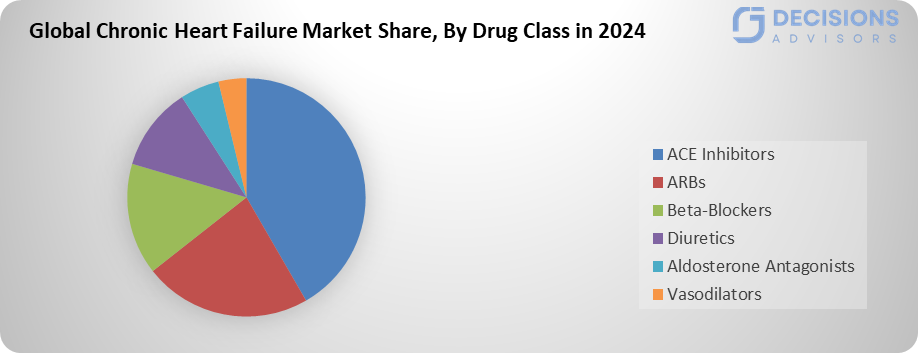
- The angiotensin-converting enzyme (ACE) inhibitors segment accounted for the largest share in 2024 and is projected to grow at a substantial CAGR over the forecast period.
Based on the drug class, the chronic heart failure market is divided into angiotensin-converting enzyme (ACE) inhibitors, angiotensin II receptor blockers (ARBs), beta-blockers, diuretics, aldosterone antagonists, and vasodilators. Among these, the angiotensin-converting enzyme (ACE) inhibitors segment accounted for the largest share in 2024 and is projected to grow at a substantial CAGR over the forecast period. The primary medication for CHF is the initial course of treatment. It includes medications such as Prinivil (lisinopril), Vasotec, Zestril, Qbrelis, captopril, and Epaned (enalapril).
- The oral segment dominated the market in 2024 and is projected to grow at a substantial CAGR during the forecast period.
Based on the route of administration, the chronic heart failure market is segmented into oral, intravenous, and subcutaneous. Among these, the oral segment dominated the market in 2024 and is projected to grow at a substantial CAGR during the forecast period. It is a popular option due to its ease of use and convenience. Additionally, the growing number of elderly people, who are the main group affected by CHF, frequently favour tablets because they are simple to use, which helps the market expand.
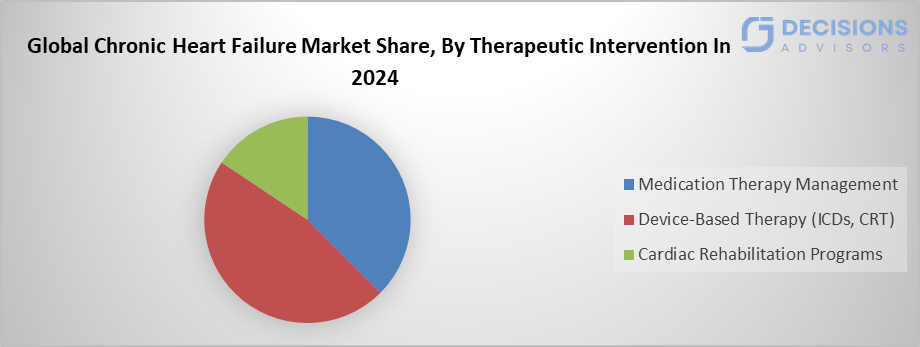
- The device-based therapy (e.g., ICDs, CRT) segment accounted for a significant share in 2024 and is anticipated to grow at a rapid pace over the forecast period.
Based on the therapeutic intervention, the chronic heart failure market is divided into medication therapy management, device-based therapy (e.g., ICDs, CRT), and cardiac rehabilitation programs. Among these, the device-based therapy (e.g., ICDs, CRT) segment accounted for a significant share in 2024 and is anticipated to grow at a rapid pace over the forecast period. The use of pharmaceuticals and medical device R&D is contributing to the segment's growth. Additionally, because it preserves the heart rhythm without causing pain, it is increasingly popular among both patients and surgeons. For example, the pacemaker is small enough to be inserted into the heart using a catheter and was developed on-site.
Regional Segment Analysis of the Chronic Heart Failure Market
- North America (U.S., Canada, Mexico)
- Europe (Germany, France, U.K., Italy, Spain, Rest of Europe)
- Asia-Pacific (China, Japan, India, Rest of APAC)
- South America (Brazil and the Rest of South America)
- The Middle East and Africa (UAE, South Africa, Rest of MEA)
Asia Pacific is anticipated to hold the largest share of the chronic heart failure market over the predicted timeframe.
Asia Pacific is anticipated to hold the largest share of the chronic heart failure market over the predicted timeframe. The elderly population at risk for CHF is growing as a result of the region's expanding population and rising life expectancy. India's vast population, rising disposable incomes, and expanding healthcare spending all contributed to the country's significant market share for congestive heart failure medications.
In July 2023, the Indian medicines regulator authorised AstraZeneca Pharma India to import dapagliflozin tablets for the treatment of heart failure. Many Indians suffering from heart failure may benefit from this action.
North America is expected to grow at a rapid CAGR in the chronic heart failure market during the forecast period. The high disease load, rising patient awareness, and rising healthcare costs are to blame. In 2023, the North American market for congestive heart failure medications was led by the United States due to the country's huge elderly population, sedentary lifestyle, and rising obesity rates. A favourable environment for drug research and commercial expansion is created by the existence of major pharmaceutical companies and widespread healthcare coverage.
The American Heart Association (AHA) launched a new program called IMPLEMENT?EF to improve care for patients with heart failure with preserved ejection fraction (HFpEF) and mildly reduced ejection fraction (HFmrEF).
Competitive Analysis:
The report offers the appropriate analysis of the key organizations/companies involved within the chronic heart failure market, along with a comparative evaluation primarily based on their product offering, business overviews, geographic presence, enterprise strategies, segment market share, and SWOT analysis. The report also provides an elaborative analysis focusing on the current news and developments of the companies, which includes product development, innovations, joint ventures, partnerships, mergers & acquisitions, strategic alliances, and others. This allows for the evaluation of the overall competition within the market.
List of Key Companies
- Abbott
- Abiomed
- Biovail Corporation
- Boston Scientific Corporation
- Bristol-Myers Squibb Company
- GlaxoSmithKline plc
- HeartWare
- Johnson & Johnson
- Medtronic
- Merck
- New Haven Pharmaceuticals Inc.
- Novartis International AG
- Pfizer
- Stanley Pharmaceuticals
- Others
Key Target Audience
- Market Players
- Investors
- End-users
- Government Authorities
- Consulting and Research Firm
- Venture capitalists
- Value-Added Resellers (VARs)
Recent Development
- In September 2025, Corstasis Therapeutics announced a strategic collaboration with U.S. Heart and Vascular to integrate ENBUMYST (bumetanide nasal spray). They work in heart failure care, aiming to improve fluid management, reduce readmissions, and enhance patient outcomes.
- In August 2025, Merck released new Phase 3 results for VERQUVO (vericiguat) in chronic heart failure with reduced ejection fraction (HFrEF). The VICTOR trial did not meet its primary endpoint, but pooled analyses with the earlier VICTORIA trial showed meaningful benefit in reducing cardiovascular death or hospitalisation for heart failure.
- In August 2024, A.S.Z. Ziekenhuis (Algemeen Stedelijk Ziekenhuis Aalst, Belgium) and Comarch have renewed their partnership to expand remote care solutions for chronic heart failure patients, embedding hybrid care pathways into the hospital’s heart failure clinic.
Market Segment
This study forecasts revenue at global, regional, and country levels from 2020 to 2035. Decisions Advisors and Consulting has segmented the chronic heart failure market based on the below-mentioned segments:
Global Chronic Heart Failure Market, By Drug Class
- Angiotensin-Converting Enzyme (ACE) Inhibitors
- Angiotensin II Receptor Blockers (ARBs)
- Beta-Blockers
- Diuretics
- Aldosterone Antagonists
- Vasodilators
Global Chronic Heart Failure Market, By Route of Administration
- Oral
- Intravenous
- Subcutaneous
Global Chronic Heart Failure Market, By Therapeutic Intervention
- Medication Therapy Management
- Device-Based Therapy (e.g., ICDs, CRT)
- Cardiac Rehabilitation Programs
Global Chronic Heart Failure Market, By Regional Analysis
- North America
- US
- Canada
- Mexico
- Europe
- Germany
- UK
- France
- Italy
- Spain
- Russia
- Rest of Europe
- Asia Pacific
- China
- Japan
- India
- South Korea
- Australia
- Rest of Asia Pacific
- South America
- Brazil
- Argentina
- Rest of South America
- Middle East & Africa
- UAE
- Saudi Arabia
- Qatar
- South Africa
- Rest of the Middle East & Africa
Frequently Asked Questions (FAQ)
- What is the projected size and growth rate of the Global Chronic Heart Failure Market?
The market was valued at USD 6.92 billion in 2024 and is expected to reach USD 18.44 billion by 2035, growing at a CAGR of 9.32% from 2025 to 2035.
- What are the main drivers of growth in the Chronic Heart Failure Market?
Rising incidence of coronary artery diseases, cardiac valve problems, and comorbidities like obesity, diabetes, hypertension, and pulmonary illnesses fuel growth. An ageing population, adoption of device-based therapies (e.g., ICDs, CRT), and advancements in diagnostics and treatments, such as AI-driven tools and novel drugs, also propel expansion.
- Which route of administration dominates the market?
The oral segment held the largest share in 2024 and is projected to grow at a substantial CAGR, driven by its convenience, especially for elderly patients.
- Which region holds the largest market share, and why?
Asia-Pacific is anticipated to hold the largest share, thanks to population growth, rising life expectancy, expanding elderly demographics, higher disposable incomes (e.g., in India), and increasing healthcare spending. North America, however, is expected to grow fastest due to high disease burden, patient awareness, and robust pharma presence.
- What are the key restraining factors for market growth?
High treatment costs, dominance of generic drugs, complex comorbidity management, physician inertia, reimbursement hurdles, and regulatory delays slow the adoption of new therapies.
- Who are the major players in the Chronic Heart Failure Market?
Key companies include Abbott, Abiomed, Biovail Corporation, Boston Scientific Corporation, Bristol-Myers Squibb Company, GlaxoSmithKline plc, HeartWare, Johnson & Johnson, Medtronic, Merck, New Haven Pharmaceuticals Inc., Novartis International AG, Pfizer, Stanley Pharmaceuticals, and others.
- How prevalent is Chronic Heart Failure globally?
CHF affects over 64 million people worldwide, causing 9.91 million years lived with disability annually. Prevalence exceeds 10% in populations over 70, with higher mortality in regions like Africa and India.
- Introduction
- Objectives of the Study
- Market Definition
- Research Scope
- Research Methodology and Assumptions
- Executive Summary
- Premium Insights
- Porter’s Five Forces Analysis
- Value Chain Analysis
- Top Investment Pockets
- Market Attractiveness Analysis By Drug Class
- Market Attractiveness Analysis By Route of Administration
- Market Attractiveness Analysis By Therapeutic Intervention
- Market Attractiveness Analysis By Region
- Industry Trends
- Market Dynamics
- Market Evaluation
- Drivers
- Healthcare awareness rises and advancements in treatment alternatives
- Restraints
- Payment obstacles, and regulatory hurdles
- Opportunities
- Better disease management and customised strategies
- Challenges
- High treatment costs, the dominance of generic drugs, and complicated management
- Global Chronic Heart Failure Market Analysis and Projection, By Drug Class
- Segment Overview
- Angiotensin-Converting Enzyme (ACE) Inhibitors
- Angiotensin II Receptor Blockers (ARBs)
- Beta-Blockers
- Diuretics
- Aldosterone Antagonists
- Vasodilators
- Global Chronic Heart Failure Market Analysis and Projection, By Route of Administration
- Segment Overview
- Oral
- Intravenous
- Subcutaneous
- Global Chronic Heart Failure Market Analysis and Projection, By Therapeutic Intervention
- Segment Overview
- Medication Therapy Management
- Device-Based Therapy (e.g., ICDs, CRT)
- Cardiac Rehabilitation Programs
- Global Chronic Heart Failure Market Analysis and Projection, By Regional Analysis
- Segment Overview
- North America
- U.S.
- Canada
- Mexico
- Europe
- Germany
- France
- U.K.
- Italy
- Spain
- Asia-Pacific
- Japan
- China
- India
- South America
- Brazil
- Middle East and Africa
- UAE
- South Africa
- Global Chronic Heart Failure Market-Competitive Landscape
- Overview
- Market Share of Key Players in the Chronic Heart Failure Market
- Global Company Market Share
- North America Company Market Share
- Europe Company Market Share
- APAC Company Market Share
- Competitive Situations and Trends
- Coverage Launches and Developments
- Partnerships, Collaborations, and Agreements
- Mergers & Acquisitions
- Expansions
- Company Profiles
- Abbott
- Business Overview
- Company Snapshot
- Company Market Share Analysis
- Company Coverage Portfolio
- Recent Developments
- SWOT Analysis
- Abiomed
- Business Overview
- Company Snapshot
- Company Market Share Analysis
- Company Coverage Portfolio
- Recent Developments
- SWOT Analysis
- Biovail Corporation
- Business Overview
- Company Snapshot
- Company Market Share Analysis
- Company Coverage Portfolio
- Recent Developments
- SWOT Analysis
- Boston Scientific Corporation
- Business Overview
- Company Snapshot
- Company Market Share Analysis
- Company Coverage Portfolio
- Recent Developments
- SWOT Analysis
- Bristol-Myers Squibb Company
- Business Overview
- Company Snapshot
- Company Market Share Analysis
- Company Coverage Portfolio
- Recent Developments
- SWOT Analysis
- GlaxoSmithKline plc
- Business Overview
- Company Snapshot
- Company Market Share Analysis
- Company Coverage Portfolio
- Recent Developments
- SWOT Analysis
- HeartWare
- Business Overview
- Company Snapshot
- Company Market Share Analysis
- Company Coverage Portfolio
- Recent Developments
- SWOT Analysis
- Johnson & Johnson
- Business Overview
- Company Snapshot
- Company Market Share Analysis
- Company Coverage Portfolio
- Recent Developments
- SWOT Analysis
- Medtronic
- Business Overview
- Company Snapshot
- Company Market Share Analysis
- Company Coverage Portfolio
- Recent Developments
- SWOT Analysis
- Merck
- Business Overview
- Company Snapshot
- Company Market Share Analysis
- Company Coverage Portfolio
- Recent Developments
- SWOT Analysis
- New Haven Pharmaceuticals Inc.
- Business Overview
- Company Snapshot
- Company Market Share Analysis
- Company Coverage Portfolio
- Recent Developments
- SWOT Analysis
- Novartis International AG
- Business Overview
- Company Snapshot
- Company Market Share Analysis
- Company Coverage Portfolio
- Recent Developments
- SWOT Analysis
- Pfizer
- Business Overview
- Company Snapshot
- Company Market Share Analysis
- Company Coverage Portfolio
- Recent Developments
- SWOT Analysis
- Stanley Pharmaceuticals
- Business Overview
- Company Snapshot
- Company Market Share Analysis
- Company Coverage Portfolio
- Recent Developments
- SWOT Analysis
- Others
- Business Overview
- Company Snapshot
- Company Market Share Analysis
- Company Coverage Portfolio
- Recent Developments
- SWOT Analysis
- Abbott
List of Table
- Global Chronic Heart Failure Market, By Drug Class, 2024-2035(USD Billion)
- Global Angiotensin-Converting Enzyme (ACE) Inhibitors, Chronic Heart Failure Market, By Region, 2024-2035(USD Billion)
- Global Angiotensin II Receptor Blockers (ARBs), Chronic Heart Failure Market, By Region, 2024-2035(USD Billion)
- Global Beta-Blockers, Chronic Heart Failure Market, By Region, 2024-2035(USD Billion)
- Global Diuretics, Chronic Heart Failure Market, By Region, 2024-2035(USD Billion)
- Global Aldosterone Antagonists, Chronic Heart Failure Market, By Region, 2024-2035(USD Billion)
- Global Vasodilators, Chronic Heart Failure Market, By Region, 2024-2035(USD Billion)
- Global Chronic Heart Failure Market, By Route of Administration, 2024-2035(USD Billion)
- Global Oral, Chronic Heart Failure Market, By Region, 2024-2035(USD Billion)
- Global Intravenous, Chronic Heart Failure Market, By Region, 2024-2035(USD Billion)
- Global Subcutaneous, Chronic Heart Failure Market, By Region, 2024-2035(USD Billion)
- Global Chronic Heart Failure Market, By Therapeutic Intervention, 2024-2035(USD Billion)
- Global Medication Therapy Management, Chronic Heart Failure Market, By Region, 2024-2035(USD Billion)
- Global Device-Based Therapy (e.g., ICDs, CRT), Chronic Heart Failure Market, By Region, 2024-2035(USD Billion)
- Global Cardiac Rehabilitation Programs, Chronic Heart Failure Market, By Region, 2024-2035(USD Billion)
- North America Chronic Heart Failure Market, By Drug Class, 2024-2035(USD Billion)
- North America Chronic Heart Failure Market, By Route of Administration, 2024-2035(USD Billion)
- North America Chronic Heart Failure Market, By Therapeutic Intervention, 2024-2035(USD Billion)
- U.S. Chronic Heart Failure Market, By Drug Class, 2024-2035(USD Billion)
- U.S. Chronic Heart Failure Market, By Route of Administration, 2024-2035(USD Billion)
- U.S. Chronic Heart Failure Market, By Therapeutic Intervention, 2024-2035(USD Billion)
- Canada Chronic Heart Failure Market, By Drug Class, 2024-2035(USD Billion)
- Canada Chronic Heart Failure Market, By Route of Administration, 2024-2035(USD Billion)
- Canada Chronic Heart Failure Market, By Therapeutic Intervention, 2024-2035(USD Billion)
- Mexico Chronic Heart Failure Market, By Drug Class, 2024-2035(USD Billion)
- Mexico Chronic Heart Failure Market, By Route of Administration, 2024-2035(USD Billion)
- Mexico Chronic Heart Failure Market, By Therapeutic Intervention, 2024-2035(USD Billion)
- Europe Chronic Heart Failure Market, By Drug Class, 2024-2035(USD Billion)
- Europe Chronic Heart Failure Market, By Route of Administration, 2024-2035(USD Billion)
- Europe Chronic Heart Failure Market, By Therapeutic Intervention, 2024-2035(USD Billion)
- Germany Chronic Heart Failure Market, By Drug Class, 2024-2035(USD Billion)
- Germany Chronic Heart Failure Market, By Route of Administration, 2024-2035(USD Billion)
- Germany Chronic Heart Failure Market, By Therapeutic Intervention, 2024-2035(USD Billion)
- France Chronic Heart Failure Market, By Drug Class, 2024-2035(USD Billion)
- France Chronic Heart Failure Market, By Route of Administration, 2024-2035(USD Billion)
- France Chronic Heart Failure Market, By Therapeutic Intervention, 2024-2035(USD Billion)
- U.K. Chronic Heart Failure Market, By Drug Class, 2024-2035(USD Billion)
- U.K. Chronic Heart Failure Market, By Route of Administration, 2024-2035(USD Billion)
- U.K. Chronic Heart Failure Market, By Therapeutic Intervention, 2024-2035(USD Billion)
- Italy Chronic Heart Failure Market, By Drug Class, 2024-2035(USD Billion)
- Italy Chronic Heart Failure Market, By Route of Administration, 2024-2035(USD Billion)
- Italy Chronic Heart Failure Market, By Therapeutic Intervention, 2024-2035(USD Billion)
- Spain Chronic Heart Failure Market, By Drug Class, 2024-2035(USD Billion)
- Spain Chronic Heart Failure Market, By Route of Administration, 2024-2035(USD Billion)
- Spain Chronic Heart Failure Market, By Therapeutic Intervention, 2024-2035(USD Billion)
- Asia Pacific Chronic Heart Failure Market, By Drug Class, 2024-2035(USD Billion)
- Asia Pacific Chronic Heart Failure Market, By Route of Administration, 2024-2035(USD Billion)
- Asia Pacific Chronic Heart Failure Market, By Therapeutic Intervention, 2024-2035(USD Billion)
- Japan Chronic Heart Failure Market, By Drug Class, 2024-2035(USD Billion)
- Japan Chronic Heart Failure Market, By Route of Administration, 2024-2035(USD Billion)
- Japan Chronic Heart Failure Market, By Therapeutic Intervention, 2024-2035(USD Billion)
- China Chronic Heart Failure Market, By Drug Class, 2024-2035(USD Billion)
- China Chronic Heart Failure Market, By Route of Administration, 2024-2035(USD Billion)
- China Chronic Heart Failure Market, By Therapeutic Intervention, 2024-2035(USD Billion)
- India Chronic Heart Failure Market, By Drug Class, 2024-2035(USD Billion)
- India Chronic Heart Failure Market, By Route of Administration, 2024-2035(USD Billion)
- India Chronic Heart Failure Market, By Therapeutic Intervention, 2024-2035(USD Billion)
- South America Chronic Heart Failure Market, By Drug Class, 2024-2035(USD Billion)
- South America Chronic Heart Failure Market, By Route of Administration, 2024-2035(USD Billion)
- South America Chronic Heart Failure Market, By Therapeutic Intervention, 2024-2035(USD Billion)
- Brazil Chronic Heart Failure Market, By Drug Class, 2024-2035(USD Billion)
- Brazil Chronic Heart Failure Market, By Route of Administration, 2024-2035(USD Billion)
- Brazil Chronic Heart Failure Market, By Therapeutic Intervention, 2024-2035(USD Billion)
- The Middle East and Africa Chronic Heart Failure Market, By Drug Class, 2024-2035(USD Billion)
- The Middle East and Africa Chronic Heart Failure Market, By Route of Administration, 2024-2035(USD Billion)
- The Middle East and Africa Chronic Heart Failure Market, By Therapeutic Intervention, 2024-2035(USD Billion)
- UAE Chronic Heart Failure Market, By Drug Class, 2024-2035(USD Billion)
- UAE Chronic Heart Failure Market, By Route of Administration, 2024-2035(USD Billion)
- UAE Chronic Heart Failure Market, By Therapeutic Intervention, 2024-2035(USD Billion)
- South Africa Chronic Heart Failure Market, By Drug Class, 2024-2035(USD Billion)
- South Africa Chronic Heart Failure Market, By Route of Administration, 2024-2035(USD Billion)
- South Africa Chronic Heart Failure Market, By Therapeutic Intervention, 2024-2035(USD Billion)
List of Figures
- Global Chronic Heart Failure Market Segmentation
- Chronic Heart Failure Market: Research Methodology
- Market Size Estimation Methodology: Bottom-Up Approach
- Market Size Estimation Methodology: Top-down Approach
- Data Triangulation
- Porter’s Five Forces Analysis
- Value Chain Analysis
- Top investment pocket in the Chronic Heart Failure Market
- Top Winning Strategies, 2024-2035
- Top Winning Strategies, By Development, 2024-2035(%)
- Top Winning Strategies, By Company, 2024-2035
- Moderate Bargaining power of Buyers
- Moderate Bargaining power of Suppliers
- Moderate Bargaining power of New Entrants
- Low threat of Substitution
- High Competitive Rivalry
- Top Player Positioning, 2024
- Market Share Analysis, 2024
- Restraint and Drivers: Chronic Heart Failure Market
- Chronic Heart Failure Market Segmentation, By Drug Class
- Chronic Heart Failure Market For Angiotensin-Converting Enzyme (ACE) Inhibitors, By Region, 2024-2035 ($ Billion)
- Chronic Heart Failure Market For Angiotensin II Receptor Blockers (ARBs), By Region, 2024-2035 ($ Billion)
- Chronic Heart Failure Market For Beta-Blockers, By Region, 2024-2035 ($ Billion)
- Chronic Heart Failure Market For Diuretics, By Region, 2024-2035 ($ Billion)
- Chronic Heart Failure Market For Aldosterone Antagonists, By Region, 2024-2035 ($ Billion)
- Chronic Heart Failure Market For Vasodilators, By Region, 2024-2035 ($ Billion)
- Chronic Heart Failure Market Segmentation, By Route of Administration
- Chronic Heart Failure Market For Oral, By Region, 2024-2035 ($ Billion)
- Chronic Heart Failure Market For Intravenous, By Region, 2024-2035 ($ Billion)
- Chronic Heart Failure Market For Subcutaneous, By Region, 2024-2035 ($ Billion)
- Chronic Heart Failure Market Segmentation, By Therapeutic Intervention
- Chronic Heart Failure Market For Medication Therapy Management, By Region, 2024-2035 ($ Billion)
- Chronic Heart Failure Market For Device-Based Therapy (e.g., ICDs, CRT), By Region, 2024-2035 ($ Billion)
- Chronic Heart Failure Market For Cardiac Rehabilitation Programs, By Region, 2024-2035 ($ Billion)
- Abbott: Net Sales, 2024-2035 ($ Billion)
- Abbott: Revenue Share, By Segment, 2024 (%)
- Abbott: Revenue Share, By Region, 2024 (%)
- Abiomed: Net Sales, 2024-2035 ($ Billion)
- Abiomed: Revenue Share, By Segment, 2024 (%)
- Abiomed: Revenue Share, By Region, 2024 (%)
- Biovail Corporation: Net Sales, 2024-2035 ($ Billion)
- Biovail Corporation: Revenue Share, By Segment, 2024 (%)
- Biovail Corporation: Revenue Share, By Region, 2024 (%)
- Boston Scientific Corporation: Net Sales, 2024-2035 ($ Billion)
- Boston Scientific Corporation: Revenue Share, By Segment, 2024 (%)
- Boston Scientific Corporation: Revenue Share, By Region, 2024 (%)
- Bristol-Myers Squibb Company: Net Sales, 2024-2035 ($ Billion)
- Bristol-Myers Squibb Company: Revenue Share, By Segment, 2024 (%)
- Bristol-Myers Squibb Company: Revenue Share, By Region, 2024 (%)
- GlaxoSmithKline plc: Net Sales, 2024-2035 ($ Billion)
- GlaxoSmithKline plc: Revenue Share, By Segment, 2024 (%)
- GlaxoSmithKline plc: Revenue Share, By Region, 2024 (%)
- HeartWare: Net Sales, 2024-2035 ($ Billion)
- HeartWare: Revenue Share, By Segment, 2024 (%)
- HeartWare: Revenue Share, By Region, 2024 (%)
- Johnson & Johnson: Net Sales, 2024-2035 ($ Billion)
- Johnson & Johnson: Revenue Share, By Segment, 2024 (%)
- Johnson & Johnson: Revenue Share, By Region, 2024 (%)
- Medtronic.: Net Sales, 2024-2035 ($ Billion)
- Medtronic.: Revenue Share, By Segment, 2024 (%)
- Medtronic.: Revenue Share, By Region, 2024 (%)
- Merck: Net Sales, 2024-2035 ($ Billion)
- Merck: Revenue Share, By Segment, 2024 (%)
- Merck: Revenue Share, By Region, 2024 (%)
- New Haven Pharmaceuticals Inc.: Net Sales, 2024-2035 ($ Billion)
- New Haven Pharmaceuticals Inc.: Revenue Share, By Segment, 2024 (%)
- New Haven Pharmaceuticals Inc.: Revenue Share, By Region, 2024 (%)
- Novartis International AG: Net Sales, 2024-2035 ($ Billion)
- Novartis International AG: Revenue Share, By Segment, 2024 (%)
- Novartis International AG: Revenue Share, By Region, 2024 (%)
- Pfizer: Net Sales, 2024-2035 ($ Billion)
- Pfizer: Revenue Share, By Segment, 2024 (%)
- Pfizer: Revenue Share, By Region, 2024 (%)
- Stanley Pharmaceuticals: Net Sales, 2024-2035 ($ Billion)
- Stanley Pharmaceuticals: Revenue Share, By Segment, 2024 (%)
- Stanley Pharmaceuticals: Revenue Share, By Region, 2024 (%)
- Others: Net Sales, 2024-2035 ($ Billion)
- Others: Revenue Share, By Segment, 2024 (%)
- Others: Revenue Share, By Region, 2024 (%)
Check Licence
Choose the plan that fits you best: Single User, Multi-User, or Enterprise solutions tailored for your needs.
We Have You Covered
- 24/7 Analyst Support
- Clients Across the Globe
- Tailored Insights
- Technology Tracking
- Competitive Intelligence
- Custom Research
- Syndicated Market Studies
- Market Overview
- Market Segmentation
- Growth Drivers
- Market Opportunities
- Regulatory Insights
- Innovation & Sustainability
Report Details
| Scope | Global |
| Pages | 285 |
| Delivery | PDF & Excel via Email |
| Language | English |
| Release | Dec 2025 |
| Access | Download from this page |