
Global Circulating Tumour Cells Market
 |
Author:
David J
|
Pages:
264
|
Author:
David J
|
Pages:
264
Global Circulating Tumor Cells Market Size, Share, and COVID-19 Impact Analysis, By Technology (CTC Detection and Enrichment Methods, CTC Direct Detection Methods, and CTC Analysis), By Specimen (Blood, Bone Marrow, and Other Body Fluids), and By Region (North America, Europe, Asia-Pacific, Latin America, Middle East, and Africa), Analysis and Forecast 2025 - 2035
CAGR
13.35%
REVENUE 2024
USD Billion 12.32
FORECAST 2035
USD Billion 48.87
REPORT COVERAGE
Global
Global Circulating Tumour Cells Market Size Insights Forecasts to 2035
- The Global Circulating Tumour Cells Market Size Was Estimated at USD 12.32 Billion in 2024
- The Market Size is Expected to Grow at a CAGR of around 13.35% from 2025 to 2035
- The Worldwide Circulating Tumour Cells Market Size is Expected to Reach USD 48.87 Billion by 2035
- Europe is expected to Grow the fastest during the forecast period.
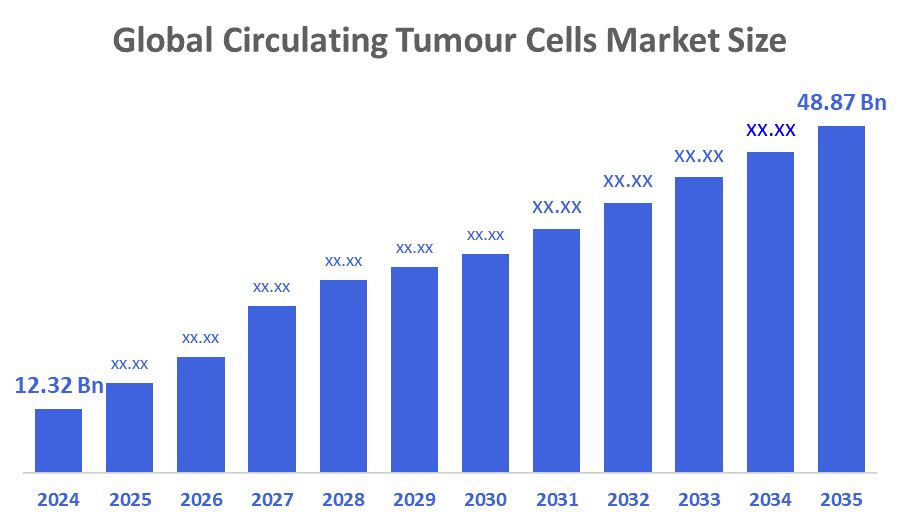
According to a Research Report Published by Decisions Advisors and Consulting, The Global Circulating Tumour Cells Market Size was worth around USD 12.32 Billion in 2024 and is predicted to Grow to around USD 48.87 Billion by 2035 with a compound annual growth rate (CAGR) of 13.35% from 2025 to 2035. With the growth of technology and increased funding into R&D activities, there is a growing use of liquid biopsee technologies (such as CTCs) being implemented in healthcare, particularly in the hospital setting. In addition, as more genetic disorders are occurring as a result of lifestyle changes, the hospitals' liquid biopsy technology market will also continue to expand.
Market Overview
The market for circulating tumour cells (CTCs) is based on the identification, examination, and management of tumour cells that circulate in the bloodstream, providing opportunities for early cancer detection, tracking, and individualised treatment. The circulating tumour cells (CTCs) describe cells that have migrated from the primary tumour into circulation (blood/lymphatic system), where they are free to move around the entire body. These cells can be detected in the peripheral blood of cancer patients and come from solid tumours. When a cancer spreads from the original tumour to other areas of the body, this is referred to as metastasis, and this is where CTCs come into play. This is due to their ability to help monitor the progression of disease, predict the impact of treatment, and assess prognosis non-invasively. CTCs have attracted significant interest from both cancer researchers and clinicians. CTCs provide valuable information on, for example, the gene alterations and protein expression of the tumour, as well as the patterns of chemotherapy resistance that develop with time in patients receiving treatment. This information can be useful for making treatment decisions regarding the use of targeted therapies. The development of technologies such as immunological techniques and microfluidic devices has made it possible to capture and analyse CTCs with a high level of sensitivity and specificity.
Report Coverage
This research report categorises the circulating tumour cells market based on various segments and regions, forecasts revenue growth, and analyzes trends in each submarket. The report analyses the key growth drivers, opportunities, and challenges influencing the circulating tumour cells market. Recent market developments and competitive strategies, such as expansion, product launch, development, partnership, merger, and acquisition, have been included to draw the competitive landscape in the market. The report strategically identifies and profiles the key market players and analyzes their core competencies in each sub-segment of the circulating tumour cells market.
Driving Factors
The circulating tumour cell market is experiencing significant growth due to increased awareness about the importance of early cancer detection and technological advancements. The development of new techniques for isolating and identifying circulating tumour cells has improved diagnostic accuracy and allowed for a more individualised approach to patient care. The growth of this market is also being driven by the recognition of the importance of these cells as a tool for monitoring patients' disease progression and responses to treatment, which is leading to the development of new non-invasive testing methods. Additionally, the circulating tumour cell market is being impacted by increasing investment in research related to cancer metastasis, resulting in collaborative efforts between academic institutions, biotechnology companies, and pharmaceutical companies, leading to the development of new therapeutic strategies. As the market continues to grow and evolve, players in the market will need to remain aware of the latest developments and advances in technology that may have an impact on cancer diagnostics and treatment in the future.
Restraining Factors
The main restraining factors in the circulating tumour cells (CTC) market are high costs, technical complexity, and limited clinical validation, which slow down widespread adoption despite strong growth potential.
Market Segmentation
The circulating tumour cells market share is classified into technology, and specimen.
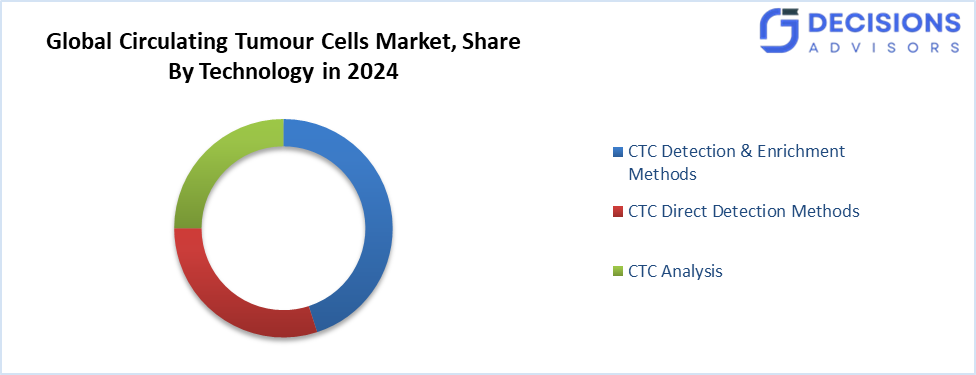
- The CTC detection and enrichment methods segment dominated the market in 2024 and is projected to grow at a significant CAGR during the forecast period.
Based on the technology, the circulating tumour cells market is divided into CTC detection and enrichment methods, CTC direct detection methods, and CTC analysis. Among these, the CTC detection and enrichment methods segment dominated the market in 2024 and is projected to grow at a significant CAGR during the forecast period. The segment expansion is influenced by the availability of several methods for CTC enrichment in cancer detection. Among the several techniques for CTC detection are centrifugal force, filtration, and other physical attributes like size, density, deformity, and electric charges. Furthermore, it is expected that CTC's positive or negative enrichment based on biological parameters will have a major impact on market growth over the projected time.
- The blood segment accounted for the highest market revenue in 2024 and is anticipated to grow at a significant CAGR during the forecast period.
Based on the specimen, the circulating tumour cells market is divided into blood, bone marrow, and other body fluids. Among these, the blood segment accounted for the highest market revenue in 2024 and is anticipated to grow at a significant CAGR during the forecast period. Finding CTCs in blood samples helps determine the prognosis and how well systemic chemotherapy is working. Thus, techniques for detecting CTCs in blood samples are essential to modern cancer research. Furthermore, a variety of items undergoing development and commercialisation that require blood samples are responsible for the projected biggest fraction.
Regional Segment Analysis of the Circulating Tumour Cells Market
- North America (U.S., Canada, Mexico)
- Europe (Germany, France, U.K., Italy, Spain, Rest of Europe)
- Asia-Pacific (China, Japan, India, Rest of APAC)
- South America (Brazil and the Rest of South America)
- The Middle East and Africa (UAE, South Africa, Rest of MEA)
Asia Pacific is anticipated to hold the largest share of the circulating tumour cells market over the predicted timeframe.
Asia Pacific is anticipated to hold the largest share of the circulating tumour cells market over the predicted timeframe. The Asia Pacific CTC market is expected to rise as a result of rising cancer incidence and mortality rates in middle- and low-income nations in the region as a result of ageing populations and changes in lifestyle brought on by epidemiologic transition and economic development. The most common cancers in the area include colorectal, breast, lung, uterine cervix, lip, and oral cavity.
In Asia, China has the highest cancer incidence, followed by Indonesia, South Korea, Japan, and India.
Europe is projected to grow at a rapid CAGR in the circulating tumour cells market during the forecast period. The regional market expansion is driven by improvements in diagnostic technology and growing awareness of early cancer screening. The region gains from financing programs and regulatory frameworks that encourage cancer research, both of which are essential for market growth. Moreover, with an increasing focus on targeted medicines and personalised medicine, nations like the UK and Germany are leading the way. The European market is a major participant in the global CTC scene due to its strong emphasis on research and development.
Germany is the market leader in Europe and is home to important companies as Menarini Silicon Biosystems and AdnaGen AG. With an emphasis on cutting-edge CTC detection techniques and partnerships among industry stakeholders, the competitive landscape is changing.
Competitive Analysis:
The report offers the appropriate analysis of the key organizations/companies involved within the circulating tumour cells market, along with a comparative evaluation primarily based on their product offering, business overviews, geographic presence, enterprise strategies, segment market share, and SWOT analysis. The report also provides an elaborative analysis focusing on the current news and developments of the companies, which includes product development, innovations, joint ventures, partnerships, mergers & acquisitions, strategic alliances, and others. This allows for the evaluation of the overall competition within the market.
List of Key Companies
- AVIVA Biosciences
- BioCEP Ltd.
- BIOCEPT, Inc.
- BioFluidica
- Biolidics Limited
- Bio-Techne Corporation
- Canopus Bioscience Ltd.
- Fluxion Biosciences, Inc.
- Greiner Bio-One International GmbH
- Ikonisys Inc.
- IVDiagnostics
- Miltenyi Biotec
- QIAGEN
- Others
Key Target Audience
- Market Players
- Investors
- End-users
- Government Authorities
- Consulting and Research Firm
- Venture capitalists
- Value-Added Resellers (VARs)
Recent Development
- In January 2026, Kazia Therapeutics announced it would participate in meetings during the J.P. Morgan Healthcare Conference Week in San Francisco (January 12–15). Moreover, they merge with a clinical and translational update expected before the end of January.
- In June 2024, Bio-Rad Laboratories announced the launch of Celselect Slides 2.0, an upgraded platform designed to advance rare cell and circulating tumour cell (CTC) enrichment for cancer research. Researchers will be able to process more liquid biopsy samples in a single run thanks to the Genesis Cell Isolation System's improved capacity, which will increase CTC capture efficiency.
Market Segment
This study forecasts revenue at global, regional, and country levels from 2020 to 2035. Decisions Advisors has segmented the circulating tumour cells market based on the below-mentioned segments:
Global Circulating Tumour Cells Market, By Technology
- CTC Detection and Enrichment Methods
- CTC Direct Detection Methods
- CTC Analysis
Global Circulating Tumour Cells Market, By Specimen
- Blood
- Bone Marrow
- Other Body Fluids
Global Circulating Tumour Cells Market, By Regional Analysis
- North America
- US
- Canada
- Mexico
- Europe
- Germany
- UK
- France
- Italy
- Spain
- Russia
- Rest of Europe
- Asia Pacific
- China
- Japan
- India
- South Korea
- Australia
- Rest of Asia Pacific
- South America
- Brazil
- Argentina
- Rest of South America
- Middle East & Africa
- UAE
- Saudi Arabia
- Qatar
- South Africa
- Rest of the Middle East & Africa
Frequently Asked Questions (FAQ)
- What is the current size and projected growth of the global CTC market?
The market was valued at USD 12.32 billion in 2024 and is expected to reach USD 48.87 billion by 2035, growing at a CAGR of 13.35% from 2025 to 2035.
- What are circulating tumour cells (CTCs) and why are they important?
CTCs are tumour cells that break off from a primary cancer and enter the bloodstream, enabling non-invasive early detection, metastasis monitoring, treatment response tracking, and personalised therapy.
- Which technology segment leads the CTC market?
CTC detection and enrichment methods dominated in 2024 and are projected to grow at a significant CAGR, driven by techniques like filtration, centrifugal force, and biological enrichment.
- Which specimen type holds the largest market share?
Blood accounted for the highest revenue in 2024 and is expected to grow strongly, as it's key for prognosis assessment and chemotherapy monitoring in cancer patients.
- Which region is expected to have the largest market share?
Asia-Pacific is anticipated to hold the largest share, fueled by rising cancer rates in countries like China, India, Japan, and Indonesia due to ageing populations and lifestyle changes.
- Who are some key players in the CTC market?
Major companies include QIAGEN, Bio-Techne Corporation, Miltenyi Biotec, Fluxion Biosciences, Biocept, Inc., and others like AVIVA Biosciences and Greiner Bio-One.
Check Licence
Choose the plan that fits you best: Single User, Multi-User, or Enterprise solutions tailored for your needs.
We Have You Covered
- 24/7 Analyst Support
- Clients Across the Globe
- Tailored Insights
- Technology Tracking
- Competitive Intelligence
- Custom Research
- Syndicated Market Studies
- Market Overview
- Market Segmentation
- Growth Drivers
- Market Opportunities
- Regulatory Insights
- Innovation & Sustainability
Report Details
| Scope | Global |
| Pages | 264 |
| Delivery | PDF & Excel via Email |
| Language | English |
| Release | Jan 2026 |
| Access | Download from this page |