
Global Commercial Construction Market
 |
Author:
Mayuri S
|
Pages:
220
|
Author:
Mayuri S
|
Pages:
220
Global Commercial Construction Market Size, Share By Construction Type (New Construction, Renovation, Repair & Maintenance, and Refurbishment & Demolition), By Building Type (Office Buildings, Retail & Shopping Centers, Hospitality Buildings, Healthcare & Institutional Buildings, Industrial & Logistics Buildings, and Others), By Project Delivery Method (Design-Bid-Build, Design-Build, Construction Management at Risk, EPC/Turnkey, and Integrated Project Delivery), and By Region (North America, Europe, Asia-Pacific, Latin America, Middle East & Africa), Analysis and Forecast 2026-2035.
CAGR
5.2%
REVENUE 2025
USD Billion 1095.5
FORECAST 2035
USD Billion 1815.4
REPORT COVERAGE
Global
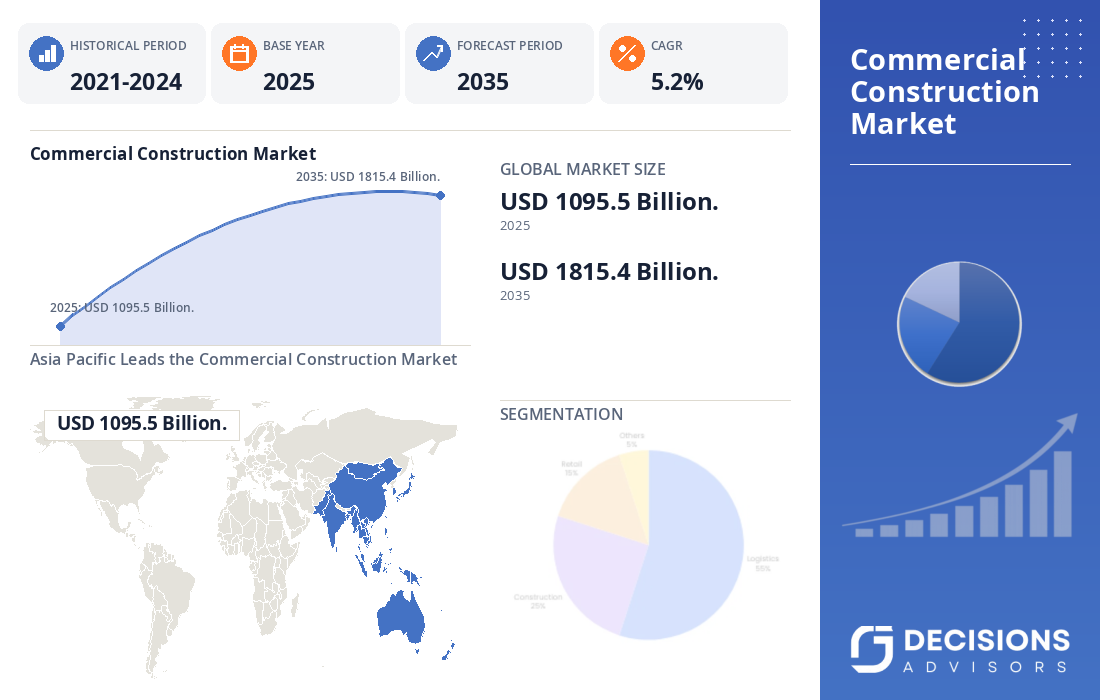
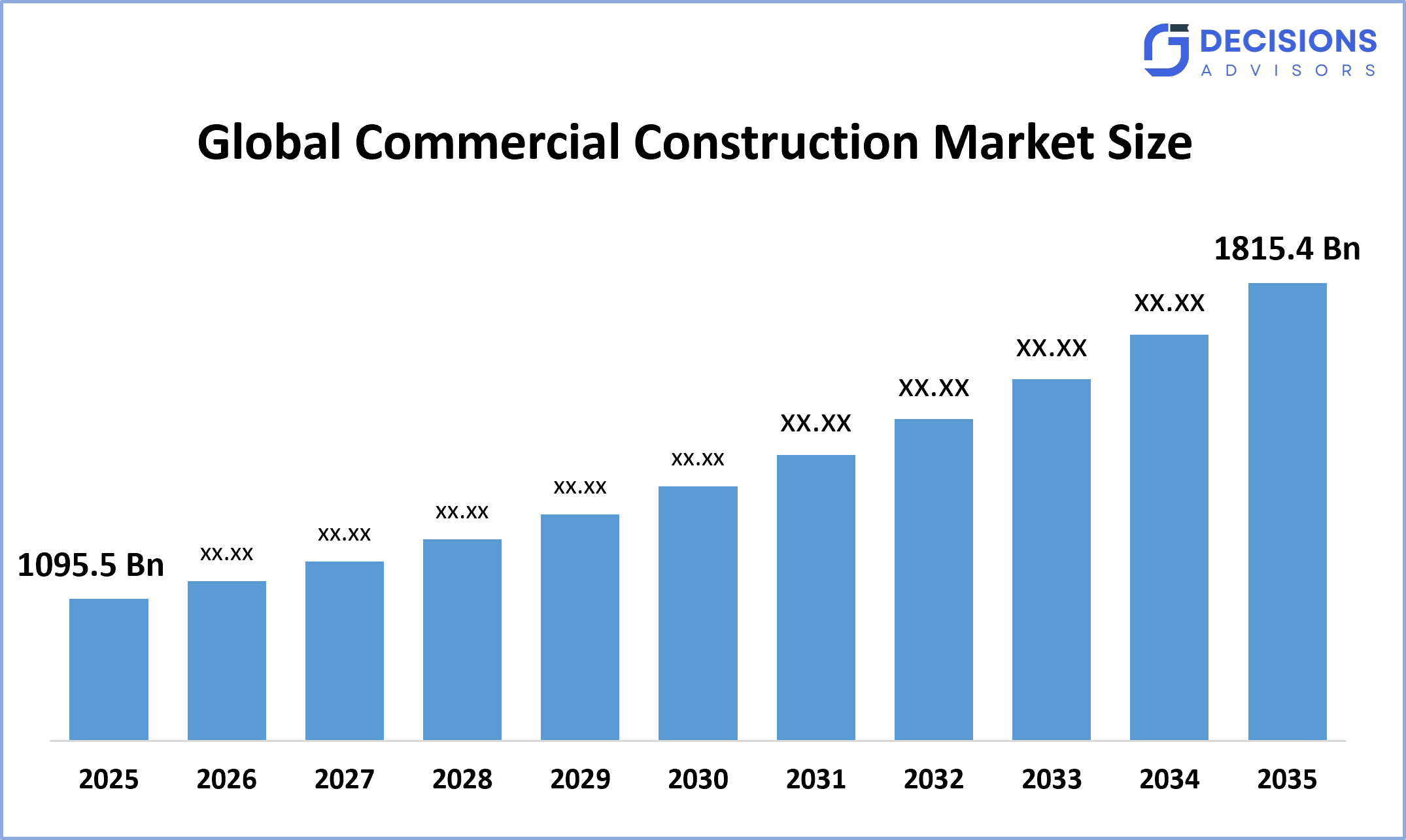
The Global Commercial Construction Market Size is predicted to grow from USD 1095.5 Billion in 2025 and is likely to reach around USD 1815.4 Billion by 2035, with a CAGR of 5.2%. According to Decision Advisors, a detailed research report on the market reflects that new commercial development and modernization of commercial facilities dominate the Global Commercial Construction Market, accounting for approximately 54% of construction activity worldwide. Large construction groups including VINCI, Bechtel, Skanska, Bouygues Construction, Turner Construction, and HOCHTIEF remain important contributors through major commercial, industrial, infrastructure, and technology-related projects.
Market Snapshot
- Global Commercial Construction Market Size (2025): USD 1095.5 Billion.
- Projected Global Commercial Construction Market Size (2035): USD 1815.4 Billion.
- Global Commercial Construction Market CAGR: 5.2%.
- Largest Regional Market: Asia Pacific
- 2nd Largest Region: North America
- Fastest Growing Region: Europe
- Base Year: 2025
- Historical Period: 2021-2024
- Market Forecast Period: 2026-2035
Market Overview/ Introduction
The global commercial construction market includes the development, construction, renovation, expansion, and modernization of non-residential buildings such as offices, retail centers, hotels, hospitals, institutional facilities, warehouses, logistics centers, industrial properties, and mixed-use commercial developments. Market growth is supported by urbanization, corporate expansion, e-commerce, logistics infrastructure, data-center development, healthcare investment, and modernization of aging commercial properties. Demand is also shifting toward energy-efficient, digitally connected, and flexible buildings that can accommodate changing business requirements. Technology is becoming an important component of commercial construction. Building Information Modeling (BIM), artificial intelligence, digital twins, cloud-based project management, robotics, prefabrication, modular construction, and automated site monitoring are helping contractors improve project scheduling, reduce material waste, and control costs.
- United States,Federal industrial and infrastructure programs continue to generate construction demand. In June 2026, the U.S. Department of Commerce finalized a CHIPS award involving up to USD 1.6 billion in incentives and loans to support rare-earth mining, processing, and manufacturing facilities in Texas, Oklahoma, and South Carolina.
- Japan, Japan's i-Construction 2.0 program is accelerating construction-site automation and digitalization. In its 2025 results, automated construction projects increased to 9 from 4 and remote construction projects increased to 41 from 21, with AI adoption identified as a major focus for FY2026.
- United States infrastructure financing, Bank of America announced a USD 250 billion Critical Infrastructure Finance Initiative in August 2026 targeting digital infrastructure, data centers, energy, transportation, and other strategic infrastructure through July 2027.
Notable Insights: -
- Asia-Pacific is anticipated to hold approximately 38% share of the Global Commercial Construction Market over the predicted timeframe.
- North America is expected to hold approximately 28% share during the forecast period, supported by data centers, advanced manufacturing, logistics, healthcare, and commercial redevelopment.
- By Construction Type, the New Construction segment dominated the market and holds approximately 54% share in 2025 and is projected to grow at a substantial CAGR during the forecast period.
- By Building Type, the Office Buildings segment dominated the market and holds approximately 28% share in 2025 and is projected to grow at a substantial CAGR during the forecast period.
- The compound annual growth rate of the Global Commercial Construction Market is 5.2%.
- The market is likely to achieve a valuation of USD 1815.4 Billion by 2035.
Market Drivers
The Global Commercial Construction Market is driven by increasing urbanization, corporate investment, expansion of commercial real estate, growth in e-commerce, and the development of logistics and distribution facilities. The rapid expansion of cloud computing and artificial intelligence is creating demand for data centers requiring specialized construction, electrical systems, cooling infrastructure, and high-reliability power systems. Healthcare providers are investing in hospitals, clinics, laboratories, and specialized medical facilities, while hospitality operators continue to develop hotels and mixed-use destinations in high-growth tourism markets. In addition, companies are upgrading offices with flexible layouts, energy-efficient systems, advanced connectivity, and employee-focused amenities. Digital technologies such as BIM, AI-based scheduling, digital twins, drones, and construction-management platforms are further improving project efficiency.
Restrain
The market faces restraints from high material prices, elevated financing costs, skilled-labor shortages, complex permitting procedures, and construction schedule uncertainty. Steel, cement, glass, electrical equipment, and mechanical systems can significantly influence project costs, particularly for large commercial developments. Skilled shortages involving electricians, engineers, equipment operators, and specialized trades can delay projects and increase labor expenses. Environmental regulations and sustainability requirements may also increase initial development costs, while changing interest rates can affect the feasibility of office, retail, hospitality, and mixed-use projects.
Competitive Analysis:
The report offers the appropriate analysis of the key organizations/companies involved within the Global Commercial Construction Market, along with a comparative evaluation primarily based on their product offerings, business overviews, geographic presence, enterprise strategies, segment market share, and SWOT analysis. The report also provides an elaborative analysis focusing on the current news and developments of the companies, which includes product development, innovations, joint ventures, partnerships, mergers & acquisitions, strategic alliances, and others. This allows for the evaluation of the overall competition within the market.
Top Companies in the Global Commercial Construction Market
- Bechtel
- Turner Construction Company
- Skanska
- VINCI
- Bouygues Construction
- Fluor Corporation
- Balfour Beatty
- Kiewit Corporation
- Jacobs
- HOCHTIEF.
Government Initiatives
|
Country |
Key Government Initiatives |
|
United States |
Infrastructure, advanced manufacturing, semiconductor, energy, and digital infrastructure programs continue to stimulate construction demand. CHIPS funding is supporting new manufacturing and processing facilities |
|
Japan |
i-Construction 2.0 promotes automation, AI, ICT, remote construction, and digital construction workflows to improve productivity and reduce labor requirements |
|
China |
National priorities around urban modernization, smart-city development, industrial upgrading, energy efficiency, and low-carbon buildings continue to support commercial construction and renovation activity |
Market Segmentation
The global commercial construction market share is classified into construction type, building type, and project delivery method.
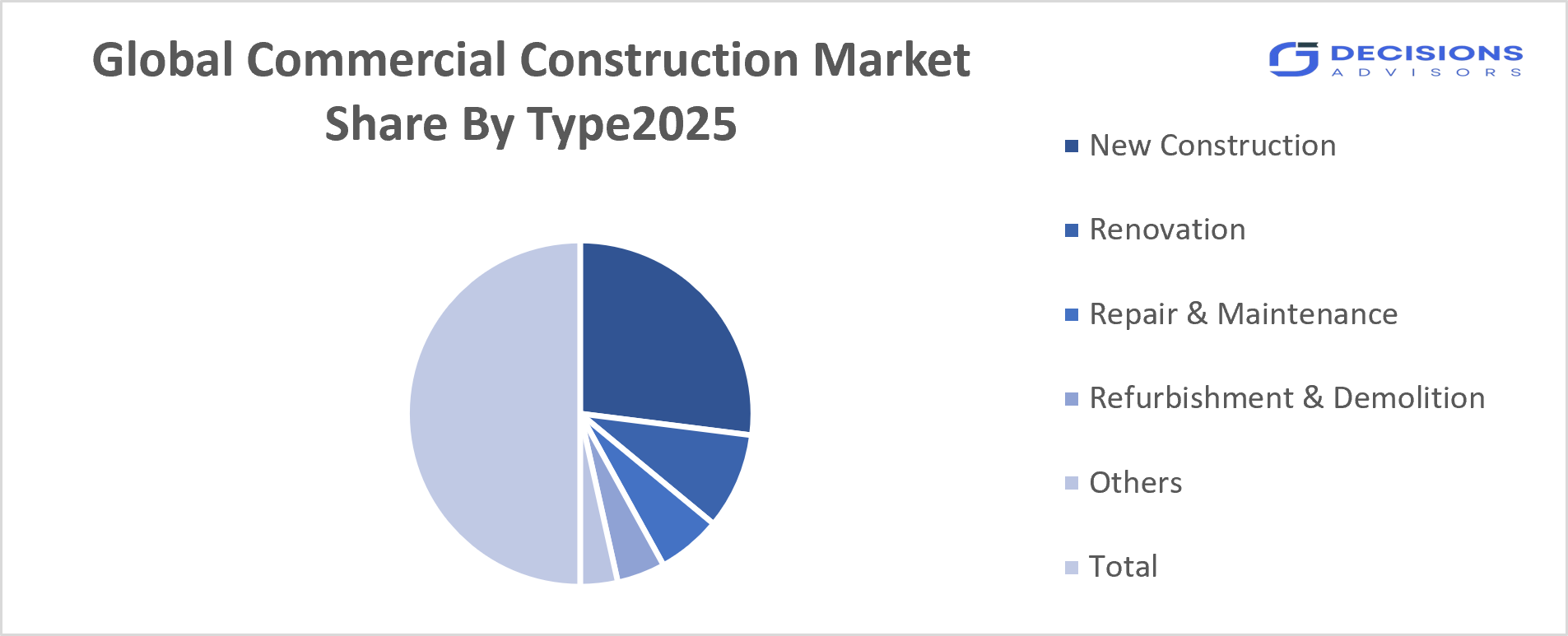
- The New Construction segment dominated the market and holds approximately 54% share in 2025 and is projected to grow at a substantial CAGR during the forecast period.
Based on construction type, the global commercial construction market is divided into new construction, renovation, repair & maintenance, refurbishment & demolition, and others. New construction represents the largest segment because expanding cities and business centers continue to require new offices, retail properties, hotels, logistics facilities, healthcare buildings, and industrial properties. Growth in data centers and advanced manufacturing is also creating large greenfield construction opportunities. Commercial developers increasingly favor modern facilities designed around energy efficiency, digital connectivity, and flexible utilization.
- The Office Buildings segment accounted for the largest share of approximately 28% in 2025 and is anticipated to grow at a significant CAGR during the forecast period.
Based on building type, the market is divided into office buildings, retail & shopping centers, hospitality buildings, healthcare & institutional buildings, industrial & logistics buildings, and others. Office buildings remain a major commercial construction category because businesses continue to invest in modern workplaces despite changes in workplace patterns. Demand is shifting toward high-quality, flexible, energy-efficient offices with advanced connectivity and employee amenities. Redevelopment of older office properties is also generating opportunities for renovation and conversion projects.
- The Design-Build segment accounted for the largest share of approximately 34% in 2025 and is anticipated to grow at a significant CAGR during the forecast period.
Based on project delivery method, the market is divided into design-bid-build, design-build, construction management at risk, epc/turnkey, and integrated project delivery. Design-build is gaining popularity because it combines design and construction responsibilities under one integrated contractual structure. This approach can improve coordination and shorten project timelines by reducing communication gaps between architects, engineers, and contractors. It is particularly suitable for complex commercial developments where cost, schedule, design, and technical requirements must be coordinated throughout the project.
Regional Segment Analysis of the Global Commercial Construction Market
- North America (U.S., Canada, Mexico)?
- Europe (Germany, U.K., France, Italy, Spain, Netherlands, Rest of Europe).
- Asia-Pacific (China, Japan, India, Australia, South Korea, Rest of Asia-Pacific).
- South America (Brazil, Argentina, Rest of South America).
- Middle East & Africa (UAE, Saudi Arabia, South Africa, Rest of MEA).
Asia Pacific is anticipated to hold approximately 38% share of the global commercial construction market over the predicted timeframe.
Asia-Pacific remains the largest regional market because of rapid urbanization, expanding commercial real estate, manufacturing investment, logistics development, and digital infrastructure construction. China remains a major construction market because of its large urban and industrial base, while India is experiencing strong demand for offices, warehouses, retail centers, data centers, and mixed-use developments. Japan and South Korea contribute through advanced manufacturing, technology facilities, infrastructure modernization, and smart-building investment. Growing construction activity across Southeast Asia is further supporting regional expansion.
North America is expected to grow at a rapid CAGR in the global commercial construction market, holding approximately 28% of the share during the forecast period.
North America benefits from strong investment in data centers, advanced manufacturing, logistics, healthcare, office redevelopment, and technology infrastructure. The United States remains the largest contributor because of its extensive commercial real-estate base and large private-sector construction pipeline. The expansion of AI infrastructure is creating additional demand for data centers and supporting energy infrastructure. In August 2026, Bank of America announced a USD 250 billion infrastructure financing initiative targeting data centers, energy, transportation, and other strategic infrastructure, demonstrating the increasing availability of capital for major infrastructure-related development.
Europe is the fastest-growing region in the Global Commercial Construction Market during the period, holding approximately 23% share.
Europe is benefiting from building modernization, sustainability requirements, energy-efficiency investments, industrial redevelopment, and demand for digitally enabled commercial properties. Germany, France, the United Kingdom, Italy, and Spain remain important markets for office, logistics, retail, hospitality, and institutional construction. Developers are increasingly integrating low-carbon materials, energy-efficient systems, smart-building technologies, and renewable-energy solutions into commercial projects. The region's focus on reducing building energy consumption is encouraging renovation and replacement of inefficient properties.
Future Market Trends in Global Commercial Construction Market: -
-
- AI-Enabled Construction Management
Artificial intelligence is expected to become increasingly important for cost estimation, project scheduling, design optimization, risk analysis, document management, safety monitoring, and predictive maintenance. AI-based systems can identify potential project delays and cost overruns earlier, allowing contractors to take corrective action.
-
- Expansion of Data-Center Construction
The growth of artificial intelligence, cloud computing, streaming, and enterprise digital services is increasing demand for data centers. These facilities require specialized structural, electrical, cooling, security, and power infrastructure. Data-center construction is therefore expected to become one of the most important high-value commercial construction segments during the forecast period.
-
- Sustainable and Low-Carbon Buildings
Sustainability will increasingly influence commercial construction decisions. Developers are adopting energy-efficient HVAC systems, renewable-energy integration, smart lighting, water-saving technologies, low-carbon materials, and building-management systems. Existing commercial buildings will also undergo significant renovation as owners seek lower operating costs and improved environmental performance.
-
- Modular and Prefabricated Construction
Modular construction and prefabrication are expected to expand because they can reduce project timelines, improve quality control, reduce material waste, and address labor shortages. These techniques are particularly suitable for hotels, healthcare facilities, logistics centers, offices, and standardized commercial buildings.
Recent Development
- In June 2026, Skanska secured a GBP 282 million contract to build 55 Old Broad Street, a 23-story commercial office development in London's financial district, strengthening its commercial construction portfolio.
- In August 2026, BlackRock and its AI infrastructure partners formed a strategic agreement with the North America's Building Trades Unions to improve workforce planning, apprenticeships, recruitment, and training for the data-center construction boom.
- In June 2026, the U.S. Department of Commerce finalized a CHIPS-related agreement involving up to USD 1.6 billion to support construction and expansion of rare-earth mining, processing, and magnet-production facilities.
Market Segment
This study forecasts revenue at global, regional, and country levels from 2021 to 2035. Decision Advisors has segmented the global commercial construction market based on the below-mentioned segment:
Global Commercial Construction Market, By Construction Type.
- New Construction
- Renovation
- Repair & Maintenance
- Refurbishment & Demolition
- Others.
Global Commercial Construction Market, By Building Type.
- Office Buildings
- Retail & Shopping Centers
- Hospitality Buildings
- Healthcare & Institutional Buildings
- Industrial & Logistics Buildings
- Others.
Global Commercial Construction Market, By Project Delivery Method.
- Design-Bid-Build
- Design-Build
- Construction Management at Risk
- EPC/Turnkey
- Integrated Project Delivery.
Global Commercial Construction Market, By Regional Analysis.
- North America
- US
- Canada
- Mexico
- Europe
- Germany
- UK
- France
- Italy
- Spain
- Russia
- Rest of Europe
- Asia Pacific
- China
- Japan
- India
- South Korea
- Australia
- Rest of Asia Pacific
- South America
- Brazil
- Argentina
- Rest of South America
- Middle East & Africa
- UAE
- Saudi Arabia
- Qatar
- South Africa
- Rest of the Middle East & Africa
Frequently Asked Questions (FAQ)
Q. What are the major factors driving the Global Commercial Construction Market?
A. Major growth drivers include urbanization, commercial real-estate expansion, logistics infrastructure, data-center development, healthcare investment, office modernization, and demand for sustainable buildings. Digital construction technologies and infrastructure investment are also increasing project opportunities.
Q. Why is design-build gaining importance in commercial construction?
A. Design-build integrates design and construction responsibilities, allowing better coordination between project stakeholders and potentially shortening project delivery times. It is particularly valuable for complex commercial developments with demanding technical and schedule requirements.
Q. How is AI changing commercial construction?
A. AI is being applied to project scheduling, cost estimation, design optimization, risk management, safety monitoring, and predictive analysis. Japan's i-Construction 2.0 program is also placing greater emphasis on AI and construction automation during its 2026 implementation phase.
Q. Why is Asia-Pacific the largest regional market?
A. Asia-Pacific benefits from rapid urbanization, large populations, expanding commercial real estate, manufacturing investment, logistics development, and major construction programs across China, India, Japan, and South Korea.
Check Licence
Choose the plan that fits you best: Single User, Multi-User, or Enterprise solutions tailored for your needs.
We Have You Covered
- 24/7 Analyst Support
- Clients Across the Globe
- Tailored Insights
- Technology Tracking
- Competitive Intelligence
- Custom Research
- Syndicated Market Studies
- Market Overview
- Market Segmentation
- Growth Drivers
- Market Opportunities
- Regulatory Insights
- Innovation & Sustainability
Report Details
| Scope | Global |
| Pages | 220 |
| Delivery | PDF & Excel via Email |
| Language | English |
| Release | Aug 2026 |
| Access | Download from this page |