
Global Commercial Conveyor Toasters Market
 |
Author:
Omkar J
|
Pages:
210
|
Author:
Omkar J
|
Pages:
210
Global Commercial Conveyor Toaster Market Size, Share, By Product Type (Horizontal Conveyor Toasters, Vertical Conveyor Toasters, and High-Speed Conveyor Toasters) By Application (Restaurants, Hotels, Cafes and Bakeries, Catering Services, and Others) By Distribution Channel (Online Sales, Specialty Stores, Wholesale Distributors, and Direct Sales) and By Region (North America, Europe, Asia-Pacific, Latin America, Middle East and Africa), Analysis and Forecast 2026 ? 2035
CAGR
5.9%
REVENUE 2025
USD Million 681.8
FORECAST 2035
USD Million 1210.75
REPORT COVERAGE
Global
Market Snapshot
- Global Commercial Conveyor Toaster Market Size (2025): USD 681.8 Million
- Global Commercial Conveyor Toaster Projected Market Size (2035): USD 1210.75 Million
- Global Commercial Conveyor Toaster Compound Annual Growth Rate (CAGR): 5.9%
- Largest Regional Market: North America
- Fastest Growing Region: Asia-Pacific
- 3rd Largest Region: Europe
- Base Year: 2025
- Historical Period: 2021–2024
- Forecast Period: 2026–2035
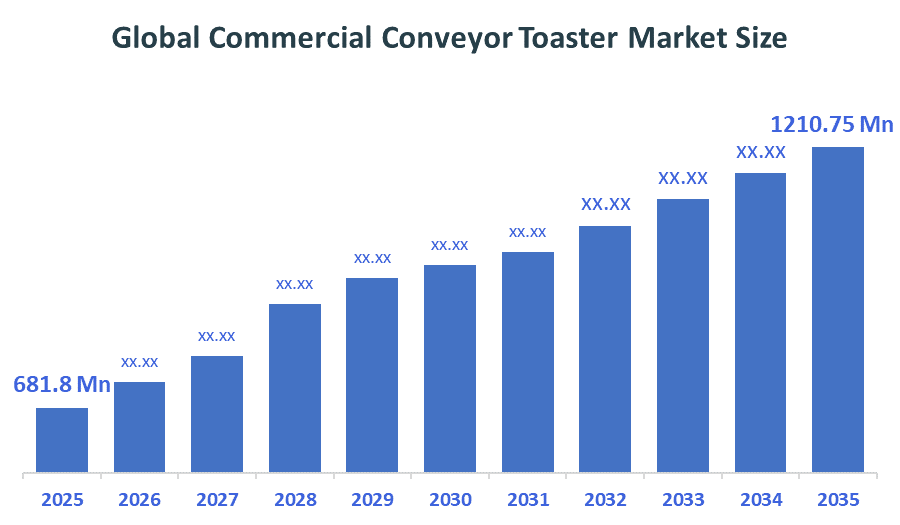
According to Decision Advisors, the global commercial conveyor toaster market size is expected to grow from USD 681.8 million in 2025 to USD 1,210.75 million by 2035, with a CAGR of 5.9% during the forecast period from 2026 to 2035. In this situation, there is unbroken growth in industry because of the rising demand for effective throughput control as well as high-capacity cooking appliances, since rapid-service eateries have become very popular throughout the world. These units have achieved a level of reliability because of improvements made in infrared cooking and conveyor technology. They have been able to provide a consistent browning experience regardless of different peak times within kitchens.
Market Overview / Introduction
The commercial conveyor toaster belongs to one of the key categories of professional food service equipment, which offers continuous browning capacity of bread and bagels by means of a motorised conveyor belt mechanism. The use of state-of-the-art technology, such as independent heating elements on top and bottom, quartz heating elements, and variable-speed control, is vital in these toasters to enable heat transfer and even crust colour. Forced convection mechanisms are used in some models of conveyor toaster to provide airflow and circulation inside the chamber and eliminate cold spots that affect the rate of output. The use of these devices has been popular in a wide range of applications, including breakfast buffets in five-star hotels and fast-food chains where consistent and efficient output is necessary in order to support high volumes of food preparation in professional kitchens. The output produced by the conveyor toaster can vary from 300 slices to over 2,000 slices of toast in one hour. With regard to government initiatives to date, efforts to improve energy efficiency in commercial cooking devices have led to a regulation requiring mandatory star ratings in 2026, among other efforts. The impact of these developments is a market-wide shift toward smart-connected kitchen ecosystems that significantly lower utility expenses for business owners while maintaining peak output levels during busy service hours, effectively bridging the gap between high-performance industrial needs and environmental responsibility.
- High-speed conveyor toaster models are witnessing growing adoption, accounting for nearly 30% of new installations, as foodservice operators increasingly prioritise faster throughput and reduced customer waiting time.
- Electric conveyor toasters dominate the product segment with nearly 48% share, driven by their energy efficiency, ease of installation, and widespread use across commercial kitchens that require consistent and high-speed toasting performance.
Notable Insights: -
- Electric conveyor toasters currently hold a dominant market share of approximately 72% within the professional toasting sector. This leading position is attributed to their dual capability of providing both high-efficiency browning and rapid heating through independent top and bottom infrared elements that ensure consistent results during peak service hours.
- Approximately 65% of commercial conveyor toaster installations are concentrated in the hospitality and quick-service restaurant (QSR) sectors.
- The Asia-Pacific region accounts for nearly 38% of the overall global market value as of 2026. Fast-growing urbanisation in developing nations such as China and India has led to the enormous requirement for standardised kitchen automation in modern dining establishments and international hotel chains to maintain uniform service standards.
What is the role of technology in shaping the market?
Technology is making ground-breaking developments in the realm of commercial conveyor toaster manufacture by way of the enhancement in energy efficiency, heat distribution accuracy, and automation in terms of operational efficiency. Modern commercial toasting devices are not only simple heating units anymore but rather intelligent kitchen systems that can run autonomously for a very long period of time, owing to the incorporation of efficient infrared heating elements, variable speed conveyor motors, and multi-zone temperature controls.
How are Recent Developments Helping the Market?
Innovations like the deployment of AI-enabled crumb detection sensors, installation of high-capacity quartz heating elements, and intelligent energy optimization software are some of the factors that have offered immense support for enhancing market growth. Companies have manufactured advanced conveyor systems that allow for multiple bread-type presents, such as artisanal sourdough and gluten-free options, to be programmed within them, operating round-the-clock during busy breakfast services without any direct interference from kitchen staff. Using AI-driven analytics, these machines will be capable of adjusting conveyor speeds depending on the surface moisture of the bread to ensure ideal browning conditions, as well as avoid unnecessary electricity wastage during off-peak hours. This attribute is anticipated to simplify the administration of large hotel chains and global quick-service restaurant organisations. Furthermore, cloud-assisted diagnostics will offer fast fault detection capabilities and assist in predictive maintenance processes for heating coils and motor belts.
Market Drivers
Commercial conveyor toasters are seeing positive growth due to the rising spending by both hotel construction companies and food service organisations on green and efficient kitchen infrastructural systems as per new environmental standards. Modern toasting systems have gained widespread popularity due to their ability to combine various functionalities, including rapid bagel browning, sandwich warming, and customised crust settings in one system, which can be reused and maintained easily. Another driving factor behind the rapid growth of the commercial conveyor toaster market is the trend towards achieving carbon neutrality, as there is an increasing need for more cost-effective electric-based solutions to replace older gas-fired equipment, especially in urban shopping malls and airport terminals where open-flame cooking lines are increasingly restricted.
Restraints
There are some difficulties in the process of the international commercial conveyor toaster market development because of the problems with providing reliability of motorised parts in high-heat conditions within busy kitchens, because of the high level of grease accumulation and potential electrical interference in crowded commercial environments. Additionally, there are some costs that may become obstacles for the fast introduction of such technology, such as specialised inverter motors, professional installation costs and expenses related to the procurement of high-grade heat-resistant conveyor belts.
Competitive Analysis:
The report offers the appropriate analysis of the key organisations/companies involved within the commercial conveyor toaster market, along with a comparative evaluation primarily based on their product offerings, business overviews, geographic presence, enterprise strategies, segment market share, and SWOT analysis. The report also provides an elaborate analysis focusing on the current news and developments of the companies, which includes product development, innovations, joint ventures, partnerships, mergers & acquisitions, strategic alliances, and others. This allows for the evaluation of the overall competition within the market.
Top 10 Companies in the Global Commercial Conveyor Toaster Market
- Hatco Corporation
- The Middleby Corporation (Star, Toastmaster, Lincat)
- ITW Food Equipment Group (Hobart, Vulcan)
- Welbilt Inc.
- Waring Commercial
- Antunes
- Dualit Ltd.
- Breville Group Limited
- Prince Castle (Marmon Foodservice Technologies)
- Sammic S.L.
Study on the Supply, Demand, Distribution, and Market Environment
The viability of the commercial conveyor toaster business lies in balancing the capacity to work at maximum levels of energy efficiency with the ever-increasing demand for intelligent, uninterrupted regulation of high-volume food preparation. Supply of commercial conveyor toasters is dependent on the ability to manufacture efficient infrared heating elements and motorised belt systems that are capable of providing uninterrupted browning in an energy-efficient manner without wastage due to heat loss that existed in earlier models. Demand will arise out of the move to full kitchen automation in the professional food service ecosystem, usage of high-definition sensors in the conveyor machinery, which are used to track bread moisture and belt speed, and the necessity for consistent thermal output in locations that have severe peak-hour traffic during breakfast and banquet services.
Price Analysis and Consumer Behaviour Analysis
Costs of commercial conveyor toasters vary according to the slice-per-hour rating, Energy Star certification, and the smartness of the products. Products incorporating advanced technologies such as variable speed power-save modes with advanced predictive maintenance features, together with multi-zone heating controls, are relatively expensive. Compact conveyor units and narrow-belt models, on the other hand, can be purchased cheaply and are very useful for providing temporary toasting solutions in smaller cafes or mobile food trucks. It has been shown that professional customers value cost-effectiveness and durability above aesthetic appeal. Therefore, firms would prefer products that offer operational independence, easy kitchen integration, and accurate browning control. There has been a growing trend toward designing modular conveyor loads in order to update equipment in response to changing energy efficiency standards and evolving menu requirements.
Market Segmentation
The Global Commercial Conveyor Toaster Market share is classified into product type, application, and distribution channel.
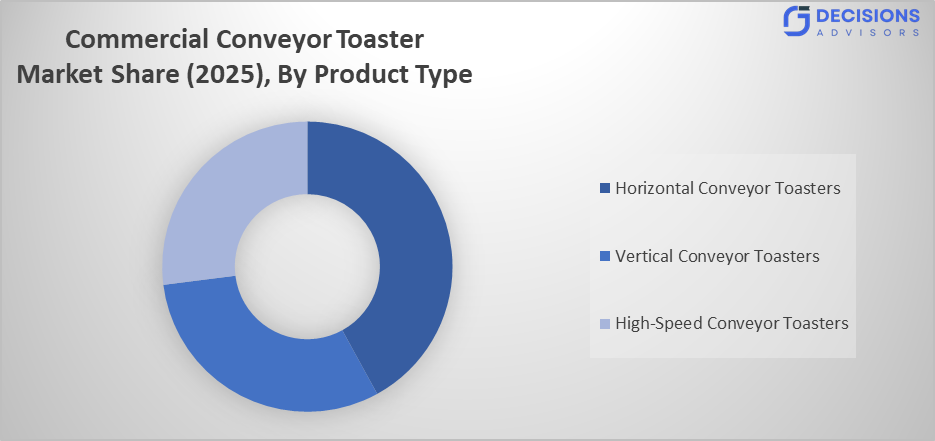
The Horizontal Conveyor Toasters segment holds the largest share, contributing approximately 42% of the market in 2025.
Based on the product type, the global commercial conveyor toaster market is divided into horizontal conveyor toasters, vertical conveyor toasters, and high-speed conveyor toasters. Among these, the Horizontal Conveyor Toasters segment holds the largest share, contributing approximately 42% of the market in 2025. The superiority of these types of toasters lies in their versatile loading area, which accommodates various bread shapes and sizes, along with their reliable performance in high-volume breakfast environments. The other main categories include high-speed models, which are gaining traction in quick-service environments owing to their rapid infrared heating cycles.
The restaurant segment accounts for the largest share, representing over 38% of the global market in 2025.
Based on the Application, the global commercial conveyor toaster market is divided into restaurants, hotels, cafes and bakeries, catering services, and others. Among these, the Restaurants segment accounts for the largest share, representing over 38% of the global market in 2025. Such implementations become essential to ensure rapid order fulfilment and to maintain consistent food quality across large franchise networks. However, the Hotels section has recently gained prominence and has become one of the most rapidly developing sectors due to the expansion of self-service continental breakfast buffets and the modernisation of professional kitchen equipment in international hospitality chains.
Wholesale Distributors and speciality dealer networks dominate the global market, accounting for approximately 41.5% of the total revenue in 2025.
Based on the Distribution Channel, the global commercial conveyor toaster market is divided into online sales, speciality stores, wholesale distributors, and direct sales. Among these, the Wholesale Distributors and speciality dealer networks dominate the global market, accounting for approximately 41.5% of the total revenue in 2025. The chosen section is favoured by business owners who demand bulk purchasing discounts along with dedicated after-sales maintenance and parts replacement services. The Online Sales industry is experiencing a rise in its usage, especially from independent cafe owners and small catering start-ups that prefer transparent pricing comparisons along with direct delivery of professional-grade equipment.
Strategies to Implement for Growth of the Market in Non-Leading Regions
The opportunities for growth in the commercial conveyor toaster market in new markets could be enhanced by using efficient modular toasting systems designed for use by local restaurant developers as well as local organisations involved in managing hospitality infrastructure. Energy efficiency programs initiated by the government, along with the development of high-efficiency electrical grids, play a crucial role in generating demand in regions where conventional kitchens make it difficult to operate high-load gas equipment. Additionally, investing more money in training local kitchen equipment technicians, along with establishing regional service centres, can further aid in the process of scaling professional food service operations.
Regional Segment Analysis of the Global Commercial Conveyor Toaster Market
- North America (U.S., Canada, Mexico)
- Europe (Germany, France, U.K., Italy, Spain, Rest of Europe)
- Asia-Pacific (China, Japan, India, South Korea, Rest of APAC)
- Latin America (Brazil and the Rest of Latin America)
- The Middle East and Africa (UAE, South Africa, Rest of MEA)
North America is expected to hold a significant share of the commercial conveyor toaster market during the forecast period. This region holds approximately 32% share of global revenue, thanks to its highly sophisticated infrastructure related to commercial food service, along with the extensive adoption of energy-efficient technology in both national sustainability goals and industrial kitchen security applications. Majority of the revenue in this region is derived from the US, owing to significant expenditure within the private sector in kitchen automation through equipment upgrades, as well as regional studies on high-throughput infrared heating units. Long-term health and safety code improvements and early deployment of smart-connected systems during kitchen retrofits have been critical factors in this regard.
Asia-Pacific is projected to be the fastest-growing region over the forecast period. This region is anticipated to witness a growth rate of around 10.6% CAGR. The reason for this lies in the rapid expansion of urban dining infrastructure alongside the increasing need for comfortable and fast-food preparation conditions in countries like China, India, and Southeast Asia. Some other factors contributing to this include the increase in government spending on tourism-linked infrastructure, indigenous innovation and development of inexpensive electric toasting appliances, and extensive use of variable speed motors for regulating production volume.
Europe is anticipated to hold a substantial share, contributing approximately 27% of the global market share. The region also enjoys a competitive advantage due to innovative clusters on thermal technology and investments in sustainable heating of professional environments as well as energy efficiency studies. Also, the comparative advantage that this region enjoys against other nations such as Germany, France, and the United Kingdom is the expertise that they possess when it comes to precision engineering of high-efficiency conveyor motors. In addition to that, the strict regulation that they impose concerning the electrification of commercial buildings has provided them with another comparative advantage. The presence of large industrial food service companies combined with an enhanced environmental consciousness system has allowed the gradual introduction of advanced conveyor toasters.
Recent Developments
- In March 2026, government-led quality control orders in India made certification mandatory for several food contact and kitchen equipment categories, impacting import and usage of advanced commercial appliances in hotels and restaurants.
- In February 2026, hospitality industry bodies reported that new compliance rules for certified kitchen equipment are affecting procurement decisions, especially for imported high-performance appliances used in commercial foodservice operations.
- In October 2025, product innovation data showed that around 40% of newly launched commercial toaster models include advanced energy-saving and digital control features, improving consistency and reducing energy consumption in commercial kitchens.
Market Segmentation
This study forecasts revenue at global, regional, and country levels from 2021 to 2035. The Decisions Advisors has segmented the global commercial conveyor toaster market is based on the following categories:
Global Commercial Conveyor Toaster Market, By Product Type
- Horizontal Conveyor Toasters
- Vertical Conveyor Toasters
- High-Speed Conveyor Toasters
Global Commercial Conveyor Toaster Market, By Application
- Restaurants
- Hotels
- Cafes and Bakeries
- Catering Services
- Others
Global Commercial Conveyor Toaster Market, By Distribution Channel
- Online Sales
- Speciality Stores
- Wholesale Distributors
- Direct Sales
Global Commercial Conveyor Toaster Market, By Regional Analysis
- North America
- United States
- Canada
- Mexico
- Europe
- Germany
- United Kingdom
- France
- Italy
- Spain
- Russia
- Rest of Europe
- Asia Pacific
- China
- Japan
- India
- South Korea
- Australia
- Rest of Asia Pacific
- Latin America
- Brazil
- Argentina
- Rest of Latin America
- Middle East & Africa
- United Arab Emirates
- Saudi Arabia
- Qatar
- South Africa
- Rest of Middle East & Africa
Frequently Asked Questions (FAQ)
What is a commercial conveyor toaster, and why is it important?
Commercial conveyor toasters are specific types of industrial food preparation mechanisms that serve to regulate bread browning through a motorised belt system. These units are vital for ensuring that professional kitchens remain efficient and productive during peak service periods while protecting food quality and providing suitable operating conditions within high-traffic dining environments.
What factors are driving the growth of the commercial conveyor toaster market?
This growth is due to the considerable number of investments that have been made into energy-efficient kitchen retrofits, increased demands for automated cooking systems in modern restaurants, and the extensive use of high-capacity infrared heating elements.
Which product type dominates the commercial conveyor toaster market?
Horizontal conveyor toasters are by far the most prominent and impactful category in the market, owing to their high operational throughput, ability to handle diverse bread products, and flexibility in offering adjustable speed functionalities. These units have immense possibilities if applied to long-term hospitality development initiatives and areas seeking to achieve full modernisation of kitchen lines.
Which applications are widely used in this market?
The application in hotel breakfast buffets and fast-food establishments is quite prominent owing to the pressing need to ensure that there are constant service speeds and that browning levels are guaranteed. This has been facilitated by the rising use of intelligent kitchen management systems in order to make sure that there is efficient use of electricity on a daily basis.
Check Licence
Choose the plan that fits you best: Single User, Multi-User, or Enterprise solutions tailored for your needs.
We Have You Covered
- 24/7 Analyst Support
- Clients Across the Globe
- Tailored Insights
- Technology Tracking
- Competitive Intelligence
- Custom Research
- Syndicated Market Studies
- Market Overview
- Market Segmentation
- Growth Drivers
- Market Opportunities
- Regulatory Insights
- Innovation & Sustainability
Report Details
| Scope | Global |
| Pages | 210 |
| Delivery | PDF & Excel via Email |
| Language | English |
| Release | Apr 2026 |
| Access | Download from this page |