
Global Commercial HVAC Market
 |
Author:
Somesh R
|
Pages:
240
|
Author:
Somesh R
|
Pages:
240
Global Commercial HVAC Market Size, Share By System Type (Central HVAC Systems, DX HVAC Systems, VRF/VRV Systems, Heat Pump Systems, and Others), By Application (Office Buildings, Retail & Shopping Centers, Hospitality & Hotels, Healthcare Facilities, Data Centers, and Others), By Technology (Conventional HVAC, Energy-Efficient HVAC, Smart HVAC Controls, Heat Pump Technology, and Low-GWP Refrigerant Systems), and By Region (North America, Europe, Asia-Pacific, Latin America, Middle East & Africa), Analysis and Forecast 2026-2035.
CAGR
7.03%
REVENUE 2025
USD Billion 66.96
FORECAST 2035
USD Billion 132.09
REPORT COVERAGE
Global
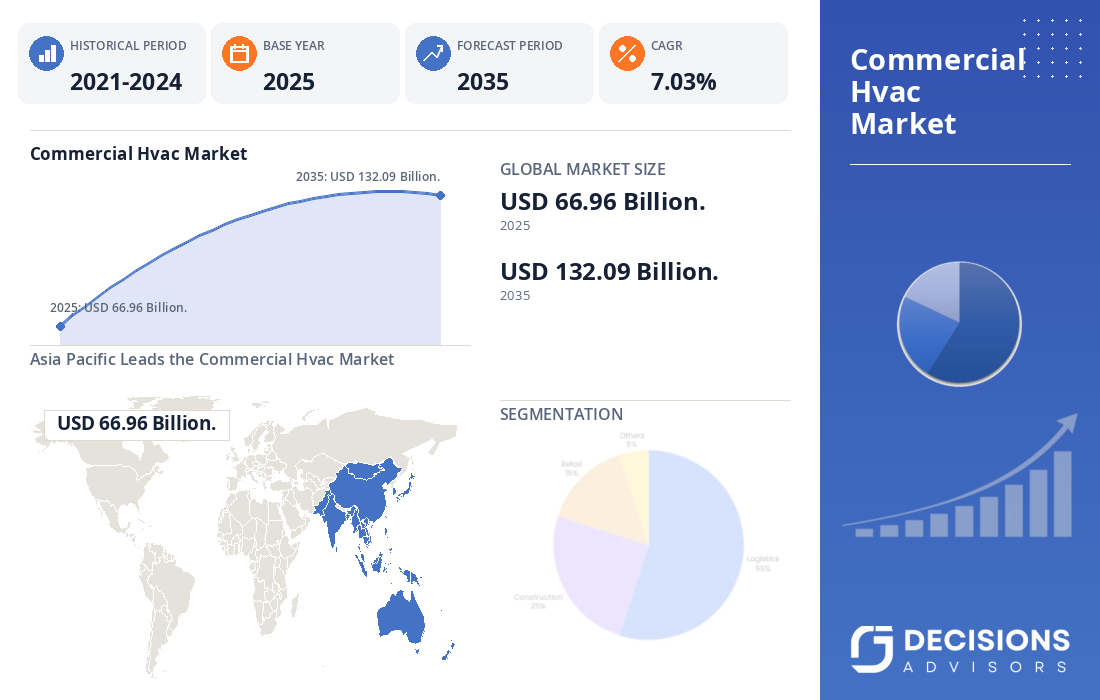
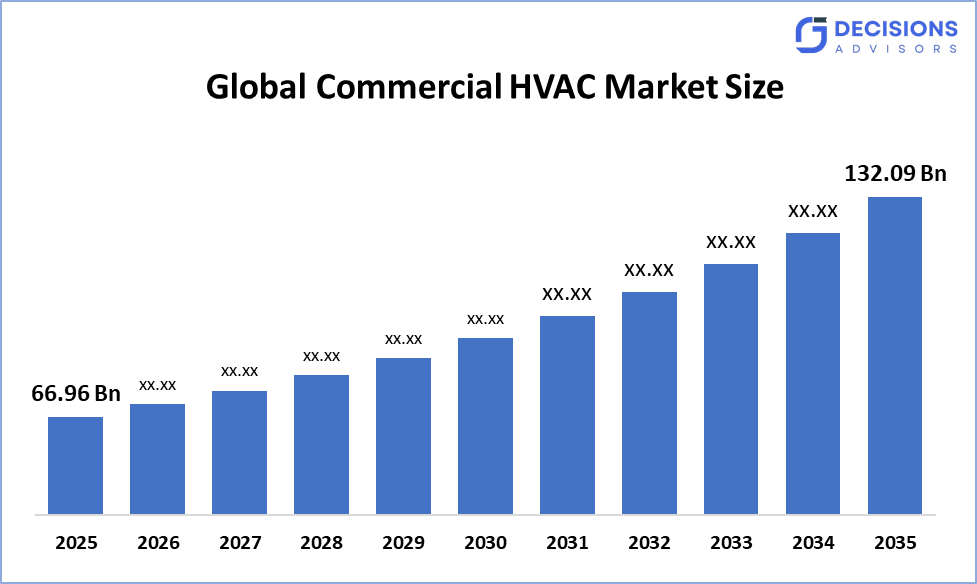
The Global Commercial HVAC Market Size is predicted to grow from USD 66.96 Billion in 2025 and is likely to reach around USD 132.09 Billion by 2035 with a CAGR of 7.03%. According to Decision Advisors, a detailed research report on the market reflects that energy-efficient and smart HVAC adoption dominates the Global Commercial HVAC Market, accounting for approximately 43% of the market's growth-oriented demand worldwide. Daikin Industries remains one of the leading global HVAC manufacturers, supported by FY2025 net sales of approximately JPY 5.015 trillion (about USD 33 billion at a broadly rounded exchange rate), with HVAC and applied solutions representing its core business base.
Market Snapshot
- Global Commercial HVAC Market Size (2025): USD 66.96 Billion.
- Projected Global Commercial HVAC Market Size (2035): USD 132.09 Billion.
- Global Commercial HVAC Market Compound Annual Growth Rate (CAGR): 7.03%.
- Largest Regional Market: Asia Pacific
- 2nd Largest Region: America
- Fastest Growing Region: Europe
- Base Year: 2025
- Historical Period: 2021-2024
- Market Forecast Period: 2026-2035
Market Overview/ Introduction
The Global Commercial HVAC Market comprises heating, ventilation, and air-conditioning equipment and associated controls deployed across offices, retail facilities, hotels, hospitals, educational buildings, industrial-commercial properties, data centers, and other non-residential facilities. Commercial HVAC has shifted from a basic comfort infrastructure category toward a strategic building-performance system because energy costs, indoor-air-quality requirements, carbon-reduction targets, and building automation increasingly influence equipment selection. Recent market estimates vary according to whether controls, service revenue, refrigeration, or industrial applications are included, but the underlying outlook consistently indicates continued expansion through the early 2030s.Growth is being supported by urbanization, commercial construction, replacement of aging equipment, increasing cooling requirements, data-center development, electrification of heating, and demand for intelligent building management. HVAC manufacturers are increasingly integrating variable-speed drives, connected sensors, building-management systems, heat pumps, energy recovery, advanced chillers, and lower-GWP refrigerants.
- United States, Section 179D provides incentives for eligible energy-efficient commercial-building property, including HVAC, although statutory provisions were modified in 2025 and the deduction has a construction-start termination provision after June 30, 2026.
- Japan, From April 2025, energy-efficiency standards became mandatory for new buildings covered by the revised framework, strengthening demand for high-efficiency building equipment and HVAC systems.
- China, National building energy-efficiency programs emphasize green buildings, energy-saving retrofits, efficient cooling, and clean-energy technologies, creating opportunities for efficient commercial HVAC equipment.
Notable Insights: -
- Asia Pacific is anticipated to hold approximately 39% share of the Global Commercial HVAC Market over the predicted timeframe.
- North America is expected to remain the second-largest region, holding approximately 27% share during the forecast period, while Europe is projected to record the fastest growth.
- By System Type, the Central HVAC Systems segment dominated the market and holds approximately 42% share in 2025 and is projected to grow at a substantial CAGR during the forecast period.
- By Application, the Office Buildings segment dominated the market and holds approximately 24% share in 2025 and is projected to grow at a substantial CAGR during the forecast period.
- The compound annual growth rate of the Global Commercial HVAC Market is 7.03%.
- The market is likely to achieve a valuation of USD 132.09 Billion by 2035.
Market Drivers
The global commercial HVAC market is being driven by the expansion of commercial construction, urbanization, rising cooling requirements, replacement of aging equipment, and increasing attention to building energy performance. Commercial facilities are seeking systems that reduce electricity consumption while maintaining thermal comfort and indoor-air quality, increasing demand for high-efficiency chillers, variable-speed equipment, heat pumps, energy-recovery ventilation, and intelligent controls. Data centers are another important demand source because high-density computing and AI infrastructure require continuous thermal management and highly reliable cooling systems. At the same time, building-management systems are allowing HVAC equipment to respond dynamically to occupancy, weather, electricity pricing, and equipment conditions. Decarbonization policies are also accelerating electrification and adoption of heat-pump technologies.
Restrain
The global commercial HVAC market faces several constraints. High initial equipment and installation costs can delay modernization projects, particularly for small and medium-sized commercial properties. Complex retrofit projects can require modifications to electrical systems, ductwork, controls, building envelopes, and refrigerant infrastructure, increasing project duration and labor requirements. The transition toward lower-GWP refrigerants is also increasing equipment redesign requirements and creating compliance challenges across different markets. Skilled-labor shortages represent another bottleneck because installation, commissioning, maintenance, and optimization of advanced HVAC systems require qualified technicians.
Competitive Analysis:
The report offers the appropriate analysis of the key organizations/companies involved within the global commercial HVAC market, along with a comparative evaluation primarily based on their product offerings, business overviews, geographic presence, enterprise strategies, segment market share, and SWOT analysis. The report also provides an elaborative analysis focusing on the current news and developments of the companies, which includes product development, innovations, joint ventures, partnerships, mergers & acquisitions, strategic alliances, and others. This allows for the evaluation of the overall competition within the market.
Top Companies in the Global Commercial HVAC Market
- Daikin Industries, Ltd.
- Carrier Global Corporation
- Trane Technologies plc
- Johnson Controls International plc
- Mitsubishi Electric Corporation
- LG Electronics
- Panasonic Holdings Corporation
- Lennox International Inc.
- Midea Group
- Gree Electric Appliances Inc.
Government Initiatives
|
Country |
Key Government Initiatives |
|
United States |
Section 179D supports eligible energy-efficient commercial-building investments, including HVAC, while DOE programs have also supported high-efficiency commercial rooftop heat-pump technology development and validation |
|
Japan |
Revised building energy-efficiency requirements became mandatory for new construction from April 2025, supporting higher-efficiency HVAC, heat pumps, and building-energy systems |
|
China |
National programs promote green buildings, energy-saving retrofits, efficient cooling systems, clean heating, and improved building energy performance |
Market Segmentation
The Global Commercial HVAC Market share is classified into system type, application, and technology.
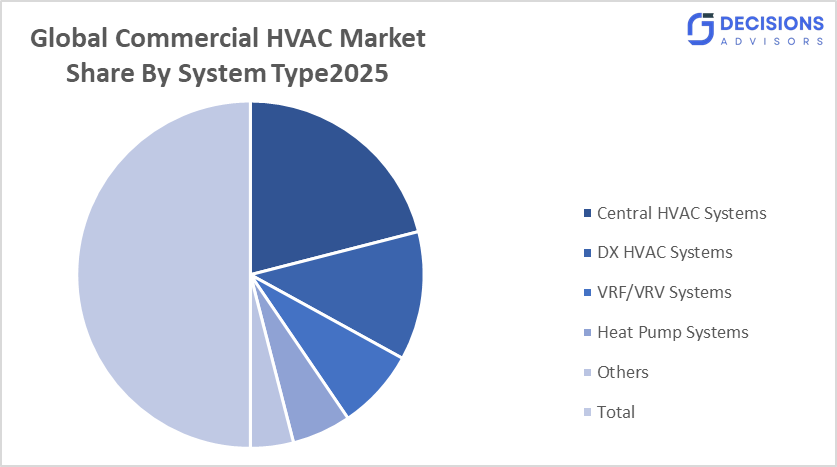
- The central HVAC systems segment dominated the market and holds approximately 42% share in 2025 and is projected to grow at a substantial CAGR during the forecast period.
Based on the system type, the global commercial HVAC market is divided into central HVAC systems, DX HVAC Systems, VRF/VRV Systems, heat pump systems, and others. Among these, central HVAC systems dominate the market and hold approximately 42% share in 2025. Their leadership is supported by extensive deployment in large offices, hospitals, hotels, shopping centers, universities, airports, and other large facilities. Central systems can provide centralized temperature control and are suitable for buildings requiring large cooling and heating capacities. Demand is also supported by modernization projects involving chillers, air-handling units, pumps, cooling towers, and advanced building controls.
- The office buildings segment accounted for the largest share of approximately 24% in 2025 and is anticipated to grow at a significant CAGR during the forecast period.
Based on application, the market is divided into Office Buildings, Retail & Shopping Centers, Hospitality & Hotels, Healthcare Facilities, Data Centers, and Others. Among these, Office Buildings accounted for the largest share and holds approximately 24% share in 2025. Offices require HVAC systems to maintain thermal comfort, ventilation, humidity, and indoor-air quality across changing occupancy levels. The growth of smart offices is increasing demand for connected HVAC controls and occupancy-based temperature management. Retrofit activity in older commercial buildings is also supporting replacement demand.
- The Smart HVAC Controls segment accounted for the largest share of approximately 31% in 2025 and is anticipated to grow at a significant CAGR during the forecast period.
Based on technology, the market is divided into Conventional HVAC, Energy-Efficient HVAC, Smart HVAC Controls, Heat Pump Technology, and Low-GWP Refrigerant Systems. Among these, Smart HVAC Controls dominate the market and hold approximately 31% share in 2025. Smart controls integrate sensors, connected thermostats, building-management systems, analytics, and automated equipment control. They enable operators to adjust HVAC operation according to occupancy, weather, schedules, and equipment performance. Increasing energy-management requirements and demand for predictive maintenance are strengthening adoption in large commercial facilities.
Regional Segment Analysis of the Global Commercial HVAC Market
- North America (U.S., Canada, Mexico)?
- Europe (Germany, U.K., France, Italy, Spain, Netherlands, Rest of Europe).
- Asia-Pacific (China, Japan, India, Australia, South Korea, Rest of Asia-Pacific).
- South America (Brazil, Argentina, Rest of South America).
- Middle East & Africa (UAE, Saudi Arabia, South Africa, Rest of MEA).
Asia Pacific is anticipated to hold approximately 39% share of the global commercial HVAC Market over the predicted timeframe.
Asia Pacific represents the largest regional market because of rapid urbanization, commercial infrastructure development, industrial expansion, data-center construction, and large-scale investment in energy-efficient buildings. China, Japan, India, South Korea, and Southeast Asian economies contribute significantly to regional demand. China has placed strong emphasis on green buildings and energy-efficient cooling, while Japan's strengthened building-energy requirements are supporting efficient HVAC technologies. India is also becoming an important growth market because of expanding office space, retail infrastructure, hospitality, healthcare facilities, and data centers. China's national building programs have specifically targeted efficient cooling and energy-saving upgrades.
North America is expected to grow at a rapid CAGR in the Global Commercial HVAC Market, holding approximately 27% of the share during the forecast period.
North America is supported by large replacement demand, commercial construction, data-center development, advanced building-management systems, and stringent energy-performance requirements. The United States remains the principal contributor because of its extensive installed HVAC base and large commercial-building stock. Major companies such as Carrier, Trane Technologies, and Johnson Controls are investing in electrification, heat pumps, intelligent controls, data-center cooling, and high-efficiency systems. Carrier's commercial HVAC technology development has included DOE-validated rooftop heat-pump systems and new lower-GWP rooftop products.
Europe is the fastest-growing region in the Global Commercial HVAC Market during the period, holding approximately 24% share.
Europe is expected to record rapid growth because of aggressive energy-efficiency and decarbonization objectives, building renovation requirements, electrification, and the transition toward low-GWP refrigerants. The revised EU Energy Performance of Buildings Directive establishes a long-term pathway toward zero-emission buildings and places greater emphasis on building operational energy, including heating and cooling. Countries including Germany, France, the U.K., Italy, and Spain are investing in building modernization, heat pumps, energy management, and efficient ventilation.
Future Market Trends in Global Commercial HVAC Market: -
- AI-Enabled HVAC Optimization
- Artificial intelligence will increasingly be integrated with HVAC controls to optimize temperature, airflow, equipment sequencing, and energy consumption. AI-based systems can analyze occupancy, weather, equipment condition, and historical operating data to automatically adjust HVAC operation.
Rapid Expansion of Data Center Cooling
The growth of AI computing and cloud infrastructure is creating substantial demand for highly reliable commercial cooling. Data centers require continuous thermal management, redundancy, precise humidity control, and increasingly advanced liquid and air-cooling technologies. HVAC manufacturers are consequently developing specialized solutions for high-density computing environments.
Electrification and Commercial Heat Pumps
Commercial heat pumps will become an increasingly important alternative to fossil-fuel-based heating systems. Regulations and corporate decarbonization programs are encouraging buildings to transition toward electrically driven heating and cooling systems. Large-scale water-to-water and air-to-water heat pumps are gaining attention in hospitals.
Low-GWP Refrigerants and Retrofit Solutions
The refrigerant transition will influence equipment design, installation practices, service requirements, and replacement cycles throughout the forecast period. Manufacturers are increasingly introducing equipment using lower-GWP refrigerants while developing retrofit-compatible solutions for existing buildings.
Recent Development
- In February 2026, Trane Technologies and Garrett Motion announced a strategic collaboration to develop next-generation oil-free centrifugal compressor technology for commercial HVAC systems, including rooftop units and chillers, with field testing and production scheduled to begin in 2026.
- In May 2026, Trane and Valent announced an exclusive U.S. and Canada supply agreement covering dedicated outdoor-air systems, rooftop units, and energy-recovery solutions for commercial HVAC applications.
- In February 2025, Carrier launched its new V-Series WeatherMaster applied rooftop line with lower-GWP R-454B refrigerant, variable-speed compression, SmartVu controls, and refrigerant leak-detection capabilities for commercial retrofit and replacement applications.
Market Segment
This study forecasts revenue at global, regional, and country levels from 2021 to 2035. Decision Advisors has segmented the global commercial HVAC market based on the below-mentioned segment:
Global Commercial HVAC Market, By System Type.
- Central HVAC Systems
- DX HVAC Systems
- VRF/VRV Systems
- Heat Pump Systems
- Others.
Global Commercial HVAC Market, By Application.
- Oil & Gas
- Mining
- Chemical & Petrochemical
- Pharmaceuticals
- Manufacturing
- Others.
Global Commercial HVAC Market, By Technology.
- Conventional HVAC
- Energy-Efficient HVAC
- Smart HVAC Controls
- Heat Pump Technology
- Low-GWP Refrigerant Systems.
Global Commercial HVAC Market, By Regional Analysis.
North America
- US
- Canada
- Mexico
Europe
- Germany
- UK
- France
- Italy
- Spain
- Russia
- Rest of Europe
Asia Pacific
- China
- Japan
- India
- South Korea
- Australia
- Rest of Asia Pacific
South America
- Brazil
- Argentina
- Rest of South America
Middle East & Africa
- UAE
- Saudi Arabia
- Qatar
- South Africa
- Rest of the Middle East & Africa
Frequently Asked Questions (FAQ)
Q. What is driving the growth of the Global Commercial HVAC Market?
A. Growth is primarily driven by commercial construction, replacement of aging HVAC infrastructure, rising cooling requirements, data-center development, energy-efficiency regulations, and demand for smart building-management systems. Electrification and commercial heat pumps are also becoming increasingly important growth areas.
Q. Why are smart HVAC controls becoming important in commercial buildings?
A. Smart HVAC controls allow building operators to optimize heating, cooling, ventilation, and energy consumption according to occupancy, weather, schedules, and equipment conditions. Integration with building-management systems and analytics can improve operational efficiency and support predictive maintenance.
Q. Which region will dominate the Global Commercial HVAC Market?
A. Asia Pacific is expected to remain the largest regional market, supported by commercial construction, urbanization, manufacturing, data centers, and expanding demand for energy-efficient building systems. China, Japan, India, and South Korea are major contributors to regional demand.
Q. How is the refrigerant transition affecting commercial HVAC manufacturers?
A. The transition toward lower-GWP refrigerants is encouraging manufacturers to redesign compressors, heat exchangers, controls, leak-detection systems, and installation procedures. It is also creating replacement and retrofit opportunities as building owners upgrade equipment to meet changing environmental requirements.
Check Licence
Choose the plan that fits you best: Single User, Multi-User, or Enterprise solutions tailored for your needs.
We Have You Covered
- 24/7 Analyst Support
- Clients Across the Globe
- Tailored Insights
- Technology Tracking
- Competitive Intelligence
- Custom Research
- Syndicated Market Studies
- Market Overview
- Market Segmentation
- Growth Drivers
- Market Opportunities
- Regulatory Insights
- Innovation & Sustainability
Report Details
| Scope | Global |
| Pages | 240 |
| Delivery | PDF & Excel via Email |
| Language | English |
| Release | Aug 2026 |
| Access | Download from this page |