
Global Commercial HVAC System Market
 |
Author:
Mayuri S
|
Pages:
240
|
Author:
Mayuri S
|
Pages:
240
Global Commercial HVAC System Market Size, Share, By Product Type (Heating Equipment, Cooling Equipment, and Ventilation Equipment), By Capacity (Up to 10 Tons, 10 to 25 Tons, and Above 25), By Application (Office Buildings, Retail Spaces, Hospitality, Healthcare, Education, Transportation & Public Venues, and Government & Institutional Buildings), and By Region (North America, Europe, Asia-Pacific, Latin America, Middle East, and Africa), Analysis and Forecast 2026-2035.
CAGR
74.1%
REVENUE 2025
USD Billion 131.9
FORECAST 2035
USD Billion 5.94
REPORT COVERAGE
Global
Market Snapshot
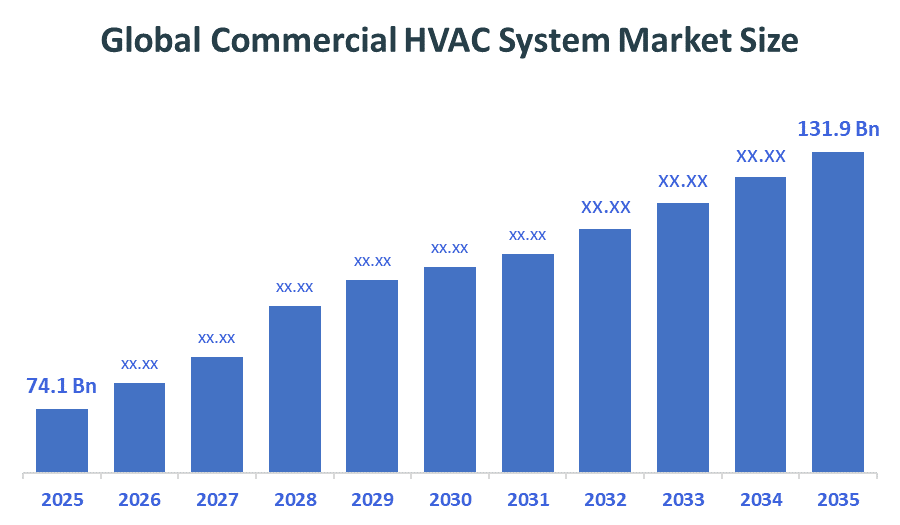
- Market Size (2025): USD 74.1 Billion
- Projected Market Size (2035): USD 131.9 Billion
- Compound Annual Growth Rate (CAGR): 5.94%
- Largest Regional Market: North America
- Fastest Growing Region: Asia-Pacific
- 3rd Largest Region: Europe
- Base Year: 2025
- Historical Period: 2021–2024
- Forecast Period: 2025–2035
Market Overview/ Introduction
The Commercial HVAC System Market represents the sector which designs, implements heating and ventilation, air conditioning systems across commercial buildings which include offices, hospitals, malls, hotels and industrial facilities. These systems maintain control over temperature, airflow, humidity levels and indoor air quality (IAQ). Modern HVAC systems now use both IoT sensors, building automation systems (BAS) and energy-efficient compressors as their primary components. Approximately 35 to 40% of all newly installed commercial HVAC systems now use smart automation technology which allows for real-time system assessment and maintenance forecasting. The global adoption of sustainability practices and green building certifications which include LEED certification has increased because of its rising importance.
- In March 2025, major HVAC manufacturers launched AI-enabled HVAC systems with predictive maintenance and energy optimization capabilities.
- Government infrastructure and smart city initiatives globally are boosting demand for advanced HVAC systems in commercial buildings.
Notable Insights: -
- North America holds the largest regional market share approximately 36% in Global Commercial HVAC System Market.
- Asia Pacific is the fastest growing region in the Global Commercial HVAC System Market with a CAGR of approximately 8.5%.
- By product type, the cooling equipment segment held a dominant position with approximately 7.5% in terms of market share in 2025.
- By capacity, 10 to 25 Tons segment is the dominating accounting for over 6% of the global market share in 2025.
- The compound annual growth rate of the Global Commercial HVAC System Market is 5.94%.
- The market is likely to achieve a valuation of USD 131.9billion by 2035.
What is role of technology in grooming the market?
Commercial HVAC systems experience technological improvements through automation, AI systems, and energy efficiency enhancements. Smart HVAC systems enable real-time monitoring of airflow, temperature, and energy usage. The implementation of IoT technology in HVAC systems results in a 20 to 30 % reduction of energy usage. Predictive maintenance reduces downtime by 25% according to its operational benefits. VRF (Variable Refrigerant Flow) systems achieve efficiency gains between 30% and 40%. The process of digital transformation develops rapidly because almost 40% of modern systems now include intelligent control systems together with cloud-based monitoring solutions. The adoption of energy-efficient technologies which include BLDC motors and inverter-driven compressors leads to operational efficiency improvements between 15 and 25%. The implementation of Building Management Systems (BMS) which connect to HVAC systems enables automatic energy management throughout buildings, as nearly half of all large commercial spaces now employ BMS systems. The increased acceptance of eco-friendly building regulations together with carbon emission reduction goals drives the need for modern HVAC systems. About 35 to 40% of worldwide new commercial construction projects now integrate energy-efficient HVAC systems which meet sustainability certification standards like LEED.
Market Drivers
The global commercial HVAC system market is primarily driven by the rising demand for energy-efficient buildings which manufacturers need to achieve through their sustainability targets while facing higher energy expenses. The rapid expansion of commercial building projects together with infrastructure development in emerging economies has created high demand for HVAC systems in office buildings and retail centers and industrial plants. The COVID pandemic has increased public awareness about indoor air quality (IAQ) which has resulted in greater use of modern ventilation systems and air filtration equipment in offices. The rising adoption of smart building technologies and automated systems creates higher demand because companies use IoT-based HVAC systems to achieve real-time system monitoring and energy management. The government regulations which aim to decrease carbon emissions and enhance energy efficiency have created a favourable environment for implementing modern HVAC systems. The commercial sector stands as the main source of HVAC demand since it generates between 60 and 65% of worldwide system requirements.
Restrain
The commercial HVAC system market faces multiple major restrictions which will prevent its development. The high costs for initial installation and continuous maintenance work create a substantial problem which particularly affects small and medium-sized businesses. The process of advanced HVAC system integration with current building systems proves to be difficult because it needs advanced design solutions and system compatibility with building management systems. The operation of older HVAC units generates two major problems because they consume excessive energy and operate at low efficiency, which forces users to spend money on their system replacements. The industry faces a critical shortage of skilled workers who possess the necessary expertise to install modern systems and operate them and perform maintenance tasks.
Competitive Analysis:
The report offers the appropriate analysis of the key organizations/companies involved within the Global Commercial HVAC System Market, along with a comparative evaluation primarily based on their product of offering, business overviews, geographic presence, enterprise strategies, segment market share, and SWOT analysis. The report also provides an elaborative analysis focusing on the current news and developments of the companies, which includes product development, innovations, joint ventures, partnerships, mergers & acquisitions, strategic alliances, and others. This allows for the evaluation of the overall competition within the market.
Top Companies in the Global Commercial HVAC System Market
- Daikin Industries Ltd.
- Carrier Global Corporation
- Trane Technologies plc
- Johnson Controls International
- Mitsubishi Electric Corporation
- LG Electronics
- Samsung Electronics
- Lennox International Inc.
- Systemair AB
- Hitachi Ltd.
Government Initiatives
|
Country |
Key Government Initiatives |
|
Europe |
In July 2021, the European Union strengthened its climate framework under the “Fit for 55” package and updated energy efficiency directives, promoting advanced HVAC systems to meet carbon reduction targets and improve building energy performance. |
|
US |
In January 2023, standards from ASHRAE (such as ASHRAE 90.1 and 62.1) and programs like ENERGY STAR continued to mandate and promote energy-efficient HVAC system usage in commercial buildings across the United States. |
|
India
|
In February 2024, the Bureau of Energy Efficiency introduced the Energy Conservation and Sustainable Building Code (ECSBC 2024), strengthening earlier ECBC policies to promote energy-efficient HVAC systems and green building initiatives by integrating stricter energy performance standards and sustainability measures across commercial buildings. |
Study on the Supply, Demand, Distribution, and Market Environment Global Commercial HVAC System Market
The commercial HVAC system market is experiencing strong growth because commercial infrastructure development expands which creates 65% of total worldwide demand. Emerging economies experience rapid urbanization and industrialization which drives their construction activities while Asia-Pacific markets develop almost 50% of new commercial building projects. The digitalization trend is changing procurement practices because online platforms and B2B systems now generate 30 to 35% of total HVAC system sales while they make products easier to access and improve supply chain operations. The rising use of smart HVAC systems which operate with building management systems and automation technology results in better business performance through its capacity to track operations and schedule equipment maintenance and save energy usage. The technological innovations which companies have developed today serve as essential instruments for updating commercial building systems while they help businesses reach their environmental sustainability targets.
Price Analysis and Healthcare Facilities Behaviour Analysis
The pricing structure of commercial HVAC systems varies significantly based on three factors which include system type and system capacity and system technological sophistication. Basic commercial HVAC systems typically range between USD 2,000 and 10,000 per unit, making them suitable for small-scale commercial applications. Advanced smart HVAC systems which include IoT integration with automation and energy optimization capabilities start at USD 10,000 and can exceed USD 50,000 depending on system complexity and building requirements. Large-scale industrial HVAC systems require substantial investment because of their increased capacity needs and their need for customized systems and installation services. The initial spending requirements remain high yet businesses adopt energy-saving solutions because they achieve 20 to 35% energy savings while companies increasingly seek financial savings and environmentally friendly solutions and better business results in their commercial buildings.
Market Segmentation
The Global Commercial HVAC System Market share is classified into solution product type, capacity, and application
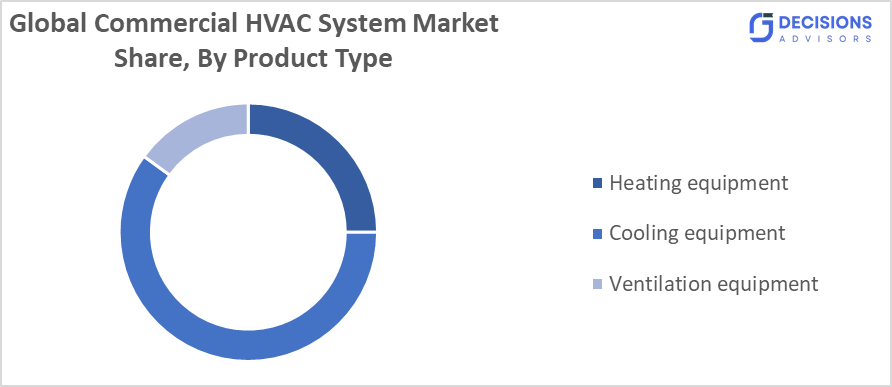
- The cooling equipment segment dominated the market in 2025, and is projected to grow at a substantial CAGR of approximately 7.5% during the forecast period.
Based on the product type, the global commercial HVAC system market is divided into heating equipment, cooling equipment, and ventilation equipment. Among these, the cooling equipment segment dominated the market in 2025, and is projected to grow at a substantial CAGR of approximately 7.5% during the forecast period. The cooling equipment segment dominates due to high demand for air conditioning in commercial buildings such as offices, malls, and hospitals, especially in warm climates. Rising global temperatures, increasing urbanization, and the need for maintaining indoor comfort and air quality further drive strong adoption and growth.
- The 10 to 25 Tons segment accounted for the largest share in 2025, and is anticipated to grow at a significant CAGR of approximately 6% during the forecast period.
Based on the capacity, the global Commercial HVAC System Marketis divided into Up to 10 Tons, 10 to 25 Tons, and Above 25. Among these, the 10 to 25 Tons segment accounted for the largest share in 2025, and is anticipated to grow at a significant CAGR of approximately 6% during the forecast period. The market for air conditioning systems for small to medium commercial spaces has been dominated by unitary AC systems because of their affordable pricing and straightforward installation process. The system has become the preferred option for users because of its wide availability and minimal upkeep needs and its ability to operate under different conditions which supports consistent development of commercial facilities throughout the world.
- The office buildings segment dominated the market at a CAGR of approximately 7% in 2025, and is projected to grow at a substantial CAGR during the forecast period.
Based on the application, the global commercial HVAC system market is divided into office buildings, retail spaces, hospitality, healthcare, education, transportation & public venues, and government & institutional buildings. Among these, the office buildings segment dominated the market at a CAGR of approximately 7% in 2025, and is projected to grow at a substantial CAGR during the forecast period. Office buildings occupy most spaces because their HVAC systems require high capacity to sustain indoor temperature control and maintain suitable air conditions and efficient energy use. The commercial construction sector is expanding because more workers are entering the market while smart building technologies are becoming popular which leads to increased demand for HVAC systems that create sustained growth for this market worldwide.
Strategies to Implement for Growth of the Market in Non-Leading Regions
The commercial HVAC system market has the potential to grow in non-leading areas because Latin America and the Middle East and Africa and selected Southeast Asian countries can use their affordable products and region-specific solutions to create awareness among customers. The establishment of local manufacturing and assembly units will lead to a 20 to 30% reduction in costs, which will enable price-sensitive markets to access advanced HVAC systems. The establishment of partnerships with regional distributors and construction firms and real estate developers will boost market penetration and create new distribution channels. The public will adopt the technology more widely because they will learn about indoor air quality, energy efficiency and the financial benefits that come with it, which will particularly impact urban environments. The company can gain new customers from small and medium-sized businesses through its smart HVAC products, which include financing resources and basic entry-level solutions. The establishment of government incentives and green building programs will increase market demand, which will assist in creating sustainable infrastructure development.
Regional Segment Analysis of the Global Commercial HVAC System Market
- North America (U.S., Canada, Mexico)
- Europe (Germany, France, U.K., Italy, Spain, Rest of Europe)
- Asia-Pacific (China, Japan, India, Rest of APAC)
- South America (Brazil and the Rest of South America)
- The Middle East and Africa (UAE, South Africa, Rest of MEA)
North America is anticipated to hold the largest share approximately 36% of the Global Commercial HVAC System Market over the predicted timeframe. The global commercial HVAC system market will see North America become its largest market with about 36% share because of the regions developed commercial infrastructure and high usage of modern HVAC systems. The region benefits from strict energy efficiency regulations and standards that encourage the use of modern, energy-efficient systems. The COVID-19 pandemic created a strong demand for indoor air quality solutions which resulted in increased HVAC system upgrades for offices hospitals and commercial buildings. The market experiences growth through the presence of Carrier Global Corporation and Trane Technologies plc which serve as leading manufacturers who drive innovation. Building systems that employ intelligent technology and organizations that retrofit existing structures will create ongoing requirements for their products.
Asia Pacific is expected to grow at a rapid CAGR approximately 8.5% in the Global Commercial HVAC System Market during the forecast period. The Asia-Pacific region will experience rapid market growth with a compound annual growth rate CAGRE of 8.5% because urbanization and commercial infrastructure development and economic expansion in China and India drives the worldwide commercial HVAC system market. The region accounts for a significant share of new construction activities which creates a demand for HVAC systems. The market expansion receives support from rising disposable income and growing adoption of smart building technologies. The rising public concern about air pollution together with indoor air quality issues drives higher HVAC system usage. The government-led smart city programs and infrastructure development initiatives act as key factors that drive market growth throughout the region.
Europe is the 3rd largest region to grow in the Global Commercial HVAC System Market during the region.
European countries hold the position of third-largest market region worldwide because their energy efficiency regulations and carbon reduction standards create mandatory requirements for commercial HVAC systems. The region benefits from strict EU directives which require sustainable building practices and require the use of energy-efficient HVAC systems. The countries of Germany United Kingdom and France have become the main countries that adopt modern HVAC systems because they pursue green building standards and retrofit programs for their existing facilities. The energy-efficient system demand which produces minimal noise grows stronger throughout commercial building spaces. The European market experiences constant growth because organizations increasingly pursue sustainable practices while they invest in intelligent building technologies and building renovation work.
Future Market Trends Global Commercial HVAC System Market: -
- Smart HVAC Systems Growth
Smart HVAC systems are witnessing rapid adoption, accounting for approximately 35–45% of new installations in commercial buildings. AI-based optimization enables real-time monitoring and predictive control, improving system efficiency by nearly 25% while reducing operational costs and enhancing overall building performance.
- Energy Efficiency Focus
Energy efficiency remains a key priority, with advanced HVAC systems reducing energy consumption by 30–40%. This growth is driven by global carbon neutrality goals, stringent regulations, and rising energy costs, encouraging businesses to adopt sustainable and energy-efficient climate control solutions.
- VRF System Expansion
Variable Refrigerant Flow (VRF) systems are expanding at a CAGR of 8–10%, driven by their flexibility and high efficiency. Widely used in commercial complexes, these systems provide zonal cooling, reduce energy consumption, and offer superior temperature control across large buildings.
Recent Development
- In June 2025, energy-efficient HVAC systems were introduced for green buildings, focusing on low energy consumption, reduced carbon emissions, and compliance with sustainability standards such as LEED certification.
- In March 2025, AI-based HVAC automation systems were launched, integrating predictive maintenance and real-time energy optimization features to improve system performance, reduce operational costs, and enhance efficiency in commercial buildings.
- In January 2025, HVAC system expansion aligned with sustainability regulations accelerated, as governments and organizations adopted stricter energy efficiency policies and carbon reduction targets across commercial sectors.
- In September 2024, smart HVAC systems were increasingly integrated with building management systems (BMS), enabling centralized control, improved energy monitoring, and automation across commercial infrastructure.
How is Recent Developments Helping the Market?
The technologies AI, IoT, and automation have brought about major advancements to commercial HVAC system performance through their capabilities for real-time system monitoring and predictive system maintenance and intelligent climate control. These technological improvements enable businesses to cut operational costs while decreasing system outages and boosting building operational efficiency. Smart HVAC systems now account for approximately 40% of new installations, reflecting rapid adoption across commercial infrastructure. The implementation of energy-efficient solutions results in power consumption reductions that approach 30%, which helps businesses achieve sustainability objectives while decreasing their energy costs over time. The combination of HVAC systems with building management platforms provides businesses with essential tools to decrease energy consumption in their modern commercial spaces that prioritize sustainability.
Market Segment
This study forecasts revenue at global, regional, and country levels from 2020 to 2035. Decision Advisor has segmented the Global Commercial HVAC System Market based on the below-mentioned segments:
Global Commercial HVAC System Market, By Product Type
- Heating Equipment
- Cooling Equipment
- Ventilation Equipment.
Global Commercial HVAC System Market, By Capacity
- Up to 10 Tons
- 10 to 25 Tons
- Above 25
Global Commercial HVAC System Market, By Application
- Residential
- Commercial
- Industrial
- Institutional
Global Commercial HVAC System Market, By Regional Analysis
- North America
- US
- Canada
- Mexico
- Europe
- Germany
- UK
- France
- Italy
- Spain
- Russia
- Rest of Europe
- Asia Pacific
- China
- Japan
- India
- South Korea
- Australia
- Rest of Asia Pacific
- South America
- Brazil
- Argentina
- Rest of South America
- Middle East & Africa
- UAE
- Saudi Arabia
- Qatar
- South Africa
- Rest of the Middle East & Africa
Frequently Asked Questions (FAQ)
1. How do HVAC systems impact operational costs in commercial buildings?
HVAC systems can account for up to 40–50% of total energy consumption in commercial buildings. Advanced systems with automation and energy-efficient components significantly reduce long-term operational expenses through optimized energy usage.
2. What role do retrofitting projects play in the commercial HVAC market?
Retrofitting older buildings with modern HVAC systems is a major growth driver, improving energy efficiency, compliance with regulations, and indoor air quality without requiring complete infrastructure redevelopment.
3. How is climate change influencing HVAC system demand?
Rising global temperatures and extreme weather conditions are increasing the need for reliable and efficient cooling systems, especially in commercial spaces with high occupancy.
4. What challenges do businesses face when upgrading HVAC systems?
Businesses often face high upfront costs, system compatibility issues, and operational disruptions during installation, making phased upgrades or hybrid systems a preferred approach.
5. How are smart buildings shaping HVAC system requirements?
Smart buildings require HVAC systems integrated with IoT and building management systems (BMS) to enable real-time monitoring, automation, and improved energy efficiency.
Check Licence
Choose the plan that fits you best: Single User, Multi-User, or Enterprise solutions tailored for your needs.
We Have You Covered
- 24/7 Analyst Support
- Clients Across the Globe
- Tailored Insights
- Technology Tracking
- Competitive Intelligence
- Custom Research
- Syndicated Market Studies
- Market Overview
- Market Segmentation
- Growth Drivers
- Market Opportunities
- Regulatory Insights
- Innovation & Sustainability
Report Details
| Scope | Global |
| Pages | 240 |
| Delivery | PDF & Excel via Email |
| Language | English |
| Release | Apr 2026 |
| Access | Download from this page |