
Global Commercial Mixers Market
 |
Author:
Pranali P
|
Pages:
210
|
Author:
Pranali P
|
Pages:
210
Global Commercial Mixers Market Size, Share, By Product Type (Planetary Mixers, Spiral Mixers, Horizontal Mixers, Vertical Mixers, and Others) By Capacity (Up to 20 Liters, 20 to 50 Liters, and Above 50 Liters) By Application (Bakery and Confectionery, Food Processing Industry, Hotels and Restaurants, Catering Services, and Others) By End User (Commercial Kitchens, Food Manufacturing Units, Hotels Restaurants and Cafes, and Institutional Sector) and By Region (North America, Europe, Asia Pacific, Latin America, and Middle East and Africa), Analysis and Forecast 2026-2035
CAGR
6.53%
REVENUE 2025
USD Billion 1.7
FORECAST 2035
USD Billion 3.2
REPORT COVERAGE
Global
Market Snapshots
- Global Commercial Mixers Market Size (2025): USD 1.7 Billion
- Global Commercial Mixers Projected Market Size (2035): USD 3.2 Billion
- Global Commercial Mixers Compound Annual Growth Rate (CAGR): 6.53%
- Largest Regional Market: Asia-Pacific
- Fastest Growing Region: North America
- 3rd Largest Region: Europe
- Base Year: 2025
- Historical Period: 2021 to 2024
- Forecast Period: 2026 to 2035
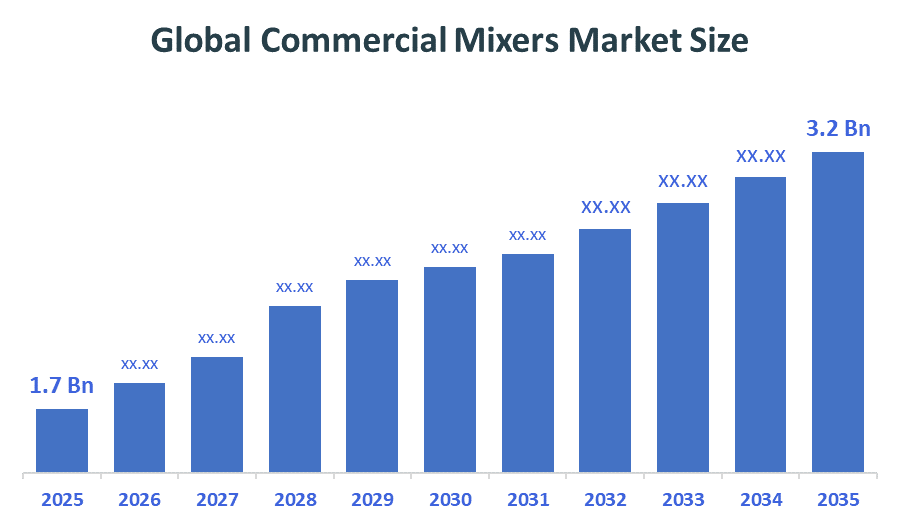
According to Decision Advisors, the global commercial mixers market size was expected to grow from USD 1.7 billion in 2025 to USD 3.2 billion by 2035, with a CAGR of 6.53% during the forecast period from 2026 to 2035. There has been an unwavering path of growth for this industry because of the need for modern food processing and high-efficiency kitchens in the world, which has become increasingly necessary owing to rising urbanisation and automation in the process of food cooking. The recent developments in variable frequency drives and smart load sensing have rendered these machines efficient to the extent that they can homogenise ingredients with great accuracy and fill the void between manual mixing processes and huge static blending facilities.
Market Overview / Introduction
Commercial mixers serve as one of the most important arrays of industrial food processing systems that enable efficient and immediate efficiency in the preparation of ingredients by homogenising the large volumes of material needed in bakeries, restaurants, and catering services. They act as the vital link between the traditional process of manual preparation and full automation in industrial food production using planetary drive systems and adjustable torque controls to achieve even texture without room for errors. The current systems employ innovative designs like the usage of variable frequency drives and high-torque energy-efficient motors in order to offer reliable and consistent operations while eliminating the possibility of motor burnout when handling high-volume dough preparation operations. In their simplest form, commercial mixers are just automatic beaters that have now transformed into smart devices that are known for their excellent reliability ratings, programmable cycle processes, and easy integration into modern kitchen arrangements. Some of the key drivers influencing market dynamics in the Global Commercial Mixers Market include the increasing demand for high-yield cooking equipment and immediate efficiency levels in modern kitchen environments, especially in urban centres where food hubs are being set up.
- Commercial mixers are utilised extensively in bakeries and food processing operations, constituting about 60% of overall demand, bolstered by the growth of the international market for food processing machinery, exceeding USD 59 billion in 2025 and continuing to grow due to high consumption of processed foods
- There is increased utilization of automated and semi-automatic industrial mixers, the entire mixers and blenders industry growing at a CAGR of about 5% due to the increasing demands for automation, consistency and labor reduction in the food processing industries.
Notable Insights: -
- The commercial mixers market is closely linked to the expansion of the global foodservice and industrial kitchen sector, contributing to steady market growth with valuation surpassing USD 1.7 billion in 2025 and expected to grow consistently due to rising demand from hotels, restaurants, and catering services
- Large capacity mixers above 50 litres are gaining higher adoption in industrial food manufacturing units, supported by increasing bulk food production and the rapid growth of centralized kitchens and cloud kitchen models across urban regions
- Asia Pacific contributes nearly 30% share in the broader food processing equipment industry, making it a key growth region for commercial mixers due to rapid industrialisation, urbanisation, and expansion of organised foodservice sectors
What is the Role of Technology in Shaping the Market?
Technological advancements are creating a revolution in the commercial mixers industry through enhanced performance through innovations such as improved motor efficiency, durable structure, and automated controls. The modern-day food processing systems are not merely passive equipment, but intelligent, high-torque, and programmable control systems that can operate independently for extended periods, thanks to the incorporation of high-quality materials such as stainless steel, state-of-the-art planetary drives, and integration with digital smart kitchen technology.
How are Recent Developments Helping the Market?
These new inventions have greatly helped in driving the growth in the market. Companies have come up with a modular mixer system that is capable of handling different forms of ingredients, starting from fragile aerated creams to heavy industrial dough masses. The machines have been designed in such a manner that they perform very well even when operated at times when there are high demands on them, without requiring much manual assistance. With the help of these new load-sensing mechanical systems, the machines will now be capable of adjusting their own speeds according to the resistance offered by the ingredients, thus preventing any chances of damage to both the machines and people.
Market Drivers
The worldwide commercial mixers industry is experiencing a period of growth with the rising expenditures of hospitality investors and industrial food producers on sustainability in terms of production efficiency and building food-safe facilities, which satisfy the current demands and needs for healthy products. Contemporary mixers are winning great popularity in the market because of the benefit of incorporating various features like attachable attachment centers, fast self-cleaning cycles, and ergonomic compactness in one efficient and maintenance-free device. Meanwhile, the emerging trend of a shortage of workers within the culinary industry is driving the need for advanced automation solutions that can help with shifting to high-capacity cloud kitchens, particularly in city centers where manual labour is restricted.
Restraints
The growth of the global commercial mixers industry is hindered by the difficulties that arise in ensuring the longevity of the internal gear systems in a highly aggressive environment because of the consistent friction and extreme temperatures. The financial burden that comes with creating exclusive food-grade alloys and the precise manufacturing process, along with the cost of integrating customised software programs, becomes yet another obstacle to rapidly adopting the new technology within smaller independent baking companies.
Competitive Analysis:
The report offers the appropriate analysis of the key organisations/companies involved within the commercial mixers market, along with a comparative evaluation primarily based on their product offerings, business overviews, geographic presence, enterprise strategies, segment market share, and SWOT analysis. The report also provides an elaborate analysis focusing on the current news and developments of the companies, which includes product development, innovations, joint ventures, partnerships, mergers & acquisitions, strategic alliances, and others. This allows for the evaluation of the overall competition within the market.
Top 10 Companies in the Global Commercial Mixers Market
- SPX FLOW, Inc.
- Hobart (ITW Food Equipment Group)
- Alfa Laval AB
- GEA Group AG
- Silverson Machines Inc.
- Charles Ross & Son Company
- EKATO HOLDING GmbH
- Sulzer Ltd
- Xylem Inc.
- IKA-Werke GmbH & Co. KG
Government Initiatives
|
Country |
Key Government Initiatives |
|
India |
In July 2025, the Union Cabinet approved a total outlay of ?6,520 crore for the Pradhan Mantri Kisan SAMPADA Yojana (PMKSY) for the period ending in 2026. This includes a specific allocation of ?1,000 crore to support integrated cold chain and value addition infrastructure and ?920 crore for food safety and quality assurance. |
|
US |
The USDA continues to support the Food Supply Chain Guaranteed Loan Program, which provides up to $40 million in guaranteed loans per project to help food processors and manufacturers expand infrastructure and purchase advanced equipment. A program in Pennsylvania opened second-round applications for $10 million in grants to help food businesses adopt new technologies and improve production efficiency. |
|
UK |
As part of the Advanced Manufacturing Plan, the UK government confirmed a funding envelope of £4.5 billion to support strategic manufacturing sectors over five years starting in 2025. This includes the expansion of the Made Smarter Adoption programme in 2025-26, which provides small and medium-sized (SME) food manufacturers with access to digital technologies and automated equipment to boost productivity |
Study on the Supply, Demand, Distribution, and Market Environment
The sustainability of the commercial mixers industry lies in the balance that exists between the capacity to function at peak mechanical efficiency and the emerging demands for continuous and intelligent food management systems. Supply in the commercial mixers sector stems from the emphasis on developing super-strong alloys and efficient planetary drive triggers that can ensure rapid homogenization of ingredients without experiencing the prolonged delays inherent in manual mixing operations. Demand factors arise from the shift towards kitchen automation and the integration of digital speed sensors to monitor speed and torque and notify the authorities about the kitchen's state of affairs.
Price Analysis and Consumer Behaviour Analysis
The price ranges for commercial mixers depend on the motor power, capacity ratings of bowls, and automation features such as programmable options. The equipment, featuring a variable frequency drive system and digital control sensor mechanisms, along with safety protection, is costly. Bench-top planetary mixers and small spiral machines suitable for residential cafes cost less and offer perfect opportunities for localised supplementary manufacturing and food preparation services in urban areas. Consumers are inclined to select products that will last longer without maintenance and provide ease of use and accurate rotation for a long time. Therefore, manufacturers are expected to focus on products that guarantee autonomous operation, kitchen-friendly equipment, and exact placement of rotating elements for a long time to come.
Market Segmentation
The Global Commercial Mixers Market share is classified into product type, capacity, application, and end user.
The Planetary Mixers segment holds the largest share, contributing approximately 42% of the market in 2025.
Based on the product type, the global commercial mixers market is divided into planetary mixers, spiral mixers, horizontal mixers, vertical mixers, and others. Among these, the Planetary Mixers segment holds the largest share, contributing approximately 42% of the market in 2025. The reason behind their dominance lies in their greater versatility while dealing with the processing of multiple ingredients, as well as in their ability to serve various functions using different attachments automatically. The spiral and horizontal types form the rest of the market and are highly valued because of their ability to handle huge dough loads with maximum torque.
The 20 to 50 Liters segment holds the largest share, contributing approximately 45% of the market in 2025.
Based on the Capacity, the global commercial mixers market is divided into up to 20 liters, 20 to 50 liters, and above 50 liters. Among these, the 20 to 50 liters segment holds the largest share, contributing approximately 45% of the market in 2025. This dominance is due to the segment providing a perfect balance between high-volume output and a compact footprint, making these units the primary choice for medium-sized bakeries, busy restaurants, and high-traffic cafes. The Above 50 Liters category constitutes a significant portion of the market, particularly favoured by industrial food manufacturing units for continuous, heavy-duty batch processing.
The Bakery and Confectionery segment accounts for the largest share, representing over 38% of the global market in 2025.
Based on the application, the global commercial mixers market is divided into bakery and confectionery, food processing industry, hotels and restaurants, catering services, and others. Among these, the Bakery and Confectionery segment accounts for the largest share, representing over 38% of the global market in 2025. These deployments are critical for maintaining the texture of high-volume dough production, improving batch resilience, and reducing production-wide economic losses through the adoption of modern, autonomous mixing equipment.
Commercial Kitchens dominate the global market, accounting for approximately 52% of the total revenue in 2025.
Based on the end user, the global commercial mixers market is divided into commercial kitchens, food manufacturing units, hotels, restaurants, and cafes, and the institutional sector. Among these, the Commercial Kitchens dominate the global market, accounting for approximately 52% of the total revenue in 2025. This segment is preferred by operators who require large-scale integrated solutions and professional maintenance services for complex culinary safety infrastructure. The Institutional Sector category is seeing a sharp increase in use, especially by facility managers in large-scale hospital and school canteens who value the productivity and the convenience of automatic ingredient processing for large-scale meal preparation.
Strategies to Implement for Growth of the Market in Non-Leading Regions
The potential for growth within the commercial mixers industry in emerging regions could be increased through the deployment of efficient modular mixing platforms for local food service developers, as well as local agencies tasked with industrial kitchen management. Programs aimed at achieving food safety resilience by governments, coupled with the expansion of high-strength sanitary engineering standards, contribute substantially toward demand within regions with traditional culinary setups that pose significant challenges to the installation of massive permanent production lines on the ground.
Regional Segment Analysis of the Global Commercial Mixers Market
- North America (U.S., Canada, Mexico)
- Europe (Germany, France, U.K., Italy, Spain, Rest of Europe)
- Asia-Pacific (China, Japan, India, South Korea, Rest of APAC)
- Latin America (Brazil and the Rest of Latin America)
- The Middle East and Africa (UAE, South Africa, Rest of MEA)
Asia-Pacific is projected to be the fastest-growing region over the forecast period. This region is anticipated to witness a growth rate of around 8.5% CAGR, maintaining a dominant market share within the global industry. In 2025, Asia-Pacific already accounts for approximately 36.5% of global revenue. This is owing to the fast-developing urban hospitality infrastructure, coupled with the growing demand for modern culinary equipment in countries such as China, India, and Japan. Other reasons for the same include greater investments made toward sustainable industrial planning in the region, state-supported indigenous research and development projects for low-cost energy-efficient mixers, and widespread adoption of planetary-based processing strategies.
North America is expected to hold a significant share of the commercial mixers market during the forecast period. This region holds approximately 28.2% share of global revenue in 2025, thanks to its highly sophisticated infrastructure related to commercial food service, along with the extensive adoption of automation-resilient technology in both national food safety goals and high-value franchise security applications. The largest part of this region’s revenues comes from the United States, as there is a lot of spending at the corporate level in efficiency assistance programs for automated equipment adoption, along with local research related to sensor-integrated drive systems. Over-the-horizon upgrades to health codes and the early adoption of smart-connected systems in industrial kitchen retrofit operations have played key roles here.
Europe is anticipated to hold a substantial share, contributing approximately 21.9% of the global market share. There is a competitive advantage in the region owing to clusters of food processing technology innovation and financing for sustainable protection of the production environment, as well as food safety management research. There is also a comparative advantage with countries like Germany, the United Kingdom, and Italy, which are highly skilled at precision engineering for high-performance self-activating mixing units. Moreover, the rigorous regulatory standards that they have regarding hygiene defense and urban culinary drainage further give them a comparative advantage. The presence of big manufacturing firms, along with improved digital awareness systems, has also helped introduce advanced automatic commercial mixers slowly but steadily.
Recent Developments
- In March 2026, China announced an investment of approximately USD 22 billion in food manufacturing infrastructure, accelerating the adoption of automated processing equipment, including commercial mixers to enhance production efficiency and quality standards across large scale food facilities
- In January 2026, the global food and beverage processing equipment sector reached approximately USD 79.5 billion in 2025, driving equipment manufacturers to expand production capacity and integrate advanced mixing technologies to meet increasing demand for processed and ready to eat food products
- In February 2025, Middleby Corporation announced strategic restructuring and business expansion plans with a valuation of about USD 9 billion, aiming to strengthen its commercial kitchen equipment segment including high performance mixing technologies across global foodservice chains
Market Segmentation
This study forecasts revenue at global, regional, and country levels from 2021 to 2035. Decision Advisors has segmented the global commercial mixers market is segmented based on the following categories:
Global Commercial Mixers Market, By Product Type
- Planetary Mixers
- Spiral Mixers
- Horizontal Mixers
- Vertical Mixers
- Others
Global Commercial Mixers Market, By Capacity
- Up to 20 Liters
- 20 to 50 Liters
- Above 50 Liters
Global Commercial Mixers Market, By Application
- Bakery and Confectionery
- Food Processing Industry
- Hotels and Restaurants
- Catering Services
- Others
Global Commercial Mixers Market, By End User
- Commercial Kitchens
- Food Manufacturing Units
- Hotels, Restaurants, and Cafes (HoReCa)
- Institutional Sector
Global Commercial Mixers Market, By Regional Analysis
- North America
- United States
- Canada
- Mexico
- Europe
- Germany
- United Kingdom
- France
- Italy
- Spain
- Russia
- Rest of Europe
- Asia Pacific
- China
- Japan
- India
- South Korea
- Australia
- Rest of Asia Pacific
- Latin America
- Brazil
- Argentina
- Rest of Latin America
- Middle East & Africa
- United Arab Emirates
- Saudi Arabia
- Qatar
- South Africa
- Rest of Middle East & Africa
Frequently Asked Questions (FAQ)
What is a commercial mixer, and why is it important?
A commercial mixer is a specialised industrial food preparation system designed to regulate and homogenise large quantities of ingredients for bakeries, restaurants, and manufacturing plants. These systems are essential for maintaining food safety and production consistency during high-volume culinary operations, protecting expensive ingredients from waste, and ensuring operational continuity in commercial settings.
What factors are driving the growth of the commercial mixers market?
The market growth can be attributed to the massive investments made in culinary infrastructure by hospitality groups, the rising requirements for automated food processing systems, and the widespread adoption of high-efficiency planetary and spiral mixers.
Which product type dominates the commercial mixers market?
Planetary mixers represent the largest and most influential segment of the market due to their exceptional operational versatility, the capability to perform multiple functions with various attachments, and their adaptability to different ingredient types.
Which applications are widely used in this market?
Bakery and confectionery, along with the food processing industry, are the most prominent applications due to the acute necessity to maintain stable production speeds and provide reliable homogenization for large-scale batches
Check Licence
Choose the plan that fits you best: Single User, Multi-User, or Enterprise solutions tailored for your needs.
We Have You Covered
- 24/7 Analyst Support
- Clients Across the Globe
- Tailored Insights
- Technology Tracking
- Competitive Intelligence
- Custom Research
- Syndicated Market Studies
- Market Overview
- Market Segmentation
- Growth Drivers
- Market Opportunities
- Regulatory Insights
- Innovation & Sustainability
Report Details
| Scope | Global |
| Pages | 210 |
| Delivery | PDF & Excel via Email |
| Language | English |
| Release | Apr 2026 |
| Access | Download from this page |