
Global Common Wart Market
 |
Pages:
250
|
Pages:
250
Global Common Wart Market Size, Share, and COVID-19 Impact Analysis, By Treatment Method (Cryotherapy, Laser Treatment, Electrosurgery, and Topical Medications), By Disease Stage (Initial Stage, Moderate Stage, and Severe Stage), By Patient Demographics (Children, Adults, and Elderly), and By Region (North America, Europe, Asia-Pacific, Latin America, Middle East, and Africa), Analysis and Forecast 2025-2035
REPORT COVERAGE
Global
Global Common Wart Market Size Insights Forecasts to 2035
- The Global Common Wart Market Size Was Estimated at USD 790.32 Million in 2024
- The Market Size is Expected to Grow at a CAGR of around 3.45 % from 2025 to 2035
- The Worldwide Common Wart Market Size is Expected to Reach USD 1147.45 Million by 2035
- North America is expected to grow the fastest during the forecast period.
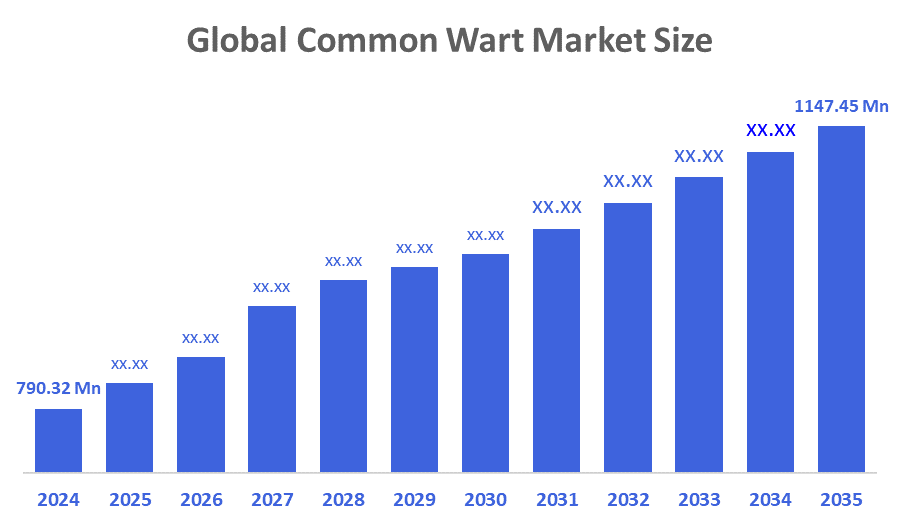
According to a research report published by Decisions Advisors and Consulting, The Global Common Wart Market Size Was Worth Around USD 790.32 Million In 2024 And Is Predicted To Grow To Around USD 1147.45 Million By 2035 With A Compound Annual Growth Rate (CAGR) Of 3.45 % From 2025 To 2035. The market for common warts is steadily expanding due to the rising incidence of human papillomavirus infections and growing knowledge of efficient diagnostic and therapeutic approaches. With the help of improvements in dermatological techniques and expanding healthcare infrastructure worldwide, the need for accurate diagnosis processes and effective therapy interventions is influencing market dynamics.
Market Overview
Common warts, which medical experts call verruca vulgaris, represent a form of skin growth that occurs when human papillomavirus (HPV) infects the skin. The warts appear as small circular or irregularly shaped bumps which show different colours, including flesh tinting, tan shade, grey shade and yellowish tint. The warts mostly develop on hands and fingers and nail areas, although they can emerge on any body location. The condition usually does not cause pain, but people experience mild itching together with tenderness and discomfort when it develops in areas that face friction or pressure. The medical community uses the specific visual characteristics of common warts together with their typical symptoms to establish their diagnosis. Healthcare professionals, such as dermatologists or general practitioners, can typically diagnose them through a visual examination of the skin. The medical professional will examine all aspects of the wart, which include its dimensions, structure, surface characteristics and body area appearance. In some cases, a healthcare provider may utilise a dermatoscope, a handheld device that magnifies the skin, to get a closer look at the wart. The medical team uses skin biopsy as a diagnostic procedure when they need to confirm a diagnosis that has unusual skin features or when they face diagnostic challenges.
Report Coverage
This research report categorizes the common wart market based on various segments and regions, forecasts revenue growth, and analyzes trends in each submarket. The report analyses the key growth drivers, opportunities, and challenges influencing the common wart market. Recent market developments and competitive strategies, such as expansion, product launch, development, partnership, merger, and acquisition, have been included to draw the competitive landscape in the market. The report strategically identifies and profiles the key market players and analyzes their core competencies in each sub-segment of the common wart market.
Driving Factors
The common warts market experiences growth because people increasingly get infected through different activities, which involve sharing personal items like towels or razors and engaging in sexual acts. The market outlook remains positive because multiple risk factors, which include both weakened immune systems and skin conditions, which include eczema and skin abrasions and multiple sexual partners, exist. The market experiences growth because people widely adopt immune checkpoint inhibitors and topical immune modulators, which activate the immune system to destroy warts. The key players of the industry invest heavily in research and development to create new drug therapies that will target specific molecular pathways that cause warts to form and persist. This factor serves as a major driver of market expansion. The common wart market will experience growth during the forecast period because laser technology advancements, which include pulsed dye and erbium YAG lasers, create precise wart tissue destruction, which protects surrounding healthy skin from damage.
Restraining Factors
Market expansion is hampered by high recurrence rates, the ineffectiveness of current therapies, and patient resistance to invasive procedures. Additionally, despite continuous progress, the adoption of advanced medicines is slowed by factors such as lack of awareness, uneven payment systems, and competition from over-the-counter remedies.
Market Segmentation
The common wart market share is classified into treatment method, disease stage and patient demographics.
- The cryotherapy segment accounted for the largest market share in 2024 and is anticipated to grow at a substantial CAGR over the forecast period.
Based on the treatment method, the common wart market is divided into cryotherapy, laser treatment, electrosurgery, and topical medications. Among these, the cryotherapy segment accounted for the largest market share in 2024 and is anticipated to grow at a substantial CAGR over the forecast period. This is due to its effectiveness and simplicity of use. Patients and dermatologists alike like this method because it not only successfully removes the wart but also lowers the possibility of scarring.
- The initial stage segment accounted for the highest market revenue in 2024 and is anticipated to grow at a significant CAGR during the forecast period.
Based on the disease stage, the common wart market is divided into the initial stage, moderate stage, and severe stage. Among these, the initial stage segment accounted for the highest market revenue in 2024 and is anticipated to grow at a significant CAGR during the forecast period. This is because of the increased number of diagnoses made during routine examinations and the emphasis on early intervention. Small, benign growths that could cause discomfort and cosmetic issues if not addressed are the hallmark of this stage.
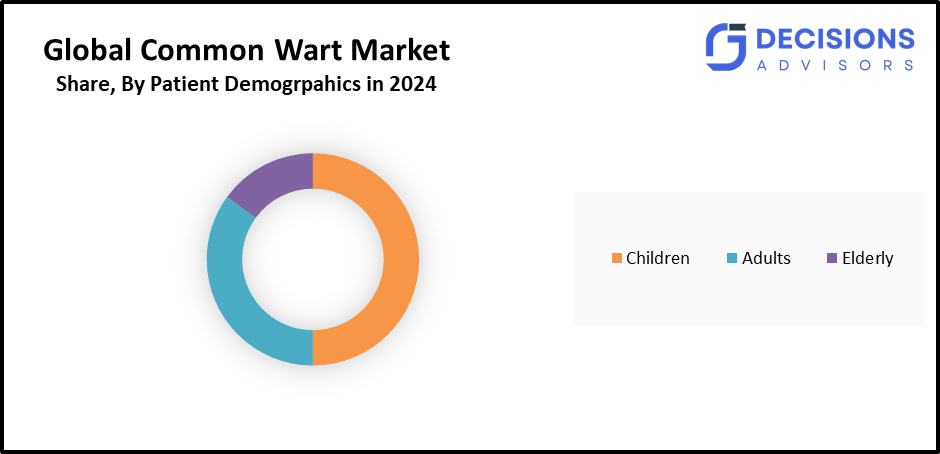
- The children segment accounted for the highest market share in 2024 and is anticipated to grow at a significant CAGR during the forecast period.
Based on the patient demographics, the common wart market is divided into children, adults, elderly. Among these, the children segment accounted for the highest market share in 2024 and is anticipated to grow at a significant CAGR during the forecast period. The segment growth is driven by their increased vulnerability to common warts as a result of physical activity and social contacts. Further, children are such a sensitive group; treatments for them are usually made to be simple and painless.
Regional Segment Analysis of the Common Wart Market
- North America (U.S., Canada, Mexico)
- Europe (Germany, France, U.K., Italy, Spain, Rest of Europe)
- Asia-Pacific (China, Japan, India, Rest of APAC)
- South America (Brazil and the Rest of South America)
- The Middle East and Africa (UAE, South Africa, Rest of MEA)
Asia Pacific is anticipated to hold the largest share of the common wart market over the predicted timeframe.
Asia Pacific is anticipated to hold the largest share of the common wart market over the predicted timeframe. The region experiences population growth, increased spending power and better skin health knowledge. The region holds a significant market share, with countries like China and India leading the charge. China's market share boosts the market because the country has a vast population and is currently increasing its healthcare spending. The market expansion will receive a boost because regulatory agencies have begun to fast-track the process, which leads to new drug approvals. Both global companies and native businesses operate in the Asia-Pacific region while they compete against each other to gain market share. The growing skin condition rates, together with rising interest in skin health, drive the need for wart treatment solutions, which will position this area as a main site of market growth.
North America is expected to grow at a rapid CAGR in the common wart market during the forecast period. The region's growth is driven by increasing healthcare expenditure, a high prevalence of warts, and advanced healthcare infrastructure. The market grows because of regulatory backing, which supports new treatment methods and the market's focus on dermatological health. The U.S. leads this market, followed closely by Canada, which contributes to the overall market share. The companies conduct research and development activities to create and launch new treatment solutions. The market is experiencing various partnerships and collaborations that seek to improve treatment results and patient health while developing new treatment methods.
Competitive Analysis:
The report offers the appropriate analysis of the key organizations/companies involved within the common wart market, along with a comparative evaluation primarily based on their product offering, business overviews, geographic presence, enterprise strategies, segment market share, and SWOT analysis. The report also provides an elaborative analysis focusing on the current news and developments of the companies, which includes product development, innovations, joint ventures, partnerships, mergers & acquisitions, strategic alliances, and others. This allows for the evaluation of the overall competition within the market.
List of Key Companies
- Aclaris Therapeutics
- Glenmark Pharmaceuticals
- Graceway Pharmaceuticals, LLC
- Iwaki Pharmaceutical
- Kino Pharma
- LEO Pharma
- Maruho Co., Ltd
- MEDA Pharma
- Nielsen BioSciences
- Novan, Inc
- Taro Pharmaceutical Industries
- Veradermics, Inc.
- Verrica Pharmaceuticals
- ViroXis Corporation
- Others
Key Target Audience
- Market Players
- Investors
- End-users
- Government Authorities
- Consulting and Research Firm
- Venture capitalists
- Value-Added Resellers (VARs)
Recent Development
- In January 2026, Verrica Pharmaceuticals announced that the Phase 3 trial of Ycanth® for common warts had officially dosed its first patient. Ycanth®, already FDA-approved for molluscum contagiosum, is being evaluated for broader dermatology indications, including common warts. This milestone marks a key step toward expanding treatment options with a non-invasive, topical therapy.
- In May 2023, Nielsen BioSciences, Inc. entered into a license agreement with Maruho Co., Ltd. to advance treatments for common warts. The collaboration combines Nielsen’s immunotherapy expertise with Maruho’s dermatology focus, aiming to expand patient access to innovative wart therapies and strengthen global dermatology solutions.
Market Segment
This study forecasts revenue at global, regional, and country levels from 2020 to 2035. Decisions Advisors has segmented the common wart market based on the below-mentioned segments:
Global Common Wart Market, By Treatment Method
- Cryotherapy
- Laser Treatment
- Electrosurgery
- Topical Medications
Global Common Wart Market, By Disease Stage
- Initial Stage
- Moderate Stage
- Severe Stage
Global Common Wart Market, By Patient Demographic
- Children
- Adults
- Elderly
Global Common Wart Market, By Regional Analysis
- North America
- US
- Canada
- Mexico
- Europe
- Germany
- UK
- France
- Italy
- Spain
- Russia
- Rest of Europe
- Asia Pacific
- China
- Japan
- India
- South Korea
- Australia
- Rest of Asia Pacific
- South America
- Brazil
- Argentina
- Rest of South America
- Middle East & Africa
- UAE
- Saudi Arabia
- Qatar
- South Africa
- Rest of the Middle East & Africa
Frequently Asked Questions (FAQ)
1. How will emerging immunotherapy-based treatments impact the long-term outlook of the common wart market?
Emerging immunotherapy-based treatments are expected to significantly improve long-term treatment outcomes by targeting the underlying immune response to HPV rather than only removing visible lesions. These therapies may reduce recurrence rates, improve patient compliance, and create premium pricing opportunities, thereby positively influencing revenue growth and competitive differentiation in the market.
2. What technological innovations are shaping the future of laser-based wart removal treatments?
Advanced laser systems such as pulsed dye lasers and erbium: YAG lasers are becoming more precise, minimising tissue damage and reducing scarring risks. Integration with digital imaging and AI-assisted dermatological diagnostics may further enhance treatment accuracy, improve clinical outcomes, and expand adoption in specialised dermatology clinics.
3. How does increasing awareness of skin health influence market expansion in developing countries?
Rising awareness through digital health campaigns, dermatology outreach programs, and improved healthcare access encourages early diagnosis and treatment. As disposable incomes rise and cosmetic concerns grow, demand for professional wart removal treatments increases, particularly in urban populations across emerging economies.
4. What are the key challenges companies face in reducing recurrence rates of common warts?
HPV persistence in surrounding skin tissues and variability in immune response are major contributors to recurrence. Companies must invest in R&D to develop treatments that eliminate both visible lesions and latent viral presence. Clinical trial complexities and regulatory approvals also add to development challenges.
5. How is the pediatric segment expected to influence product development strategies?
Since children represent a major patient group, companies focus on painless, non-invasive, and easy-to-apply treatments. Child-friendly formulations, shorter treatment durations, and improved safety profiles are key product development priorities to maintain competitive advantage in this segment.
6. What role do strategic collaborations play in accelerating market penetration?
Partnerships between biotechnology firms and dermatology-focused pharmaceutical companies help combine innovation capabilities with established distribution networks. Licensing agreements, co-development strategies, and geographic expansion collaborations allow faster commercialisation and broader global reach.
7. How could regulatory fast-track approvals influence the competitive dynamics of the market?
Fast-track designations for novel therapies can shorten time-to-market, giving early movers a competitive advantage. Companies that secure regulatory acceleration may capture higher market share, strengthen brand positioning, and increase investor confidence before competitors launch alternative treatments.
Check Licence
Choose the plan that fits you best: Single User, Multi-User, or Enterprise solutions tailored for your needs.
We Have You Covered
- 24/7 Analyst Support
- Clients Across the Globe
- Tailored Insights
- Technology Tracking
- Competitive Intelligence
- Custom Research
- Syndicated Market Studies
- Market Overview
- Market Segmentation
- Growth Drivers
- Market Opportunities
- Regulatory Insights
- Innovation & Sustainability
Report Details
| Scope | Global |
| Pages | 250 |
| Delivery | PDF & Excel via Email |
| Language | English |
| Release | Mar 2026 |
| Access | Download from this page |