
Global Compost Turning Machines Market
 |
Author:
Sayali T
|
Pages:
245
|
Author:
Sayali T
|
Pages:
245
Global Compost Turning Machines Market Size, Share, By Product Type (Drum Compost Turning Machines, and Elevating Face Compost Turning Machines), By Output Capacity (Below 500 cubic Mtrs/h, between 500 to 1,000 cubic Mtrs/h, and More than 1,000 cubic Mtrs/h), By Application (Construction, Agriculture, and Manufacturing), and By Region (North America, Europe, Asia-Pacific, Latin America, Middle East, and Africa), Analysis and Forecast 2026-2035.
CAGR
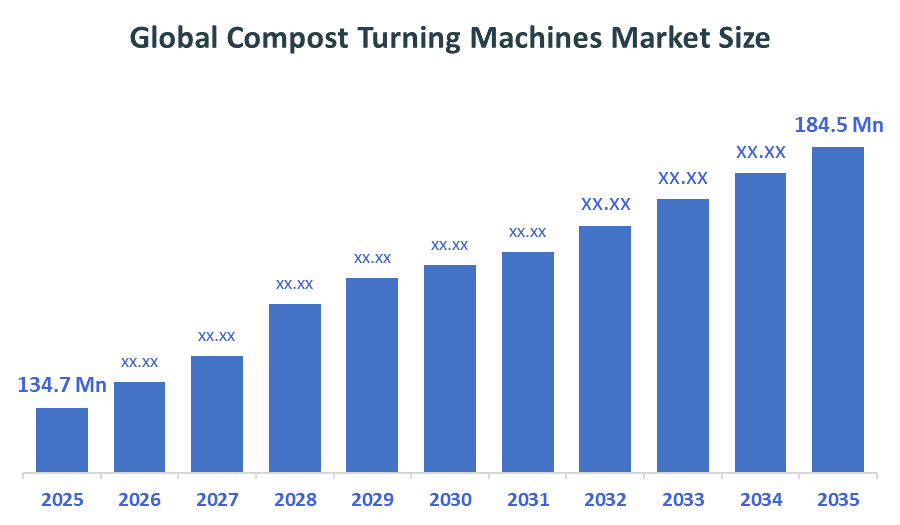
3.2%
REVENUE 2025
USD Million 134.7
FORECAST 2035
USD Million 184.5
REPORT COVERAGE
Global
Market Snapshot
- Market Size (2025): USD 134.7 Million
- Projected Market Size (2035): USD 184.5 Million
- Compound Annual Growth Rate (CAGR): 3.2%
- Largest Regional Market: North America
- Fastest Growing Region: Asia-Pacific
- 3rd Largest Region: Europe
- Base Year: 2025
- Historical Period: 2021–2024
- Forecast Period: 2025–2035
Market Overview/ Introduction
the compost turning machines market includes equipment used to aerate, mix, and accelerate decomposition of organic waste into compost, which agricultural and municipal waste management and industrial composting facilities use for their operations. The machines create better oxygen distribution together with improved moisture spread, which results in a 40-to-60% reduction of composting duration while producing better compost quality together with stable nutrient content. Modern compost turners now include automatic systems together with GPS tracking and sensor-based monitoring technology, which 30 to 35% of new installations use as either semi-automatic or fully automatic systems. The market is currently expanding because of multiple modern developments, which include remote monitoring systems together with engines that provide better fuel efficiency and electric-powered equipment. The demand for effective composting methods worldwide increases because of rising global waste generation, which exceeds 2 billion tons annually, and more stringent environmental regulations, and the increasing implementation of circular economy strategies.
- In 2024–2025, composting equipment manufacturers increasingly introduced automated compost turning machines with IoT-enabled monitoring systems for real-time tracking of temperature, moisture, and airflow
- Government policies promoting waste segregation, organic waste recycling, and composting mandates are significantly driving demand for compost turning machines, particularly in municipal and agricultural waste management applications.
Notable Insights: -
- North America holds the largest regional market share approximately 35% in Global Compost Turning Machines Market.
- Asia Pacific is the fastest growing region in the Global Compost Turning Machines Market with a CAGR of approximately 9%.
- By product type, the elevating face compost turning machines segment held a dominant position with approximately 7% in terms of market share in 2025.
- By capacity, between 500 to 1,000 cubic Mtrs/h segment is the dominating accounting for over 6.5% of the global market share in 2025.
- The compound annual growth rate of the Global Compost Turning Machines Market is 3.2%.
- The market is likely to achieve a valuation of USD 184.5 Million by 2035.
What is role of technology in grooming the market?
Automation together with intelligent monitoring systems are currently reshaping compost turning machines through technological advancements. The machines equipped with IoT technology monitor temperature and moisture content and oxygen levels throughout the composting process to enhance compost quality and maintain consistent results. The implementation of automation technologies enables organizations to decrease their labor expenses by 30 to 35% while achieving higher productivity levels in their large-scale operations. Hybrid and electric machines have become more popular because they achieve emissions reductions of 20 to 25% when compared with diesel-powered systems. The new advanced designs which include self-propelled machines and windrow turners enable faster turning operations and better mixing results together with higher processing capabilities. Modern machines now incorporate both GPS tracking systems and remote monitoring technologies as standard practice. Smart and semi-automated features now appear in approximately 38% of all newly developed machines which leads to increased usage in composting facilities used by municipalities and industrial operations.
Market Drivers
The compost turning machines market exists due to worldwide organic waste production keeps rising while people demand sustainable waste management methods which enable recycling and reduce landfill use and support circular economy systems. Governments throughout the world established strict landfill regulations and waste segregation laws and composting requirements to protect the environment. The rise of organic farming combined with greater understanding of soil health creates higher demand for compost which contains essential nutrients used in agricultural applications. The implementation of smart city initiatives, circular economy practices and municipal waste management programs accelerates the process of adoption. The market expansion receives support from the increasing investments made in waste processing facilities, the partnerships between public and private sectors. The agriculture sector remains the dominant end user, accounting for approximately 50–55% of global demand.
Restrain
The market demonstrates strong growth potential yet encounters multiple obstacles. Developing regions face three main obstacles which include limited awareness, lack of technical expertise, and insufficient waste segregation infrastructure. Price-sensitive markets continue to experience market entry difficulties because of affordable manual composting solutions and established conventional methods. The irregular supply of organic waste together with seasonal changes and transportation difficulties reduces the operational efficiency of machines. The absence of qualified personnel who can operate advanced automated systems creates obstacles for developing countries which want to adopt these technologies.
Competitive Analysis:
The report offers the appropriate analysis of the key organizations/companies involved within the Global Compost Turning Machines Market, along with a comparative evaluation primarily based on their product of offering, business overviews, geographic presence, enterprise strategies, segment market share, and SWOT analysis. The report also provides an elaborative analysis focusing on the current news and developments of the companies, which includes product development, innovations, joint ventures, partnerships, mergers & acquisitions, strategic alliances, and others. This allows for the evaluation of the overall competition within the market.
Top Companies in the Global Compost Turning Machines Market
- Vermeer Corporation
- Komptech GmbH
- Ecoverse Industries
- SCARAB International
- Midwest Bio-Systems
- Brown Bear Corporation
- ALLU Finland Oy
- EZ Machinery
- Terex Corporation
- Eggersmann Group
- Green Mountain Technologies
Government Initiatives
|
Country |
Key Government Initiatives |
|
Europe |
In March 2023, the EU continued implementing Circular Economy Action Plan and Waste Framework Directive (EU 2018/851), strengthening mandatory bio-waste segregation and composting targets, boosting municipal composting infrastructure and compost turning machine adoption across Europe. |
|
US |
In January 2024, the United States implemented stringent landfill diversion mandates and composting incentives at federal and state levels, driving organic waste processing and increasing demand for composting facilities and compost turning machines. |
|
India
|
In October 2025, India’s Solid Waste Management (SWM) Rules (based on the Draft SWM Rules, 2024) strengthen waste segregation requirements and mandate on-site processing of biodegradable waste through composting or bio methanation, thereby promoting composting practices and supporting decentralized waste management systems. |
Study on the Supply, Demand, Distribution, and Market Environment Global Compost Turning Machines Market
The market experiences growth because cities around the world search for sustainable waste management methods to handle their yearly organic waste production which leads to a higher need for effective composting machines used in urban and industrial waste processing facilities. The agriculture sector together with the municipal sector creates demand which accounts for approximately 75% of total market consumption. The European market provides most supply because it has strict environmental regulations and well-established waste treatment facilities while the Asia-Pacific market experiences fast growth through urban development and smart city projects and rising use of mechanized composting technology. The total sales distribution between online platforms and distributor-based sales channels reaches 25 to 30% while B2B procurement through direct channels becomes more common in major municipal and industrial operations. The agricultural industry experiences market growth because of increasing mechanization together with circular economy policies and landfill reduction targets.
Price Analysis and Healthcare Facilities Behaviour Analysis
Basic compost turning machines range from USD 10,000–50,000, while advanced automated and self-propelled machines cost between USD 50,000–150000. The price of industrial windrow turners used in municipal composting facilities starts at USD 200000 and increases with higher capacity and automated systems. The pricing of products depends on their engine type and automation level and working width and sensor integration. The high initial costs of the system lead to system adoption because it provides 30 to 40% operational efficiency gains and decreases the need for human workers and shortens the composting process. Governments are advancing low-emission waste management solutions which has led to increased popularity for fuel-saving and electric waste collection systems that provide both environmental advantages and financial benefits.
Market Segmentation
The Global Compost Turning Machines Market share is classified into solution product type, output capacity, and application
- The elevating face compost turning machines segment dominated the market in 2025, and is projected to grow at a substantial CAGR of approximately 7% during the forecast period.
Based on the product type, the global Compost Turning Machines Market is divided into drum compost turning machines, and elevating face compost turning machines. Among these, the elevating face compost turning machines segment dominated the market in 2025, and is projected to grow at a substantial CAGR of approximately 7% during the forecast period. Elevating face compost turning machines dominate due to their high processing capacity, efficient windrow aeration, and faster decomposition cycles. They are widely used in municipal and industrial facilities, offer better scalability than drum systems, and support large-scale composting with lower operational downtime.
- The Between 500 to 1,000 cubic Mtrs/h segment accounted for the largest share in 2025, and is anticipated to grow at a significant CAGR of approximately 6.5% during the forecast period.
Based on the output capacity, the global Compost Turning Machines Market is divided into Below 500 cubic Mtrs/h, Between 500 to 1,000 cubic Mtrs/h, and more than 1,000 cubic Mtrs/h. Among these, the between 500 to 1,000 cubic Mtrs/h segment accounted for the largest share in 2025, and is anticipated to grow at a significant CAGR of approximately 6.5% during the forecast period. The Between 500 to 1,000 cubic Mtrs/h segment dominates due to its balanced capacity, suitable for medium and large-scale municipal composting operations. It offers efficient throughput, operational flexibility, and cost-effectiveness, making it widely adopted in commercial and industrial waste management facilities globally.
The agriculture segment dominated the market at a CAGR of approximately 7% in 2025, and is projected to grow at a substantial CAGR during the forecast period.
Based on the application, the global compost turning machines market is divided into construction, agriculture, and manufacturing. Among these, the agriculture segment dominated the market at a CAGR of approximately 7% in 2025, and is projected to grow at a substantial CAGR during the forecast period. Agriculture leads due to high demand for nutrient-rich compost to improve soil fertility, increasing adoption of organic farming practices, and strong use of compost turning machines for large-scale farm waste recycling and sustainable crop production.
Strategies to Implement for Growth of the Market in Non-Leading Regions
The compost turning machines market can expand in Latin America, the Middle East, Africa and Southeast Asia through strategies that include developing affordable products and creating localized solutions and implementing educational programs. Local manufacturing and assembly facilities will achieve equipment cost reductions between 20 to 30% which will enable small and medium businesses to access machines. The establishment of partnerships with municipal authorities and agricultural cooperatives and waste management organizations will enhance mechanized composting adoption in areas that currently lack this technology. The government can promote business development through its subsidy program and landfill waste diversion policies and circular economy initiatives. The public will start using organic waste recycling because they understand its positive effects on soil health. The introduction of rental and leasing and financing options will lower initial costs which will lead to increased adoption of compost turning machines across developing nations.
Regional Segment Analysis of the Global Compost Turning Machines Market
- North America (U.S., Canada, Mexico)
- Europe (Germany, France, U.K., Italy, Spain, Rest of Europe)
- Asia-Pacific (China, Japan, India, Rest of APAC)
- South America (Brazil and the Rest of South America)
- The Middle East and Africa (UAE, South Africa, Rest of MEA)
North America is anticipated to hold the largest share approximately 35% of the Global Compost Turning Machines Market over the predicted timeframe. North America leads the compost turning machines market due to strong municipal waste management systems, high organic waste processing capacity, and strict environmental regulations which require composting instead of landfilling. The region widely adopts advanced mechanized composting equipment in agriculture and urban facilities. Government incentives, sustainability goals, and circular economy initiatives further support growth. Large-scale composting plants use automated windrow turners to handle high waste volumes efficiently. The region benefits from technological advancements which enable institutions to invest in established companies that deliver enhanced operational performance and shorter processing durations.
Asia Pacific is expected to grow at a rapid CAGR approximately 9% in the Global Compost Turning Machines Market during the forecast period. The Asia-Pacific region will experience rapid market growth with a compound annual growth rate CAGRE of 9% because Asia Pacific is growing rapidly due to massive urbanization, rising organic waste generation, and expanding agricultural activities across countries like India, China, and Southeast Asia. Governments are promoting composting through strict waste segregation laws and sustainability programs. The region increasingly adopts mechanized and automated compost turning machines in municipal and industrial composting facilities. These systems improve efficiency, reduce labor costs, and accelerate decomposition processes. Growing awareness of soil health, circular economy initiatives, and investments in waste management infrastructure further support strong demand, driving a high CAGR growth rate.
Europe is the 3rd largest region to grow in the Global Compost Turning Machines Market during the region.
Europe ranks as the third-largest region due to strong environmental regulations, circular economy policies, and mandatory bio-waste segregation under EU directives. The municipal and industrial sectors require continuous composting infrastructure because of these policies. Landfill reduction targets and recycling mandates drive the widespread use of compost turning machines. The combination of advanced waste management systems and high automation adoption and government support for sustainable practices creates additional growth opportunities. Europe benefits from established composting facilities and rising green technology investments which create continuous market growth throughout the region.
Future Market Trends Global Compost Turning Machines Market: -
1. Automation & Smart Composting Growth
The market for compost turning machines is currently experiencing a major shift because of increasing demand for two technological advancements which are automatic systems and intelligent monitoring systems. The Internet of Things (IoT) sensors enable continuous monitoring of temperature and oxygen and moisture levels, which results in better compost quality and needs less human work. The implementation of automated windrow turners leads to operational improvements which result in decreased workforce expenses and better composting results for large municipal and industrial composting facilities around the world.
2. Electrification & Low-Emission Machines
The market is shifting toward electric and hybrid compost turning machines to reduce carbon emissions and operational costs. The machines produce less noise, use less fuel, and operate with superior energy efficiency. The government programs which support sustainable development and zero-emission waste management practices have increased their adoption rate especially in urban composting facilities and eco-friendly agriculture projects.
3. Circular Economy & Regulatory Push
The demand for compost turning machines has increased because of two factors which are circular economy policies and strict waste management regulations. Governments worldwide are mandating organic waste diversion from landfills and promoting compost production. The current trend of investing in large-scale composting facilities has created a demand for automated compost turning equipment which has high capacity in both municipal and agricultural applications.
Recent Development
- In March 2024, Komptech GmbH expanded its industrial waste and compost processing line with new high-throughput systems designed for mixed organic and municipal waste, improving uniformity and processing speed in composting operations.
- In June 2023, AAKAAR GREEN LLP introduced compact in-vessel composting machines with automated processing and faster decomposition, supporting decentralized waste management, though categorized under composting equipment rather than compost turning machines.
- In October 2022, Averda International partnered with KAUST to advance sustainable waste management and recycling solutions, supporting circular economy initiatives; however, the collaboration is indirectly related to the compost turning machines market.
- In March 2022, Agnys Waste Management Pvt. Ltd. launched the “BHOOMI” automatic composting machine for efficient organic waste processing, reflecting growing innovation in composting technologies, though it belongs to in-vessel composting rather than compost turning machine equipment.
How is Recent Developments Helping the Market?
The global compost turning machines market experiences substantial market expansion from recent technological progress which brings automated systems and Internet of Things solutions and intelligent waste monitoring equipment. Current machines enable users to monitor real-time changes in temperature, humidity and oxygen concentrations which leads to better compost results and faster decomposition that takes only 40 to 60% of the typical time. The implementation of AI together with sensor technologies enables companies to boost their operational productivity while decreasing their need for human workers by 30%. The period from 2024 to 2025 will bring multiple new technologies which will enhance both autonomous and semi-automated compost turners to handle large waste quantities in municipal and agricultural systems. Government programs which support waste separation and decrease landfill use while advancing circular economy methods are driving faster technology adoption. Electric machines and low-emission equipment help achieve sustainability objectives through their environmental impact reduction capabilities. The combined system improvements result in higher productivity levels while decreasing operational expenses and creating commercial composting facilities that implement the system throughout the world.
Market Segment
This study forecasts revenue at global, regional, and country levels from 2020 to 2035. Decision Advisor has segmented the Global Compost Turning Machines Market based on the below-mentioned segments:
Global Compost Turning Machines Market, By Product Type
- Drum Compost Turning Machines
- Elevating Face Compost Turning Machines
Global Compost Turning Machines Market, By Capacity
- Below 500 cubic Mtrs/h
- Between 500 to 1,000 cubic Mtrs/h
- More than 1,000 cubic Mtrs/h
Global Compost Turning Machines Market, By Application
- Construction
- Agriculture
- Manufacturing
Global Compost Turning Machines Market, By Regional Analysis
- North America
- US
- Canada
- Mexico
- Europe
- Germany
- UK
- France
- Italy
- Spain
- Russia
- Rest of Europe
- Asia Pacific
- China
- Japan
- India
- South Korea
- Australia
- Rest of Asia Pacific
- South America
- Brazil
- Argentina
- Rest of South America
- Middle East & Africa
- UAE
- Saudi Arabia
- Qatar
- South Africa
- Rest of the Middle East & Africa
Frequently Asked Questions (FAQ)
1. How does compost pile geometry affect the performance of compost turning machines?
Compost pile height, width, and density directly influence oxygen flow and heat distribution. Machines are designed with adjustable turning widths to optimize windrow structure, ensuring uniform decomposition and preventing anaerobic zones that slow microbial activity.
2. Can compost turning machines operate effectively with mixed organic and inorganic contamination?
Limited contamination reduces efficiency. Modern machines perform best with pre-segregated organic waste, as plastics or inert materials can damage blades and reduce aeration efficiency, making source segregation a critical performance factor
3. What role does moisture variability play in machine selection?
Regions with high rainfall or variable moisture levels require heavy-duty or sensor-integrated machines. These systems adjust turning frequency to maintain optimal 50–60% moisture levels for faster microbial decomposition.
4. How do compost turning machines impact microbial diversity in composting?
Regular turning improves oxygen penetration, supporting aerobic microbial populations. This enhances thermophilic activity, reduces pathogens, and accelerates organic breakdown, resulting in more stable and nutrient-rich compost.
5. Why do machine performance requirements differ between municipal and agricultural applications?
Municipal systems require high-capacity, continuous operation machines due to large waste volumes, while agricultural systems prioritize mobility, fuel efficiency, and adaptability for seasonal farm residue management.
Check Licence
Choose the plan that fits you best: Single User, Multi-User, or Enterprise solutions tailored for your needs.
We Have You Covered
- 24/7 Analyst Support
- Clients Across the Globe
- Tailored Insights
- Technology Tracking
- Competitive Intelligence
- Custom Research
- Syndicated Market Studies
- Market Overview
- Market Segmentation
- Growth Drivers
- Market Opportunities
- Regulatory Insights
- Innovation & Sustainability
Report Details
| Scope | Global |
| Pages | 245 |
| Delivery | PDF & Excel via Email |
| Language | English |
| Release | Apr 2026 |
| Access | Download from this page |