
Global Congestive Heart Failure Market
 |
Pages:
245
|
Pages:
245
Global Congestive Heart Failure Market Size, Share, By Type (Systolic Heart Failure, Diastolic Failure, Left-Sided Heart Failure, Right-Sided Heart Failure), By Diagnosis (Electrocardiogram, Echocardiogram, MRI, Stress Test, Blood Tests, Cardiac Catheterization, Others), By Route of Administration (Oral, Parenteral, Others), By Distribution Channel (Hospital Pharmacy, Online Pharmacy, Retail Pharmacy), and By Region (North America, Europe, Asia-Pacific, Latin America, Middle East, and Africa), Analysis and Forecast 2025 ? 2035
REPORT COVERAGE
Global
Market Snapshot
- Market Size (2025): USD 21.76 Billion
- Projected Market Size (2035): USD 48.74 Billion
- Compound Annual Growth Rate (CAGR): 8.41%
- Largest Regional Market: North America
- Fastest Growing Region: Asia Pacific
- Base Year: 2025
- Historical Period: 2021–2024
- Forecast Period: 2025–2035
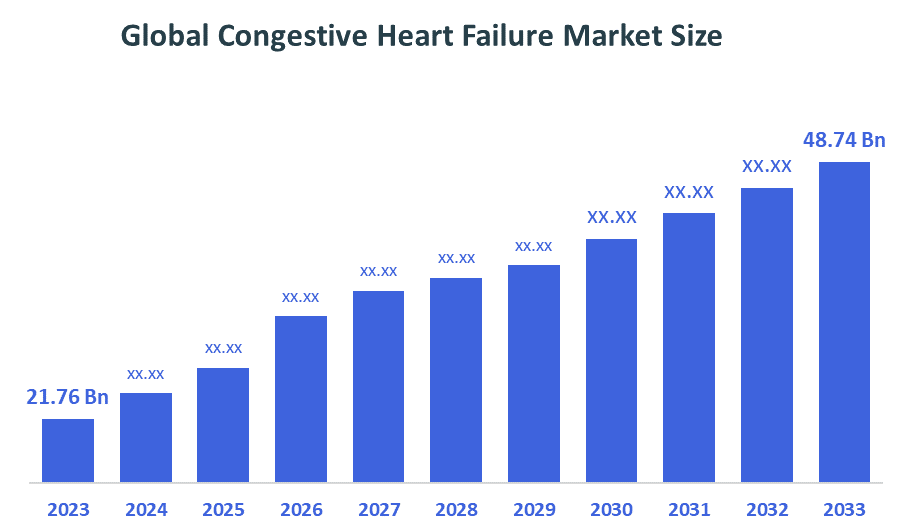
According to Decision Advisors, the Global Congestive Heart Failure Market Size is expected to grow from USD 21.76 billion in 2025 to USD 48.74 billion by 2035, at a CAGR of 8.41% during the forecast period 2025-2035. The global congestive heart failure market is driven by the rising prevalence of coronary artery disease and heart attack worldwide, and emerging markets are the factors responsible for the growth of this market.
Market Overview/ Introduction
The congestive heart failure market refers to the global market for drugs, devices, and therapies used to manage and treat heart failure, a chronic condition where the heart cannot pump blood effectively. The market encompasses pharmaceutical therapies, which include ACE inhibitors, beta-blockers, diuretics and ARNIs, with medical devices that include implantable cardioverter-defibrillators and cardiac resynchronization therapy devices, ventricular assist devices and emerging regenerative treatments. The market also includes diagnostic tools and monitoring technologies that help in early detection and management, while they improve patient outcomes.
The CHF drugs market, which reached a value between USD 7.7 billion and USD 8.8 billion during 2024, will experience substantial market growth between 2030 and 2035 because of increased treatment usage and upcoming product releases. A World Economic Forum report highlights that nearly 32 million people in the Asia Pacific region experience heart failure, which requires smart investments and sustainable financing solutions to reduce hospitalizations and healthcare system demands.
The market size increases because next-generation drug classes, combination treatments and personalized medicine make more treatment options available to patients. The Asia-Pacific region and other developing areas are experiencing rapid healthcare facility expansion, which creates substantial growth opportunities because more people are gaining access to healthcare services and becoming aware of healthcare resources.
- The U.S. Centers for Disease Control and Prevention (CDC) awarded approximately $116 million to state, local, tribal, and health organizations through its Division for Heart Disease and Stroke Prevention during fiscal year 2025 to enhance their efforts in preventing and managing high blood pressure, with other cardiovascular risk factors that lead to heart failure.
- Boston Scientific Corporation announced its acquisition of Baylis Medical Company Inc. through a definitive agreement in October 2021, which included an initial payment of $1.75 billion that would be adjusted according to closing conditions.
Notable Insights: -
- North America holds the largest regional market share, approximately 41.3% in the global Congestive Heart Failure market.
- Asia Pacific is the fastest-growing region in the global Congestive Heart Failure market.
- By diagnosis, the electrocardiogram segment held a dominant position of over 37% in terms of market share in 2025.
- By route of administration, the oral segment is the dominating one, accounting for over 63% of the global market share in 2025.
- The compound annual growth rate of the global Congestive Heart Failure market is 8.41%.
- The market is likely to achieve a valuation of USD 48.74 billion by 2035.
What is role of technology in grooming the market?
Technology is reshaping the global CHF market by enhancing diagnosis, treatment, and patient management. AI-powered diagnostic tools and predictive analytics enable early detection of heart failure, which leads to a 25% reduction in hospitalization rates and superior treatment results. Wearable devices and remote monitoring systems have implemented patient monitoring through implantable cardiac monitors and smart scales, which results in 20 to 30% better treatment compliance. Telemedicine platforms enable access in underserved areas, which will benefit 15 to 20 million additional patients worldwide by 2030. Advanced drug delivery systems use intranasal diuretics and sustained-release ARNI tablets to provide patients with better treatment options and higher outpatient compliance rates. Big data analytics enables pharmaceutical companies to discover promising markets while they optimize their clinical trials and forecast future demand patterns, which results in an annual market growth rate of 8 to 10% in developing regions. The CHF industry achieves sustainable growth through technology, which improves patient results and enables faster market expansion.
Market Drivers
The global congestive heart failure market is propelled by the increase in the number of cardiovascular procedures because of modern medical developments and technological advancements. The percutaneous circulatory support devices provide three benefits because they increase native cardiac output and decrease ventricular size and filling pressure, and maintain vital organ blood flow. The worldwide population of heart failure patients continues to increase because of the aging demographic, which affects millions of people. The rising occurrence of hypertension, diabetes and obesity as comorbid conditions drives the need for CHF treatments. The drug development process receives benefits from technological progress and R&D funding, which creates new treatments and drug formulations that enhance patient care through better awareness and diagnostic methods. The development of healthcare facilities in the Asia-Pacific and developing regions creates better access to medical services, which drives market expansion.
Restrain
The main restraints on the global congestive heart failure market include the high treatment expenses for novel medications and advanced cardiac devices, which create barriers to healthcare access in low- and middle-income countries. The strict requirements for obtaining regulatory approval of new medical treatments and devices create delays that extend the time needed for products to enter the market. The long-term use of diuretics and ARNIs, particularly medications, brings about negative effects which make it difficult for patients to continue their treatment.
Competitive Analysis:
The report offers the appropriate analysis of the key organizations/companies involved within the congestive heart failure market, along with a comparative evaluation primarily based on their product of offering, business overviews, geographic presence, enterprise strategies, segment market share, and SWOT analysis. The report also provides an elaborative analysis focusing on the current news and developments of the companies, which includes product development, innovations, joint ventures, partnerships, mergers & acquisitions, strategic alliances, and others. This allows for the evaluation of the overall competition within the market.
Top Companies in Global Congestive Heart Failure Market
- Novartis AG
- Bayer AG
- Pfizer Inc.
- AstraZeneca PLC
- Johnson & Johnson
- Merck & Co., Inc.
- Abbott Laboratories
- Boehringer Ingelheim GmbH
- Viatris Inc.
- Medtronic PLC
Government Initiatives
|
Country |
Key Government Initiatives |
|
UK |
The UK’s National Heart Failure Programme aims to improve early diagnosis and patient outcomes by strengthening primary care pathways, reducing hospital admissions, and integrating digital tools like remote monitoring apps and virtual wards across NHS services. This initiative emphasizes community?based care and evidence?based treatment to enhance quality of life for heart failure patients and reduce healthcare costs. |
|
Japan |
Japan has prioritized cardiovascular health through the National Plan for Promotion of Measures Against Cerebrovascular and Cardiovascular Disease, which includes heart failure prevention, public awareness, and relapse prevention systems (e.g., Heart Failure Treatment Educator System), aiming to extend healthy life expectancy and improve chronic care) |
|
China |
China’s health reforms and expansion of screening and management programs support early CHF detection, chronic care integration, and access to cardiovascular services, especially in primary care settings. Pilot community?based screening models and public health planning target improved uptake of preventive care and reduce progression to advanced heart failure. |
Market Segmentation
The congestive heart failure market share is classified into type, diagnosis, route of administration and distribution channel.
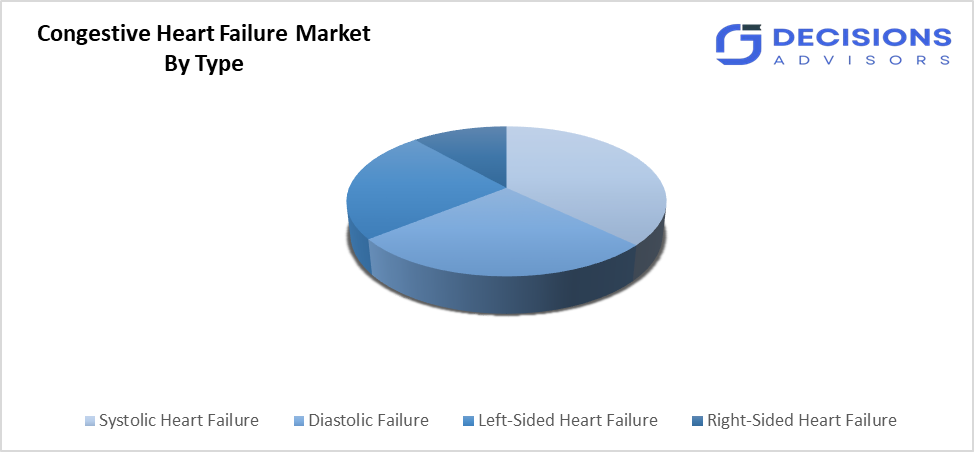
- The systolic heart failure segment dominated the market in 2025, and is projected to grow at a substantial CAGR during the forecast period.
Based on the type, the congestive heart failure market is divided into systolic heart failure, diastolic failure, left-sided heart failure, right-sided heart failure. Among these, the systolic heart failure segment dominated the market in 2025 and is projected to grow at a substantial CAGR during the forecast period. The growth of the segment is driven by the high prevalence among aging populations, which results from well-established diagnostic criteria that enable treatment with guideline-directed medical therapies that include ACE inhibitors, beta-blockers and ARNIs.
- The electrocardiogram segment accounted for the largest share in 2025, and is anticipated to grow at a significant CAGR of approximately 37% during the forecast period.
Based on the diagnosis, the congestive heart failure market is divided into electrocardiogram, echocardiogram, MRI, stress test, blood tests, cardiac catheterization, others. Among these, the electrocardiogram segment accounted for the largest share in 2025 and is anticipated to grow at a significant CAGR of approximately 37% during the forecast period. The segmental growth is driven by the broad accessibility of ECG systems together with their affordable pricing and their ability to detect heart problems without surgery, and their rapid testing results make them essential tools for primary cardiac assessment. The primary diagnostic method for detecting heart rhythm and electrical activity disorders relies on ECG systems, as they function as crucial initial diagnostic devices.
- The oral segment dominated the market in 2025, and is projected to grow at a substantial CAGR of approximately 63% during the forecast period.
Based on the route of administration, the congestive heart failure market is divided into oral, parenteral, others. Among these, the oral segment dominated the market in 2025 and is projected to grow at a substantial CAGR of approximately 63% during the forecast period. The market growth is driven by the oral medications provide an easy-to-use and affordable solution that doctors recommend for patients who need extended treatment outside of hospitals. The oral therapies of this treatment include tablets and capsules which contain ARNIs (e.g. Entresto), beta-blockers, ACE inhibitors and SGLT2 inhibitors.
- The hospital pharmacy segment dominated the market in 2025, and is projected to grow at a substantial CAGR during the forecast period.
Based on the distribution channel, the congestive heart failure market is divided into hospital pharmacy, online pharmacy, retail pharmacy. Among these, the hospital pharmacy segment dominated the market in 2025 and is projected to grow at a substantial CAGR during the forecast period. The segmental growth is due to the system generating its prescription output through its direct links to both inpatient and outpatient medical facilities, which work with healthcare providers. The system generates its highest revenue through its specialized treatment services, which include both congestive heart failure therapy and other expensive medical treatments.
Regional Segment Analysis of the Congestive Heart Failure Market
- North America (U.S., Canada, Mexico)
- Europe (Germany, France, U.K., Italy, Spain, Rest of Europe)
- Asia-Pacific (China, Japan, India, Rest of APAC)
- South America (Brazil and the Rest of South America)
- The Middle East and Africa (UAE, South Africa, Rest of MEA)
North America is anticipated to hold the largest share of the congestive heart failure market over the predicted timeframe.
North America is anticipated to hold the largest share of the Congestive Heart Failure market over the predicted timeframe. This market is accounting about approximately 41.3% of the total market share. North America dominates the market due to the healthcare system in this region, which functions through its established medical facilities, which provide advanced treatment options while supporting ongoing research efforts. The market expansion received substantial support from major pharmaceutical and biotechnology companies, which include Pfizer, Merck and Johnson & Johnson, as their presence in the area strengthened commercial operations. Bayer submitted a request to the USFDA in January 2025 for approval to use its drug KERENDIA as a treatment option for patients with heart failure who have a left ventricular ejection rate between 40% and 100% in the United States. The US Food and Drug Administration (FDA) approved in 2025 for bumetanide nasal spray (Enbumyst) to treat edema that occurs in patients with congestive heart failure (CHF), liver disease and chronic kidney disease (CKD).
Asia Pacific is expected to grow at a rapid CAGR in the congestive heart failure market during the forecast period. The Asia Pacific region is expected to exhibit the fastest growth in the global congestive heart failure market, with 35.2% in 2025. This growth can be attributed to several factors, including the rising prevalence of cardiovascular diseases, increasing healthcare expenditure, and growing awareness about early diagnosis and treatment. Countries like China and India have emerged as significant players in the market, driven by large patient populations and a growing middle class with increased disposable income. Additionally, government initiatives to improve healthcare access and affordability have further fueled the market growth in the region. In August, Lupin Digital Health, a leading cardiac digital therapeutics company in India, announced the launch of its latest innovation, the Lyfe Digital Heart Failure Clinic.
Strategies to Implement for Growth of the Market in Non-Leading Regions
Strategies to grow the Congestive Heart Failure market in non-leading regions should focus on improving access, awareness, and affordability. The local market needs to develop product requirements that will help their business growth. Companies need to use localized marketing together with targeted promotions and strategic partnerships to drive market growth in non-leading regions. Region-specific campaigns lead to brand awareness increases between 25 and 30%. The distribution network expansion, which includes 15 to 20 new retail outlets per region, will make products more accessible to customers. The introduction of low-cost product options designed for local markets has resulted in a 12% increase in customer adoption in similar markets. Social media and mobile app digital engagement enable companies to access 40% of their previously untapped customer base. The organization uses continuous data analysis to ensure its resource allocation supports areas with high potential, which leads to sustainable growth.
Future Market Trends in Global Congestive Heart Failure Market: -
1. Shift Toward Personalized & Novel Therapies
There’s a growing trend toward combination drug therapies and novel classes such as SGLT2 inhibitors and ARNIs, improving outcomes and reducing hospitalization rates. Advances in research are expected to bring pipeline therapies like RNA?based and gene therapies into clinical practice, expanding therapeutic options.
2. Device Innovation & Remote Monitoring
The CHF treatment devices market is also expanding, forecast to grow from ~USD?5.6?billion in 2024 to more than USD?8.2?billion by 2030 (~6.7% CAGR), driven by ventricular assist devices and implantable cardioverter defibrillators. Remote patient monitoring technologies and telehealth are gaining importance, enabling earlier intervention and better chronic disease management.
3. Diagnosis & Early Intervention Trends
Increasing emphasis on early diagnosis through advanced imaging, biomarker testing, and AI?assisted tools is expected to shift the market toward preventive and personalized care approaches, improving treatment efficacy and quality of life.
Recent Development
In January 2025, Viatris Inc. announced the launch of its heart failure treatment Inpefa (sotagliflozin) in the United Arab Emirates, marking the first commercialization of the drug within Viatris territories outside the United States.
In January 2025, Global pharma major Lupin Limited announced that it had received approval from the United States Food and Drug Administration (U.S.FDA) for its Abbreviated New Drug Application (ANDA), Sacubitril and Valsartan Tablets.
In March 2024, Analog Devices, Inc. announced U.S. Food and Drug Administration (FDA) 510(k) clearance and the commercial launch of the Sensinelb Cardiopulmonary Management (CPM) System. The compact wearable device is a non-invasive, remote management system that captures cardiopulmonary measurements for chronic disease management, such as heart failure.
How is Recent Developments Helping the Market?
Recent developments are significantly driving growth and innovation in the congestive heart failure market. The CHF market receives substantial improvements through recent product launches and regulatory approvals, which increase available treatment options while delivering better results for patients. Viatris introduced Inpefa as the first dual SGLT1/2 heart failure inhibitor, which now operates in the UAE with plans to extend its distribution throughout the region to decrease hospital admissions and cardiovascular death rates. The FDA has given approval to ENBUMYST, which serves as the first intranasal diuretic for treating oedema linked to CHF and provides patients with an efficient outpatient treatment option. The Philips AI-powered cardiac MRI solutions lead to better diagnostic imaging procedures, which enable doctors to discover and manage CHF cases with greater accuracy. The existence of more than 25 CHF therapies in clinical development demonstrates that research and development activities continue to progress, which will enable companies to create solutions for unmet needs to drive their future expansion.
Market Segment
This study forecasts revenue at global, regional, and country levels from 2020 to 2035. Decision Advisors has segmented the congestive heart failure market based on the below-mentioned segments:
Global Congestive Heart Failure Market, By Type
- Systolic Heart Failure
- Diastolic Failure
- Left-Sided Heart Failure
- Right-Sided Heart Failure
Global Congestive Heart Failure Market, By Diagnosis
- Electrocardiogram
- Echocardiogram
- MRI
- Stress Test
- Blood Tests
- Cardiac Catheterization
- Others
Global Congestive Heart Failure Market, By Route of Administration
- Oral
- Parenteral
- Others
Global Congestive Heart Failure Market, By Distribution Channel
- Hospital Pharmacy
- Online Pharmacy
- Retail Pharmacy
Global Congestive Heart Failure Market, By Regional Analysis
- North America
- US
- Canada
- Mexico
- Europe
- Germany
- UK
- France
- Italy
- Spain
- Russia
- Rest of Europe
- Asia Pacific
- China
- Japan
- India
- South Korea
- Australia
- Rest of Asia Pacific
- South America
- Brazil
- Argentina
- Rest of South America
- Middle East & Africa
- UAE
- Saudi Arabia
- Qatar
- South Africa
- Rest of the Middle East & Africa
Frequently Asked Questions (FAQ)
Q: Which therapies are most common?
A: Common therapies include ACE inhibitors, ARNIs, beta-blockers, diuretics, SGLT2 inhibitors, and combination drug regimens, alongside implantable cardioverter-defibrillators (ICDs), pacemakers, and ventricular assist devices (VADs)
Q: How do devices impact the market?
A: Devices such as ICDs, pacemakers, and VADs improve survival, reduce hospitalizations, and enhance patient quality of life. Adoption of advanced monitoring technologies supports better CHF management, boosting market growth.
Q: What role does technology play?
A: Telemedicine, AI diagnostics, remote monitoring, and digital health platforms improve early detection, treatment adherence, and patient engagement, expanding reach and efficiency in CHF management
Q: How does patient awareness impact growth?
A: Greater awareness reduces delayed diagnosis, encourages treatment adherence, and expands the addressable market, particularly in emerging regions where stigma or knowledge gaps exist.
Q: What are emerging trends?
A: Emerging trends include non-hormonal therapies for comorbidities, telehealth adoption, AI-assisted diagnostics, remote patient monitoring, and personalized medicine approaches.
Q: How do government initiatives help?
A: Funding for prevention programs, public awareness campaigns, and healthcare policy reforms improve early diagnosis and management, indir
Check Licence
Choose the plan that fits you best: Single User, Multi-User, or Enterprise solutions tailored for your needs.
We Have You Covered
- 24/7 Analyst Support
- Clients Across the Globe
- Tailored Insights
- Technology Tracking
- Competitive Intelligence
- Custom Research
- Syndicated Market Studies
- Market Overview
- Market Segmentation
- Growth Drivers
- Market Opportunities
- Regulatory Insights
- Innovation & Sustainability
Report Details
| Scope | Global |
| Pages | 245 |
| Delivery | PDF & Excel via Email |
| Language | English |
| Release | Mar 2026 |
| Access | Download from this page |