
Global Contact Image Sensors Market
 |
Author:
Shruti G
|
Pages:
190
|
Author:
Shruti G
|
Pages:
190
Global Contact Image Sensors Market Size, Share By Product Type (Monochrome CIS, Color CIS), By Technology (CMOS-Based CIS, LED-Based CIS), By Application (Scanners, Printers, Barcode Readers, Document Imaging, Others), and By Region (North America, Europe, Asia-Pacific, Latin America, Middle East & Africa), Analysis and Forecast 2026-2035.
CAGR
9.6%
REVENUE 2025
USD Billion 1.4
FORECAST 2035
USD Billion 3.5
REPORT COVERAGE
Global
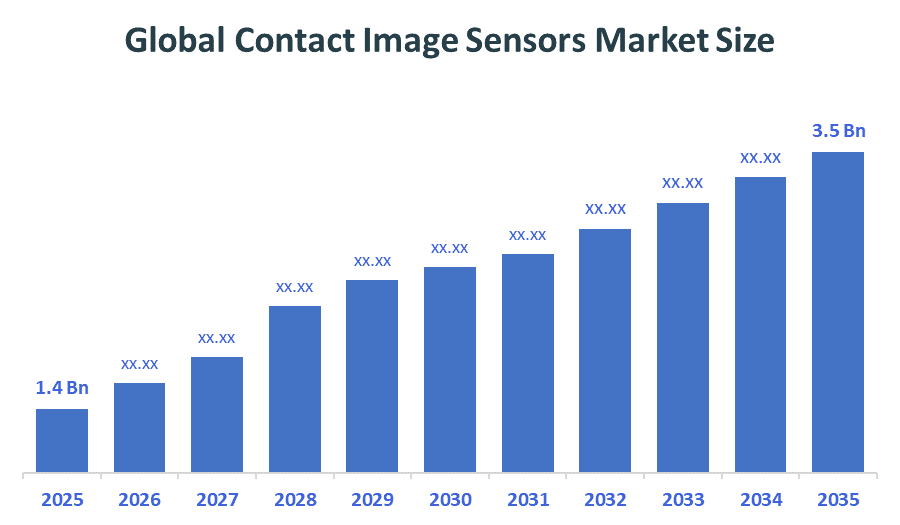
The Global Contact Image Sensors Market Size is predicted to grow from USD 1.4 Billion in 2025 and is likely to reach around USD 3.5 Billion by 2035 with a CAGR of 9.6%. According to Decision Advisors, a detailed research report on the market reflects that the Compact imaging solutions trend dominates the Global Contact Image Sensors Market, accounting for approximately 46% of the total share worldwide. Canon Inc. leads the market with approximately annual revenue of USD 3.45 billion and approx 15- 16% global market share, making it the key contributor to global market development and growth dynamics.
Market Snapshot
- Global Contact Image Sensors Market Size (2025): USD 1.4 Billion
- Projected Global Contact Image Sensors Market Size (2035): USD 3.5 Billion
- Global Contact Image Sensors Market Compound Annual Growth Rate (CAGR): 9.6%
- Largest Regional Market: Asia Pacific
- 2nd Largest Region: North America
- Fastest Growing Region: Europe
- Base Year: 2025
- Historical Period: 2021-2024
- Market Forecast Period: 2026-2035
Market Overview/ Introduction
The Global Contact Image Sensors Market refers to the industry focused on manufacturing compact optical sensing devices used for image scanning and document capture in printers, scanners, barcode readers, and multifunction devices. These sensors provide high-resolution imaging with low power consumption and compact design. Governments are supporting digital transformation initiatives, paperless workflows, and smart office infrastructure, boosting demand for CIS-based imaging devices. Leading companies are investing in advanced CMOS technology, miniaturization, AI-based image processing, and energy-efficient designs to enhance performance and reduce device footprint. Key advantages include lightweight design, lower cost, high-speed scanning, and reduced power usage. Future growth is driven by increasing demand for document digitization, e-commerce logistics scanning, office automation, and smart retail systems globally through 2035.
Notable Insights: -
- Asia Pacific is anticipated to hold approximately 38% share of the Global Contact Image Sensors Market over the predicted timeframe.
- North America is expected to grow at a rapid CAGR in the Global Contact Image Sensors Market by holding approximately 27% of the share during the forecast period.
- By product type, the monochrome CSI segment dominated the market and holds approximately 54% share in 2025 and is projected to grow at a substantial CAGR during the forecast period.
- By technology, the CMOS-based segment dominated the market and holds approximately 61 share in 2025 and is projected to grow at a substantial CAGR during the forecast period.
- The compound annual growth rate of the Global Contact Image Sensors Market is 9.6%.
- The market is likely to achieve a valuation of USD 3.5 Billion by 2035.
What is the role of technology in grooming the market?
Technology plays a critical role in accelerating growth in the Global Contact Image Sensors Market by enhancing performance, efficiency, and application versatility. Advancements in CMOS imaging and LED illumination systems enable high-resolution output with faster scanning speeds, improving accuracy and productivity in document processing. Integration of AI-driven image enhancement and edge computing allows real-time processing within devices, reducing latency and operational dependency on external systems. Energy-efficient designs help lower power consumption, making CIS ideal for portable and multifunction devices. Additionally, continuous miniaturization supports compact product development, expanding adoption across offices, retail, banking, and logistics sectors worldwide.
Market Drivers
The Global Contact Image Sensors Market is driven by increasing demand for document digitization and the transition toward paperless office environments across enterprises and government sectors. The growing use of multifunction printers and scanners is significantly boosting CIS adoption due to their compact size and energy efficiency. Rapid expansion of e-commerce is driving demand for barcode readers and logistics scanning systems. Additionally, retail automation and POS systems are increasing the need for efficient imaging solutions. The banking sector is also contributing through identity verification and document processing applications. Overall, rising preference for compact, low-power, and cost-effective imaging technologies continues to accelerate market growth globally.
Restrain
The market faces challenges from high competition from CCD sensors in premium applications, limitations in depth-of-field performance, pricing pressure, and rapid technological obsolescence.
Competitive Analysis:
The report offers the appropriate analysis of the key organizations/companies involved within the Global Contact Image Sensors Market along with a comparative evaluation primarily based on their product offerings, business overviews, geographic presence, enterprise strategies, segment market share, and SWOT analysis. The report also provides an elaborative analysis focusing on the current news and developments of the companies, which includes product development, innovations, joint ventures, partnerships, mergers & acquisitions, strategic alliances, and others. This allows for the evaluation of the overall competition within the market.
Top Companies in the Global Contact Image Sensors Market
- Canon Inc.
- Seiko Epson Corporation
- ROHM Semiconductor
- Mitsubishi Electric Corporation
- Hamamatsu Photonics
- Fujitsu Limited
- Toshiba Corporation
- On Semiconductor
- Samsung Electronics
- Sony Corporation
Government Initiatives
|
Country |
Key Government Initiatives |
|
US |
Digital transformation and smart office initiatives are driving adoption of scanners and multifunction devices, increasing demand for contact image sensors used in document imaging, workflow automation, and enterprise data digitization systems. |
|
China |
A strong electronics manufacturing ecosystem supports large-scale production of contact image sensors, enabling cost efficiency, innovation, and widespread adoption across printers, scanners, and barcode systems globally. |
|
India |
Digital India and e-governance initiatives are accelerating document digitization across public and private sectors, increasing demand for scanning devices and boosting adoption of contact image sensors in administrative workflows. |
Study on the Supply, Demand, Distribution, and Market Environment of the Global Contact Image Sensors Market
The Global Contact Image Sensors Market demonstrates steady growth across supply, demand, distribution, and overall market environment. Supply is supported by semiconductor manufacturers and OEMs producing compact CIS modules for integration into scanners, printers, and barcode devices. Demand is primarily driven by office automation, document digitization, retail scanning systems, and logistics operations. Distribution channels include OEM partnerships, electronics distributors, and direct enterprise sales. The market environment is shaped by rapid digitization, advancements in CMOS imaging technology, and increasing adoption of energy-efficient devices. Additionally, growing demand for compact, high-speed, and cost-effective imaging solutions continues to strengthen overall market expansion globally.
Price Analysis and Consumer Behaviour Analysis
The Global Contact Image Sensors Market is influenced by pricing dynamics and evolving consumer preferences. CIS devices are typically 25% more cost-effective than CCD alternatives, making them highly attractive for cost-sensitive applications such as office equipment and retail scanning systems. Around 65% of buyers prioritize compact design, low power consumption, and operational efficiency over premium imaging features. Asia Pacific dominates consumption due to strong electronics manufacturing and large-scale device production. Buyers increasingly prefer reliable brands that offer consistent performance, easy integration, and long-term durability. Growing demand for affordable, energy-efficient, and compact imaging solutions continues to shape purchasing behavior globally.
Market Segmentation
The Global Contact Image Sensors Market share is classified into product type, technology, and application.
- The monochrome CIS segment dominated the market and holds approximately 54% share in 2025 and is projected to grow at a substantial CAGR during the forecast period.
Based on the product type, the market is divided into monochrome CIS and color CIS. Among these, the monochrome CIS segment dominated the market due to its cost efficiency, faster processing speed, and suitability for standard document scanning applications. It is widely used in office scanners, barcode readers, and document processing systems. Its ability to deliver clear text-based imaging with lower power consumption makes it highly preferred across commercial and industrial sectors globally.
- The CMOS-based CIS segment accounted for the largest share of approximately 61% in 2025 and is anticipated to grow at a significant CAGR during the forecast period.
Based on the technology, the market is divided into CMOS-based CIS and LED-based CIS. Among these, CMOS-based CIS dominates due to its low power consumption, compact integration capability, and high-speed data processing. It is extensively used in multifunction printers, portable scanners, and imaging devices. Rising demand for energy-efficient and compact imaging solutions across offices and retail environments further supports segment growth worldwide.
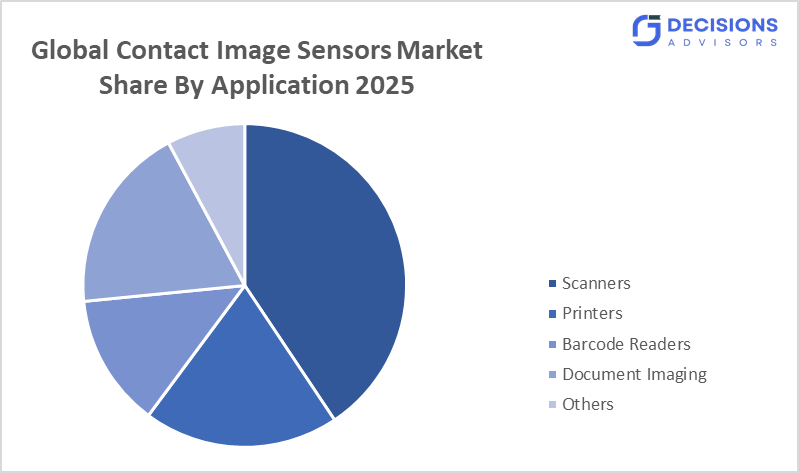
- The scanners segment accounted for the largest share of approximately 35% in 2025 and is expected to grow at a significant CAGR during the forecast period.
Based on the application, the market is segmented into scanners, printers, barcode readers, document imaging, and others. Among these, scanners dominate due to extensive use of contact image sensors in document digitization, office automation, and enterprise workflow systems. Increasing demand for paperless operations, digital record management, and high-speed scanning solutions continues to make scanners the leading application segment globally.
Strategies to Implement for Growth of the Market in Non-Leading Regions
To accelerate growth of the Global Contact Image Sensors Market in non-leading regions, companies should focus on expanding local manufacturing and strengthening distribution networks to reduce costs and improve accessibility. Offering cost-effective and application-specific CIS modules for small and medium enterprises can enhance adoption. Strategic partnerships with OEMs, system integrators, and government-led digital initiatives will improve market penetration. Investing in aftersales services, technical support, and training programs can build customer trust and ensure proper product utilization. Additionally, developing region-specific solutions tailored for retail, banking, and logistics sectors will further support sustained demand and long-term market expansion globally.
Regional Segment Analysis of the Global Contact Image Sensors Market
- North America (U.S., Canada, Mexico)?
- Europe (Germany, France, U.K., Italy, Spain, Rest of Europe)
- Asia-Pacific (China, Japan, India, Rest of APAC)
- South America (Brazil and the Rest of South America)?
- The Middle East and Africa (UAE, South Africa, Rest of MEA)
Asia Pacific is anticipated to hold approximately 38% share of the Global Contact Image Sensors Market over the predicted timeframe.
Asia Pacific holds approximately 38% share of the Global Contact Image Sensors Market, driven by strong electronics manufacturing capabilities and high demand for printers, scanners, and barcode devices. Countries such as China, Japan, and India are leading growth due to expanding industrialization and rapid adoption of office automation technologies. The region benefits from cost-effective production, large-scale semiconductor manufacturing, and increasing investments in digital infrastructure. Rising e-commerce activities and logistics operations further boost demand for scanning solutions. Additionally, government-led digitization initiatives and growing use of multifunction devices continue to strengthen Asia Pacific’s dominant position in the global market.
North America is expected to grow at a rapid CAGR in the Global Contact Image Sensors Market, holding approximately 27% of the share during the forecast period
North America holds approximately 27% share of the Global Contact Image Sensors Market, driven by strong adoption of advanced office automation systems and digital workflows across enterprises. The region benefits from high demand for multifunction printers, scanners, and barcode imaging devices in sectors such as retail, banking, healthcare, and logistics. The presence of established technology companies and early adoption of innovative imaging solutions further supports market growth. Increasing investments in digital transformation, cloud-based document management, and smart retail infrastructure are accelerating demand. Additionally, a strong focus on efficiency, accuracy, and automation continues to reinforce North America’s position in the global market.
Europe is the fastest-growing region in the Global Contact Image Sensors Market during the period, holding approximately 24% share.
Europe holds approximately 24% share of the Global Contact Image Sensors Market and is the fastest-growing region. Growth is driven by strong emphasis on sustainability, paperless operations, and increasing enterprise digitization across countries such as Germany, France, and the UK. Rising adoption of advanced office automation systems, multifunction printers, and document scanning solutions is supporting market expansion. Additionally, strict environmental regulations and energy-efficiency standards are encouraging the use of low-power CIS technologies. Continuous investments in smart infrastructure and digital transformation initiatives further strengthen Europe’s growth trajectory in the global market.
Future Market Trends in Global Contact Image Sensors Market: - ???????
- Development of ultra-compact CIS modules
Manufacturers are focusing on designing ultra-compact contact image sensor modules that reduce device size while maintaining performance. These modules enable slimmer scanners and printers, improve portability, and support integration into multifunction and handheld devices, increasing usability across office, retail, and industrial applications globally.
- Integration of AI-based image enhancement
AI-based image enhancement is improving scanning accuracy by automatically correcting distortions, noise, and brightness levels in real time. This technology enhances document clarity, speeds up processing, and reduces manual intervention, making CIS solutions more efficient for applications in banking, logistics, and enterprise document management systems.
- Increasing demand in e-commerce logistics scanning
Rapid growth of e-commerce is driving demand for barcode scanners and package tracking systems using CIS technology. High shipment volumes require fast and accurate scanning solutions, enabling efficient inventory management, order tracking, and warehouse automation across global logistics and supply chain operations.
- Growth in smart retail and POS systems
Smart retail and POS systems increasingly rely on CIS-based barcode and document scanning for fast transactions and inventory tracking. Retailers are adopting automated checkout, digital billing, and real-time stock management systems, boosting demand for compact, efficient, and reliable contact image sensors worldwide.
- Expansion in mobile and portable scanning devices
The rising need for on-the-go document capture is driving adoption of mobile and portable scanning devices using CIS technology. These lightweight devices are widely used in field services, banking, healthcare, and logistics, offering flexibility, quick data capture, and improved operational efficiency in remote environments.
Recent Development
- In May 2025, Canon Inc. enhanced its contact image sensor technology for high-speed document scanners, improving image clarity, processing speed, and efficiency in enterprise and industrial imaging applications.
- In November 2024, ROHM Semiconductor advanced compact CMOS-based CIS solutions, focusing on improved integration, low power consumption, and performance optimization for barcode readers and portable scanning devices.
- In February 2025, Seiko Epson Corporation strengthened its energy-efficient printing and scanning technologies by optimizing CIS modules for multifunction devices, supporting reduced power usage and enhanced operational efficiency.
How is Recent Developments Helping the Market?
Recent developments in the Global Contact Image Sensors Market are significantly enhancing performance, efficiency, and application scope across industries. Improvements in CMOS technology and LED illumination are delivering higher image resolution and faster scanning speeds while reducing power consumption. Integration of AI-based image enhancement is enabling real-time processing and improved accuracy in document capture. These advancements support compact device design, making CIS ideal for multifunction printers, portable scanners, and retail systems. Increasing adoption in sectors such as banking, logistics, and office automation is driving demand. Overall, these innovations are strengthening product capabilities, reducing operational costs, and supporting long-term market expansion globally.
Market Segment
This study forecasts revenue at global, regional, and country levels from 2020 to 2035. Decision Advisors has segmented the Global Contact Image Sensors Market based on the below-mentioned segments:
Global Contact Image Sensors Market, By Product Type
- Monochrome CIS
- Color CIS
Global Contact Image Sensors Market, By Material Type
- CMOS-Based CIS
- LED-Based CIS
Global Contact Image Sensors Market, By Application
- Scanners
- Printers
- Barcode Readers
- Document Imaging
- Others
Global Carbon Brush Market, By Regional Analysis
- North America
- US
- Canada
- Mexico
- Europe
- Germany
- UK
- France
- Italy
- Spain
- Russia
- Rest of Europe
- Asia Pacific
- China
- Japan
- India
- South Korea
- Australia
- Rest of Asia Pacific
- South America
- Brazil
- Argentina
- Rest of South America
- Middle East & Africa
- UAE
- Saudi Arabia
- Qatar
- South Africa
- Rest of the Middle East & Africa
Frequently Asked Questions (FAQ)
Q. How does sensor calibration impact CIS performance in real-world applications?
A. Accurate calibration ensures consistent brightness, color uniformity, and image clarity across scans. Poor calibration can cause distortions and uneven output. Advanced calibration techniques improve reliability, especially in high-volume environments like banking, logistics, and industrial document processing systems.
Q. What role does heat management play in CIS device longevity?
A. Effective thermal management prevents overheating, which can degrade sensor accuracy and lifespan. Efficient heat dissipation designs improve durability, maintain performance stability, and reduce failure rates, particularly in continuous-use devices such as enterprise scanners and high-speed printing systems.
Q. How does CIS integration affect device design flexibility?
A. CIS enables compact and lightweight device designs due to its slim structure and low power requirements. This allows manufacturers to develop portable, multifunction, and space-saving products, enhancing usability across industries such as retail, healthcare, and field operations.
Q. What are the key challenges in scaling CIS production globally?
A. Scaling production requires managing semiconductor supply chains, maintaining quality consistency, and addressing cost pressures. Manufacturers must balance innovation with affordability while ensuring compatibility with evolving imaging standards and meeting increasing global demand across multiple industries.
Q. How does CIS technology support sustainability goals?
A. CIS consumes less power and requires fewer materials compared to traditional imaging technologies. This reduces energy consumption and environmental impact. Additionally, compact designs contribute to lower resource usage and support eco-friendly manufacturing and operational practices.
Check Licence
Choose the plan that fits you best: Single User, Multi-User, or Enterprise solutions tailored for your needs.
We Have You Covered
- 24/7 Analyst Support
- Clients Across the Globe
- Tailored Insights
- Technology Tracking
- Competitive Intelligence
- Custom Research
- Syndicated Market Studies
- Market Overview
- Market Segmentation
- Growth Drivers
- Market Opportunities
- Regulatory Insights
- Innovation & Sustainability
Report Details
| Scope | Global |
| Pages | 190 |
| Delivery | PDF & Excel via Email |
| Language | English |
| Release | May 2026 |
| Access | Download from this page |