
Global Cooling Management System Market
 |
Author:
Pranali P
|
Pages:
210
|
Author:
Pranali P
|
Pages:
210
Global Cooling Management System Market Size, Share, By Cooling Type (Air Cooling, Liquid Cooling, and Hybrid Cooling Systems) By Deployment Type (On-Premises and Cloud-Based Systems) By Application (Data Centers, Industrial Equipment Cooling, Automotive Thermal Management, Consumer Electronics Cooling, and Healthcare Equipment Cooling) By End User (IT and Telecom, Manufacturing, Automotive, Healthcare, and Commercial Infrastructure) and By Region (North America, Europe, Asia-Pacific, Latin America, Middle East and Africa), Analysis and Forecast 2026-2035
CAGR
12.07%
REVENUE 2025
USD Billion 3.66
FORECAST 2035
USD Billion 11.43
REPORT COVERAGE
Global
Market Snapshot
- Global Cooling Management System Market Size (2025): USD 3.657.40 Million
- Global Cooling Management System Projected Market Size (2035): USD 11.427.28 Million
- Global Cooling Management System Compound Annual Growth Rate (CAGR): 12.07%
- Largest Regional Market: Asia-Pacific
- Fastest Growing Region: North America
- 3rd Largest Region: Europe
- Base Year: 2025
- Historical Period: 2021 to 2024
- Forecast Period: 2026 to 2035
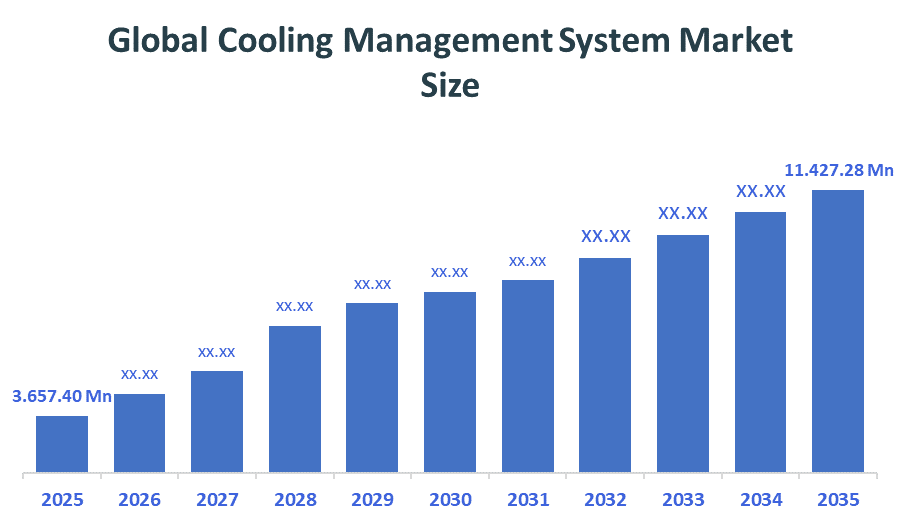
According to Decision Advisors, the global cooling management system market size was expected to grow from USD 3.657.40 Million in 2025 to USD 11.427.28 Million by 2035, with a CAGR of 12.07% during the forecast period from 2026 to 2035. Cooling system solutions have been growing at a steady rate, as there is an increasing need for these kinds of solutions among data centers and industries. The cooling process consumes about 40% of the power consumption in data centers, and that is why better solutions have been sought after. liquid cooling solutions and AI-based solutions for monitoring are being developed to reduce costs and improve reliability.
Market Overview / Introduction
The cooling management systems are an array of thermal management systems that work towards instant heat dispersal for electronic, manufacturing, and automotive parts. The cooling management systems serve as a vital intermediate phase between air ventilation and liquid cooling systems, using modern heat exchanger technology and fluid dynamics for rapid cooling with minimal energy consumption. Modern cooling management systems possess features such as dielectric fluid compatibility and micro-channel cold plates to ensure consistent performance levels while lowering the possibility of hardware damage. The cooling management systems were formerly basic fan designs but have been upgraded into fully autonomous thermal management systems with reliability ratings, energy savings technology, and integration within industrial internet of things environments. The increased adoption of cooling management systems is attributed to the rise in demand for sustainable data processing and heat management in hyperscale clouds and manufacturing plants. Cooling management systems help protect hardware assets against failures and other forms of physical damage due to their ability to maintain a stable environment without the use of older, more carbon-intensive refrigeration systems.
- The data center and telecommunications segments contribute to approximately 65% of the application-based use in the market, driven by the increasing demand for server rack cooling, 5G infrastructure maintenance, and the safeguarding of essential digital utility hubs.
- Automated thermal protection technology in the automotive sector is experiencing substantial growth, with a CAGR forecasted to surpass 11% on account of the increasing adoption of battery thermal management systems as part of the advanced generation of electric vehicles for providing optimized safety to large-scale battery packs and high-power charging stations.
Notable Insights: -
- Liquid cooling modules make up about 46.8% of the total market share of this sector. They have gained a reputation in high-performance computing operations, particularly in supercomputers, research laboratories, and heavy industrial processing units.
- About 72.5% of all installations occur in corporate data centers and industrial facilities. These investments are stimulated mainly by high levels of investment into digital transformation projects and green energy initiatives because many industries experience heat-driven performance bottlenecks that result in the downtime of critical services.
- Applications of cooling management in the sphere of renewable energy storage account for almost 41.3% of all demand. The rapid development of smart grids, alongside increased worries about battery overheating in stationary storage systems, has become one of the main drivers of using these advanced systems.
- About 48.6% of the market value belongs to the Asia-Pacific region in 2026. Many countries within this region, like China and India, invest considerable amounts of money in semiconductor manufacturing and digital infrastructure in order to address the growing needs of their expanding tech sectors.
- Precision cooling systems show an annual increase above 6.9%. The rise in edge computing and frequent occurrences of local hardware densification create the conditions that encourage enterprises to invest more money in modular cooling management solutions.
What is the Role of Technology in Shaping the Market?
Technological progress is making some groundbreaking modifications within the thermal management industry with respect to heat transfer efficiency, size efficiency, and automation of operations. The present generation of thermal management platforms has ceased to be simple heat sinks, but now they are complex fluid and air flow management platforms capable of self-operation for prolonged periods of time owing to their capacity to utilize non-corrosive materials, advanced thermal management components, and diagnostic network integration capability.
How are Recent Developments Helping the Market?
These innovations include the implementation of AI-integrated coolant flow control systems, the incorporation of advanced phase change material performance, and passive thermosyphon-based activation systems. These innovations have significantly aided in promoting development and growth within the market. Innovations have included the creation of modular cooling systems that are capable of safeguarding all manner of electronic casings, which may range from edge computing devices to full-fledged industrial server racks, all without fail. Using smart sensor-based mechanics, such innovations will enable autonomous management of coolant flow through utilization of the thermodynamic pressure of increasing temperature levels without any form of human error or system failure occurring.
Market Drivers
Market demand for global cooling management systems is rising owing to the increased funding of technology firms and industry bodies towards sustainable thermal resilience and energy-efficient structures that can satisfy carbon neutrality targets in the present times. The modern cooling systems have gained considerable popularity in the market on account of their benefits associated with incorporating several features, including intelligent load balancing, fast automatic adjustment, and compact system design in one robust and maintenance-free solution. Conversely, the emergence of high-density chip architecture has led to an increased need for efficient thermal solutions that can help cater to the trend of changing from air cooling to liquid cooling in highly dense environments where the application of conventional air cooling systems is becoming difficult.
Restraints
The growth of the international market for the cooling management system industry is constrained by the difficulties in ensuring the quality of fluid flow components under high vibration conditions because of the possibility of leakage and pipe deterioration.
Competitive Analysis:
The report offers the appropriate analysis of the key organisations/companies involved within the cooling management system market, along with a comparative evaluation primarily based on their product offerings, business overviews, geographic presence, enterprise strategies, segment market share, and SWOT analysis. The report also provides an elaborate analysis focusing on the current news and developments of the companies, which includes product development, innovations, joint ventures, partnerships, mergers & acquisitions, strategic alliances, and others. This allows for the evaluation of the overall competition within the market.
Top 10 Companies in the Global Cooling Management System Market
- Vertiv Holdings Co.
- Schneider Electric SE
- Rittal GmbH & Co. KG
- Emerson Electric Co.
- Boyd Corporation
- Delta Electronics, Inc.
- STULZ GmbH
- Airedale International Air Conditioning Ltd.
- Johnson Controls International plc
- Daikin Industries, Ltd.
Government Initiatives
|
Country |
Key Government Initiatives |
|
US |
In alignment with the Department of Energy's sustainability goals for 2026, the federal government has intensified funding for the COOLERCHIPS program. This initiative allocates significant grants to develop high-efficiency cooling technologies that aim to reduce data center cooling energy to less than 5% of total IT load. |
|
EU |
The revised Energy Efficiency Directive EU 2023 1791 set stricter energy saving targets and introduced the energy efficiency first principle, aiming to double energy efficiency improvements to more than 4% annually by 2030, significantly influencing cooling system upgrades across industries. |
|
India |
In the Union Budget 2026, the Indian government granted Critical Infrastructure Status to data centers, facilitating a national framework for capital expansion. The government has proposed a 35% grant-eligible green capex support for advanced technologies such as closed-loop cooling and heat recovery. |
Study on the Supply, Demand, Distribution, and Market Environment
The success of the cooling management system industry depends on finding the sweet spot between the ability to operate with maximum thermal reliability and the growing need for constant, smart-enabled energy management. The supply of cooling management systems comes from a focus on producing high-thermal-conductivity alloys and highly efficient liquid-driven heat exchangers capable of delivering instantaneous temperature stabilisation without the excessive operational lag associated with legacy air-cooling hardware.
Price Analysis and Consumer Behaviour Analysis
The pricing for cooling management systems varies depending on the heat dissipation capacity, fluid dynamics ratings, and activation capabilities. Higher-end products using immersion cooling technology and equipped with state-of-the-art AI-driven remote monitoring sensors coupled with integrated leak detection systems are more expensive. However, modular air-cooled units and smaller fan-based systems for consumer electronics are less costly and provide an ideal opportunity for localised supplemental cooling and temporary heat diversion services in compact processing spaces. Consumers have clearly demonstrated a preference toward long-term cost-effectiveness and energy efficiency; hence, companies are expected to favour products that ensure operational autonomy, easy hardware integration, and precise temperature positioning for long periods of time.
Market Segmentation
The Global Cooling Management System Market share is classified into cooling type, deployment type, application, and end user.
The Liquid Cooling segment holds the largest share, contributing approximately 47% of the market in 2025.
Based on the Cooling Type, the global cooling management system market is divided into Air Cooling, Liquid Cooling, and Hybrid Cooling Systems. Among these, the Liquid Cooling segment holds the largest share, contributing approximately 47% of the market in 2025. The reason for this dominance lies in their ability to perform better in terms of thermal conductivity in high-density computation and their ability to dissipate heat from servers with power densities greater than 100kW without consuming excessive amounts of energy compared to the standard fans. The hybrids and air cooling represent the other two major segments in this market, but they still remain relevant due to their reduced maintenance costs.
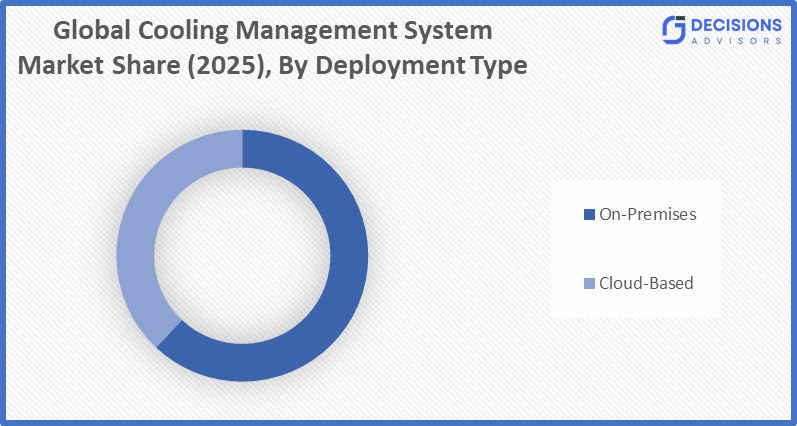
The on-premises segment accounts for the largest share, representing over 62% of the global market in 2025.
Based on the Deployment Type, the global cooling management system market is divided into On-Premises and Cloud-Based Systems. Among these, the On-Premises segment accounts for the largest share, representing over 62% of the global market in 2025. These deployments are critical for maintaining the physical security of enterprise hardware, improving localised thermal control, and reducing latency-related cooling adjustments through the adoption of modern, onsite monitoring equipment. On the other hand, the Cloud-Based segment has emerged as a rapidly growing sector, thanks to the increasing adoption of remote thermal diagnostic platforms and the transition of cooling-as-a-service models for distributed edge computing sites.
Data Centers dominate the global market, accounting for approximately 52% of the total revenue in 2025.
Based on the Application, the global cooling management system market is divided into Data Centers, Industrial Equipment Cooling, Automotive Thermal Management, Consumer Electronics Cooling, and Healthcare Equipment Cooling. Among these, Data Centers dominate the global market, accounting for approximately 52% of the total revenue in 2025. This segment is preferred by operators who require large-scale integrated solutions and professional thermal engineering services for complex AI and HPC infrastructure. The Automotive Thermal Management category is seeing a sharp increase in use, especially in the production of electric vehicles, where sophisticated battery cooling is required to maintain safety and performance.
The IT and Telecom segment dominates the global market, accounting for approximately 52% of the total revenue in 2025.
Based on the End User, the global cooling management system market is divided into IT and Telecom, Manufacturing, Automotive, Healthcare, and Commercial Infrastructure. Among these, the IT and Telecom segment dominates the global market, accounting for approximately 52% of the total revenue in 2025. This segment is preferred by planners who require large-scale integrated solutions and professional thermal engineering services for complex public digital infrastructure and 5G network expansion. The Automotive segment is seeing a sharp increase in use, especially by manufacturers in the electric vehicle industry who value the precision and safety of automated thermal protection for high-capacity battery systems and power electronics.
Strategies to Implement for Growth of the Market in Non-Leading Regions
The potential for growth within the cooling management system industry in emerging regions could be increased through the deployment of efficient modular thermal platforms for local industrial developers, as well as local agencies tasked with digital infrastructure management. Programs aimed at achieving carbon neutrality by governments, coupled with the expansion of high-density data center standards, contribute substantially toward demand within regions with traditional hardware that poses significant challenges to the installation of massive liquid immersion cooling on the ground. Further support through increasing investments in training local thermal engineering technicians, as well as setting up regional maintenance facilities, will facilitate the adoption of sustainable climate control and smart thermal response solutions.
Regional Segment Analysis of the Global Cooling Management System Market
- North America (U.S., Canada, Mexico)
- Europe (Germany, France, U.K., Italy, Spain, Rest of Europe)
- Asia-Pacific (China, Japan, India, South Korea, Rest of APAC)
- Latin America (Brazil and the Rest of Latin America)
- The Middle East and Africa (UAE, South Africa, Rest of MEA)
Asia-Pacific is projected to be the fastest-growing region over the forecast period. This region is anticipated to witness a growth rate of around 15.09% CAGR, maintaining a dominant market share within the global industry. In 2025, the Asia-Pacific already account for approximately 35.2% of global revenue. This is owing to the fast-developing digital housing infrastructure, coupled with the growing demand for modern hardware protection in countries such as China, India, and Japan. Other reasons for the same include greater investments made toward sustainable smart city planning in the region, state-supported indigenous research and development projects for low-cost liquid cooling modules, and widespread adoption of sensor-based thermal control strategies.
North America is expected to hold a significant share of the cooling management system market during the forecast period. This region holds approximately 26.8% share of global revenue in 2025, thanks to its highly sophisticated infrastructure related to hyperscale data centers, along with the extensive adoption of energy-efficient technology in both national digital goals and high-value industrial security applications. The largest part of this region’s revenues comes from the United States, as there is a lot of spending at the corporate level in high-performance computing assistance programs for automated cooling adoption, along with local research related to AI-integrated hydraulic systems.
Europe is anticipated to hold a substantial share, contributing approximately 22.4% of the global market share. There is a competitive advantage in the region owing to clusters of semiconductor technology innovation and financing for sustainable protection of the environment, as well as thermal risk management research. There is also a comparative advantage with countries like Germany, the United Kingdom, and the Netherlands, which are highly skilled at precision engineering for high-performance self-adjusting cooling units. Moreover, the rigorous regulatory standards that they have regarding carbon footprints and industrial energy drainage further give them a comparative advantage.
Recent Developments
- In June 2025, the European Union announced plans to tighten energy performance standards for data centers, which currently account for nearly 3% of total electricity demand, driving innovation in energy efficient cooling systems to manage rising heat loads from AI and cloud infrastructure.
- In March 2023, global data center energy consumption trends indicated that total usage could reach nearly 1000 TWh by 2026, significantly increasing the demand for advanced cooling management systems to maintain operational stability.
- In November 2022, the European Union strengthened energy consumption reduction targets by 11.7% by 2030 under its updated directive, pushing industries to adopt advanced cooling and thermal management systems to meet stricter efficiency requirements
- In July 2021, global infrastructure investments in sustainable buildings and industrial systems accelerated, with cooling management technologies playing a key role in reducing overall energy consumption by nearly 20% in energy efficient construction projects.
Market Segmentation
This study forecasts revenue at global, regional, and country levels from 2021 to 2035. Decision Advisor has segmented the global cooling management system market is segmented based on the following categories:
Global Cooling Management System Market, By Cooling Type
- Air Cooling
- Liquid Cooling
- Hybrid Cooling System
Global Cooling Management System Market, By Deployment Type
- On-Premises
- Cloud-Based Systems
Global Cooling Management System Market, By Application
- Data Centers
- Industrial Equipment Cooling
- Automotive Thermal Management
- Consumer Electronics Cooling
- Healthcare Equipment Cooling
Global Cooling Management System Market, By End User
- IT and Telecom
- Manufacturing
- Automotive
- Healthcare
- Commercial Infrastructure
Global Cooling Management System Market, By Regional Analysis
- North America
- United States
- Canada
- Mexico
- Europe
- Germany
- United Kingdom
- France
- Italy
- Spain
- Russia
- Rest of Europe
- Asia Pacific
- China
- Japan
- India
- South Korea
- Australia
- Rest of Asia Pacific
- Latin America
- Brazil
- Argentina
- Rest of Latin America
- Middle East & Africa
- United Arab Emirates
- Saudi Arabia
- Qatar
- South Africa
- Rest of Middle East & Africa
Frequently Asked Questions (FAQ)
What is a cooling management system, and why is it important?
A cooling management system is a specialised thermal regulation framework designed to maintain optimal temperatures by dissipating heat from sensitive electronic components, industrial machinery, and automotive systems. These systems are essential for ensuring operational reliability, extending the lifespan of high-value hardware, and preventing thermal throttling in high-load environments.
What factors are driving the growth of the cooling management system market?
The market growth can be attributed to the massive investments made in hyperscale data centers by technology giants, the rising requirements for electric vehicle battery thermal management, and the widespread adoption of liquid cooling modules.
Which cooling type dominates the cooling management system market?
Liquid cooling systems represent the largest and most influential segment of the market due to their superior heat transfer efficiency, the capability to handle extremely high rack densities, and their versatility in adapting to various hardware enclosures. They have significant potential when used in long-term AI and high-performance computing projects where air cooling alone is insufficient to manage the intense heat generated by modern processors.
Which applications are widely used in this market?
Data centers and automotive thermal management are the most prominent applications due to the acute necessity to maintain stable operating temperatures and provide reliable protection for critical digital infrastructure and electric vehicle battery packs.
Check Licence
Choose the plan that fits you best: Single User, Multi-User, or Enterprise solutions tailored for your needs.
We Have You Covered
- 24/7 Analyst Support
- Clients Across the Globe
- Tailored Insights
- Technology Tracking
- Competitive Intelligence
- Custom Research
- Syndicated Market Studies
- Market Overview
- Market Segmentation
- Growth Drivers
- Market Opportunities
- Regulatory Insights
- Innovation & Sustainability
Report Details
| Scope | Global |
| Pages | 210 |
| Delivery | PDF & Excel via Email |
| Language | English |
| Release | Apr 2026 |
| Access | Download from this page |