
Global Copper-stranded Wire Market
 |
Author:
Achal E
|
Pages:
210
|
Author:
Achal E
|
Pages:
210
Global Copper-stranded Wire Market Size, Share, By Wire Type (Hard-drawn copper stranded wire, Annealed copper stranded wire, Tinned copper stranded wire, Bare copper stranded wire), By Conductor Material (Pure copper, Copper alloys), By Application (Building wiring, Power transmission and distribution, Automotive wiring harness, Industrial equipment, Electronics and communication systems), and By Region (North America, Europe, Asia-Pacific, Latin America, Middle East, and Africa), Analysis and Forecast 2026-2035
CAGR
4.16%
REVENUE 2025
USD Billion 39.97
FORECAST 2035
USD Billion 60.1
REPORT COVERAGE
Global
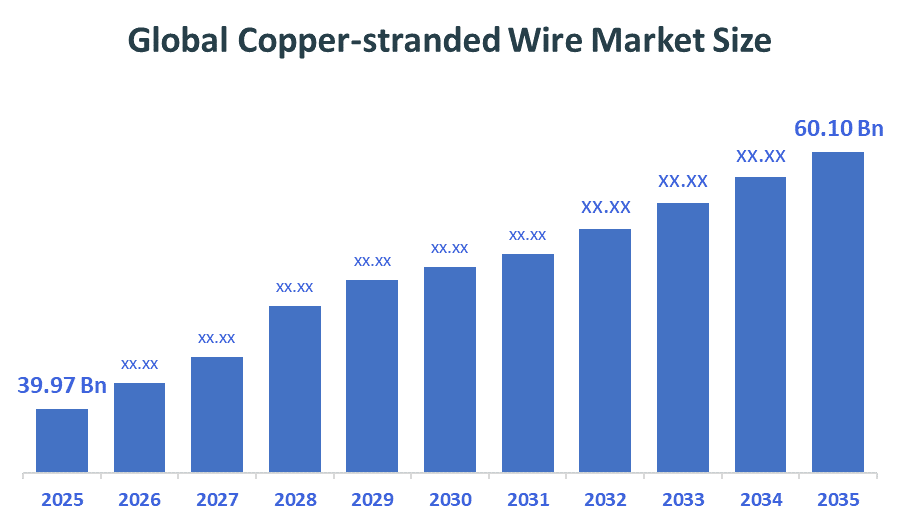
The Global Copper-stranded Wire Market Size is Expected to grow from USD 39.97 billion in 2025 and is expected to reach around USD 60.10 billion by 2035. According to Decision Advisors, an in-depth evaluation shows electrification as the key force shaping the global copper-stranded wire market, accounting for approximately 65-70% of the global market. Prysmian Group demonstrates a strong global presence, generating USD 17-18 Billion in revenue while holding approximately 15-20% market share globally, impacting global industry trends and strategic positioning.
Market Snapshot
- Global Copper-stranded Wire Market Size (2025): USD 39.97 billion
- Projected Global Copper-stranded Wire Market Size (2035): USD 60.10 billion
- Global Copper-stranded Wire Market Compound Annual Growth Rate (CAGR): 4.16%
- Largest Regional Market: Asia-Pacific
- Fastest Growing Region: Middle East and Africa
- 3rd Largest Region: North America
- Base Year: 2025
- Historical Period: 2021-2024
- Forecast Period: 2026-2035
Market Overview/ Introduction
The copper-stranded wire functions as a multi-filament conductor because it combines multiple fine copper strands which engineers twist or braid together. The construction industry uses copper-stranded wire for electrification purposes while the automotive industry employs it for wiring systems, and the consumer electronics sector uses it and industrial automation requires it powers transmission systems need it to transmit electricity from renewable energy sources. The system provides critical support for current flow, its ability to ensure reliable electrical conduction and mechanical strength and capacity to function in various operational conditions. The development of high-flexibility stranding and eco-friendly insulation together with miniaturized conductors which deliver performance improvements for small dynamic systems. The combination of smart cabling, embedded sensors enable better monitoring and operational efficiency. The future market opportunities stem from three main factors which include the development of electric vehicle infrastructure and the growth of renewable energy systems the modernization of smart grids and the increasing need for telecommunications, especially for high-speed data networks, which together create ongoing technological progress and market growth.
- In India, regulatory tightening led by Bureau of Indian Standards is influencing the global copper-stranded wire market, with USD 2-3 billion in compliance investments, improving product quality, limiting inferior imports, and reinforcing supply-chain efficiency and competitiveness.
- In China, state-driven grid expansion, led by State Grid Corporation of China, is shaping the global copper-stranded wire market, with over USD 550 billion planned investments, accelerating UHV deployment, boosting conductor demand, and reinforcing long-term infrastructure-led consumption trends.
- In South Africa, anti-theft enforcement amid ~R46 billion annual losses is reshaping the global copper-stranded wire market, with tighter scrap export curbs and compliance investments enhancing traceability, stabilizing supply chains, and elevating demand for certified copper conductors.
- In Japan, circular economy policies targeting resource security, backed by a USD 6.3 billion recycling program, are influencing the global copper-stranded wire market, enhancing scrap recovery, stabilizing supply chains, and supporting sustained availability of refined copper for industrial applications.
Notable Insights: -
- Asia-Pacific holds the largest regional market share, approximately 47.3% in the global copper-stranded wire market.
- Middle East & Africa is the fastest growing region in the copper-stranded wire market supported by the expansion of grid systems together with investments in renewable energy and the development of urban infrastructure projects throughout the UAE, Saudi Arabia, and South Africa will create ongoing demand for their services.
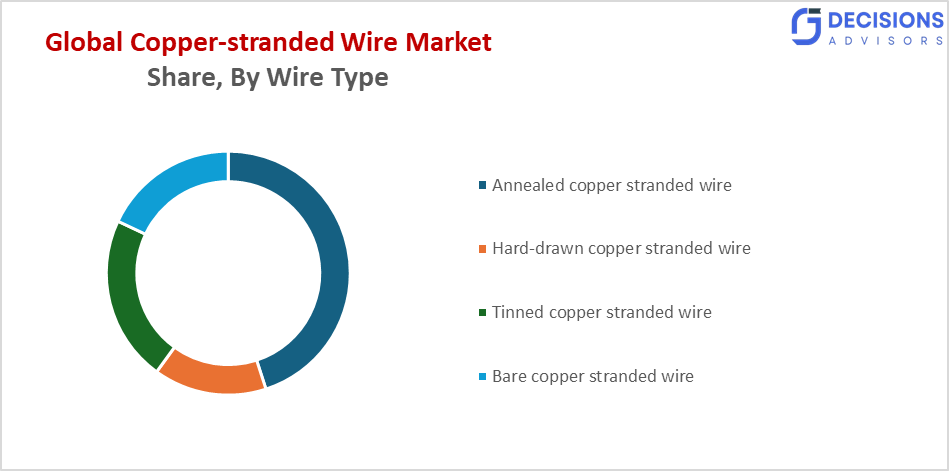
- By wire type, the annealed copper stranded wire segment held a dominant position with 42.2% in terms of market share in 2025.
- By conductor material, pure copper segment is the dominating accounting for over 83.1% of the global market share in 2025.
- The compound annual growth rate of the global copper-stranded wire market is 4.16%.
- The market is likely to achieve a valuation of USD 60.10 billion by 2035.
What is role of technology in grooming the market?
The global copper-stranded wire market experiences transformation through technological advancements which increase operational efficiency, product durability and improve performance capabilities for different use cases. The development of advanced manufacturing techniques which include continuous casting, precision stranding and automated quality inspection systems leads to better conductivity and decreased material losses. The energy infrastructure sector experiences rising demand for high-performance conductors because of digital monitoring systems and smart grid technology integration. The development of new insulation materials and fire-resistant coatings improves safety compliance standards for construction and industrial applications.
How is Recent Developments Helping the Market?
Recent developments are driving the global Copper-stranded Wire Market forward because of the investment opportunities and establish regulatory frameworks. The power grid system expansion together with electric vehicle charging station development and renewable energy corridor construction requires increased usage of high-efficiency conductors. Governments are enforcing stricter quality standards while they restrict scrap metal exports which leads to better product quality and steady supply availability. Companies increase their production capabilities by using automated systems and advanced stranding techniques which improve their output quality. The infrastructure-led consumption pattern receives reinforcement from State Grid Corporation of China and Bureau of Indian Standards through their strategic initiatives while recycling programs improve global material access and cost effectiveness.
Market Drivers
The global copper-stranded wire market is being propelled by the three main factors which include infrastructure development together with electrification and digital transformation trends. The demand for dependable conductive materials is increasing because of rapid urban expansion which is especially happening throughout the Asia-Pacific region and its need for construction and power distribution network development. The worldwide shift to renewable energy sources has resulted in extensive solar and wind energy project installations which require high-capacity copper cables for their electrical transmission networks. The growing adoption of electric vehicles creates an increased need for adaptable wiring solutions which provide high electrical conductivity throughout vehicle power systems and their charging stations. The development of 5G networks together with data centre expansion creates an increased need for sophisticated communication cable systems. The market for copper-stranded wire products maintains its global growth rate because these products offer essential benefits which include better flexibility and durability plus, they withstand mechanical stress.
Restrain
The global copper-stranded wire market encounters structural challenges because of increasing operational costs and restrictions on production capabilities. The copper price fluctuations, which stem from geopolitical threats and changing demand patterns, result in decreased profit margins and slow down project development. The market expansion faces obstacles due to the production costs exceed those of alternative materials and aluminium usage increases in applications where costs determine product selection. The mining and refining operations face high compliance costs because of strict environmental regulations, and operational efficiency suffers from technical challenges that arise during high-frequency operations due to proximity losses.
Competitive Analysis:
The report offers an appropriate analysis of the key organizations/companies involved within the global copper-stranded wire market, along with a comparative evaluation primarily based on their product of offering, business overviews, geographic presence, enterprise strategies, segment market share, and SWOT analysis. The report also provides an elaborative analysis focusing on the current news and developments of the companies, which includes product development, innovations, joint ventures, partnerships, mergers & acquisitions, strategic alliances, and others. This allows for the evaluation of the overall competition within the market.
Top Companies in Global Copper-stranded Wire Market
- Prysmian Group
- Nexans
- Sumitomo Electric Industries Ltd.
- LS Cable & System
- NKT A/S
- Southwire Company LLC
- Furukawa Electric Co., Ltd.
- Fujikura Ltd.
- Belden Inc.
- KEI Industries Ltd.
- Polycab India Limited
- Finolex Cables Ltd.
- Lapp Group
- Ducab
Government Initiatives
|
Country |
Key Government Initiatives |
|
Saudi Arabia |
Saudi Arabia government initiatives under Vision 2030, backed by multi-billion-dollar investments and delivery of 300,000 housing units alongside industrial expansion by Royal Commission for Jubail and Yanbu, are accelerating demand in the global copper-stranded wire market. |
|
South Korea |
South Korea government initiatives led by Korea Mine Rehabilitation and Mineral Resources Corporation, supported by a USD 38 billion critical minerals strategy and annual capital injections of KRW 200 billion, are strengthening copper supply security and stabilizing the global copper-stranded wire market. |
|
|
Market Segmentation
The Copper-stranded Wire Market share is classified into wire, conductor material, and application
- The annealed copper stranded wire segment dominated the market in 2024 and is projected to grow at a substantial CAGR of approximately 6.1% during the forecast period.
Based on the wire type, the copper-stranded wire market is divided into hard-drawn copper stranded wire, annealed copper stranded wire, tinned copper stranded wire, bare copper stranded wire. Among these, the annealed copper stranded wire segment dominated the market in 2024 and is projected to grow at a substantial CAGR of approximately 6.1% during the forecast period. It is because ts offers superior flexibility combined with high conductivity and simple installation procedures. The strong demand across construction, power distribution, and industrial applications continues to reinforce its leadership, ensuring sustained adoption and steady growth momentum worldwide.
- The pure copper segment accounted for the largest share in 2024 and is anticipated to grow at a significant CAGR of approximately 5.4% during the forecast period.
Based on the conductor material, the copper-stranded wire market is divided into pure copper, copper alloys. Among these, the pure copper segment accounted for the largest share in 2024 and is anticipated to grow at a significant CAGR of approximately 5.4% during the forecast period. It is dominating because of the superior conductivity, reliability, and efficiency. The strong demand from power transmission, construction, and industrial sectors continues to reinforce its dominance, supporting consistent adoption and long-term market expansion globally.
- The power transmission and distribution segment dominated the market in 2024, and is projected to grow at a substantial CAGR during the forecast period.
Based on the application, the copper-stranded wire market is divided into building wiring, power transmission and distribution, automotive wiring harness, industrial equipment, electronics and communication systems. Among these, the power transmission and distribution segment dominated the market in 2024, and is projected to grow at a substantial CAGR during the forecast period. It is because of the grid expansion, renewable energy integration and electrification programs. The increasing need for electricity throughout both industrial and urban areas strengthens its market position because it creates predictable energy use patterns which will support company growth for many years.
Strategies to Implement for Growth of the Market in Non-Leading Regions
The global copper-stranded wire market requires infrastructure development, policy implementation, and industrial capacity expansion through unified efforts in non-leading regions. The government needs to dedicate funding resources for public grid development, rural electricity distribution and renewable energy system integration through public-private partnership programs. The local manufacturing sector will gain strength from the implementation of incentives, tax advantages in technology transfer agreements that help decrease reliance on imported goods. The organizations can achieve better product reliability and investor confidence through standardization and quality control procedures that follow International Electrotechnical Commission standards. The recycling systems and workforce training programs will create better supply stability while trade policies attract international businesses to develop a competitive market which supports long-term growth.
Regional Segment Analysis of the Global Copper-stranded Wire Market
- North America (U.S., Canada, Mexico)
- Europe (Germany, France, U.K., Italy, Spain, Rest of Europe)
- Asia-Pacific (China, Japan, India, Rest of APAC)
- South America (Brazil and the Rest of South America)
- The Middle East and Africa (UAE, South Africa, Rest of MEA)
Asia-Pacific is anticipated to hold the largest share of the copper-stranded wire market over the predicted timeframe. The Asia-Pacific is anticipated to hold the largest share of the copper-stranded wire market, accounting for approximately 47.4% of total revenue over the forecast period. It is due to the combination of rapid urbanization together with extensive infrastructure development and growing power transmission systems has created a need for additional infrastructure development. The region continuously meets market needs because of its strong manufacturing capabilities together with its expanding renewable energy initiatives and rising electricity consumption in China and India.
Middle East and Africa are expected to grow at a rapid CAGR in the copper-stranded wire market during the forecast period. The Middle East and Africa market will experience fast growth because it accounts for approximately 7.3% of it is because of the growing electricity distribution projects and major renewable energy funding. The Gulf and African economies experience growing market demand of their developing cities and diverse industries and government-supported power grid upgrades.
North America is the 3rd largest region to grow in the copper-stranded wire market during the region. The North America region stands as the third biggest area global for the copper-stranded wire market since it holds approximately 22.5% the improvements in electrical grids and develop new renewable energy sources and build electric vehicle charging networks. The region maintains its market strength because of ongoing industrial operations and the need for electrical system improvements and the constant demand for construction work.
Future Market Trends in Copper-stranded Wire Market: -
- Grid Digitalization and Smart Infrastructure
The global copper-stranded wire market shows increasing development through the implementation of grid digitalization which utilities use to deploy smart meters and automation systems and intelligent transmission networks. The market requires high-performance conductors which can support real-time monitoring and enable efficient operation and create resilient data-driven energy systems for both developed and developing countries.
2. Electrification of Mobility Ecosystem
The growing need for flexible copper-stranded wiring comes from the fast electrification of transportation systems which includes electric vehicles and charging stations. The expanding use of electric vehicles together with better battery technology and charging infrastructure development, establishes copper as the key material for efficient power transmission in future worldwide mobility systems.
3. Advanced Manufacturing and Material Innovation
The manufacturing industry is experiencing improved product performance through technological progress which includes precision stranding and automation and better insulation materials. Copper stranded wires now meet industrial needs through innovations that enhance their conductivity and durability and heat resistance, which allows their use in high-demand industries like energy and construction and electronics.
Recent Development
- January 2026, Chile copper prices surged beyond $14,000 per tonne, while over USD 10-15 billion mining investments aimed to boost supply, escalating input costs and margin pressures across the global copper-stranded wire market amid tightening raw material availability.
- In February 2026, China over USD 1.2 billion worth of copper wire rod exports surged toward Southeast Asia, with more than 70% shipments to Thailand, Vietnam, and Malaysia, driven by power grid and renewable investments, strengthening supply dynamics in the global copper-stranded wire market.
- In February 2026, India dynamic Cables Limited introduced FR-LSH and HR-FRLSH copper building wires, supported by enhanced ?350 crore banking facilities and phased capex expansion plans, strengthening product innovation and elevating premium demand across the global copper-stranded wire market.
- In March 2026, Germany over €2 billion investments in fire-safe infrastructure accelerated adoption of halogen-free, flame-retardant copper cables, strengthening safety compliance and boosting demand across the global copper-stranded wire market amid tightening environmental and building regulations.
- In April 2026, Canada the Canadian Copper advanced acquisition of the Caribou Processing Complex in New Brunswick, backed by USD 64 million capex, strengthening upstream copper supply and reinforcing raw material availability across the global copper-stranded wire market value chain.
Market Segment
This study forecasts revenue at global, regional, and country levels from 2020 to 2035. Decision Advisors has segmented the copper-stranded wire market based on the above-mentioned segments:
Global Copper-stranded Wire Market, By Wire Type
- Hard-drawn copper stranded wire
- Annealed copper stranded wire
- Tinned copper stranded wire
- Bare copper stranded wire
Global Copper-stranded Wire Market, By Conductor Material
- Pure copper
- Copper alloys
Global Copper-stranded Wire Market, By Application
- Building wiring
- Power transmission and distribution
- Automotive wiring harness
- Industrial equipment
- Electronics and communication systems
Global Copper-stranded Wire Market, By Regional Analysis
- North America
- US
- Canada
- Mexico
- Europe
- Germany
- UK
- France
- Italy
- Spain
- Russia
- Rest of Europe
- Asia Pacific
- China
- Japan
- India
- South Korea
- Australia
- Rest of Asia Pacific
- South America
- Brazil
- Argentina
- Rest of South America
- Middle East & Africa
- UAE
- Saudi Arabia
- Qatar
- South Africa
- Rest of the Middle East & Africa
Frequently Asked Questions (FAQ)
Q. Why is copper-stranded wire preferred over solid wire?
A. The electrical wiring system uses copper-stranded wire because it offers better flexibility and durability while sustaining its strength during mechanical stress. The material provides efficient performance for operational conditions which include automotive systems and industrial machinery while maintaining easy installation. This combination makes the material a popular choice for use in multiple electrical systems and infrastructure projects which extend throughout the world.
Q. What role does technology play in market development?
A. The transition toward renewable energy sources creates increased demand for copper-stranded wire because solar and wind power systems need extensive electrical wiring. The need for copper as a crucial material to support worldwide decarbonization efforts and sustainable energy development increases because renewable energy sources require grid system expansion to reach their full potential.
Q. What role does technology play in competitive differentiation?
A. The manufacturing processes received improvements through technological advancements which include automation systems and precision stranding technology that improve product quality and operational efficiency. The development of new insulation materials together with fire-resistant coating solutions enables safer products which perform better, while the implementation of digital technology and smart grid systems creates a need for advanced conductors which modernize the global copper-stranded wire market and enhance its competitive strength.
Q. What are the future trends shaping the market?
A. The future trends include increased adoption of smart grids and expansion of electric vehicle infrastructure and growing emphasis on sustainable materials and recycling. The global copper-stranded wire market will achieve long-term growth and resilience through two factors which include manufacturing technology advancements and increased funding for infrastructure development
Check Licence
Choose the plan that fits you best: Single User, Multi-User, or Enterprise solutions tailored for your needs.
We Have You Covered
- 24/7 Analyst Support
- Clients Across the Globe
- Tailored Insights
- Technology Tracking
- Competitive Intelligence
- Custom Research
- Syndicated Market Studies
- Market Overview
- Market Segmentation
- Growth Drivers
- Market Opportunities
- Regulatory Insights
- Innovation & Sustainability
Report Details
| Scope | Global |
| Pages | 210 |
| Delivery | PDF & Excel via Email |
| Language | English |
| Release | Apr 2026 |
| Access | Download from this page |