
Global Cylindrical Lithium-Ion Battery Market
 |
Author:
Somesh R
|
Pages:
210
|
Author:
Somesh R
|
Pages:
210
Global Cylindrical Lithium Ion Battery Market Size, Share, By Capacity (Less than 3 Ah, 3 Ah to 6 Ah, 6 Ah to 12 Ah, 12 Ah to 20 Ah, Over 20 Ah), By Voltage (Below 3.6 V, 3.6 V to 3.7 V, 3.8 V to 4.0 V, Over 4.0 V), By Application (Consumer Electronics, Power Tools, Electric Vehicles, Medical Devices, Energy Storage Systems), and By Region (North America, Europe, Asia-Pacific, Latin America, Middle East, and Africa), Analysis and Forecast 2026-2035.
CAGR
18.08%
REVENUE 2025
USD Billion 155.63
FORECAST 2035
USD Billion 820.36
REPORT COVERAGE
Global
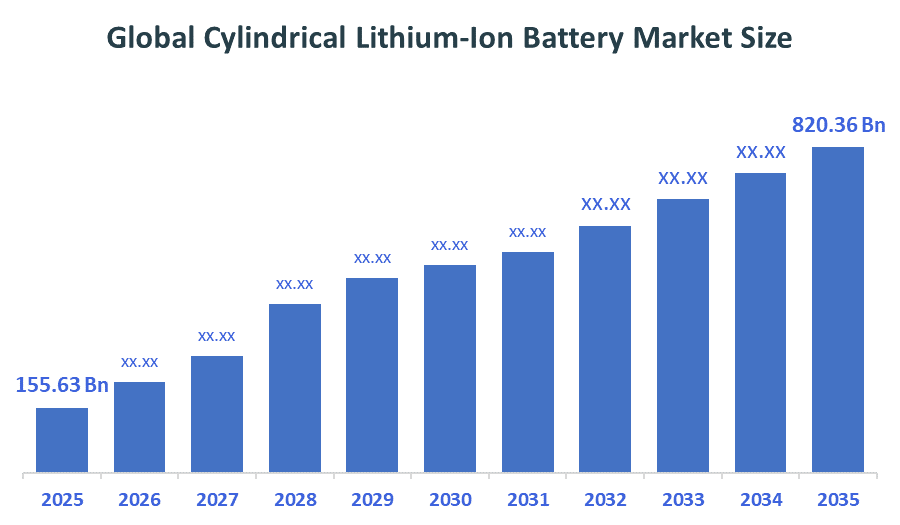
The Global Cylindrical Lithium-Ion Battery Market Size is forecasted to grow from USD 155.63 Billion in 2025 and going to reach approx. USD 820.36 Billion by 2035. According to Decision Advisors, there is a detailed research report on the Global Cylindrical Lithium-Ion Battery Market highlights that electric vehicle applications dominate the global market, accounting for approximately 60–65% of the total share worldwide. Panasonic corporation generates strong revenue through advancements in high-capacity cylindrical cell design, fast-charging technology segment, which accounts for approximately 10–15% market share, thus acting as a main driver that cost optimization strategies, and global market expansion.
Market Snapshot
- Market Size (2025): USD 155.63 Billion
- Projected Market Size (2035): USD 820.36 Billion
- Compound Annual Growth Rate (CAGR): 18.08%
- Largest Regional Market: North America
- Fastest Growing Region: Asia-Pacific
- 3rd Largest Region: Europe
- Base Year: 2025
- Historical Period: 2021–2024
- Forecast Period: 2025–2035
Market Overview/ Introduction
The Global Cylindrical Lithium-Ion Battery Market has become a crucial component of energy storage systems which support electrification technologies. Electric vehicles, consumer electronics and power tools and energy storage systems all utilize cylindrical lithium-ion batteries because these batteries provide high energy density, thermal stability, long-life cycle and low-cost mass production capacity. The market is currently controlled by standard formats which include 18650, 21700 and 4680 cell types that EV battery packs and large-scale storage systems now adopt. The electric vehicle sector accounts for over 45–50% of total demand, driven by global decarbonization goals and government incentives. The market growth is driven by increasing demand for portable electronics which has reached 20-25% and by the rapid expansion of renewable energy storage systems. The development of battery chemistry (NMC, LFP) and fast-charging technology and thermal management systems delivers improved performance and safety and lifecycle efficiency.
- China’s industrial policies under Made in China 2025 and energy storage initiatives support lithium-ion battery leadership through subsidies, tax benefits, and integrated supply chains, enabling dominance in cell manufacturing and materials for cylindrical and advanced battery formats.
Notable Insights: -
- Asia Pacific holds the largest regional market share approximately 58% in Global Cylindrical Lithium-Ion Battery Market.
- North America is the fastest growing region in the Global Cylindrical Lithium-Ion Battery Market with a CAGR of approximately 22%.
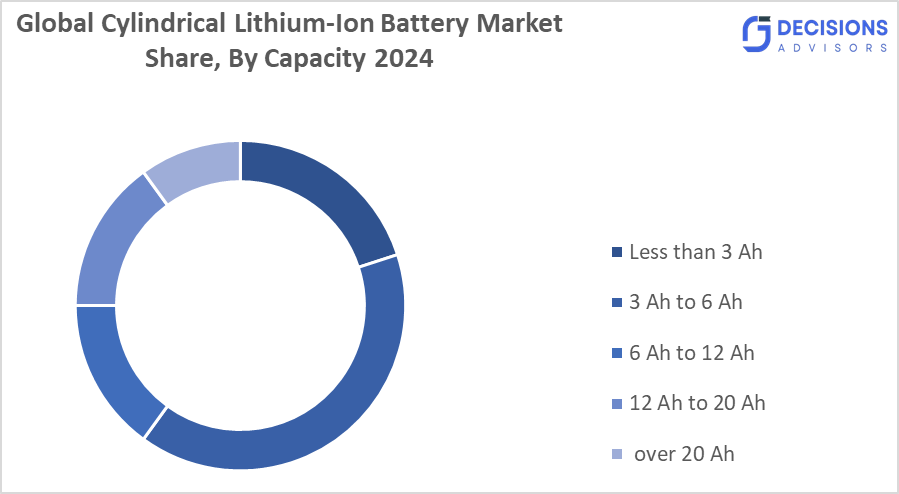
- By capacity, the 3 Ah to 6 Ah segment held a dominant position with approximately 18% in terms of market share in 2025.
- By Voltage, 3.6V–3.7V segment is the dominating accounting for over 16% of the global market share in 2025.
- The compound annual growth rate of the Global Cylindrical Lithium-Ion Battery Market is 18.08%.
- The market is likely to achieve a valuation of USD 820.36 Billion by 2035.
What is role of technology in grooming the market?
Technologicalprogressionsnowadaysenablebetterperformanceofcylindricallithiumionbatteries Advanced cathode materials (NMC NCA) provide energy density improvements between 20 and 30%. Fast charging technology enables users to complete charging processes 30 to 50% faster. Thermal management systems create two benefits which include better safety and extended equipment lifespan. Solid state research and development (R D) work to develop better safety measures while increasing energy storage capabilities. Artificial intelligence-based battery management systems (BMS) systems deliver operational efficiency improvements which extend product life between 15 and 20%. Automatic operations in Gigafactories enable companies to decrease production expenses between 25 and 30%. The percentage of modern batteries which use advanced materials together with intelligent monitoring systems has reached 40%.
Market Drivers
The Global Cylindrical Lithium-Ion Battery Market experiences its primary growth because electric vehicle adoption becomes more widespread which creates a higher need for advanced battery systems that provide both power and charging capabilities. The need for dependable energy storage systems which help maintain grid operations, support solar and wind power integration has increased because of the growth of renewable energy storage systems. The market expands because portable electronics and power tools create a higher need for compact energy solutions which provide efficient performance. The combination of government policies which support clean energy and electrification together with major investments in battery manufacturing plants known as gigafactories creates an environment that enables increased production capabilities and technological progress. The rise in data center investments together with backup power system expenditures creates new business opportunities for cylindrical lithium-ion batteries which provide continuous power protection.
Restrain
The market encounters multiple obstacles which prevent its expansion. The manufacturing costs for businesses become unpredictable because of fluctuations in raw material prices which include essential materials like lithium, cobalt and nickel. The industry needs to enhance battery design together with their thermal runaway protection systems because safety issues maintain their status as a major problem. The supply chain faces risks because it depends on only a few mining areas which makes it susceptible to both political and supply chain disruptions. The process of recycling batteries together with the environmental problems from battery disposal and material recovery creates sustainability challenges. The high costs needed to build battery production plants create a major obstacle which particularly affects companies that want to enter the market.
Competitive Analysis:
The report offers the appropriate analysis of the key organizations/companies involved within the Global Cylindrical Lithium-Ion Battery Market, along with a comparative evaluation primarily based on their product of offering, business overviews, geographic presence, enterprise strategies, segment market share, and SWOT analysis. The report also provides an elaborative analysis focusing on the current news and developments of the companies, which includes product development, innovations, joint ventures, partnerships, mergers & acquisitions, strategic alliances, and others. This allows for the evaluation of the overall competition within the market.
Top Companies in the Global Cylindrical Lithium-Ion Battery Market
- Panasonic Holdings Corporation
- Samsung SDI Co., Ltd.
- LG Energy Solution Ltd.
- Contemporary Amperex Technology Co. Limited (CATL)
- BYD Company Ltd.
- Tesla, Inc.
- EVE Energy Co., Ltd.
- BAK Power Battery Co., Ltd.
- Murata Manufacturing Co., Ltd.
- Toshiba Corporation
Government Initiatives
|
Country |
Key Government Initiatives |
|
Europe |
In 2024–2025, in Europe the Net-Zero Industry Act acts as a catalyst, setting ambitious goals for regional battery manufacturing to meet at least 40% of annual deployment needs, supporting regional cylindrical cell investments across Europe strategic initiatives. |
|
US |
In August 2022, The U.S. Department of Energy announced over USD 3 billion funding to expand domestic battery manufacturing, strengthen supply chains, and boost EV and energy storage production. |
|
India
|
India 2022–2023, Production Linked Incentive (PLI) scheme for Advanced Chemistry Cell (ACC) batteries targets 50 GWh capacity to strengthen domestic manufacturing and localize EV and power tool supply chains across India ecosystem development initiative program. |
Study on the Supply, Demand, Distribution, and Market Environment Global Cylindrical Lithium-Ion Battery Market
The supply chain of the cylindrical lithium-ion battery market is highly dependent on the mining and processing of key raw materials such as lithium, cobalt, nickel, and graphite, followed by stages including refining, cell manufacturing, and final battery pack assembly. The Asia-Pacific region dominates the global supply chain with approximately 70% production share, with China playing a leading role in both battery manufacturing and raw material processing. Market demand is primarily driven by electric vehicles (EVs), energy storage systems (ESS), and consumer electronics sectors. Additionally, the adoption of digital procurement platforms and advanced automation technologies is improving operational efficiency by around 20–25%, enhancing supply chain transparency and reducing production lead time.
Price Analysis and Healthcare Facilities Behaviour Analysis
In terms of price analysis, the average battery pack cost is estimated to range between USD 100–150 per kWh in 2025, with leading manufacturers aiming to reduce it below USD 100 per kWh to achieve cost parity with internal combustion engine vehicles. The cost of cylindrical cells varies depending on battery chemistry such as NMC, LFP, or NCA, energy density, and capacity range. Prices are declining at an annual rate of approximately 8–10% due to economies of scale, advancements in manufacturing processes, and increasing competition among global players. Raw materials account for nearly 50–60% of the total battery cost, with lithium alone contributing significantly to price fluctuations. Furthermore, innovations such as high-nickel cathodes, silicon-based anodes, and improved cell designs e.g., 21700 and 4680 formats are helping reduce cost per kWh while improving performance. Recycling initiatives and second-life battery applications are also emerging as key strategies to stabilize material costs and improve long-term supply sustainability.
Market Segmentation
The Global Cylindrical Lithium-Ion Battery Market share is classified into solution product type, distribution channel, and application
- The 3 Ah to 6 Ah segment dominated the market in 2025, and is projected to grow at a substantial CAGR of approximately 18% during the forecast period.
Based on the capacity, the global Cylindrical Lithium-Ion Battery Market is divided into Less than 3 Ah, 3 Ah to 6 Ah, 6 Ah to 12 Ah, 12 Ah to 20 Ah, over 20 Ah. Among these, 3 Ah to 6 Ah segment dominated the market in 2025, and is projected to grow at a substantial CAGR of approximately 18% during the forecast period. The 3 Ah to 6 Ah segment is projected to grow at a strong CAGR of 18% due to its optimal balance between energy density, size, and cost. It is widely used in electric vehicles, power tools, and consumer electronics, where compact yet high-performance batteries are essential. Increasing EV adoption and demand for portable devices further accelerate growth.
- The 3.6V–3.7V segment accounted for the largest share in 2025, and is anticipated to grow at a significant CAGR of approximately 16% during the forecast period.
Based on the distribution channel, the global Cylindrical Lithium-Ion Battery Market is divided into Below 3.6 V, 3.6 V to 3.7 V, 3.8 V to 4.0 V, over 4.0 V. Among these, the 3.6V–3.7V segment accounted for the largest share in 2025, and is anticipated to grow at a significant CAGR of approximately 16% during the forecast period. The 3.6V–3.7V range represents the standard nominal voltage for most lithium-ion battery chemistries, making it widely adopted across electric vehicles, consumer electronics, and energy storage systems. Its optimal balance of energy density, safety, and compatibility with existing battery management systems drives consistent demand and large-scale production.
- The Electric Vehicles segment dominated the market at a CAGR of approximately 21% in 2025, and is projected to grow at a substantial CAGR during the forecast period.
Based on the application, the global Cylindrical Lithium-Ion Battery market is divided Consumer Electronics, Power Tools, Electric Vehicles, Medical Devices, Energy Storage Systems. Among these, the Electric Vehicles segment dominated the market at a CAGR of approximately 21% in 2025, and is projected to grow at a substantial CAGR during the forecast period. The EV segment leads due to the rapid global shift toward electrification, supported by government incentives, emission reduction targets, and expanding charging infrastructure. Cylindrical batteries are widely used in EVs because of their high energy density, durability, and scalability, making them ideal for large battery packs. Increasing production of electric cars and commercial vehicles continues to drive strong demand.
Strategies to Implement for Growth of the Market in Non-Leading Regions
The cylindrical lithium-ion battery market must establish local manufacturing and assembly centers in Latin America and the Middle East and Africa to achieve growth in these non-leading regions. The establishment of strategic partnerships with regional distributors and automotive manufacturers and energy providers will enable companies to enhance their market presence and customer outreach efforts. The construction of charging infrastructure and energy storage systems requires collaboration between government entities and private organizations to support electric vehicle adoption and renewable energy implementation. The provision of affordable battery products together with flexible payment options will attract small and medium-sized enterprises and emerging customers who operate in markets with strict budget limitations. The business sector needs to establish educational programs that will inform people about the advantages of lithium-ion batteries which include energy efficiency and long-term cost reductions. The combination of government incentives and subsidies and clean energy policies will create additional demand for products. The sustainable growth of the market depends on companies investing in workforce training programs and technical assistance and after-sales support for battery system installations.
Regional Segment Analysis of the Global Cylindrical Lithium-Ion Battery Market
- North America (U.S., Canada, Mexico)
- Europe (Germany, France, U.K., Italy, Spain, Rest of Europe)
- Asia-Pacific (China, Japan, India, Rest of APAC)
- South America (Brazil and the Rest of South America)
- The Middle East and Africa (UAE, South Africa, Rest of MEA)
Asia Pacific is anticipated to hold the largest share approximately 58% of the Global Cylindrical Lithium-Ion Battery Market over the predicted timeframe. The Asia Pacific region will capture between 58% of the Global Cylindrical Lithium-Ion Battery Market during the upcoming assessment period. The region maintains its market position because it contains major battery manufacturers including Contemporary Amperex Technology Co. Limited (CATL) and Panasonic Holdings Corporation and LG Energy Solution Ltd. The region possesses established supply networks which enable efficient raw material processing and production at their extensive manufacturing facilities. The battery market experiences substantial growth because China and Japan and South Korea dominate global electric vehicle manufacturing. The region benefits from its industrial development and expanding consumer electronics sector and rising funding for renewable energy storage technologies. The combination of government backing and cost benefits and technological progress enables the company to maintain its position as market leader.
North America is expected to grow at a rapid CAGR approximately 22% in the Global Cylindrical Lithium-Ion Battery Market during the forecast period. North America is expected to grow at a rapid CAGR of approximately 22% in the Global Cylindrical Lithium-Ion Battery Market during the forecast period, driven by large-scale investments in electric vehicle (EV) manufacturing and battery gigafactories across the United States and Canada. Government incentives under clean energy and electrification policies are accelerating EV adoption, while major automakers are expanding domestic battery sourcing to reduce dependency on imports. Additionally, rising demand for energy storage systems, smart grid infrastructure, and renewable energy integration is further boosting cylindrical lithium-ion battery consumption. The presence of advanced technological ecosystems and strong R&D investments also supports faster innovation and market expansion in the region.
Europe is the 3rd largest region to grow in the Global Cylindrical Lithium-Ion Battery Market during the region.
The Global Cylindrical Lithium-Ion Battery Market ranks Europe as its third-largest region because electric vehicle usage and renewable energy systems and industrial electrical operations all continue to grow. The region expands because environmental laws and carbon neutrality goals which governments and the European Union established serve as its main driving forces. The automotive manufacturing industry in Germany and France and the United Kingdom makes these countries major contributors because they invest in electric vehicle production and battery supply chain development. The demand for cylindrical lithium-ion batteries receives additional support from energy storage system deployment and power infrastructure modernization activities. Europe will experience market growth during the forecast period because companies keep investing in clean mobility solutions and sustainable energy technologies.
Future Market Trends Global Cylindrical Lithium-Ion Battery Market: -
1. Shift Toward High-Energy Density & 4680 Cells
The market is rapidly moving toward next-generation cylindrical formats like 4680 and high-nickel batteries, which offer higher energy density, longer range, and lower cost per kWh. This trend is mainly driven by electric vehicle manufacturers aiming to improve driving range and reduce battery pack size.
2. Fast-Charging & Silicon-Anode Innovation
There is strong development in fast-charging technologies and silicon-based anodes, which significantly reduce charging time and increase storage capacity. These innovations are improving battery performance for EVs, power tools, and portable electronics while enhancing lifecycle efficiency.
3. Expansion of Energy Storage Systems (ESS)
Growing deployment of renewable energy is increasing demand for grid-scale energy storage systems, where cylindrical lithium-ion batteries are widely used for stability, backup power, and load balancing. This trend is supported by solar and wind energy expansion globally.
Recent Development
- In March 2025, Samsung SDI Co., Ltd. began production of 46-series cylindrical batteries (46 mm) using high-nickel NCA cathode and silicon-carbon nanocomposite anode technology for U.S. micro-mobility applications, advancing high-energy density battery solutions.
- In March 2025, EVE Energy Co., Ltd. showcased its “Mr. Big” ultra-large-capacity battery (628Ah) and “Mr. Giant” 5MWh energy storage system, designed for grid-scale renewable integration and long-duration storage applications. The company also announced a roadmap for All-Solid-State Battery 1.0 with 350Wh/kg energy density by 2026, focusing on improved safety and higher energy density solutions.
- In January 2025, Gotion High-Tech Co., Ltd. demonstrated its new 4695 cylindrical lithium-ion cell featuring a silicon-based anode, enabling ultra-fast charging capability with full charge achieved in under 20 minutes, enhancing EV performance and efficiency.
- In July 2024, SVOLT Energy Technology Co., Ltd. introduced its “Short Blade” 5C fast-charging LFP battery cells, combining high safety and cost efficiency with improved fast-charging performance, targeting electric vehicle and energy storage applications.
How is Recent Developments Helping the Market?
Recent developments in the Global Cylindrical Lithium-Ion Battery Market are significantly enhancing performance, safety, and cost efficiency, thereby accelerating overall market growth. Continuous innovations in high-energy-density cell designs, such as 21700 and 4680 formats, are improving driving range and reducing battery pack size, making them highly suitable for electric vehicles and portable applications. Advancements in silicon-based anodes and nickel-rich cathode materials are increasing energy storage capacity while improving lifecycle performance. Additionally, improvements in fast-charging technologies and advanced electrolytes are reducing charging time and enhancing user convenience, which is crucial for EV adoption. The integration of AI-driven battery management systems (BMS) and smart monitoring tools is improving safety by detecting faults early and preventing thermal runaway risks. Furthermore, innovations in manufacturing automation and gigafactory scaling are reducing production costs by improving yield efficiency and minimizing defects. These developments collectively support higher production volumes, lower cost per kWh, and faster commercialization of next-generation cylindrical lithium-ion batteries across EVs, energy storage systems, and consumer electronics.
Market Segment
This study forecasts revenue at global, regional, and country levels from 2020 to 2035. Decision Advisor has segmented the Global Cylindrical Lithium-Ion Battery Market based on the below-mentioned segments:
Global Cylindrical Lithium-Ion Battery Market, By Capacity
- Less than 3 Ah
- 3 Ah to 6 Ah
- 6 Ah to 12 Ah
- 12 Ah to 20 Ah
- Over 20 Ah
Global Cylindrical Lithium-Ion Battery Market, By Voltage
- Below 3.6 V
- 3.6 V to 3.7 V
- 3.8 V to 4.0 V
- Over 4.0 V
Global Cylindrical Lithium-Ion Battery Market, By Application
- Consumer Electronics
- Power Tools
- Electric Vehicles
- Medical Devices
- Energy Storage Systems
Global Cylindrical Lithium-Ion Battery Market, By Regional Analysis
- North America
- US
- Canada
- Mexico
- Europe
- Germany
- UK
- France
- Italy
- Spain
- Russia
- Rest of Europe
- Asia Pacific
- China
- Japan
- India
- South Korea
- Australia
- Rest of Asia Pacific
- South America
- Brazil
- Argentina
- Rest of South America
- Middle East & Africa
- UAE
- Saudi Arabia
- Qatar
- South Africa
- Rest of the Middle East & Africa
Frequently Asked Questions (FAQ)
Q1. Why are cylindrical lithium-ion batteries preferred over prismatic and pouch formats in high-vibration applications?
Cylindrical batteries offer a rigid steel/aluminium casing that provides superior mechanical stability, making them more resistant to vibration, pressure, and thermal expansion. This makes them ideal for power tools, EVs, and industrial equipment.
Q2. How does the 4680 cylindrical cell formats change the economics of EV battery pack manufacturing?
The 4680 format reduces the number of cells required per pack, lowers interconnection complexity, and improves energy density, leading to reduced assembly cost and improved manufacturing scalability in gigafactories.
Q3. What role does tabless electrode design play in next-generation cylindrical batteries?
Tabless design reduces internal resistance and heat generation by allowing current to flow more evenly across the electrode surface, enabling faster charging and improved thermal performance.
Q4. How is artificial intelligence transforming cylindrical lithium-ion battery production?
AI is being used in predictive quality control, defect detection, and battery management systems (BMS), improving yield rates, reducing production defects, and extending battery lifecycle performance.
Q5. Why is silicon anode integration considered a breakthrough for cylindrical lithium-ion batteries?
Silicon anodes significantly increase energy storage capacity compared to graphite, enabling higher energy density and longer EV range, though they require advanced engineering to manage volume expansion.
Check Licence
Choose the plan that fits you best: Single User, Multi-User, or Enterprise solutions tailored for your needs.
We Have You Covered
- 24/7 Analyst Support
- Clients Across the Globe
- Tailored Insights
- Technology Tracking
- Competitive Intelligence
- Custom Research
- Syndicated Market Studies
- Market Overview
- Market Segmentation
- Growth Drivers
- Market Opportunities
- Regulatory Insights
- Innovation & Sustainability
Report Details
| Scope | Global |
| Pages | 210 |
| Delivery | PDF & Excel via Email |
| Language | English |
| Release | Apr 2026 |
| Access | Download from this page |