
Global Cysteine Market
 |
Author:
David J
|
Pages:
180
|
Author:
David J
|
Pages:
180
Cysteine Market Size, Share, By Product Type (Natural Cysteine, Synthetic/Fermentation-Based Cysteine), By Application (Food & Beverages, Pharmaceuticals, Cosmetics & Personal Care, Animal Feed), By End User (Food Industry, Pharmaceutical Companies, Cosmetic Manufacturers, Feed Industry), and By Region (North America, Europe, Asia-Pacific, Latin America, Middle East & Africa), Analysis and Forecast 2025-2035.
CAGR
4.74%
REVENUE 2025
USD Billion 441.1
FORECAST 2035
USD Billion 701.1
REPORT COVERAGE
Global
Market Snapshot
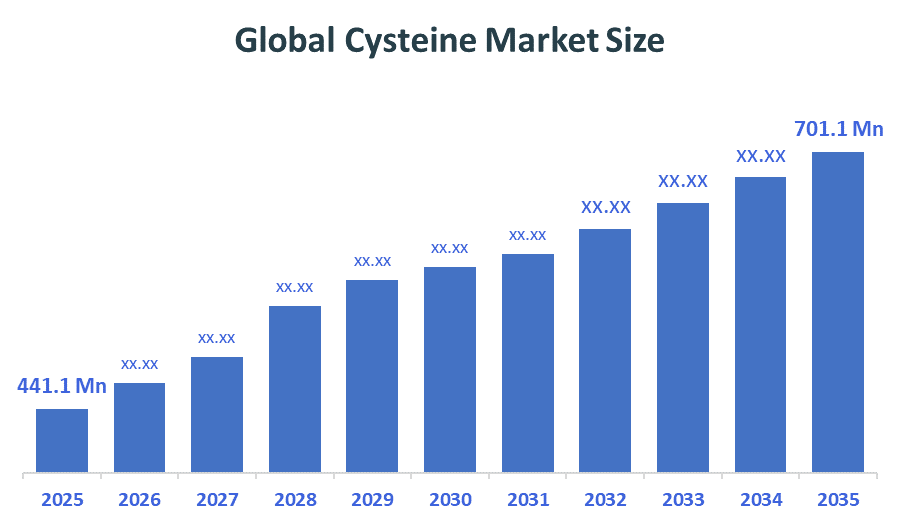
- Global Cysteine Market Size (2025): USD 441.1 Million
- Projected Global Cysteine Market Size (2035): USD 701.1 Million
- Global Cysteine Market Compound Annual Growth Rate (CAGR): 4.74%
- Largest Growing Region: Asia-Pacific
- Fastest Regional Market: North America
- 3rd Largest Region: Europe
- Base Year: 2025
- Historical Period: 2021–2024
- Forecast Period: 2026–2035
Market Overview/ Introduction
The global cysteine market is defined as the annual output and trade of pure L-cysteine, a sulfur-based non-essential amino acid critical for protein synthesis and metabolic health, produced via microbial fermentation or traditional protein hydrolysis. A major shift is happening under the hood, governments and companies are moving away from old-school methods (like extracting cysteine from feathers) and toward green fermentation. For instance, facility, while Wacker Chemie is doubling down on its vegan-friendly FERMOPURE line in Germany. The big win for the future is the clean-label movement, as more of us look for vegan and natural options, the market is ditching animal byproducts in favor of sustainable, lab-grown alternatives that fit modern lifestyles.
- Industry giants are jumping in too Ajinomoto recently poured $150 million into a new U.S.
- India’s BioE3 Policy and Canada’s $110M protein fund are paving the way for high-tech, eco-friendly manufacturing.
Notable Insights: -
- Asia Pacific is the largest growing region in the global cysteine market during the forecast period, holding approximately 40% share.
- North America is anticipated to hold approximately 30% share of the Global Cysteine Market over the predicted timeframe.
- By product type, the fermentation-based cysteine segment dominated the market and holds approximately 60% share in 2025, and is projected to grow at a substantial CAGR during the forecast period.
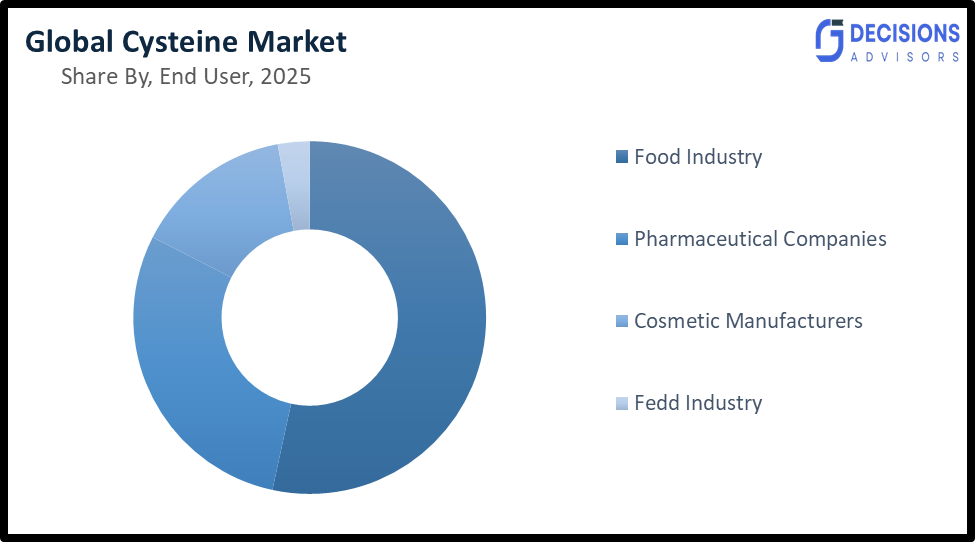
- By end user, the food industry segment dominated the market and holds approximately 50% share in 2025 and is projected to grow at a substantial CAGR during the forecast period.
- The compound annual growth rate of the Global Cysteine Market is 4.74%.
- The market is likely to achieve a valuation of USD 701.1 Million by 2035.
What is the role of technology in grooming the market?
Technology is playing a key role in transforming the cysteine market by improving production methods, product quality, and sustainability. The shift from animal-based extraction to fermentation technology has enabled companies to produce vegan and high-purity cysteine. For example, companies like Ajinomoto and Wacker Chemie use microbial fermentation to meet clean-label demand. Additionally, advanced purification and automation technologies ensure consistent quality and reduce costs. These innovations are also expanding cysteine applications in pharmaceuticals, food processing, and cosmetics, making the market more efficient and future-ready.
Market Drivers
It’s really about our collective shift toward better health and a cleaner conscience. Cysteine isn’t just a line on an ingredient label anymore, it’s the secret sauce in NAC, a powerhouse supplement that helps people breathe easier and detox their bodies. As we all become more focused on living longer and staying resilient, the demand for this medical-grade stuff is hitting new heights.
Even your local hair salon is part of the story. Instead of using those old, harsh chemicals that make your eyes sting, stylists are switching to cysteine-based treatments because they’re a much gentler, safer way to get that smooth look. When you take these personal health wins and mix them with governments backing green factories, you get a market that’s doing more than just making money it’s actually evolving to be kinder to our bodies and the planet.
Restrain
The cysteine market faces several challenges that may hinder its growth. One of the primary restraints is the ethical concern associated with animal-derived cysteine, as traditional production methods use sources like feathers or human hair, which limits acceptance among vegan and health-conscious consumers.
Competitive Analysis:
The report offers the appropriate analysis of the key organizations/companies involved within the global cysteine market, along with a comparative evaluation primarily based on their product of offering, business overviews, geographic presence, enterprise strategies, segment market share, and SWOT analysis. The report also provides an elaborative analysis focusing on the current news and developments of the companies, which includes product development, innovations, joint ventures, partnerships, mergers & acquisitions, strategic alliances, and others. This allows for the evaluation of the overall competition within the market.
Top Companies in the Global Cysteine Market
- Wacker Chemie AG
- Ajinomoto Co., Inc.
- CJ CheilJedang Corp.
- Evonik Industries AG
- Merck KGaA
- Nippon Rika Co., Ltd.
- Shine Star (Hubei) Biological Engineering Co., Ltd.
- Wuhan Grand Hoyo Co., Ltd
- Zhejiang NHU Co., Ltd
- Donboo Amino Acid Co., Ltd.
Government Initiatives
|
Country |
Key Government Initiatives |
|
India |
This is one of the most direct pushes for bio-based cysteine. It establishes Biomanufacturing Hubs to help factories switch from boiling animal feathers to using high-tech microbial fermentation. The goal is to turn India into a global smart protein hub by 2030.
|
|
Europe |
The EU has set strict Regulation (EU) No 231/2012, which defines exactly what can be called food-grade L-cysteine (E 920). Crucially, the EU prohibits human hair as a source, which has forced many global suppliers to reformulate their products specifically for the European market
|
|
US |
In a landmark move, the FDA issued a final guidance allowing N-acetyl-L-cysteine (NAC)-a major cysteine derivative-to be sold as a dietary supplement. Before this, it was technically banned because it was first used as a drug in the 1960s. This green light has reopened the massive U.S. supplement market for cysteine producers.
|
Study on the Supply, Demand, Distribution, and Market Environment of the Global Cysteine Market
The global cysteine market is supported by strong supply from fermentation-based production, mainly concentrated in Asia-Pacific, particularly China and Japan. Demand is driven by the food, pharmaceutical, and cosmetics industries, with the food sector holding the largest share due to its use in bakery processing. Distribution occurs through direct contracts, distributors, and export channels, with Asia-Pacific acting as a major supplier to global markets. The market environment is favorable, supported by growing demand for clean-label and vegan ingredients, advancements in biotechnology, and expanding applications, although it faces challenges such as regulatory requirements and production costs.
Price Analysis and Consumer Behaviour Analysis
The price of cysteine varies depending on its purity and production method, with food-grade cysteine typically ranging from USD 8–20 per kg and pharmaceutical-grade reaching USD 25–60 per kg. Prices are influenced by raw material costs, fermentation technology, and regulatory standards. From a consumer perspective, there is a growing preference for fermentation-based (vegan) cysteine due to ethical and clean-label concerns. Buyers, especially in the food and pharmaceutical industries, prioritize high purity, consistent quality, and sustainable sourcing, even if it comes at a slightly higher cost.
Market Segmentation
- The fermentation-based cysteine segment dominated the market and holds approximately 60% share in 2025, and is projected to grow at a substantial CAGR during the forecast period.
Based on the product type, the Global Cysteine Market is divided into natural cysteine and synthetic (fermentation-based) cysteine. Among these, the fermentation-based cysteine segment dominated the market and holds approximately 60% share in 2025, and is projected to grow at a substantial CAGR during the forecast period. This dominance is attributed to its high purity, consistent quality, and suitability for vegan and clean-label applications across food, pharmaceutical, and cosmetic industries. The increasing global shift toward sustainable and cruelty-free ingredients has significantly boosted demand for fermentation-based cysteine as an alternative to traditional animal-derived sources. Recent developments further support this dominance, as major manufacturers are investing in biotechnology and expanding fermentation capacities to meet rising global demand. For instance, several leading amino acid producers have scaled up microbial fermentation facilities to enhance production efficiency and reduce environmental impact. Additionally, growing regulatory pressure and consumer preference for ethically sourced ingredients in regions like Europe and North America are accelerating the adoption of fermentation-based cysteine.
- The food & beverages segment accounted for the largest share of approximately 45% in 2025 and is anticipated to grow at a significant CAGR during the forecast period.
Based on the application, the Global Cysteine Market is divided into food & beverages, pharmaceuticals, cosmetics & personal care, and animal feed. Among these, the food & beverages segment accounted for the largest share of approximately 45% in 2025 and is anticipated to grow at a significant CAGR during the forecast period. This is primarily due to the increasing use of cysteine as a dough conditioner in bakery products, improving texture, elasticity, and processing efficiency. Additionally, the rising demand for processed and convenience foods is further driving the adoption of cysteine in the food industry. Supporting this trend, recent industry insights indicate a growing shift toward clean-label and functional food ingredients, with manufacturers focusing on improving product quality and shelf life. Furthermore, the expansion of bakery and processed food industries, particularly in emerging economies, is significantly boosting demand. The increasing preference for vegan and fermentation-based cysteine is also contributing to the growth of this segment.
- The food industry segment dominated the market and holds approximately 50% share in 2025 and is projected to grow at a substantial CAGR during the forecast period.
Based on end user, the Global Cysteine Market is divided into food industry, pharmaceutical companies, cosmetic manufacturers, and feed industry. Among these, the food industry segment dominated the market and holds approximately 50% share in 2025 and is projected to grow at a substantial CAGR during the forecast period, owing to the high consumption of cysteine in bakery, processed foods, and flavor enhancement applications. The increasing demand for efficient food processing ingredients and clean-label additives has made cysteine a preferred choice among food manufacturers. Recent industry trends also support this dominance, as global food companies are increasingly investing in product innovation and clean-label formulations. Moreover, the rapid expansion of food processing industries in regions such as Asia-Pacific and Latin America is boosting cysteine consumption. Additionally, innovations in food formulations and the growing popularity of convenience foods are enabling manufacturers to expand cysteine usage, thereby strengthening the growth of this segment.
Strategies to Implement for Growth of the Market in Non-Leading Regions
Growth in non-leading regions of the cysteine market can be achieved by focusing on cost-effective production, local manufacturing, and awareness expansion. Companies should invest in fermentation-based facilities in emerging markets to reduce import dependency and production costs. Strengthening distribution networks and partnerships with local food, pharmaceutical, and cosmetic companies can improve market penetration. Additionally, increasing awareness about the benefits of cysteine, especially vegan and clean-label variants, and offering affordable product options will help drive demand in regions such as Latin America, the Middle East, and Africa.
Regional Segment Analysis of the Global Cysteine Market
- North America (U.S., Canada, Mexico)
- Europe (Germany, France, U.K., Italy, Spain, Rest of Europe)
- Asia-Pacific (China, Japan, India, Rest of APAC)
- South America (Brazil and the Rest of South America)
- The Middle East and Africa (UAE, South Africa, Rest of MEA)
Asia Pacific is the largest growing region in the global cysteine market during the forecast period, holding approximately 40% share.
Asia Pacific is the largest growing region in the global cysteine market during the forecast period, holding approximately 40% share. This growth is driven by the strong presence of amino acid manufacturing hubs, abundant availability of raw materials such as corn and sugar for fermentation, and expanding food processing industries in countries such as China, Japan, India, and South Korea. The region benefits from low production costs, advanced fermentation infrastructure, and well-established supply chains, making it the global hub for cysteine production. Recent developments indicate strong government and industrial support, particularly in China and India, where investments in biotechnology and fermentation-based production are increasing. Additionally, the rapid growth of the food and beverage industry, along with rising demand for processed and convenience foods, is accelerating cysteine consumption. The expansion of pharmaceutical manufacturing, increasing exports to North America and Europe, and growing adoption of vegan cysteine are further strengthening the region’s dominance in the global market.
North America is anticipated to hold approximately 30% share of the Global Cysteine Market over the predicted timeframe.
North America is anticipated to hold approximately 30% share of the Global Cysteine Market over the predicted timeframe. It maintains a strong market presence due to the high demand for clean-label and plant-based ingredients, well-established food processing industries, and increasing adoption of cysteine in pharmaceutical and nutraceutical applications. The United States is the key driver, supported by rising consumer preference for vegan products and growing investments in biotechnology and life sciences research. Recent developments further support this growth, as regulatory bodies such as the U.S. Food and Drug Administration (FDA) promote the use of safe and approved food additives. Moreover, leading food and pharmaceutical companies in North America are expanding their product portfolios with clean-label formulations, increasing the adoption of fermentation-based cysteine as an alternative to traditional sources, thereby strengthening the region’s market position.
Europe is expected to grow at a rapid CAGR in the Global Cysteine Market by holding approximately 25% of the share during the forecast period.
Europe is expected to grow at a rapid CAGR in the Global Cysteine Market by holding approximately 25% of the share during the forecast period. The region’s growth is supported by strict food safety regulations, increasing demand for clean-label and organic food products, and a strong emphasis on sustainable and vegan ingredient sourcing. Countries such as Germany, France, and the United Kingdom are leading the adoption of fermentation-based cysteine in food processing and pharmaceutical applications. Recent industry trends highlight that regulatory bodies such as the European Food Safety Authority (EFSA) continue to encourage the use of safe and sustainable additives, driving demand for cysteine. Additionally, the growing vegan population, rising innovation in plant-based foods, and increasing application of cysteine in pharmaceuticals and cosmetics are significantly contributing to market expansion across the region.
Future Market Trends in the Global Cysteine Market: -
1. Shift Toward Fermentation-Based and Vegan Cysteine
The market is witnessing a strong shift from animal-derived cysteine to fermentation-based production. This trend is driven by increasing consumer demand for vegan, clean-label, and sustainable ingredients, especially in food and pharmaceutical applications.
2. Growing Demand in Pharmaceutical and Nutraceutical Applications
Cysteine is gaining importance in the pharmaceutical and nutraceutical sectors due to its antioxidant properties and use in treatments for respiratory and liver-related conditions. Rising healthcare awareness and drug development activities are further boosting this demand.
3. Expansion in Cosmetics and Personal Care Industry
The use of cysteine in hair care, skin care, and anti-aging products is increasing due to its protein-building and restorative properties. Growth in the global personal care industry is expected to significantly drive cysteine consumption in the coming years.
Recent Development
- In March 2026, CJ CheilJedang entered into a technology licensing agreement with StarLakeEppen, marking a strategic shift toward a licensing-based business model in industrial fermentation
- In March 2026, Ajinomoto Bio-Pharma Services and NJ Bio, Inc. entered into a research collaboration to expand access to AJICAP , a site-specific conjugation technology used in antibody-drug conjugates (ADCs).
- In June 2024, The Government of Canada, through its agriculture department, released a customized report analysing the use of pea starch ingredients in packaged food and beverage products.
- In February 2023, CJ CheilJedang globally launched its new business unit, CJ Food & Nutrition Tech (CJ FNT), to become a total solutions provider in the food and nutrition market.
How is Recent Developments Helping the Market?
Recent developments are significantly boosting the cysteine market by improving production efficiency, sustainability, and expanding applications. The shift toward fermentation-based production has enabled companies to produce vegan and high-purity cysteine, meeting global clean-label demand.
Real-world examples:
- Ajinomoto Co., Inc. has expanded its fermentation-based amino acid production, allowing a large-scale supply of high-quality cysteine for the food and pharmaceutical industries.
- Wacker Chemie AG has invested in biotechnology-driven production methods to improve purity and reduce reliance on animal-derived sources.
- The increasing use of N-acetylcysteine (NAC) in medicines for respiratory conditions (such as cough and mucus treatment) has expanded cysteine demand in the pharmaceutical sector
Market Segment
This study forecasts revenue at global, regional, and country levels from 2020 to 2035. Decision Advisors has segmented the global cysteine market based on the below-mentioned segments:
Global Cysteine Market, By Product Type
- Natural Cysteine
- Synthetic (Fermentation-Based) Cysteine
Global Cysteine Market, By Applications
- Food & Beverages
- Pharmaceuticals
- Cosmetics & Personal Care
- Animal Feed
Global Cysteine Market, By End User
- Food Industry
- Pharmaceutical Companies
- Cosmetic Manufacturers
- Feed Industry
Global Cysteine Market, By Regional Analysis
- North America
- US
- Canada
- Mexico
- Europe
- Germany
- UK
- France
- Italy
- Spain
- Russia
- Rest of Europe
- Asia Pacific
- China
- Japan
- India
- South Korea
- Australia
- Rest of Asia Pacific
- South America
- Brazil
- Argentina
- Rest of South America
- Middle East & Africa
- UAE
- Saudi Arabia
- Qatar
- South Africa
- Rest of the Middle East & Africa
Frequently Asked Questions (FAQ)
Q. How is cysteine different from other amino acids in industrial applications?
A. Cysteine is unique due to its sulfur content, which gives it strong reducing and antioxidant properties, making it highly useful in food processing, pharmaceuticals, and cosmetics compared to other amino acids.
Q. What are the key raw materials used in fermentation-based cysteine production?
A. Fermentation-based cysteine is primarily produced using raw materials such as glucose, molasses, or corn-derived sugars, along with genetically engineered microorganisms.
Q. Which industries are expected to create new growth opportunities for cysteine in the future?
A. Emerging industries such as nutraceuticals, sports supplements, and biotechnology are expected to create new growth opportunities due to increasing health awareness and innovation.
Q. What are the major challenges in scaling up cysteine production?
A. Key challenges include maintaining consistent fermentation conditions, high purification costs, and ensuring regulatory compliance for pharmaceutical-grade production.
Q. How does cysteine contribute to sustainability goals?
A. Fermentation-based cysteine reduces reliance on animal sources, lowers environmental impact, and supports sustainable manufacturing practices aligned with global ESG goals.
Check Licence
Choose the plan that fits you best: Single User, Multi-User, or Enterprise solutions tailored for your needs.
We Have You Covered
- 24/7 Analyst Support
- Clients Across the Globe
- Tailored Insights
- Technology Tracking
- Competitive Intelligence
- Custom Research
- Syndicated Market Studies
- Market Overview
- Market Segmentation
- Growth Drivers
- Market Opportunities
- Regulatory Insights
- Innovation & Sustainability
Report Details
| Scope | Global |
| Pages | 180 |
| Delivery | PDF & Excel via Email |
| Language | English |
| Release | Apr 2026 |
| Access | Download from this page |