
Global Data Center Cooling Market
 |
Author:
Kunal M
|
Pages:
225
|
Author:
Kunal M
|
Pages:
225
Global Data Center Cooling Market Size, Share By Cooling System Type (CRAC/CRAH Units, Chiller Units, Cooling Towers, Heat Exchangers, and Others), By Application (Hyperscale, Colocation, Enterprise, and Edge Data Centers), By Cooling Technology (Air-Based Cooling, Direct-to-Chip Liquid Cooling, Immersion Cooling, and Hybrid Cooling), and By Region (North America, Europe, Asia-Pacific, Latin America, Middle East & Africa), Analysis and Forecast 2026-2035.
CAGR
15.25%
REVENUE 2025
USD Billion 10.95
FORECAST 2035
USD Billion 45.26
REPORT COVERAGE
Global
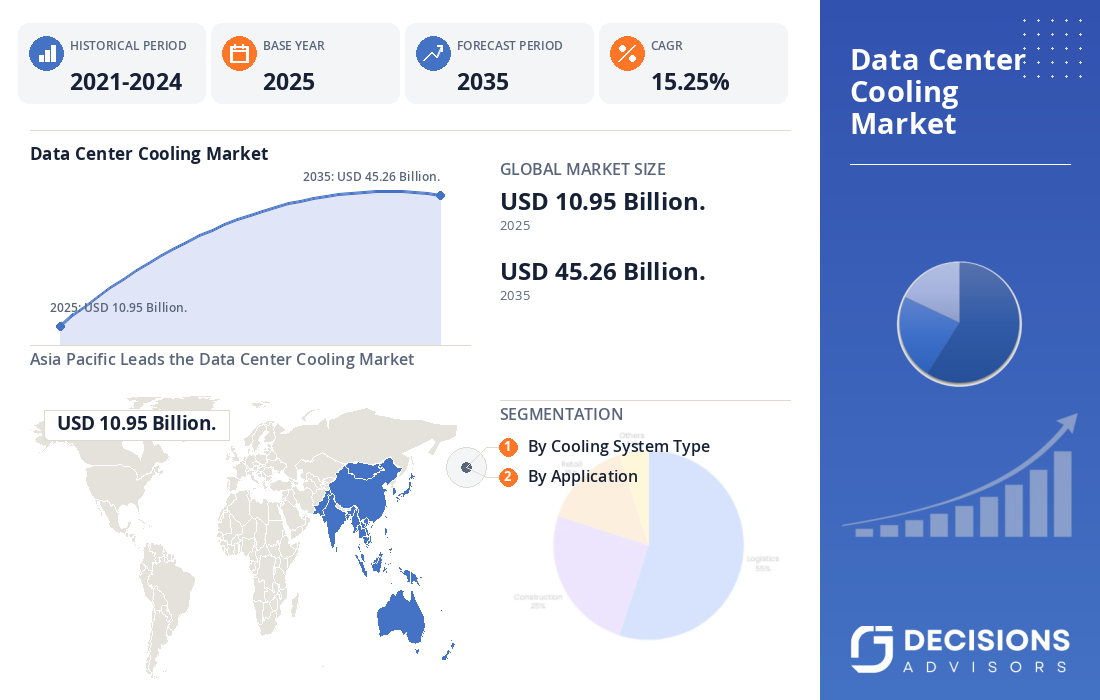
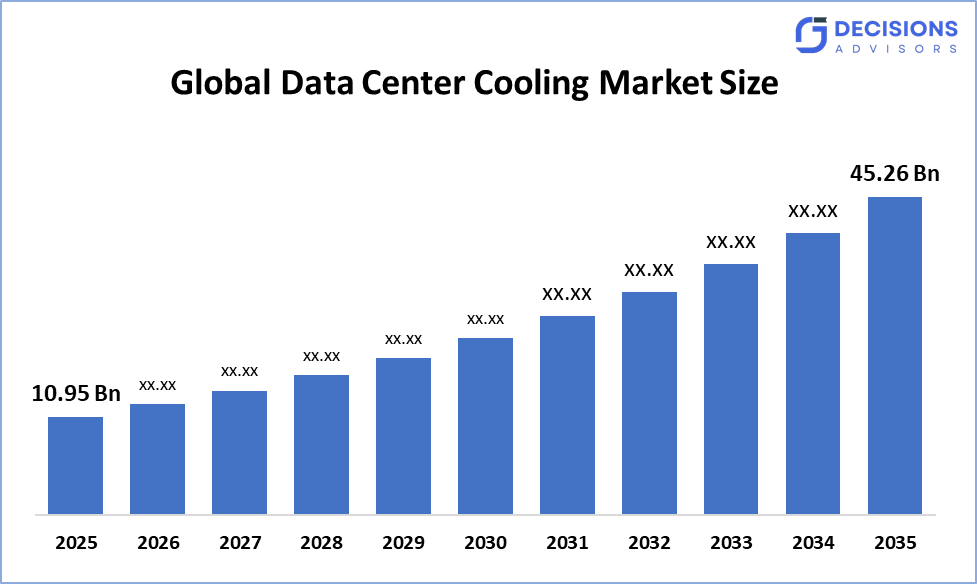
The global data center cooling market size is predicted to grow from USD 10.95 Billion in 2025 and is likely to reach around USD 45.26 Billion by 2035, with a CAGR of 15.25%. According to Decision Advisors, the rapid expansion of AI, high-performance computing, hyperscale facilities, and high-density GPU infrastructure is the principal growth driver, with advanced liquid cooling increasingly gaining market share. Vertiv, Schneider Electric, Johnson Controls, STULZ, Munters, and CoolIT Systems are among the major companies shaping the competitive landscape. Industry estimates also show strong momentum toward liquid-based cooling as rack power densities increase.
Market Snapshot
- Global Data Center Cooling Market Size (2025): USD 10.95 Billion.
- Projected Global Data Center Cooling Market Size (2035): USD 45.26 Billion.
- Global Data Center Cooling Market CAGR: 15.25%.
- Largest Regional Market: Asia Pacific
- 2nd Largest Region: America
- Fastest Growing Region: Europe
- Base Year: 2025
- Historical Period: 2021-2024
- Market Forecast Period: 2026-2035
Market Overview/ Introduction
The global data center cooling market comprises technologies and services used to remove heat generated by servers, gpus, networking equipment, storage systems, and other IT infrastructure. Cooling systems include precision air-conditioning units, chillers, cooling towers, heat exchangers, rear-door heat exchangers, direct-to-chip liquid cooling, and immersion cooling. Rapid cloud adoption, AI workloads, hyperscale expansion, edge computing, and increasing rack power density are creating strong demand for advanced thermal-management infrastructure. Industry research indicates that the global market was approximately USD 10.95 billion in 2025 and could reach USD 45.26 billion by 2035.
The shift toward AI infrastructure is particularly important because modern GPU and accelerator clusters generate substantially greater heat loads than conventional enterprise servers. Liquid cooling is consequently moving from a specialized technology toward a mainstream solution for high-density computing.
- United States, Federal programs are increasingly supporting data-center energy-efficiency initiatives. The U.S. Department of Energy's Federal Energy Management Program provides technical support, tools, best practices, and analyses for improving data-center energy efficiency.
- United States, The 2025 federal data-center infrastructure initiative also encouraged investment in large-scale data-center and associated energy infrastructure, increasing the long-term requirement for efficient thermal-management systems.
- Asia-Pacific, China, Japan, Singapore, India, and other Asian markets are expanding cloud, AI, and digital infrastructure, supporting demand for energy-efficient cooling and high-density thermal-management technologies.
Notable Insights: -
- Asia Pacific is anticipated to hold approximately 36% share of the Global Data Center Cooling Market over the predicted timeframe.
- North America is expected to hold approximately 27% share during the forecast period, supported by hyperscale AI infrastructure and major cloud-service investments.
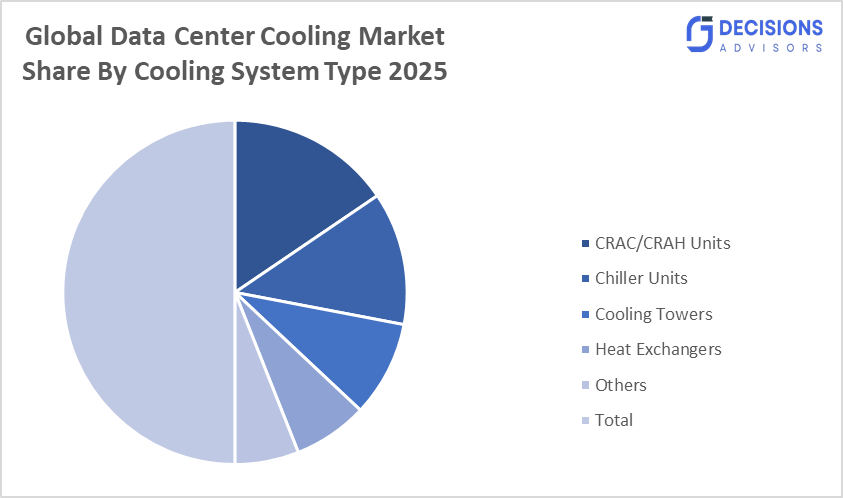
- By Cooling System Type, CRAC/CRAH Units dominated the market and held approximately 31% share in 2025.
- By Application, Hyperscale Data Centers dominated the market and held approximately 42% share in 2025.
- By Cooling Technology, Air-Based Cooling held approximately 62% share in 2025, although liquid cooling is expected to record faster growth.
- The compound annual growth rate of the Global Data Center Cooling Market is 15.25%.
- The market is likely to achieve a valuation of USD 45.26 Billion by 2035.
Market Drivers
The primary driver of the global data center cooling market is the rapid expansion of AI, cloud computing, high-performance computing, and data-intensive digital services. AI servers equipped with advanced GPUs generate significantly higher thermal loads, forcing operators to increase cooling capacity and adopt direct-to-chip liquid cooling, rear-door heat exchangers, and immersion technologies. Hyperscale cloud providers are also expanding data-center campuses to accommodate AI training and inference workloads, creating continuous demand for cooling infrastructure. Edge computing and 5G networks are further increasing demand for compact cooling systems in distributed facilities. At the same time, data-center operators are focusing on power usage effectiveness, water conservation, heat recovery, and intelligent cooling controls to lower operating costs and meet sustainability objectives.
Restrain
The market faces several restraints, including the high capital expenditure associated with advanced liquid-cooling infrastructure, integration complexity, and concerns surrounding water consumption in evaporative cooling systems. Retrofitting existing data centers can require substantial modifications to racks, piping, pumps, heat exchangers, and facility cooling loops. Operators also face challenges related to coolant management, maintenance expertise, reliability requirements, and compatibility with existing IT equipment.
Competitive Analysis:
The report offers the appropriate analysis of the key organizations/companies involved within the global data center cooling market, along with a comparative evaluation primarily based on their product offerings, business overviews, geographic presence, enterprise strategies, segment market share, and SWOT analysis. The report also provides an elaborative analysis focusing on the current news and developments of the companies, which includes product development, innovations, joint ventures, partnerships, mergers & acquisitions, strategic alliances, and others. This allows for the evaluation of the overall competition within the market.
Top Companies in the Global Data Center Cooling Market
- Vertiv Holdings Co.
- Schneider Electric
- Johnson Controls International plc
- Munters Group AB
- STULZ GmbH
- CoolIT Systems
- Danfoss A/S
- Carrier Global Corporation
- Rittal GmbH & Co. KG
- Alfa Laval.
Government Initiatives
|
Country |
Key Government Initiatives |
|
United States |
The U.S. Department of Energy supports federal data-center energy-efficiency projects through technical assistance, tools, best practices, and technology guidance. The federal government has also promoted accelerated development of large-scale data-center infrastructure |
|
Japan |
Japan's digital-infrastructure expansion and energy-efficiency focus are encouraging data-center operators to deploy efficient thermal-management systems, particularly as cloud and AI workloads increase |
|
China |
China's green-data-center and digital-infrastructure programs emphasize energy efficiency, intelligent computing, and lower resource consumption, supporting adoption of efficient cooling technologies |
Market Segmentation
The global data center cooling market share is classified into Cooling System Type, Application, and Cooling Technology.
- The CRAC/CRAH Units segment dominated the market and holds approximately 31% share in 2025 and is projected to grow at a substantial CAGR during the forecast period.
Based on cooling system type, the global data center cooling market is divided into CRAC/CRAH Units, chiller units, cooling towers, heat exchangers, and others. Among these, CRAC/CRAH units dominate because they remain widely deployed in conventional enterprise, colocation, and hyperscale facilities. They provide precise temperature and humidity control and can be integrated with raised-floor and contained-airflow architectures. Their established installed base and relatively straightforward maintenance continue to support demand, even as liquid cooling gains importance in high-density AI environments.
- The Hyperscale Data Centers segment accounted for the largest share of approximately 42% in 2025 and is anticipated to grow at a significant CAGR during the forecast period.
Based on Application, the market is divided into Hyperscale Data Centers, Colocation Data Centers, Enterprise Data Centers, and Edge Data Centers. Among these, Hyperscale Data Centers accounted for the largest share and hold approximately 42% share in 2025. Hyperscale operators are rapidly expanding AI and cloud infrastructure, requiring high-capacity cooling systems capable of handling substantial rack densities. The increasing deployment of GPU clusters and accelerated-computing platforms is encouraging hyperscalers to adopt liquid cooling and hybrid thermal architectures. Continuous investment by cloud and technology companies is therefore expected to maintain the segment's leading position.
- The Air-Based Cooling segment accounted for the largest share of approximately 62% in 2025 and is anticipated to grow at a significant CAGR during the forecast period.
Based on Cooling Technology, the market is divided into Air-Based Cooling, Direct-to-Chip Liquid Cooling, Immersion Cooling, and Hybrid Cooling. Among these, Air-Based Cooling dominates because it has the largest installed base and remains economical for conventional and medium-density workloads. CRAC/CRAH systems, chillers, cooling towers, and containment technologies are widely understood by data-center operators. However, Direct-to-Chip Liquid Cooling is expected to register faster growth because AI and HPC workloads increasingly exceed the practical thermal limits of traditional air cooling.
Regional Segment Analysis of the Global Data Center Cooling Market
- North America (U.S., Canada, Mexico)?
- Europe (Germany, U.K., France, Italy, Spain, Netherlands, Rest of Europe).
- Asia-Pacific (China, Japan, India, Australia, South Korea, Rest of Asia-Pacific).
- South America (Brazil, Argentina, Rest of South America).
- Middle East & Africa (UAE, Saudi Arabia, South Africa, Rest of MEA).
Asia Pacific is anticipated to hold approximately 36% share of the global data center cooling market over the predicted timeframe.
Asia Pacific represents the largest regional market because of its expanding cloud infrastructure, rapidly growing digital economy, large electronics ecosystem, and increasing data-center investments in China, Japan, India, South Korea, Singapore, and Australia. China remains a major contributor because of its large-scale computing infrastructure, while India is becoming an important destination for hyperscale and colocation facilities. Increasing AI adoption and rising rack densities are encouraging operators to move toward advanced liquid and hybrid cooling technologies. The region's strong manufacturing ecosystem also supports the local supply of cooling components, semiconductor equipment, heat exchangers, and related infrastructure.
North America is expected to grow at a rapid CAGR in the Global Data Center Cooling Market, holding approximately 27% of the share during the forecast period.
North America benefits from the presence of major cloud providers, AI companies, hyperscale operators, and advanced data-center infrastructure suppliers. The United States remains the dominant contributor because of substantial AI infrastructure investment and a large installed base of hyperscale and colocation facilities. Growing GPU density is increasing the need for direct-to-chip liquid cooling, rear-door heat exchangers, and high-capacity cooling distribution systems. At the same time, energy and water concerns are pushing operators toward more efficient cooling architectures. The U.S. DOE continues to provide technical resources for data-center energy efficiency.
Europe is expected to be the fastest-growing region in the Global Data Center Cooling Market during the forecast period, holding approximately 22% share.
Europe is experiencing strong demand for energy-efficient data-center infrastructure due to sustainability requirements, increasing cloud adoption, and the expansion of AI computing. Germany, the U.K., France, the Netherlands, Ireland, and the Nordic countries are major data-center locations. Operators are increasingly evaluating liquid cooling, free cooling, heat reuse, and renewable-energy integration to reduce operational energy consumption. The region's focus on environmental performance and efficient digital infrastructure is expected to accelerate investment in next-generation cooling technologies.
Future Market Trends in Global Data Center Cooling Market: -
- Expansion of Direct-to-Chip Liquid Cooling
Direct-to-chip liquid cooling is expected to become one of the most important technologies in high-density AI data centers. The approach transfers heat directly from processors through cold plates and coolant loops, enabling higher rack densities than conventional air cooling.
- Growth of Immersion Cooling
Immersion cooling is gaining attention for extremely high-density computing because servers can be submerged in dielectric fluids that efficiently absorb heat. The technology can reduce dependence on conventional air-conditioning infrastructure and may become increasingly relevant for specialized AI and HPC environments.
- ???????AI-Based Cooling Optimization
Artificial intelligence and machine learning are increasingly being applied to optimize cooling-system operation. Intelligent controllers can analyze temperature, airflow, workload, and equipment conditions to dynamically adjust cooling capacity. Research into reinforcement-learning-based cooling optimization has demonstrated the potential for substantial reductions in cooling energy consumption.
- ???????Heat Recovery and Water-Efficient Cooling
Data-center operators are increasingly exploring heat recovery, dry cooling, closed-loop systems, and water-efficient technologies. Growing community and regulatory concerns regarding data-center water consumption are likely to encourage cooling architectures that reduce freshwater requirements while maintaining reliable thermal performance.
Recent Development
- In February 2025, Vertiv launched Vertiv Liquid Cooling Services globally, providing installation, fluid-management, maintenance, and digital services for liquid-cooled systems supporting AI and high-density computing.
- In June 2025, Vertiv expanded its CoolChip CDU family with the CoolChip CDU 70, CDU 100, and CDU 600 for direct-to-chip liquid cooling applications serving AI and HPC workloads in EMEA.
- In June 2026, CoolIT Systems demonstrated a 15 kW coldplate design, nearly quadrupling the capacity of its previous demonstrated single-phase direct-liquid-cooling coldplate and targeting future high-density AI infrastructure.
Market Segment
This study forecasts revenue at global, regional, and country levels from 2021 to 2035. Decision Advisors has segmented the global data center cooling market based on the below-mentioned segment:
Global Data Center Cooling Market, By Cooling System Type
- CRAC/CRAH Units
- Chiller Units
- Cooling Towers
- Heat Exchangers
- Others.
Global Data Center Cooling Market, By Application
- Hyperscale Data Centers
- Colocation Data Centers
- Enterprise Data Centers
- Edge Data Centers.
Global Data Center Cooling Market, By Cooling Technology.
- Air-Based Cooling
- Direct-to-Chip Liquid Cooling
- Immersion Cooling
- Hybrid Cooling.
Global Data Center Cooling Market, By Regional Analysis.
North America
- US
- Canada
- Mexico
Europe
- Germany
- UK
- France
- Italy
- Spain
- Russia
- Rest of Europe
Asia Pacific
- China
- Japan
- India
- South Korea
- Australia
- Rest of Asia Pacific
South America
- Brazil
- Argentina
- Rest of South America
Middle East & Africa
- UAE
- Saudi Arabia
- Qatar
- South Africa
- Rest of the Middle East & Africa
Frequently Asked Questions (FAQ)
Q. Why is liquid cooling becoming important in data centers?
A. AI accelerators and high-performance processors generate substantially more heat than conventional server workloads. Direct-to-chip and immersion cooling provide more efficient heat removal and enable higher rack densities than traditional air-based systems.
Q. What is the difference between air cooling and liquid cooling in data centers?
A. Air cooling uses CRAC/CRAH units, chillers, airflow management, and heat-rejection equipment to remove server heat. Liquid cooling transfers heat using a liquid medium and is particularly effective for high-density AI and HPC workloads.
Q. Which application segment dominates the data center cooling market?
A. Hyperscale data centers represent the leading application segment because large cloud and technology companies are expanding AI, cloud-computing, and high-performance infrastructure. Their high rack densities require increasingly advanced thermal-management systems.
Q. What is the biggest future opportunity in data center cooling?
A. The strongest opportunity is expected to come from direct-to-chip liquid cooling, immersion cooling, intelligent cooling controls, and water-efficient heat-rejection systems. These technologies address the growing thermal and sustainability requirements of AI-driven data centers.
Check Licence
Choose the plan that fits you best: Single User, Multi-User, or Enterprise solutions tailored for your needs.
We Have You Covered
- 24/7 Analyst Support
- Clients Across the Globe
- Tailored Insights
- Technology Tracking
- Competitive Intelligence
- Custom Research
- Syndicated Market Studies
- Market Overview
- Market Segmentation
- Growth Drivers
- Market Opportunities
- Regulatory Insights
- Innovation & Sustainability
Report Details
| Scope | Global |
| Pages | 225 |
| Delivery | PDF & Excel via Email |
| Language | English |
| Release | Aug 2026 |
| Access | Download from this page |