
Global Dental Radiometers Market
 |
Author:
David J
|
Pages:
210
|
Author:
David J
|
Pages:
210
Global Dental Radiometers Market Size, Share, By Product Type (Digital Radiometers and Analog Radiometers) By Technology (LED-based Measurement and Halogen-based Measurement) By End User (Private Dental Clinics, Hospitals & Academic Institutes, and Dental Laboratories) and By Region (North America, Europe, Asia-Pacific, Latin America, Middle East, and Africa), Analysis and Forecast 2025 ? 2035
REPORT COVERAGE
Global
Market Snapshot
- Market Size (2025): USD 176.20 Million
- Projected Market Size (2035): USD 339.2 Million
- Compound Annual Growth Rate (CAGR): 6.77%
- Largest Regional Market: North America
- Fastest Growing Region: Asia-Pacific
- 3rd Largest Region: Europe
- Base Year: 2024
- Historical Period: 2021–2024
- Forecast Period: 2025–2035
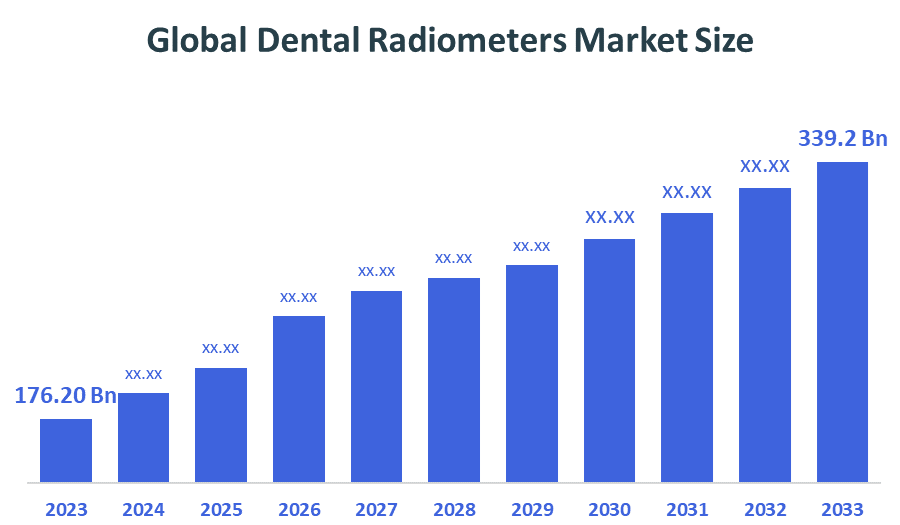
According to Decision Advisors, the Global Dental Radiometer Market Size is expected to grow from USD 176.20 million in 2025 to USD 339.2 million by 2035, at a CAGR of 6.77% during the forecast period 2025–2035. The market is projected to expand steadily over the next decade, driven by the increasing global demand for precise restorative procedures and a rising emphasis on the clinical validation of light-curing equipment. This growth is further supported by the shift toward digital dentistry, including the adoption of high-accuracy handheld meters that offer practitioners immediate feedback and greater confidence in composite polymerisation. As dental associations worldwide implement stricter quality control protocols and technological advancements in sensor sensitivity make testing more efficient, the integration of radiometers into routine practice maintenance is increasing, solidifying the market’s long-term trajectory.
Market Overview/ Introduction
The global dental radiometer market shows a growing commitment to clinical precision and long-term restorative success. A dental radiometer is a specialised diagnostic tool that measures the blue light output of curing units. This ensures that resin-based materials achieve full polymerization. The technology has advanced from basic analogue sensors to digital systems that use sensitive photodiodes. These photodiodes can detect a wide range of wavelengths found in modern LED lights. In clinical practice, these devices perform routine checks of curing equipment. This helps dentists spot any drop in light intensity before it causes restoration failures or secondary decay. Recent government and professional efforts, like the National Dental Commission and updated medical device safety standards, have stressed the importance of consistent equipment checks. This move toward evidence-based maintenance practices directly affects patient safety by reducing post-operative complications and improving the overall quality of oral healthcare worldwide.
- North America contributes more than 30% of global revenue, supported by high dental care expenditure (over USD 150 billion annually in the U.S. dental sector) and widespread adoption of advanced dental devices.
- LED-based curing technologies dominate the market, accounting for over 50% share, which directly increases the need for radiometers to ensure proper light intensity and curing efficiency.
- Preventive dental care awareness has increased globally, with over 3.5 billion people affected by oral diseases, which indirectly supports the demand for accurate dental treatment tools such as radiometers.
Notable Insights: -
- North America holds the largest share of the global dental radiometer market, accounting for approximately 32% of total revenue in 2025, supported by advanced dental infrastructure and high adoption of digital dentistry tools.
- The Asia-Pacific region is the fastest-growing market, projected to expand at a CAGR of around 8%, driven by increasing dental awareness, rising patient volume, and rapid expansion of private dental clinics in countries like India and China.
- By product type, digital/LED-based radiometers dominate the market, contributing nearly 50% of the total share, due to their higher accuracy and compatibility with modern LED curing lights.
- By end user, dental clinics represent the leading segment, accounting for over 60% of market share in 2025, as these devices are routinely used in restorative and cosmetic dental procedures.
- The global dental radiometer market is growing at a Compound Annual Growth Rate (CAGR) of approximately 6.5% during the forecast period.
- The market is projected to reach a valuation of over USD 300 million by 2035, increasing from an estimated USD 160–170 million in 2025, driven by technological advancements and rising demand for precision in dental treatments.
What is the role of technology in grooming the market?
Technology is fundamentally reshaping the dental radiometers market by shifting the focus toward digital precision and automated quality assurance. In the modern restorative landscape, the transition from analogue to digital sensors is a primary driver of change, as digital radiometers provide more accurate and quantised data that is essential for verifying high-intensity LED curing units. The integration of wireless connectivity and smart data-logging features is also gaining traction, allowing dental practices to track the performance history of their equipment over time and ensure every restoration meets strict polymerisation standards. Furthermore, the rise of AI-driven diagnostics in dentistry is creating a synergistic effect, where automated interpretation and real-time monitoring of clinical tools help practitioners reduce human error and improve procedural outcomes.
How are Recent Developments Helping the Market?
Recent developments such as product innovation, digital workflow integration, and the expansion of smart dental technology are fuelling the global dental radiometers market growth. In 2025, a significant number of new diagnostic sensors and handheld measurement devices will have been introduced, showcasing rapid innovation in multi-wavelength detection and wireless data synchronisation. The preference for high-precision digital radiometers is rising as a majority of dental professionals are increasingly adopting LED-optimised meters over traditional analogue tools to ensure the performance of high-power curing lights. Furthermore, the availability of specialised equipment through professional e-commerce channels has improved, driven by the rise of direct-to-clinician health platforms that offer faster access to the latest diagnostic technology.
Market Drivers
The global dental radiometers market is expanding as healthcare providers adopt advanced diagnostic tools to ensure the success of restorative procedures. Digital measurement solutions are increasingly favoured for their ability to provide precise validation of curing light intensity and identify performance issues before they impact patient outcomes. North America remains the dominant region, holding an estimated 39.5% market share in 2025 due to high levels of technological integration and strict adherence to clinical maintenance protocols. At the same time, the transition toward evidence-based dentistry is driving the use of portable and handheld radiometers that offer immediate feedback at the chairside. Increasing awareness of the connection between insufficient polymerisation and restoration failure is encouraging practitioners to shift from reactive equipment care to regular, data-driven audits. Furthermore, the development of universal sensors capable of measuring diverse light spectra is appealing to high-volume clinics that prioritise efficiency and versatile diagnostic capabilities.
Restraints
The dental radiometers market faces challenges such as the high cost of digital sensors and a lack of universal calibration standards across brands. Many practices continue to rely on outdated analogue meters or visual checks, which hinders the adoption of high-precision technology. Furthermore, the absence of mandatory global regulations for routine light audits allows for inconsistent maintenance habits. Limited awareness in emerging economies regarding the clinical risks of poor polymerisation also restricts widespread use. These hurdles highlight the need for more affordable, standardised solutions and better professional education to ensure global restorative success.
Competitive Analysis:
The report offers the appropriate analysis of the key organisations/companies involved within the dental radiometer market, along with a comparative evaluation primarily based on their product offerings, business overviews, geographic presence, enterprise strategies, segment market share, and SWOT analysis. The report also provides an elaborate analysis focusing on the current news and developments of the companies, which includes product development, innovations, joint ventures, partnerships, mergers & acquisitions, strategic alliances, and others. This allows for the evaluation of the overall competition within the market.
Top 10 Companies in the Dental Radiometers Market
- Henry Schein
- Ivoclar Vivadent
- SDI
- Kerr Restoratives
- Dentalget
- DentAmerica
- Dymax Corporation
- First Medica
- Practicon, Inc
- Motion Dental Equipment Corporation
Government Initiatives
|
Country |
Key Government Initiatives |
|
US |
In the United States, oral healthcare is supported through federal programs such as Medicaid and the Children’s Health Insurance Program (CHIP), which collectively cover over 90 million Americans. The government also promotes preventive dental care under initiatives aligned with Healthy People 2030, focusing on increasing access to oral health services. These programs indirectly drive demand for dental equipment, including radiometers, as clinics adopt standardised tools to ensure treatment quality and safety. |
|
India |
India has strengthened oral healthcare delivery under the National Oral Health Programme (NOHP), aimed at improving access to preventive and curative dental services, particularly in rural areas. The government supports over 1.5 lakh Health and Wellness Centres under Ayushman Bharat, where basic dental services are being integrated. These efforts increase the need for reliable dental tools, including radiometers, to maintain treatment standards across expanding public healthcare facilities. |
|
China |
China’s healthcare reforms under the Healthy China 2030 initiative emphasise preventive healthcare, including oral health awareness and early diagnosis. The policy promotes the expansion of dental services and modernisation of clinical infrastructure, encouraging the adoption of advanced dental technologies. This indirectly supports the demand for precision devices such as dental radiometers in both public and private dental institutions. |
Study on Supply, Demand, Distribution, and Market Environment
The global dental radiometer market is influenced by a combination of controlled supply, rising clinical demand, evolving distribution channels, and a quality-focused market environment. On the supply side, the market is supported by specialised dental equipment manufacturers offering increasingly advanced digital radiometers with improved sensor accuracy and durability. Demand is steadily increasing due to the growing number of restorative and cosmetic dental procedures, along with the rising adoption of LED curing systems that require precise light intensity validation. In terms of distribution, while traditional channels such as authorised dealers and dental equipment suppliers remain dominant, there is a noticeable shift toward online platforms and direct-to-clinic sales, improving accessibility for smaller practices.
Price Analysis and Consumer Behaviour Analysis
Pricing in the dental radiometer market varies depending on product type, technology, and brand positioning, with digital radiometers generally priced higher than analogue models due to their enhanced precision and advanced features. High-end devices equipped with multi-wavelength detection and smart calibration capabilities are positioned in the premium segment, while basic models cater to cost-sensitive users. From a consumer behaviour perspective, dental professionals prioritise accuracy, reliability, and long-term performance over initial cost, as proper curing directly impacts treatment success and patient satisfaction. In developing markets, however, pricing remains a key consideration, leading to a balanced demand for both mid-range and entry-level devices. Purchasing decisions are also influenced by factors such as product durability, ease of use, after-sales service, and compatibility with existing dental equipment, reflecting a shift toward value-based decision-making rather than purely price-driven choices.
Market Segmentation
The dental radiometers market share is classified into product type, technology, and end user.
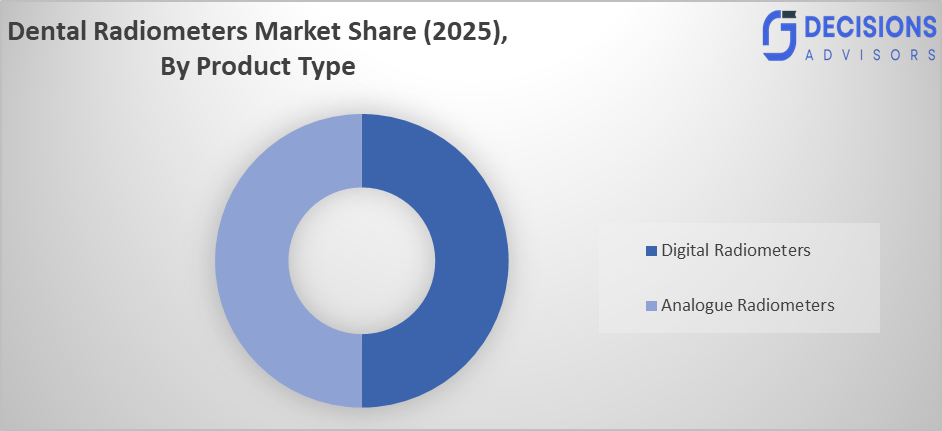
By product type, digital dental radiometers dominate the global dental radiometer market, accounting for approximately 50% of the total market share in 2025.
Based on the product type, the dental radiometer market is segmented into digital radiometers and analogue radiometers. By product type, digital dental radiometers dominate the global dental radiometer market, accounting for approximately 50% of the total market share in 2025. The digital radiometer segment dominated the market in 2024 and is expected to grow at a steady CAGR of around 6.5% to 7.5% during the forecast period. This dominance is mainly attributed to the increasing demand for precise light intensity measurement in modern dental procedures.
By technology, LED-based measurement systems hold the largest share, contributing approximately 55% of the market in 2025.
Based on technology, the dental radiometer market is segmented into LED-based measurement and halogen-based measurement. By technology, LED-based measurement systems hold the largest share, contributing approximately 55% of the market in 2025. The LED-based segment dominates due to the widespread transition from traditional halogen curing lights to LED curing technologies in dental practices. LED systems provide higher efficiency, longer lifespan, and stable light output, which necessitates accurate monitoring through compatible radiometers.
By end user, private dental clinics account for the largest share, representing over 60% of the global market in 2025.
Based on end user, the market is categorised into private dental clinics, hospitals & academic institutes, and dental laboratories. By end user, private dental clinics account for the largest share, representing over 60% of the global market in 2025. The private dental clinics segment leads the market as these facilities perform a high volume of restorative and cosmetic dental procedures that require precise curing processes. The increasing number of private dental practices worldwide, along with rising patient visits for aesthetic and preventive treatments, is significantly contributing to segment growth.
Strategies to Implement for Growth of the Market in Non-Leading Regions
Market growth in non-leading regions can be accelerated by introducing affordable, high-durability digital radiometers and expanding e-commerce accessibility. Strengthening partnerships with local dental schools and professional associations is essential to educate practitioners on the link between light-intensity monitoring and restoration longevity. Furthermore, collaborating with health authorities to include equipment validation in clinical guidelines will drive the adoption of these diagnostic tools. By offering flexible financing and localised technical support, manufacturers can help smaller clinics transition from legacy tools to modern systems, ultimately improving the global standard of restorative care.
Regional Segment Analysis of the Dental Radiometer Market
• North America (U.S., Canada, Mexico)
• Europe (Germany, France, U.K., Italy, Spain, Rest of Europe)
• Asia-Pacific (China, Japan, India, Rest of APAC)
• Latin America (Brazil and the Rest of Latin America)
• The Middle East and Africa (UAE, South Africa, Rest of MEA)
North America is anticipated to hold the largest share of the dental radiometers market during the forecast period. The region dominates the market, accounting for approximately 41% of the global revenue share, supported by exceptionally advanced healthcare systems and the high adoption rate of modern digital diagnostic technologies. The United States contributes the majority of this regional revenue due to strong healthcare spending, widespread clinical quality control programs, and the early adoption of innovative LED-measurement solutions.
Asia-Pacific is anticipated to hold the fastest growth in the dental radiometers market over the predicted timeframe. This region is expected to witness the highest growth during the forecast period, with an estimated CAGR of around 9.8%, while accounting for approximately 22% of the global market share. This expansion is primarily driven by improving healthcare infrastructure, rising awareness about oral health standards, and massive population bases in countries like China and India. The region is benefiting from increasing government-led dental health programs and expanding access to diagnostic services, especially in rapidly developing urban and semi-urban areas.
Europe is expected to hold the third-largest share in the dental radiometers market during the forecast period, contributing approximately 27% of the global market share. Europe maintains a strong position due to well-established healthcare systems and consistent professional support for high-standard restorative programs. Countries such as Germany, France, and the United Kingdom contribute significantly due to high awareness levels and routine clinical audit initiatives.
Future Market Trends in the Global Dental Radiometers Market: -
1. Increasing Adoption of Digital and Smart Radiometers
There is a noticeable transition from conventional analogue devices to digital and smart radiometers equipped with advanced sensors and real-time display systems. These devices improve measurement accuracy by up to 15% and reduce the risk of improper curing in dental procedures.
2. Growing Demand Driven by LED-Based Curing Technologies
The widespread shift toward LED curing lights, which account for over 50% of dental curing systems, is significantly boosting the demand for compatible radiometers. LED systems require precise intensity validation, leading to increased adoption of radiometers that can accurately measure irradiance levels.
3. Expansion of Dental Care Infrastructure in Emerging Markets
Market growth is accelerating in developing regions such as Asia-Pacific and Latin America, where improving healthcare infrastructure and rising awareness of oral health are increasing dental visits. The expansion of private dental clinics and government-supported oral health programs is driving demand for reliable dental tools, including radiometers, especially in countries like India, Brazil, and China.
Recent Developments
- In March 2025, Ivoclar Vivadent continued expanding its Bluephase curing light ecosystem with integrated radiometer functionality, enabling dental professionals to monitor light intensity in real time and improve curing consistency.
- In October 2024, Bluelight Analytics received a U.S. patent for its CheckUp Smart Radiometer, which uses advanced optical sensors and intelligent diagnostics to enhance curing light measurement accuracy.
- In August 2024, Kerr Restoratives strengthened its dental equipment portfolio by promoting Demetron curing light systems with built-in radiometer validation features, supporting improved clinical performance and reliability.
- In May 2023, 3M advanced its dental solutions segment by integrating curing light monitoring tools alongside restorative systems, emphasising the importance of accurate light intensity verification in dental procedures.
- In February 2023, Dentsply Sirona highlighted the role of radiometer-compatible curing systems in its restorative dentistry portfolio, focusing on improving treatment precision and long-term restoration durability.
Market Segment
This study forecasts revenue at global, regional, and country levels from 2020 to 2035. The dental radiometer market is segmented based on the following categories:
Global Dental Radiometer Market, By Product Type
• Digital Radiometers
• Analogue Radiometers
Global Dental Radiometer Market, By Technology
• LED-based Measurement
• Halogen-based Measurement
Global Dental Radiometer Market, By End User
• Private Dental Clinics
• Hospitals & Academic Institutes
• Dental Laboratories
Global Dental Radiometers Market, By Regional Analysis
• North America
• US
• Canada
• Mexico
• Europe
• Germany
• UK
• France
• Italy
• Spain
• Russia
• Rest of Europe
• Asia Pacific
• China
• Japan
• India
• South Korea
• Australia
• Rest of Asia Pacific
• Latin America
• Brazil
• Argentina
• Rest of Latin America
• Middle East & Africa
• UAE
• Saudi Arabia
• Qatar
• South Africa
• Rest of the Middle East & Africa
Frequently Asked Questions (FAQ)
How are technological advancements influencing growth in the global dental radiometer market?
Technological advancements such as digital radiometers, smart sensors, and real-time measurement systems are significantly improving the accuracy of curing light intensity in dental procedures. These innovations help ensure proper polymerisation of dental materials and reduce treatment errors.
Why is the demand for dental radiometers increasing in modern dentistry?
The rising use of LED curing lights and advanced restorative materials has increased the need for precise light intensity measurement. Dental radiometers play a critical role in maintaining treatment quality by verifying curing performance.
Which end-user segment contributes the most to the dental radiometer market?
Private dental clinics account for the largest share of the market, as they perform a high volume of restorative and cosmetic procedures. These clinics increasingly invest in advanced dental equipment, including radiometers, to improve treatment efficiency and patient satisfaction.
What factors are driving growth in emerging markets for dental radiometers?
Growth in emerging markets is supported by expanding dental infrastructure, increasing awareness of oral health, and rising disposable income. The growing number of private dental clinics and government initiatives to improve healthcare access are also contributing to higher adoption of dental radiometers.
How do dental radiometers improve treatment quality in dental procedures?
Dental radiometers ensure that curing lights deliver the correct intensity required for proper hardening of dental materials. Accurate measurement helps avoid under-curing or over-curing, both of which can lead to restoration failure, sensitivity issues, or reduced lifespan of dental treatments.
- Introduction
- Objectives of the Study
- Market Definition
- Research Scope
- Research Methodology and Assumptions
- Executive Summary
- Premium Insights
- Porter’s Five Forces Analysis
- Value Chain Analysis
- Top Investment Pockets
- Market Attractiveness Analysis By Product Type
- Market Attractiveness Analysis By Technology
- Market Attractiveness Analysis By End User
- Market Attractiveness Analysis By Region
- Industry Trends
- Market Dynamics
- Market Evaluation
- Drivers
- Demand for accurate light intensity measurement in dental curing procedures
- Restraints
- High cost associated with advanced and digital dental radiometers
- Opportunities
- Rising adoption of technologically portable dental diagnostic devices
- Challenges
5.5.1. Lack of standardization across small and mid-sized dental clinics
- Global Dental Radiometers Market Analysis and Projection, By Product Type
- Segment Overview
- Digital Radiometers
- Analog Radiometers
- Global Dental Radiometers Market Analysis and Projection, By Technology
- Segment Overview
- LED-based Measurement
- Halogen-based Measurement
- Global Dental Radiometers Market Analysis and Projection, By End User
- Segment Overview
- Private Dental Clinics
- Hospitals & Academic Institutes
- Dental Laboratories
- Global Dental Radiometers Market Analysis and Projection, By Regional Analysis
- Segment Overview
- North America
- U.S.
- Canada
- Mexico
- Europe
- Germany
- France
- U.K.
- Italy
- Spain
- Asia-Pacific
- Japan
- China
- India
- South America
- Brazil
- Middle East and Africa
- UAE
- South Africa
- Global Dental Radiometers Market-Competitive Landscape
- Overview
- Market Share of Key Players in the Dental Radiometers Market
- Global Company Market Share
- North America Company Market Share
- Europe Company Market Share
- APAC Company Market Share
- Competitive Situations and Trends
- Coverage Launches and Developments
- Partnerships, Collaborations, and Agreements
- Mergers & Acquisitions
- Expansions
- Company Profiles
- Henry Schein
- Business Overview
- Company Snapshot
- Company Market Share Analysis
- Company Coverage Portfolio
- Recent Developments
- SWOT Analysis
- Ivoclar Vivadent
- Business Overview
- Company Snapshot
- Company Market Share Analysis
- Company Coverage Portfolio
- Recent Developments
- SWOT Analysis
- SDI
- Business Overview
- Company Snapshot
- Company Market Share Analysis
- Company Coverage Portfolio
- Recent Developments
- SWOT Analysis
- Kerr Restoratives
- Business Overview
- Company Snapshot
- Company Market Share Analysis
- Company Coverage Portfolio
- Recent Developments
- SWOT Analysis
- Dentalget
- Business Overview
- Company Snapshot
- Company Market Share Analysis
- Company Coverage Portfolio
- Recent Developments
- SWOT Analysis
- DentAmerica
- Business Overview
- Company Snapshot
- Company Market Share Analysis
- Company Coverage Portfolio
- Recent Developments
- SWOT Analysis
- Dymax Corporation
- Business Overview
- Company Snapshot
- Company Market Share Analysis
- Company Coverage Portfolio
- Recent Developments
- SWOT Analysis
- First Medica
- Business Overview
- Company Snapshot
- Company Market Share Analysis
- Company Coverage Portfolio
- Recent Developments
- SWOT Analysis
- Practicon, Inc
- Business Overview
- Company Snapshot
- Company Market Share Analysis
- Company Coverage Portfolio
- Recent Developments
- SWOT Analysis
- Motion Dental Equipment Corporation
- Business Overview
- Company Snapshot
- Company Market Share Analysis
- Company Coverage Portfolio
- Recent Developments
- SWOT Analysis
- Henry Schein
List of Table
- Global Dental Radiometers Market, By Product Type, 2024-2035(USD Billion)
- Global Digital Radiometers, Dental Radiometers Market, By Region, 2024-2035(USD Billion)
- Global Analog Radiometers, Dental Radiometers Market, By Region, 2024-2035(USD Billion)
- Global Dental Radiometers Market, By Technology, 2024-2035(USD Billion)
- Global LED-based Measurement, Dental Radiometers Market, By Region, 2024-2035(USD Billion)
- Global Halogen-based Measurement, Dental Radiometers Market, By Region, 2024-2035(USD Billion)
- Global Dental Radiometers Market, By End User, 2024-2035(USD Billion)
- Global Private Dental Clinics, Dental Radiometers Market, By Region, 2024-2035(USD Billion)
- Global Hospitals & Academic Institutes, Dental Radiometers Market, By Region, 2024-2035(USD Billion)
- Global Dental Laboratories, Dental Radiometers Market, By Region, 2024-2035(USD Billion)
- North America Dental Radiometers Market, By Product Type, 2024-2035(USD Billion)
- North America Dental Radiometers Market, By Technology, 2024-2035(USD Billion)
- North America Dental Radiometers Market, By End User, 2024-2035(USD Billion)
- U.S. Dental Radiometers Market, By Product Type, 2024-2035(USD Billion)
- U.S. Dental Radiometers Market, By Technology, 2024-2035(USD Billion)
- U.S. Dental Radiometers Market, By End User, 2024-2035(USD Billion)
- Canada Dental Radiometers Market, By Product Type, 2024-2035(USD Billion)
- Canada Dental Radiometers Market, By Technology, 2024-2035(USD Billion)
- Canada Dental Radiometers Market, By End User, 2024-2035(USD Billion)
- Mexico Dental Radiometers Market, By Product Type, 2024-2035(USD Billion)
- Mexico Dental Radiometers Market, By Technology, 2024-2035(USD Billion)
- Mexico Dental Radiometers Market, By End User, 2024-2035(USD Billion)
- Europe Dental Radiometers Market, By Product Type, 2024-2035(USD Billion)
- Europe Dental Radiometers Market, By Technology, 2024-2035(USD Billion)
- Europe Dental Radiometers Market, By End User, 2024-2035(USD Billion)
- Germany Dental Radiometers Market, By Product Type, 2024-2035(USD Billion)
- Germany Dental Radiometers Market, By Technology, 2024-2035(USD Billion)
- Germany Dental Radiometers Market, By End User, 2024-2035(USD Billion)
- France Dental Radiometers Market, By Product Type, 2024-2035(USD Billion)
- France Dental Radiometers Market, By Technology, 2024-2035(USD Billion)
- France Dental Radiometers Market, By End User, 2024-2035(USD Billion)
- U.K. Dental Radiometers Market, By Product Type, 2024-2035(USD Billion)
- U.K. Dental Radiometers Market, By Technology, 2024-2035(USD Billion)
- U.K. Dental Radiometers Market, By End User, 2024-2035(USD Billion)
- Italy Dental Radiometers Market, By Product Type, 2024-2035(USD Billion)
- Italy Dental Radiometers Market, By Technology, 2024-2035(USD Billion)
- Italy Dental Radiometers Market, By End User, 2024-2035(USD Billion)
- Spain Dental Radiometers Market, By Product Type, 2024-2035(USD Billion)
- Spain Dental Radiometers Market, By Technology, 2024-2035(USD Billion)
- Spain Dental Radiometers Market, By End User, 2024-2035(USD Billion)
- Asia Pacific Dental Radiometers Market, By Product Type, 2024-2035(USD Billion)
- Asia Pacific Dental Radiometers Market, By Technology, 2024-2035(USD Billion)
- Asia Pacific Dental Radiometers Market, By End User, 2024-2035(USD Billion)
- Japan Dental Radiometers Market, By Product Type, 2024-2035(USD Billion)
- Japan Dental Radiometers Market, By Technology, 2024-2035(USD Billion)
- Japan Dental Radiometers Market, By End User, 2024-2035(USD Billion)
- China Dental Radiometers Market, By Product Type, 2024-2035(USD Billion)
- China Dental Radiometers Market, By Technology, 2024-2035(USD Billion)
- China Dental Radiometers Market, By End User, 2024-2035(USD Billion)
- India Dental Radiometers Market, By Product Type, 2024-2035(USD Billion)
- India Dental Radiometers Market, By Technology, 2024-2035(USD Billion)
- India Dental Radiometers Market, By End User, 2024-2035(USD Billion)
- South America Dental Radiometers Market, By Product Type, 2024-2035(USD Billion)
- South America Dental Radiometers Market, By Technology, 2024-2035(USD Billion)
- South America Dental Radiometers Market, By End User, 2024-2035(USD Billion)
- Brazil Dental Radiometers Market, By Product Type, 2024-2035(USD Billion)
- Brazil Dental Radiometers Market, By Technology, 2024-2035(USD Billion)
- Brazil Dental Radiometers Market, By End User, 2024-2035(USD Billion)
- The Middle East and Africa Dental Radiometers Market, By Product Type, 2024-2035(USD Billion)
- The Middle East and Africa Dental Radiometers Market, By Technology, 2024-2035(USD Billion)
- The Middle East and Africa Dental Radiometers Market, By End User, 2024-2035(USD Billion)
- UAE Dental Radiometers Market, By Product Type, 2024-2035(USD Billion)
- UAE Dental Radiometers Market, By Technology, 2024-2035(USD Billion)
- UAE Dental Radiometers Market, By End User, 2024-2035(USD Billion)
- South Africa Dental Radiometers Market, By Product Type, 2024-2035(USD Billion)
- South Africa Dental Radiometers Market, By Technology, 2024-2035(USD Billion)
- South Africa Dental Radiometers Market, By End User, 2024-2035(USD Billion)
List of Figures
- Global Dental Radiometers Market Segmentation
- Dental Radiometers Market: Research Methodology
- Market Size Estimation Methodology: Bottom-Up Approach
- Market Size Estimation Methodology: Top-down Approach
- Data Triangulation
- Porter’s Five Forces Analysis
- Value Chain Analysis
- Top investment pocket in the Dental Radiometers Market
- Top Winning Strategies, 2024-2035
- Top Winning Strategies, By Development, 2024-2035(%)
- Top Winning Strategies, By Company, 2024-2035
- Moderate Bargaining power of Buyers
- Moderate Bargaining power of Suppliers
- Moderate Bargaining power of New Entrants
- Low threat of Substitution
- High Competitive Rivalry
- Top Player Positioning, 2024
- Market Share Analysis, 2024
- Restraint and Drivers: Dental Radiometers Market
- Dental Radiometers Market Segmentation, By Product Type
- Dental Radiometers Market For Digital Radiometers, By Region, 2024-2035 ($ Billion)
- Dental Radiometers Market For Analog Radiometers, By Region, 2024-2035 ($ Billion)
- Dental Radiometers Market Segmentation, By Technology
- Dental Radiometers Market For LED-based Measurement, By Region, 2024-2035 ($ Billion)
- Dental Radiometers Market For Halogen-based Measurement, By Region, 2024-2035 ($ Billion)
- Dental Radiometers Market Segmentation, By End User
- Dental Radiometers Market For Private Dental Clinics, By Region, 2024-2035 ($ Billion)
- Dental Radiometers Market For Hospitals & Academic Institutes, By Region, 2024-2035 ($ Billion)
- Dental Radiometers Market For Dental Laboratories, By Region, 2024-2035 ($ Billion)
- Henry Schein: Net Sales, 2024-2035 ($ Billion)
- Henry Schein: Revenue Share, By Segment, 2024 (%)
- Henry Schein: Revenue Share, By Region, 2024 (%)
- Ivoclar Vivadent: Net Sales, 2024-2035 ($ Billion)
- Ivoclar Vivadent: Revenue Share, By Segment, 2024 (%)
- Ivoclar Vivadent: Revenue Share, By Region, 2024 (%)
- SDI: Net Sales, 2024-2035 ($ Billion)
- SDI: Revenue Share, By Segment, 2024 (%)
- SDI: Revenue Share, By Region, 2024 (%)
- Kerr Restoratives: Net Sales, 2024-2035 ($ Billion)
- Kerr Restoratives: Revenue Share, By Segment, 2024 (%)
- Kerr Restoratives: Revenue Share, By Region, 2024 (%)
- Dentalget: Net Sales, 2024-2035 ($ Billion)
- Dentalget: Revenue Share, By Segment, 2024 (%)
- Dentalget: Revenue Share, By Region, 2024 (%)
- DentAmerica: Net Sales, 2024-2035 ($ Billion)
- DentAmerica: Revenue Share, By Segment, 2024 (%)
- DentAmerica: Revenue Share, By Region, 2024 (%)
- Dymax Corporation: Net Sales, 2024-2035 ($ Billion)
- Dymax Corporation: Revenue Share, By Segment, 2024 (%)
- Dymax Corporation: Revenue Share, By Region, 2024 (%)
- First Medica: Net Sales, 2024-2035 ($ Billion)
- First Medica: Revenue Share, By Segment, 2024 (%)
- First Medica: Revenue Share, By Region, 2024 (%)
- Practicon, Inc.: Net Sales, 2024-2035 ($ Billion)
- Practicon, Inc.: Revenue Share, By Segment, 2024 (%)
- Practicon, Inc.: Revenue Share, By Region, 2024 (%)
- Motion Dental Equipment Corporation: Net Sales, 2024-2035 ($ Billion)
- Motion Dental Equipment Corporation: Revenue Share, By Segment, 2024 (%)
- Motion Dental Equipment Corporation: Revenue Share, By Region, 2024 (%)
Check Licence
Choose the plan that fits you best: Single User, Multi-User, or Enterprise solutions tailored for your needs.
We Have You Covered
- 24/7 Analyst Support
- Clients Across the Globe
- Tailored Insights
- Technology Tracking
- Competitive Intelligence
- Custom Research
- Syndicated Market Studies
- Market Overview
- Market Segmentation
- Growth Drivers
- Market Opportunities
- Regulatory Insights
- Innovation & Sustainability
Report Details
| Scope | Global |
| Pages | 210 |
| Delivery | PDF & Excel via Email |
| Language | English |
| Release | Apr 2026 |
| Access | Download from this page |