
Global Dermatology Market
 |
Pages:
240
|
Pages:
240
Global Dermatology Market Size, Share, and COVID-19 Impact Analysis, By Type (Medical Dermatology, Surgical Dermatology, Pediatric Dermatology, Cosmetic Dermatology, Cutaneous Lymphoma, Dermatoimmunology, and Others), By Application (Acne, Dermatitis, Psoriasis, Skin Cancer, Rosacea, Alopecia, and Others), By End-Use (Hospitals, Skin Clinics, and Others), and By Region (North America, Europe, Asia-Pacific, Latin America, Middle East, and Africa), Analysis and Forecast 2025 - 2035
REPORT COVERAGE
Global
Global Dermatology Market Insights Forecasts to 2035
- The Global Dermatology Market Size Was Estimated at USD 1.59 billion in 2024
- The Market Size is Expected to Grow at a CAGR of around 6.41% from 2025 to 2035
- The Worldwide Dermatology Market Size is Expected to Reach USD 3.15 billion by 2035
- North America is expected to grow the fastest during the forecast period.
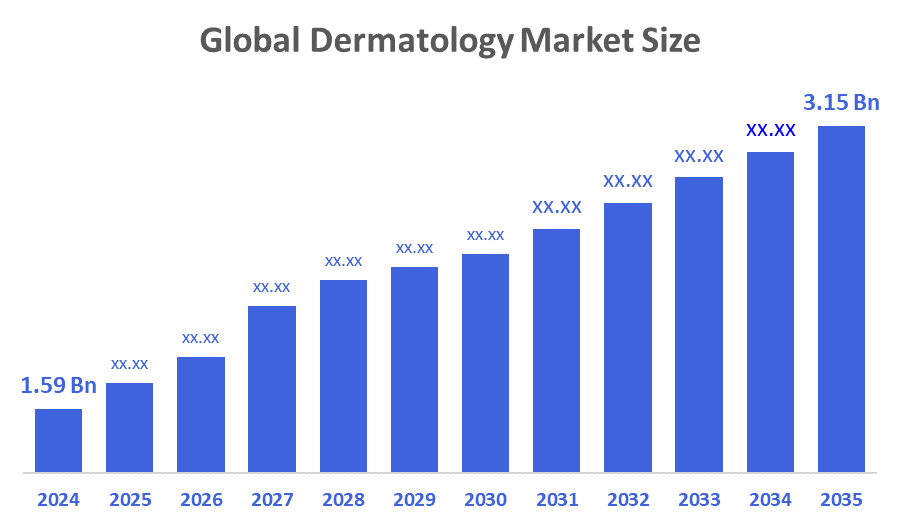
According to a research report published by Decisions Advisors and Consulting, The Global Dermatology Market Size was worth around USD 1.59 Billion in 2024 and is predicted to grow to around USD 3.15 Billion by 2035 with a compound annual growth rate (CAGR) of 6.41% from 2025 to 2035. The market is driven by the increasing prevalence and incidence of skin disorders. It is estimated that skin disorders affect 30 - 70% of the total global population. The increasing emphasis on a beautiful appearance motivates individuals to take care of their skin.
Market Overview
Dermatology is a branch of medicine that focuses on the diagnosis and treatment of skin, hair, and nail diseases. The global dermatological market is expected to grow at a faster pace in the next few years, which is largely attributable to a number of interrelated factors, such as population growth, rising disposable incomes, and expanding health insurance coverage. Several elements related to and provided by the dermatology market have been found to significantly elevate the skin's regenerative capacity and enhance the results of cosmetic procedures. In order to control and alleviate skin disorders, dermatologists, apart from topical drug usage, resort to various systemic treatments. The arena of dermatological therapeutics is gradually becoming more diverse and sophisticated as a result of continuous breakthroughs in medical research and technology. Dermatologists tailor personalised therapy regimens that best fit the characteristics of their patients' skin problems through close collaboration with them.
Artificial intelligence (AI) has been instrumental in enhancing the sensitivity and precision of the detection of dermatological problems. One of the significant outcomes of this technology is the potential to create novel and more sophisticated products for the diagnosis and treatment of skin disorders. AI has been deployed across various healthcare functions such as patient identification, risk prediction, disease subtype classification, and disease progression.
In December 2025, Alphyn Biologics announced it had closed a $25 million oversubscribed Series B financing round to advance its dermatology pipeline, funding global Phase 2b trials in atopic dermatitis and Phase 2 studies in molluscum contagiosum.
In March 2025, L’Oréal Groupe launched the €20 million “Act for Dermatology” programme, a five-year global initiative aimed at increasing access to skin health services. Partnering with the WHO Foundation, the program supports efforts to combat common skin diseases and neglected tropical diseases, addressing the needs of the 2.1 billion people worldwide living with skin conditions.
Report Coverage
This research report categorises the dermatology market based on various segments and regions, forecasts revenue growth, and analyzes trends in each submarket. The report analyses the key growth drivers, opportunities, and challenges influencing the dermatology market. Recent market developments and competitive strategies, such as expansion, product launch, development, partnership, merger, and acquisition, have been included to draw the competitive landscape in the market. The report strategically identifies and profiles the key market players and analyzes their core competencies in each sub-segment of the dermatology market.
Driving Factors
The dermatology market is benefiting from the rising cases of acne, the development of the pharmaceutical sector, population growth, and the rapid progression of laser and light-based treatments for the skin. Dermatologists recommend dermatology visits to treat skin, nail, and hair conditions. With the improvement of high-tech skin imaging and the increase in the demand for early diagnosis of dermatological conditions, the market seems to continue its growth. Government policies and investments that create awareness of the appearance of youthful skin are some of the factors that are driving the market. The booming healthcare and beauty sectors are also major contributors to market growth. The increasing geriatric population, which is more susceptible to skin disorders and ageing, is also a positive factor for the market. Technological advancements are the main drivers behind the latest innovations in dermatology treatment procedures. The increased adoption of smartphones and the growing use of social media are also factors that have led to an increase in awareness of healthy skin and the best ways to maintain it. The rising disposable income is making more willing to invest in products that promote healthy, radiant skin.
Restraining Factors
Access to care in rural and low-income areas is severely restricted, treatment costs are high, and there is a lack of sufficient specialists, which makes it difficult to provide equitable care, particularly to patients with skin of colour. Dermatology market expansion is also impeded by the slower adoption of treatments due to obstacles such as regulatory barriers, safety concerns, stigma, and low awareness among the population.
Market Segmentation
The dermatology market share is classified into type, application, and end use.
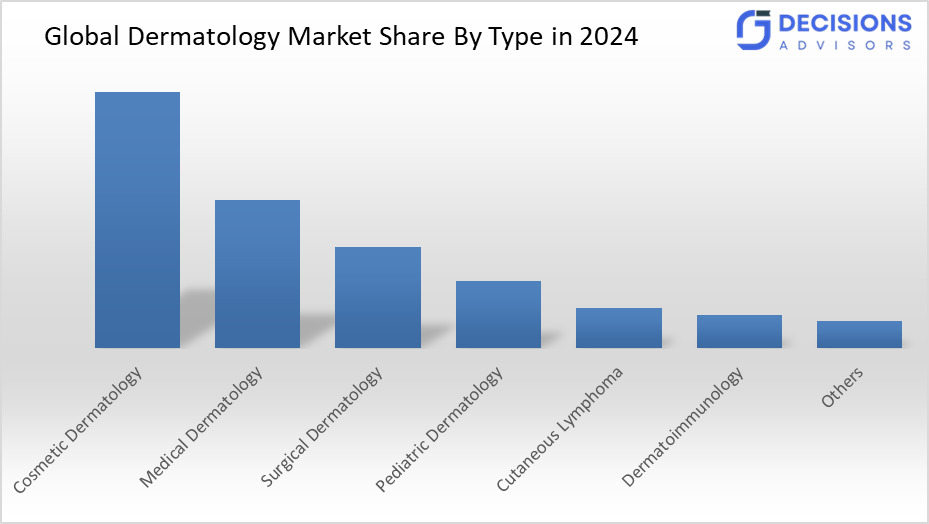
- The cosmetic dermatology segment accounted for the largest share in 2024 and is anticipated to grow at a significant CAGR during the forecast period.
Based on the type, the dermatology market is segmented into medical dermatology, surgical dermatology, pediatric dermatology, cosmetic dermatology, cutaneous lymphoma, dermatoimmunology, and others. Among these, the cosmetic dermatology segment accounted for the largest share in 2024 and is anticipated to grow at a significant CAGR during the forecast period. The segment growth is driven by the non-surgical and minimally invasive methods utilised by cosmetic dermatology to enhance the visual appeal of the skin, hair, and nails. It entails utilising various methods and technologies to improve the skin's tone, texture, and general look. These consist of dermal fillers, which are used to add volume to the hands, face, and lips, whilst Botox injections are employed to reduce the appearance of wrinkles and fine lines.
- The acne segment accounted for the highest market revenue in 2024 and is anticipated to grow at a significant CAGR during the forecast period.
Based on the application, the dermatology market is classified into acne, dermatitis, psoriasis, skin cancer, rosacea, alopecia, and others. Among these, the acne segment accounted for the highest market revenue in 2024 and is anticipated to grow at a significant CAGR during the forecast period. Alterations in lifestyle, the consumption of an unhealthy diet, and hormonal changes are the most common factors that have raised cases of acne conditions. The increase in the number of patients and the numerous treatment options available for the same cause together propel the segment's growth. The significant expansion in the invention of remedies and the development of treatments for acne conditions is, in fact, a major factor that leads to the progression of this segment.
- The skin clinics segment accounted for the highest market revenue in 2024 and is anticipated to grow at a significant CAGR during the forecast period.
Based on the end use, the dermatology market is divided into hospitals, skin clinics, and others. Among these, the skin clinics segment accounted for the highest market revenue in 2024 and is anticipated to grow at a significant CAGR during the forecast period. Skin clinics mainly focus on the diagnosis and treatment of skin diseases. Patients have been compelled to opt for skin clinics owing to the availability of certified or professional surgeons at the skin clinics and also the presence of advanced equipment for skin treatments at such clinics. By delivering targeted therapies for skin problems such as acne, ageing, pigmentation, and rejuvenation, skin clinics will be able to attract more clients.
Regional Segment Analysis of the Dermatology Market
- North America (U.S., Canada, Mexico)
- Europe (Germany, France, U.K., Italy, Spain, Rest of Europe)
- Asia-Pacific (China, Japan, India, Rest of APAC)
- South America (Brazil and the Rest of South America)
- The Middle East and Africa (UAE, South Africa, Rest of MEA)
Asia Pacific is anticipated to hold the largest share of the dermatology market over the predicted timeframe.
Asia Pacific is anticipated to hold the largest share of the dermatology market over the predicted timeframe. The area has developed into a commercial centre for the dermatology sector as a result of the growing prevalence of skin conditions, the ageing population, and the growing expense of medical care. In order to increase awareness of dermatological diseases, other campaigns are also carried out using different government connections. Asians are more likely to experience severe skin disorders as a result of their exposure to the sun. Additionally, there is a significant need for early treatment of minor skin diseases due to the region's growing awareness of skin cancer. This factor is anticipated to support market expansion.
India expanded its National Policy for Rare Diseases (NPRD) to include several rare dermatological conditions, notably epidermolysis bullosa (EB), xeroderma pigmentosa (XP), and ichthyosis.
North America is expected to grow at a rapid CAGR in the dermatology market during the forecast period. The region is seeing an increase in the prevalence of skin cancer and other skin problems, including rosacea and eczema, as well as a rise in the popularity of cosmetic procedures as a result of better healthcare facilities. Additionally, there is increased public awareness of skin cancer and other skin disorders, as well as improved dermatological techniques for treating skin conditions. In the majority of national populations, skin and pore disorders are more prevalent than diseases, obesity, and hypertension. So encouraging the expansion of the area.
The U.S. Department of Health and Human Services (HHS) released the “Surgeon General’s Call to Action to Prevent Skin Cancer” to highlight skin cancer as a major public health problem in the United States.
Competitive Analysis:
The report offers the appropriate analysis of the key organizations/companies involved within the dermatology market, along with a comparative evaluation primarily based on their product offering, business overviews, geographic presence, enterprise strategies, segment market share, and SWOT analysis. The report also provides an elaborative analysis focusing on the current news and developments of the companies, which includes product development, innovations, joint ventures, partnerships, mergers & acquisitions, strategic alliances, and others. This allows for the evaluation of the overall competition within the market.
List of Key Companies
- AbbVie Inc.
- Allergen plc
- AstraZeneca
- Dermira
- Eli Lilly
- Foamix Pharmaceutical
- GlaxoSmithKline Plc.
- Glenmark Pharmaceutical
- Johnson and Johnson
- Mayne Pharma
- Novartis
- Pfizer Inc.
- Sanofi
- Sun Pharmaceutical
- Others
Key Target Audience
- Market Players
- Investors
- End-users
- Government Authorities
- Consulting and Research Firm
- Venture capitalists
- Value-Added Resellers (VARs)
Recent Development
- In October 2025, recently, FDA approvals have expanded dermatology treatment options for patients with skin of colour, introducing new topical therapies (like tapinarof cream, roflumilast foam, and delgocitinib) and biologics (such as lebrikizumab and nemolizumab) for conditions like atopic dermatitis (AD), hidradenitis suppurativa (HS), and plaque psoriasis.
- In September 2025, at EADV 2025, Galderma showcased its leadership in dermatology by presenting new data on sensitive skin and itch management, including insights from the largest global survey on sensitive skin and late-breaking results on Nemluvio (nemolizumab) for atopic dermatitis and prurigo nodularis, reinforcing its role as a frontline therapy.
Market Segment
This study forecasts revenue at global, regional, and country levels from 2020 to 2035. Decisions Advisors has segmented the dermatology market based on the below-mentioned segments:
Global Dermatology Market, By Type
- Medical Dermatology
- Surgical Dermatology
- Pediatric Dermatology
- Cosmetic Dermatology
- Cutaneous Lymphoma
- Dermatoimmunology
- Others
Global Dermatology Market, By Application
- Acne
- Dermatitis
- Psoriasis
- Skin Cancer
- Rosacea
- Alopecia
- Others
Global Dermatology Market, By End Use
- Hospitals
- Skin Clinics
- Others
Global Dermatology Market, By Regional Analysis
- North America
- US
- Canada
- Mexico
- Europe
- Germany
- UK
- France
- Italy
- Spain
- Russia
- Rest of Europe
- Asia Pacific
- China
- Japan
- India
- South Korea
- Australia
- Rest of Asia Pacific
- South America
- Brazil
- Argentina
- Rest of South America
- Middle East & Africa
- UAE
- Saudi Arabia
- Qatar
- South Africa
- Rest of the Middle East & Africa
Frequently Asked Questions (FAQ)
- Market Size in 2024?
The market reached USD 1.59 billion in 2024.
- Projected Size by 2035?
It is expected to grow to USD 3.15 billion by 2035.
- What is the CAGR?
Growth occurs at a CAGR of 6.41% from 2025 to 2035.
- Largest Segment by Type?
Cosmetic dermatology held the largest share in 2024 due to minimally invasive procedures like Botox and fillers.
- Top Application Segment?
Acne generated the highest revenue in 2024, fueled by lifestyle and hormonal factors.
- Leading End-Use Segment?
Skin clinics dominated in 2024 with advanced equipment and specialised treatments.
- Key Regional Insights?
Asia-Pacific holds the largest share, while North America grows fastest amid rising skin cancer awareness.
Check Licence
Choose the plan that fits you best: Single User, Multi-User, or Enterprise solutions tailored for your needs.
We Have You Covered
- 24/7 Analyst Support
- Clients Across the Globe
- Tailored Insights
- Technology Tracking
- Competitive Intelligence
- Custom Research
- Syndicated Market Studies
- Market Overview
- Market Segmentation
- Growth Drivers
- Market Opportunities
- Regulatory Insights
- Innovation & Sustainability
Report Details
| Scope | Global |
| Pages | 240 |
| Delivery | PDF & Excel via Email |
| Language | English |
| Release | Jan 2026 |
| Access | Download from this page |