
Global Diagnostic Imaging Market
 |
Author:
Disha B
|
Pages:
195
|
Author:
Disha B
|
Pages:
195
Global Diagnostic Imaging Market Size, Share, By Product (X-ray Imaging Systems, Magnetic Resonance Imaging (MRI), Computed Tomography (CT) Scanners, Ultrasound Systems, Nuclear Imaging Systems), By End User (Hospitals, Diagnostic Centres, Ambulatory Surgical Centres, Others), By Application (Cardiology, Oncology, Neurology, Orthopaedics, Gastroenterology, Others), and By Region (North America, Europe, Asia-Pacific, Latin America, Middle East, and Africa), Analysis and Forecast 2025 ? 2035.
REPORT COVERAGE
Global
Market Snapshot
- Market Size (2025): USD 51.41 Billion
- Projected Market Size (2035): USD 78.55 Billion
- Compound Annual Growth Rate (CAGR): 4.33%
- Largest Regional Market: Asia-Pacific
- Steadily Growing Region: North America
- 3rd Largest Region: Europe
- Base Year: 2025
- Historical Period: 2021–2024
- Forecast Period: 2025–2035
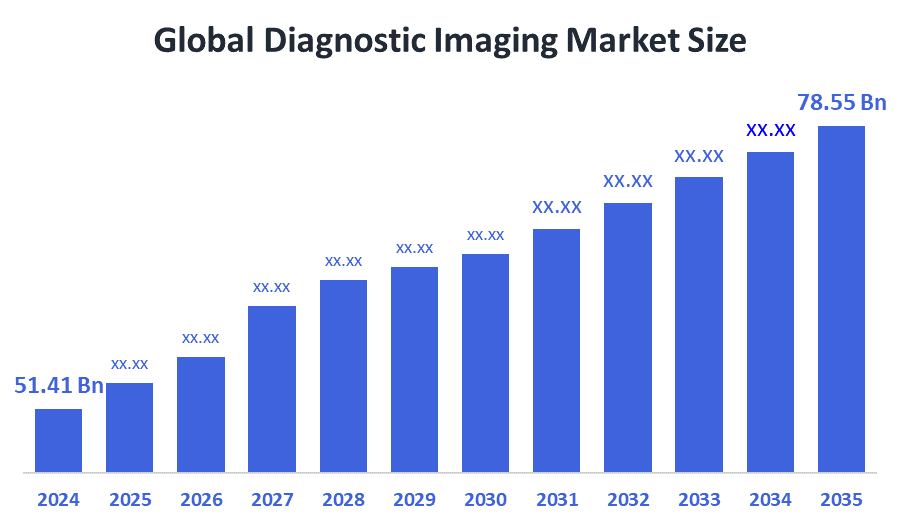
According to Decision Advisors, the Global Diagnostic Imaging Market Size is expected to grow from USD 51.41 billion in 2025 to USD 78.55 billion by 2035, at a CAGR of 4.33% during the forecast period 2025-2035. The global diagnostic imaging market is expected to witness substantial growth over the forecast period, driven by the increasing demand for early and accurate disease diagnosis. Rising prevalence of chronic diseases, growing geriatric population, and continuous advancements in imaging technologies such as AI-integrated systems and digital imaging solutions. Additionally, the increasing adoption of advanced imaging equipment by healthcare providers, along with expanding healthcare infrastructure in emerging economies, is further supporting market growth.
Market Overview/ Introduction
The diagnostic imaging market refers to the global industry that includes technologies and equipment used to visualise the internal structures of the human body for diagnosis, monitoring, and treatment planning. It plays a vital role in modern healthcare by enabling early disease detection, accurate diagnosis, and effective treatment management across conditions such as cancer, cardiovascular diseases, and neurological disorders. Companies like Siemens Healthineers and GE Healthcare are using intelligence to make diagnoses more accurate. This intelligence helps to automate the process of looking at images. It also makes things run smoothly. Siemens Healthineers and GE Healthcare are making machines that combine types of imaging like PET-CT and PET-MRI. A major development happened recently in 78.55, when the World Health Organization introduced a resolution. The World Health Organization resolution aimed at improving access to imaging technologies. The World Health Organization encouraged member countries to invest in infrastructure workforce training and advanced diagnostic systems. The World Health Organization also gave support to promote access, to essential diagnostic imaging. The diagnostic services, like the imaging, teleradiology and cloud-based platforms, will help patients in remote and underserved areas to get the help they need.
- GE Healthcare is a leading player in diagnostic imaging, with a total business size of around $19.7 billion in start and strong revenue contribution from its imaging segment.
- WHO data indicates that 70–80% of clinical diagnostic needs can be addressed using basic imaging techniques such as X-ray and ultrasound, emphasising their importance in healthcare systems globally, especially in resource-limited settings.
- The United States is a major producer of diagnostic imaging equipment, with a strong focus on high-end and technologically advanced systems, supported by leading companies and significant R&D investments.
Notable Insights: -
- Asia Pacific holds the largest market share, accounting for approximately 25–30% of the global diagnostic imaging market in 2025.
- North America is the fastest-growing region in the global diagnostic imaging market.
- By product, X-ray systems dominate the market, holding around a dominant diagnostic share in 2025, due to their cost-effectiveness and widespread use in diagnostics.
- The compound annual growth rate of the global diagnostic imaging market is 4.33%.
- The market is likely to achieve a valuation of USD 78.55 billion by 2035.
What is role of technology in grooming the market?
Technology plays a crucial role in shaping the diagnostic imaging market by enhancing diagnostic accuracy, improving workflow efficiency, and expanding access to advanced healthcare services. The integration of artificial intelligence (AI) is transforming imaging by enabling faster image interpretation, early disease detection, and improved clinical decision-making, with companies like GE Healthcare and Siemens Healthineers leading these innovations. Digital imaging systems and cloud-based platforms are streamlining data storage, sharing, and remote access, significantly supporting the growth of tele-radiology services worldwide. Additionally, automation and advanced software solutions are reducing human error and increasing efficiency in radiology workflows. The development of portable and point-of-care imaging devices is further expanding access to diagnostic services, especially in remote and underserved regions. Technologies such as 3D/4D imaging and molecular imaging are also improving visualization and enabling early detection of complex diseases.
How is Recent Developments Helping the Market?
Recent developments, such as advanced product launches, AI integration, and strategic partnerships, are significantly supporting the growth of the diagnostic imaging market. Companies like Koninklijke Philips N.V., Canon Medical Systems, and Fujifilm Holdings are introducing next-generation imaging systems with improved speed, accuracy, and patient comfort. For instance, Philips launched AI-enabled CT systems and expanded its helium-free MRI installations globally, improving efficiency and sustainability, while Canon has developed advanced hybrid CT-angiography systems to enhance clinical workflows. Additionally, innovations such as AI-powered MRI acceleration software and cloud-based imaging platforms are enabling faster diagnosis and better data management across healthcare systems. The growing adoption of digital imaging, tele-radiology, and portable imaging devices is further improving accessibility, especially in remote areas. Moreover, continuous advancements in imaging technologies, including workflow automation and low-dose imaging solutions, are enhancing patient safety and operational efficiency.
Market Drivers
The market is driven by the increasing burden of chronic diseases such as cancer and cardiovascular disorders. The growing demand for early diagnosis and precision medicine is significantly boosting the adoption of advanced imaging technologies. Technological advancements such as AI-based imaging analysis, hybrid imaging systems (PET-CT, SPECT-CT), and digital radiography are improving diagnostic accuracy and workflow efficiency. Additionally, rising healthcare investments and the expansion of diagnostic centres are supporting market growth globally.
- In June 2025, Siemens Healthineers introduced an AI-powered imaging platform integrated with advanced MRI and CT systems, significantly improving diagnostic accuracy and reducing scan interpretation time, thereby enhancing workflow efficiency in hospitals.
- In April 2025, GE Healthcare launched a next-generation PET-CT system equipped with AI-driven image reconstruction technology, enabling faster scans and more precise detection of cancer and cardiovascular diseases.
Restrain
The diagnostic imaging market is restrained by the high cost of advanced imaging equipment and installation, along with maintenance expenses. Stringent regulatory requirements, concerns regarding radiation exposure, and limited access to advanced imaging systems in low-income regions also hinder market expansion.
Competitive Analysis:
The report offers the appropriate analysis of the key organizations/companies involved within the global diagnostic imaging market, along with a comparative evaluation primarily based on their product of offering, business overviews, geographic presence, enterprise strategies, segment market share, and SWOT analysis. The report also provides an elaborative analysis focusing on the current news and developments of the companies, which includes product development, innovations, joint ventures, partnerships, mergers & acquisitions, strategic alliances, and others. This allows for the evaluation of the overall competition within the market.
Top Companies in Global Diagnostic Imaging Market
- GE Healthcare
- Siemens Healthineers
- Koninklijke Philips N.V.
- Canon Medical Systems
- Fujifilm Holdings Corporation
- Hitachi Medical Systems
- Hologic, Inc.
- Shimadzu Corporation
- Carestream Health
- Samsung Medison
Government Initiatives
|
Country |
Key Government Initiatives |
|
UK |
The UK government is strengthening diagnostic capacity through increased NHS funding and investments in imaging infrastructure, including the expansion of community diagnostic centres to improve early disease detection and reduce waiting times |
|
US |
The U.S. government supports the diagnostic imaging market through programs under Medicare and Medicaid, along with investments in digital health and AI-based diagnostics, promoting innovation and wider adoption of advanced imaging technologies.
|
|
China |
China’s healthcare reforms and policies under its Five-Year Plans focus on expanding hospital infrastructure, encouraging domestic manufacturing of medical imaging equipment, and improving access to advanced diagnostic services across urban and rural areas. |
Market Segmentation
The global diagnostic imaging market share is classified into product, end user, and application.
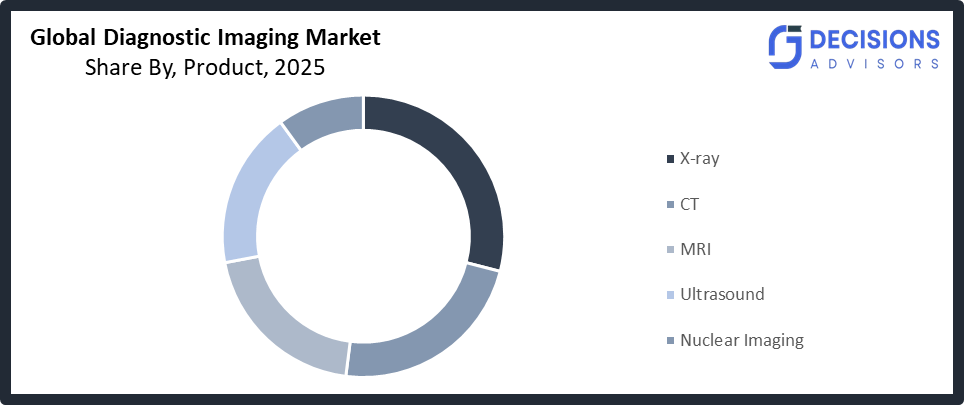
- The X-ray segment dominated the market in 2025, and is projected to grow steadily during the forecast period.
Based on the product, the X-ray segment dominated the market in 2025 and is projected to grow steadily during the forecast period. The diagnostic imaging market is divided into X-ray, CT, MRI, ultrasound, and nuclear imaging. Among these, the X-ray segment dominated the market in 2025, and is projected to grow steadily during the forecast period. This dominance is primarily attributed to its cost-effectiveness, widespread availability, and extensive use in routine diagnostics and emergency care. X-ray systems are often the first line of imaging due to their ability to provide quick results, making them highly suitable for detecting fractures, infections, and lung-related diseases. Moreover, continuous technological advancements such as digital radiography, portable X-ray devices, and AI-assisted imaging are further enhancing image quality, reducing radiation exposure, and improving workflow efficiency. The increasing demand for point-of-care diagnostics, especially in rural and underserved areas, is also contributing to the segment’s growth.
- The hospitals segment accounted for the largest share in 2025, and is anticipated to grow at a significant CAGR of approximately 59% during the forecast period.
Based on the end-user, the hospitals segment accounted for the largest share in 2025, and is anticipated to grow at a significant CAGR during the forecast period. The diagnostic imaging market is segmented into hospitals, diagnostic imaging centres, ambulatory surgical centres, and other settings. Among these, the hospitals segment accounted for the largest share in 2025, and is anticipated to grow at a significant CAGR of approximately 59% during the forecast period. Hospitals serve as primary healthcare providers and handle a large volume of patients requiring diagnostic imaging for various medical conditions. The dominance of this segment is driven by the availability of advanced imaging infrastructure, including MRI, CT scanners, and hybrid imaging systems, along with skilled healthcare professionals capable of performing complex diagnostic procedures. Furthermore, hospitals often receive government funding and support, enabling them to adopt cutting-edge technologies and expand their diagnostic capabilities. The increasing number of hospital admissions, rising prevalence of chronic diseases, and growing focus on early and accurate diagnosis are further contributing to the growth of this segment. In addition, the integration of digital health systems and tele-radiology within hospital settings is improving efficiency and patient outcomes.
- The cardiology segment dominated the market in 2025, and is projected to grow at a substantial CAGR during the forecast period.
Based on the application, the cardiology segment dominated the market in 2025, and is projected to grow at a substantial CAGR during the forecast period. The diagnostic imaging market is divided into cardiology, oncology, neurology, orthopaedics, and others. Among these, the cardiology segment dominated the market in 2025 and is projected to grow at a substantial CAGR during the forecast period. This dominance is largely driven by the increasing global burden of cardiovascular diseases, which remain one of the leading causes of mortality worldwide. Diagnostic imaging plays a crucial role in the early detection, diagnosis, and management of heart-related conditions. Technologies such as echocardiography, cardiac CT, MRI, and nuclear imaging enable detailed visualization of heart structures and functions, supporting accurate clinical decision-making. The diagnostic imaging market is segmented into cardiology, oncology, neurology, orthopaedics, gastroenterology, and others. Among these, cardiology dominates due to the high prevalence of heart diseases, while oncology and neurology are growing due to increasing cancer and neurological disorders. Orthopaedics and gastroenterology segments are also expanding due to rising cases of bone and digestive conditions, supporting overall market growth.
What is the Reason of the Region Dominance?
The dominance of certain regions in the diagnostic imaging market is primarily driven by advanced healthcare infrastructure, high adoption of innovative technologies, and increased healthcare spending. Regions such as North America lead the market due to the strong presence of major companies, well-established hospital networks, and early adoption of advanced imaging systems. Additionally, a high prevalence of chronic diseases and strong awareness regarding early diagnosis further support market growth. On the other hand, the Asia-Pacific is emerging as a key growth region due to its large population base, rising disposable incomes, and rapid expansion of healthcare infrastructure. Government initiatives, increasing investments in medical technologies, and growing demand for diagnostic services are also contributing to regional dominance.
Strategies to Implement for Growth of the Market in Non-Leading Regions
Growth in non-leading regions can be supported through strategic investments, technological adoption, and expansion of healthcare infrastructure. Companies can increase market penetration by introducing affordable and portable imaging solutions tailored to the needs of rural and underserved areas, making diagnostics more accessible. Expanding digital platforms such as tele-radiology and cloud-based imaging can also improve access to expert diagnosis in remote locations. Additionally, forming partnerships with local hospitals, diagnostic centers, and government bodies can help strengthen distribution networks and increase service availability. Collaborations with organizations such as the World Health Organization can further support initiatives aimed at improving diagnostic access in low- and middle-income countries. Increasing investments in training healthcare professionals and technicians is also essential to ensure effective use of advanced imaging technologies.
Regional Segment Analysis of the Global Diagnostic Imaging Market
- North America (U.S., Canada, Mexico)
- Europe (Germany, France, U.K., Italy, Spain, Rest of Europe)
- Asia-Pacific (China, Japan, India, Rest of APAC)
- South America (Brazil and the Rest of South America)
- The Middle East and Africa (UAE, South Africa, Rest of MEA)
Asia Pacific is anticipated to hold the largest share of the global diagnostic imaging market over the predicted timeframe.
Asia Pacific is anticipated to hold the largest share of the global diagnostic imaging market over the predicted timeframe. This market is anticipated to hold a significant share of the diagnostic imaging market over the predicted timeframe. This region accounts for approximately 25–30% of the global market share in 2025, driven by rapid healthcare infrastructure development, rising healthcare expenditure, and increasing demand for early disease diagnosis. The dominance of this region is supported by large and growing populations in countries like China and India, along with rapid urbanization and improving access to healthcare services. Additionally, the increasing prevalence of chronic diseases, such as cardiovascular disorders and cancer, is significantly boosting the demand for diagnostic imaging procedures across the region. Governments are also investing heavily in healthcare systems and promoting the adoption of advanced imaging technologies, further supporting market growth. The expansion of hospitals and diagnostic centers, along with rising awareness regarding preventive healthcare, is contributing to increased utilization of imaging services.
North America is expected to grow at a steady CAGR in the global diagnostic imaging market during the forecast period. North America is expected to grow at a steady CAGR in the global diagnostic imaging market during the forecast period. The market is driven by continuous technological advancements and strong healthcare infrastructure. The United States itself accounts for a significant share of the regional revenue, supported by high healthcare expenditure and early adoption of advanced imaging technologies. The region’s growth is fueled by increasing demand for precise and early diagnosis, particularly for chronic diseases such as cancer and cardiovascular disorders. Companies like Hologic, Inc. and Carestream Health are continuously introducing innovative imaging solutions, including advanced mammography systems and digital imaging platforms, reflecting the growing focus on accuracy and patient-centric care.
Europe is the 3rd largest region to grow in the global diagnostic imaging market during the period. It is driven by its well-established healthcare systems and strong adoption of advanced medical technologies. The region benefits from a long-standing focus on quality healthcare services and early disease diagnosis, with significant contributions from countries such as Germany, France, and the United Kingdom. Although the growth rate in Europe is relatively moderate compared to emerging regions, the market continues to generate high value due to the adoption of premium imaging technologies, focus on patient safety, and ongoing advancements in digital and AI-based diagnostic solutions.
Future Market Trends in Global Diagnostic Imaging Market: -
- Increasing Integration of Artificial Intelligence (AI) in Imaging
Artificial intelligence is expected to play a transformative role in the diagnostic imaging market by enhancing the speed, accuracy, and efficiency of image interpretation. AI-powered tools can assist radiologists in detecting abnormalities at an early stage, reducing diagnostic errors and improving patient outcomes. Advanced algorithms are also enabling automated workflows, including image segmentation, reporting, and clinical decision support.
- Rising Demand for Portable and Point-of-Care Imaging Solutions
The growing need for accessible and real-time diagnostics is driving the demand for portable and point-of-care imaging devices. These compact systems allow healthcare providers to perform imaging procedures outside traditional hospital settings, such as in clinics, ambulances, and rural areas. This trend is particularly important in emerging markets, where access to advanced healthcare infrastructure is limited. Portable ultrasound and mobile X-ray systems are gaining popularity due to their affordability, ease of use, and rapid deployment.
- Expansion of Cloud-Based Imaging and Tele-Radiology Services
The adoption of cloud computing and digital health platforms is revolutionizing the way imaging data is stored, managed, and shared. Cloud-based imaging solutions enable seamless access to patient data, facilitating remote diagnosis and collaboration among healthcare professionals across different locations. Tele-radiology services are becoming increasingly important, especially in regions with a shortage of skilled radiologists.
Recent Development
- In November 2025, GE Healthcare announced the acquisition of Intelerad Medical Systems for approximately USD 2.3 billion, aiming to expand its cloud-based imaging and AI capabilities and strengthen its position in the outpatient imaging market.
- In November 2025, Fujifilm Holdings Corporation showcased advanced diagnostic imaging innovations at RSNA 2025, including AI-powered MRI solutions and intelligent mobile imaging systems, aimed at improving workflow efficiency and enhancing patient care.
- In June 2025, Siemens Healthineers launched an advanced AI-powered MRI system designed to significantly enhance diagnostic precision and reduce scan time. The system integrates deep learning algorithms for faster image reconstruction and improved image clarity, enabling healthcare providers to increase patient throughput while maintaining high diagnostic accuracy.
Market Segment
This study forecasts revenue at global, regional, and country levels from 2020 to 2035. Decision Advisors has segmented the global diagnostic imaging market based on the below-mentioned segments:
Global Diagnostic Imaging Market, By Product
- X-ray
- CT (Computed Tomography)
- MRI (Magnetic Resonance Imaging)
- Ultrasound
- Nuclear Imaging
Global Diagnostic Imaging Market, By End User
- Hospitals
- Diagnostic centers
- Ambulatory Surgical Centers
- Others
Global Diagnostic Imaging Market, By Application
- Cardiology
- Oncology
- Neurology
- Orthopedics
- Gastroenterology
- Others
Global Diagnostic Imaging Market, By Regional Analysis
- North America
- US
- Canada
- Mexico
- Europe
- Germany
- UK
- France
- Italy
- Spain
- Russia
- Rest of Europe
- Asia Pacific
- China
- Japan
- India
- South Korea
- Australia
- Rest of Asia Pacific
- South America
- Brazil
- Argentina
- Rest of South America
- Middle East & Africa
- UAE
- Saudi Arabia
- Qatar
- South Africa
- Rest of the Middle East & Africa
Frequently Asked Questions (FAQ)
Q. How is artificial intelligence transforming the diagnostic imaging market?
A. Artificial intelligence is transforming diagnostic imaging by enabling automated image analysis, improving detection accuracy, reducing interpretation time, and supporting radiologists in clinical decision-making, thereby enhancing overall efficiency
Q. What is the role of hybrid imaging technologies in modern diagnostics?
A. Hybrid imaging technologies such as PET-CT and PET-MRI combine functional and anatomical imaging, allowing more precise disease detection, especially in oncology and cardiology applications.
Q. What impact does the ageing population have on the diagnostic imaging market?
A. The growing geriatric population increases the demand for imaging procedures due to higher susceptibility to chronic diseases such as cancer, cardiovascular disorders and musculoskeletal conditions.
Q. How is teleradiology influencing the diagnostic imaging industry?
A. Teleradiology allows remote interpretation of medical images, helping healthcare providers address the shortage of radiologists and ensuring timely diagnosis across different geographic locations
- Introduction
- Objectives of the Study
- Market Definition
- Research Scope
- Research Methodology and Assumptions
- Executive Summary
- Premium Insights
- Porter’s Five Forces Analysis
- Value Chain Analysis
- Top Investment Pockets
- Market Attractiveness Analysis By Product
- Market Attractiveness Analysis By End User
- Market Attractiveness Analysis By Application
- Market Attractiveness Analysis By Region
- Industry Trends
- Market Dynamics
- Market Evaluation
- Drivers
- Rising prevalence of chronic diseases and aging population
- Restraints
- High cost of imaging equipment and procedures
- Opportunities
- Expansion in emerging markets and healthcare infrastructure
- Challenges
5.5.1. Shortage of skilled radiologists and technicians
- Global Diagnostic Imaging Market Analysis and Projection, By Product
- Segment Overview
- X-ray Imaging Systems
- Magnetic Resonance Imaging (MRI)
- Computed Tomography (CT) Scanners
- Ultrasound Systems
- Nuclear Imaging Systems
- Global Diagnostic Imaging Market Analysis and Projection, By End User
- Segment Overview
- Hospitals
- Diagnostic Centres
- Ambulatory Surgical Centres
- Others
- Global Diagnostic Imaging Market Analysis and Projection, By Application
- Segment Overview
- Cardiology
- Oncology
- Neurology
- Orthopaedics
- Gastroenterology
- Others
- Global Diagnostic Imaging Market Analysis and Projection, By Regional Analysis
- Segment Overview
- North America
- U.S.
- Canada
- Mexico
- Europe
- Germany
- France
- U.K.
- Italy
- Spain
- Asia-Pacific
- Japan
- China
- India
- South America
- Brazil
- Middle East and Africa
- UAE
- South Africa
- Global Diagnostic Imaging Market-Competitive Landscape
- Overview
- Market Share of Key Players in the Diagnostic Imaging Market
- Global Company Market Share
- North America Company Market Share
- Europe Company Market Share
- APAC Company Market Share
- Competitive Situations and Trends
- Coverage Launches and Developments
- Partnerships, Collaborations, and Agreements
- Mergers & Acquisitions
- Expansions
- Company Profiles
- GE Healthcare
- Business Overview
- Company Snapshot
- Company Market Share Analysis
- Company Coverage Portfolio
- Recent Developments
- SWOT Analysis
- Siemens Healthineers
- Business Overview
- Company Snapshot
- Company Market Share Analysis
- Company Coverage Portfolio
- Recent Developments
- SWOT Analysis
- Koninklijke Philips N.V.
- Business Overview
- Company Snapshot
- Company Market Share Analysis
- Company Coverage Portfolio
- Recent Developments
- SWOT Analysis
- Canon Medical Systems
- Business Overview
- Company Snapshot
- Company Market Share Analysis
- Company Coverage Portfolio
- Recent Developments
- SWOT Analysis
- Fujifilm Holdings Corporation
- Business Overview
- Company Snapshot
- Company Market Share Analysis
- Company Coverage Portfolio
- Recent Developments
- SWOT Analysis
- Hitachi Medical Systems
- Business Overview
- Company Snapshot
- Company Market Share Analysis
- Company Coverage Portfolio
- Recent Developments
- SWOT Analysis
- Hologic, Inc.
- Business Overview
- Company Snapshot
- Company Market Share Analysis
- Company Coverage Portfolio
- Recent Developments
- SWOT Analysis
- Shimadzu Corporation
- Business Overview
- Company Snapshot
- Company Market Share Analysis
- Company Coverage Portfolio
- Recent Developments
- SWOT Analysis
- Carestream Health
- Business Overview
- Company Snapshot
- Company Market Share Analysis
- Company Coverage Portfolio
- Recent Developments
- SWOT Analysis
- Samsung Medison
- Business Overview
- Company Snapshot
- Company Market Share Analysis
- Company Coverage Portfolio
- Recent Developments
- SWOT Analysis
- GE Healthcare
List of Table
- Global Diagnostic Imaging Market, By Product, 2024-2035(USD Billion)
- Global X-ray Imaging Systems, Diagnostic Imaging Market, By Region, 2024-2035(USD Billion)
- Global Magnetic Resonance Imaging (MRI), Diagnostic Imaging Market, By Region, 2024-2035(USD Billion)
- Global Computed Tomography (CT) Scanners, Diagnostic Imaging Market, By Region, 2024-2035(USD Billion)
- Global Ultrasound Systems, Diagnostic Imaging Market, By Region, 2024-2035(USD Billion)
- Global Nuclear Imaging Systems, Diagnostic Imaging Market, By Region, 2024-2035(USD Billion)
- Global Diagnostic Imaging Market, By End User, 2024-2035(USD Billion)
- Global Hospitals, Diagnostic Imaging Market, By Region, 2024-2035(USD Billion)
- Global Diagnostic Centres, Diagnostic Imaging Market, By Region, 2024-2035(USD Billion)
- Global Ambulatory Surgical Centres, Diagnostic Imaging Market, By Region, 2024-2035(USD Billion)
- Global Others, Diagnostic Imaging Market, By Region, 2024-2035(USD Billion)
- Global Diagnostic Imaging Market, By Application, 2024-2035(USD Billion)
- Global Cardiology, Diagnostic Imaging Market, By Region, 2024-2035(USD Billion)
- Global Oncology, Diagnostic Imaging Market, By Region, 2024-2035(USD Billion)
- Global Neurology, Diagnostic Imaging Market, By Region, 2024-2035(USD Billion)
- Global Orthopaedics, Diagnostic Imaging Market, By Region, 2024-2035(USD Billion)
- Global Gastroenterology, Diagnostic Imaging Market, By Region, 2024-2035(USD Billion)
- Global Others, Diagnostic Imaging Market, By Region, 2024-2035(USD Billion)
- North America Diagnostic Imaging Market, By Product, 2024-2035(USD Billion)
- North America Diagnostic Imaging Market, By End User, 2024-2035(USD Billion)
- North America Diagnostic Imaging Market, By Application, 2024-2035(USD Billion)
- U.S. Diagnostic Imaging Market, By Product, 2024-2035(USD Billion)
- U.S. Diagnostic Imaging Market, By End User, 2024-2035(USD Billion)
- U.S. Diagnostic Imaging Market, By Application, 2024-2035(USD Billion)
- Canada Diagnostic Imaging Market, By Product, 2024-2035(USD Billion)
- Canada Diagnostic Imaging Market, By End User, 2024-2035(USD Billion)
- Canada Diagnostic Imaging Market, By Application, 2024-2035(USD Billion)
- Mexico Diagnostic Imaging Market, By Product, 2024-2035(USD Billion)
- Mexico Diagnostic Imaging Market, By End User, 2024-2035(USD Billion)
- Mexico Diagnostic Imaging Market, By Application, 2024-2035(USD Billion)
- Europe Diagnostic Imaging Market, By Product, 2024-2035(USD Billion)
- Europe Diagnostic Imaging Market, By End User, 2024-2035(USD Billion)
- Europe Diagnostic Imaging Market, By Application, 2024-2035(USD Billion)
- Germany Diagnostic Imaging Market, By Product, 2024-2035(USD Billion)
- Germany Diagnostic Imaging Market, By End User, 2024-2035(USD Billion)
- Germany Diagnostic Imaging Market, By Application, 2024-2035(USD Billion)
- France Diagnostic Imaging Market, By Product, 2024-2035(USD Billion)
- France Diagnostic Imaging Market, By End User, 2024-2035(USD Billion)
- France Diagnostic Imaging Market, By Application, 2024-2035(USD Billion)
- U.K. Diagnostic Imaging Market, By Product, 2024-2035(USD Billion)
- U.K. Diagnostic Imaging Market, By End User, 2024-2035(USD Billion)
- U.K. Diagnostic Imaging Market, By Application, 2024-2035(USD Billion)
- Italy Diagnostic Imaging Market, By Product, 2024-2035(USD Billion)
- Italy Diagnostic Imaging Market, By End User, 2024-2035(USD Billion)
- Italy Diagnostic Imaging Market, By Application, 2024-2035(USD Billion)
- Spain Diagnostic Imaging Market, By Product, 2024-2035(USD Billion)
- Spain Diagnostic Imaging Market, By End User, 2024-2035(USD Billion)
- Spain Diagnostic Imaging Market, By Application, 2024-2035(USD Billion)
- Asia Pacific Diagnostic Imaging Market, By Product, 2024-2035(USD Billion)
- Asia Pacific Diagnostic Imaging Market, By End User, 2024-2035(USD Billion)
- Asia Pacific Diagnostic Imaging Market, By Application, 2024-2035(USD Billion)
- Japan Diagnostic Imaging Market, By Product, 2024-2035(USD Billion)
- Japan Diagnostic Imaging Market, By End User, 2024-2035(USD Billion)
- Japan Diagnostic Imaging Market, By Application, 2024-2035(USD Billion)
- China Diagnostic Imaging Market, By Product, 2024-2035(USD Billion)
- China Diagnostic Imaging Market, By End User, 2024-2035(USD Billion)
- China Diagnostic Imaging Market, By Application, 2024-2035(USD Billion)
- India Diagnostic Imaging Market, By Product, 2024-2035(USD Billion)
- India Diagnostic Imaging Market, By End User, 2024-2035(USD Billion)
- India Diagnostic Imaging Market, By Application, 2024-2035(USD Billion)
- South America Diagnostic Imaging Market, By Product, 2024-2035(USD Billion)
- South America Diagnostic Imaging Market, By End User, 2024-2035(USD Billion)
- South America Diagnostic Imaging Market, By Application, 2024-2035(USD Billion)
- Brazil Diagnostic Imaging Market, By Product, 2024-2035(USD Billion)
- Brazil Diagnostic Imaging Market, By End User, 2024-2035(USD Billion)
- Brazil Diagnostic Imaging Market, By Application, 2024-2035(USD Billion)
- The Middle East and Africa Diagnostic Imaging Market, By Product, 2024-2035(USD Billion)
- The Middle East and Africa Diagnostic Imaging Market, By End User, 2024-2035(USD Billion)
- The Middle East and Africa Diagnostic Imaging Market, By Application, 2024-2035(USD Billion)
- UAE Diagnostic Imaging Market, By Product, 2024-2035(USD Billion)
- UAE Diagnostic Imaging Market, By End User, 2024-2035(USD Billion)
- UAE Diagnostic Imaging Market, By Application, 2024-2035(USD Billion)
- South Africa Diagnostic Imaging Market, By Product, 2024-2035(USD Billion)
- South Africa Diagnostic Imaging Market, By End User, 2024-2035(USD Billion)
- South Africa Diagnostic Imaging Market, By Application, 2024-2035(USD Billion)
List of Figures
- Global Diagnostic Imaging Market Segmentation
- Diagnostic Imaging Market: Research Methodology
- Market Size Estimation Methodology: Bottom-Up Approach
- Market Size Estimation Methodology: Top-down Approach
- Data Triangulation
- Porter’s Five Forces Analysis
- Value Chain Analysis
- Top investment pocket in the Diagnostic Imaging Market
- Top Winning Strategies, 2024-2035
- Top Winning Strategies, By Development, 2024-2035(%)
- Top Winning Strategies, By Company, 2024-2035
- Moderate Bargaining power of Buyers
- Moderate Bargaining power of Suppliers
- Moderate Bargaining power of New Entrants
- Low threat of Substitution
- High Competitive Rivalry
- Top Player Positioning, 2024
- Market Share Analysis, 2024
- Restraint and Drivers: Diagnostic Imaging Market
- Diagnostic Imaging Market Segmentation, By Product
- Diagnostic Imaging Market For X-ray Imaging Systems, By Region, 2024-2035 ($ Billion)
- Diagnostic Imaging Market For Magnetic Resonance Imaging (MRI), By Region, 2024-2035 ($ Billion)
- Diagnostic Imaging Market For Computed Tomography (CT) Scanners, By Region, 2024-2035 ($ Billion)
- Diagnostic Imaging Market For Ultrasound Systems, By Region, 2024-2035 ($ Billion)
- Diagnostic Imaging Market For Nuclear Imaging Systems, By Region, 2024-2035 ($ Billion)
- Diagnostic Imaging Market Segmentation, By End User
- Diagnostic Imaging Market For Hospitals, By Region, 2024-2035 ($ Billion)
- Diagnostic Imaging Market For Diagnostic Centres, By Region, 2024-2035 ($ Billion)
- Diagnostic Imaging Market For Ambulatory Surgical Centres, By Region, 2024-2035 ($ Billion)
- Diagnostic Imaging Market For Others, By Region, 2024-2035 ($ Billion)
- Diagnostic Imaging Market Segmentation, By Application
- Diagnostic Imaging Market For Cardiology, By Region, 2024-2035 ($ Billion)
- Diagnostic Imaging Market For Oncology, By Region, 2024-2035 ($ Billion)
- Diagnostic Imaging Market For Neurology, By Region, 2024-2035 ($ Billion)
- Diagnostic Imaging Market For Orthopaedics, By Region, 2024-2035 ($ Billion)
- Diagnostic Imaging Market For Gastroenterology, By Region, 2024-2035 ($ Billion)
- Diagnostic Imaging Market For Others, By Region, 2024-2035 ($ Billion)
- GE Healthcare: Net Sales, 2024-2035 ($ Billion)
- GE Healthcare: Revenue Share, By Segment, 2024 (%)
- GE Healthcare: Revenue Share, By Region, 2024 (%)
- Siemens Healthineers: Net Sales, 2024-2035 ($ Billion)
- Siemens Healthineers: Revenue Share, By Segment, 2024 (%)
- Siemens Healthineers: Revenue Share, By Region, 2024 (%)
- Koninklijke Philips N.V.: Net Sales, 2024-2035 ($ Billion)
- Koninklijke Philips N.V.: Revenue Share, By Segment, 2024 (%)
- Koninklijke Philips N.V.: Revenue Share, By Region, 2024 (%)
- Canon Medical Systems: Net Sales, 2024-2035 ($ Billion)
- Canon Medical Systems: Revenue Share, By Segment, 2024 (%)
- Canon Medical Systems: Revenue Share, By Region, 2024 (%)
- Fujifilm Holdings Corporation: Net Sales, 2024-2035 ($ Billion)
- Fujifilm Holdings Corporation: Revenue Share, By Segment, 2024 (%)
- Fujifilm Holdings Corporation: Revenue Share, By Region, 2024 (%)
- Hitachi Medical Systems: Net Sales, 2024-2035 ($ Billion)
- Hitachi Medical Systems: Revenue Share, By Segment, 2024 (%)
- Hitachi Medical Systems: Revenue Share, By Region, 2024 (%)
- Hologic, Inc.: Net Sales, 2024-2035 ($ Billion)
- Hologic, Inc.: Revenue Share, By Segment, 2024 (%)
- Hologic, Inc.: Revenue Share, By Region, 2024 (%)
- Shimadzu Corporation: Net Sales, 2024-2035 ($ Billion)
- Shimadzu Corporation: Revenue Share, By Segment, 2024 (%)
- Shimadzu Corporation: Revenue Share, By Region, 2024 (%)
- Carestream Health.: Net Sales, 2024-2035 ($ Billion)
- Carestream Health.: Revenue Share, By Segment, 2024 (%)
- Carestream Health.: Revenue Share, By Region, 2024 (%)
- Samsung Medison: Net Sales, 2024-2035 ($ Billion)
- Samsung Medison: Revenue Share, By Segment, 2024 (%)
- Samsung Medison: Revenue Share, By Region, 2024 (%)
Check Licence
Choose the plan that fits you best: Single User, Multi-User, or Enterprise solutions tailored for your needs.
We Have You Covered
- 24/7 Analyst Support
- Clients Across the Globe
- Tailored Insights
- Technology Tracking
- Competitive Intelligence
- Custom Research
- Syndicated Market Studies
- Market Overview
- Market Segmentation
- Growth Drivers
- Market Opportunities
- Regulatory Insights
- Innovation & Sustainability
Report Details
| Scope | Global |
| Pages | 195 |
| Delivery | PDF & Excel via Email |
| Language | English |
| Release | Mar 2026 |
| Access | Download from this page |